|
|
Spring has caught up with us quickly and now it’s almost summer. We’re getting prepared for a new field season and finishing up some of our lab projects.
Our sprouts are in the ground! It’s been quite the germination process. We had an overall germination rate of 97% for all sprouts with a E. pallida mother and an overall germination rate of 87% for sprouts with an E. angustifolia mother. That’s a lot higher than we expected! Consequently, our plug trays were very full.

Germination also spanned more than a month, with our first radicals emerging on April 7th and our last emerging on May 8th. We measured all sprouts when they were 21 days old and decided to take leaf tissue samples when they were 28 days old. The tallest sprout was a whopping 7.4 cm. We took leaf samples primarily to be able to analyze the sprouts’ DNA and perform paternity tests since we also have tissue from their parents. This will be a project for a future date.
Alex, our Lake Forest College intern, has finished up his analysis on the heads in the aphid addition/exclusion experiment and is working on a report that we will post in the coming weeks.
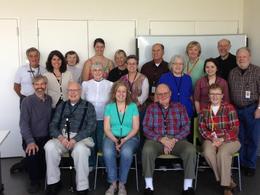
We had our annual Volunteer Appreciation Potluck last week. Gia came and presented some of her ant data and Gretel and I talked about some of our recent research. We’re so lucky for all the help we receive from our volunteers, we really couldn’t do our research without them. Although there are many steps in Echinacea workflow process (cleaning, scanning, counting, randomizing, and weighing/x-raying) we decided to recognize one of our volunteers, Lois, as the “Achene Queen.” Since we’ve transferred all our counting to an online database, Lois has counted over 350,000 achenes!
While it may seem obvious, here at the Echinacea Project we look at a lot of Echinacea. With such large numbers–thousands of plants each summer and heads each winter– we’re used to a certain degree of variation. Bracts differ in length and degree of “pokey-ness”, trichome density varies among leaves, and achenes range in size and color (see the post “A Palette of Pallida” from March 21st for an example).
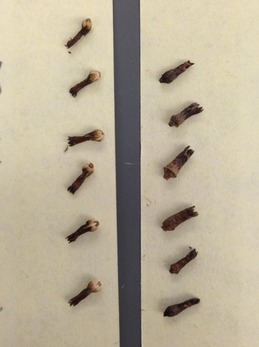
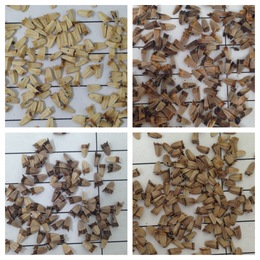
This morning one of our volunteers, Suzie, noticed that the florets on the head she was cleaning had a distinctly different shape and color. The florets come from CG-6152 wht, or plant 27, 915 in the quantitative genetics (qGen) section of the common garden. Below is is a side by side view of these unusual florets (on the left) compared with what we typically see.

This is the first time we’ve seen this sort of variation in floret shape and color in the lab. Right now we can’t say for certain what caused it, whether it’s natural variation or a response to insect herbivory, for example. It’ll be interesting to visit this plant next year, however, and see if this variation persists and is conspicuous when the plant is flowering.
Sarah Baker presented “Flowering phenology of Echinacea angustifolia in Minnesota tallgrass prairie remnants over three years,” the results of her summer 2013 REU project, at the National Conference on Undergraduate Research, University of Kentucky, on 4 April 2014.
Here’s the presentation…
Sarah_Baker_NCUR_Presentation_FINAL.pdf
It’s finally beginning to feel like spring here at the Chicago Botanic Garden and with the change in seasons, we’ve got some new projects in the lab.
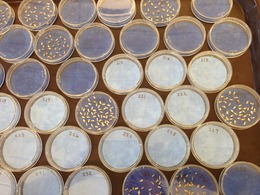
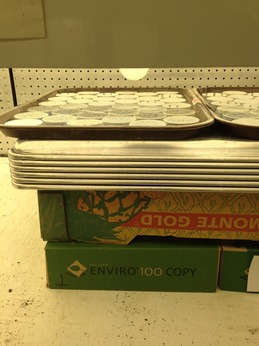
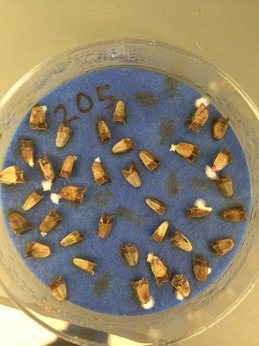
All those E. pallida and E. angustifolia seeds I was weighing a couple weeks ago have been germinated and I’m in the process of transferring the sprouts to plug trays. The achenes first went through a two week cold-stratification, pre-germination treatment. I kept the achenes in petri dishes, evenly spread on blotter paper and put them in the refrigerator (4 degrees C), making sure to keep them well moistened throughout this time period.
After two weeks I transferred the achenes to the growth chamber where it was significantly warmer (25 degrees C) and put them close to the light.

Sprouts are ready once their radicle emerges 1 mm. Nearly 20% of the seeds germinated within 24 hours of being transferred to the growth chamber, and even more germinated the following day.
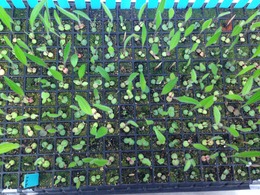
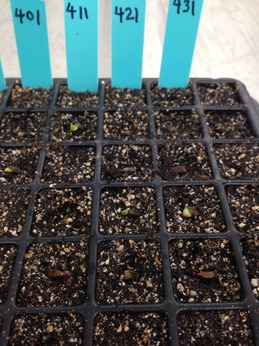
We place sprouts in plug trays were they’ll grow up for the next 5-7 weeks before being transplanted in the ground. And man oh man do they grow up fast! Can you spot the sprouts in this section of the plug tay?
We like to tell anyone that volunteers or works in the lab that Echinacea achenes come in all shapes and sizes. Here’s an example:

Now if you can’t already tell, these are not the achenes you may be used to seeing. These are all achenes from Echinacea pallida, a purple cone flower species not native to Minnesota but planted in some restorations within our field site. These specific achenes come from Hegg Lake, and they are some of the same achenes that Grace and Aaron, our interns from December, weighed and x-rayed in their analysis modeling hybridization between E. angustifolia and E. pallida. We are going to germinate and grow up some of these plants to see if hybridization is occurring in nature. Nicolas and Shona demonstrated hybridization between ANG and PAL was possible and viable through their artificial crosses, Dayvis concluded that the two species have overlapping flowering phenologies and pollinator assemblages, and Grace and Aaron modeled seed set of PAL and ANG heads collected this year and concluded that the model that best explains their data is one where the two species interbreed. So do they?!?!? We’ll let you know.
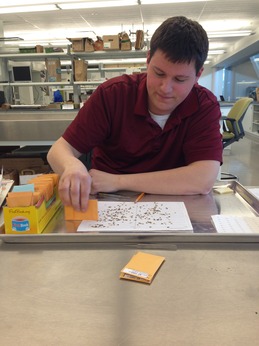
It’s not actually madness in the lab right now. But we do have a few new things going on. Alex, a senior from Lake Forest College, starting working with us last week. He’ll be analyzing the achenes from heads in our aphids experiment. If you recall, this is an experiment that Katherine began in 2011 that involved adding or excluding aphids from 100 plants in the common garden. We’re interested if aphids have any effect on plant fitness and Alex will be looking at achene count and achene weight to see if there’s a difference between plants in our addition or exclusion treatments. He just started randomly sampling 30 achenes for the weigh machine today!
In other news, we’ve got our volunteers hard at work cleaning and counting. We’re still working on counts from 2011, BUT we’re making progress.
Check out this episode of Prairie Yard & Garden. Stuart was interviewed this summer for this half-hour long public TV show about the Echinacea Project. The episode is called “Prairie Flora: History and Future” and it aired yesterday in western MN and the Dakotas.
Please help spread the word about prairies! Here’s the link: http://goo.gl/qU4bcN
The whole interview and much of the footage is from the main common garden experimental plot.
It’s been a while flog followers! I hope I haven’t lost any of you with my somewhat infrequent posting. But I’m back and here to tell you that things are moving along at the Chicago Botanic Garden! We’re progressing with the 2013 CG heads, tweaking and improving our protocols as we go in hopes of making things even more efficient. We’ve got a new volunteer in the lab and tomorrow will be the first day of our new intern. There will be more details in more posts to follow (I promise).
In other news: Kory Kolis and Sarah Baker (2013 Team members) gave some nice presentations at their schools this fall about their research with Echinacea. If you recall, Kory examined pollinator efficiency and Sarah looked at flowering phenology in remnants. Check out their work below!
Sarah_Baker_Presentation_FINAL.pdf
KolisPosterFinal4.0.pdf
Check out the awesome final report that Aaron and Grace wrote about their work during their December internship. It details how they modeled hybridization between E. angustifolia and E. pallida from Hegg Lake. Cool stuff!
HybridLabReport2014.pdf
Hey everyone!
We just updated our website and have a brand new page listing all the ways you can get involved with The Echinacea Project. Check it out!
https://echinaceaproject.org/opportunities/
This summer we’re looking to hire both undergraduates and graduates interested in learning more about the evolution and ecology of prairie systems. If you know anyone who might fit the bill, pass this information along!
Additionally, we’ve added a new component to our application process that we’re calling a “brown M&M.” Stuart was inspired by a section of the book The Checklist Manifesto written by Atul Gawande where musician David Lee Roth (of the rock band Van Halen) famously demanded that all brown M&Ms be removed from his bowl of candy backstage. While it might seem like a ridiculous request, Roth was testing his concert venues. The clause where all brown M&Ms must be removed was buried deep within a huge document specifying all sorts of technical details about the production of Van Halen’s shows. If brown M&Ms were not removed from the candy bowl Roth knew that there must be other details that were probably missed and so he would cancel the show all together.
Here at The Echinacea Project we aren’t as stringent as Roth, but we have included our own form of a “brown M&M” on the project’s website. If any potential applicants are reading this and wondering how to make their application go above and beyond the call of duty, make sure you read carefully about The Echinacea Project’s summer field work and put “brown M&M” somewhere in your cover letter!
|
|