|
|
Today is my last day with in Douglas County, MN for the summer. I have been trying to get everything together before I go, and so this post will include some files that do a bit of wrapping up from my independent project.
Here is the project status report which summarizes where certain information is located. Some of these rely on accessing our shared drive, so sorry for some of the file locations that don’t make sense outside of the Hjelm house: ProjectStatusFormNG.doc
I have also quickly summarized my results so far, updated my methods, et cetera. Here is that file: Echinacea Project Summary 15 August 2011.doc
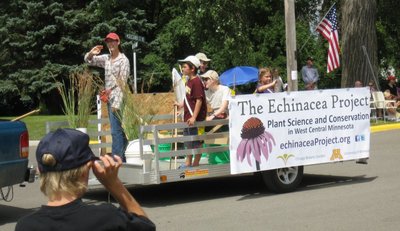
We made an Echinacea Project float and participated in the annual Harvest Festival Parade in Hoffman, MN. It was great fun!

This is how our float was announced… “Native prairies are very rare in Minnesota, but there are several prairie remnants in the Hoffman area. Every summer a team of scientists from around the country comes to study the biology, conservation, and restoration of prairie plants and insects. They are based in the Hoffman – Kensington area. If you see members of The Echinacea Project working on a hillside or in a ditch, ask them what they are doing!”

Team Echinacea is busy in two states! The Minnesota crew is working in the field and the dedicated crew of volunteers at Chicago Botanic Garden in Illinois is working in the lab. This panoramic image of the lab, taken by Bob Mueller, shows volunteers counting Echinacea seeds and taking random samples for weighing. Click & drag the image to see all 360 degrees!
12 August 2011 The Echinacea Project established a new website at echinaceaProject.org.
I have been working some on my R analysis, and hope to get some statistics time in to help me better analyze my data. Here is what I have so far. I have reorganized my script since the last version to have a more question-based flow, and have changed some of the tests I perform.
NGRAnalysis3.R
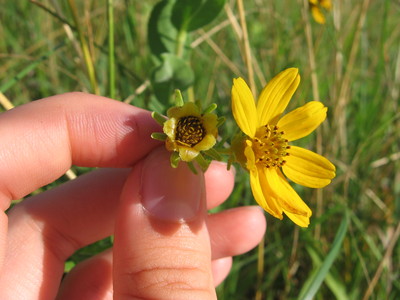
H. helianthoides appears to be self-incompatible. Here’s the data I collected:
hhelianthoides.csv
I’ve also started my data analysis in R. It’s not done yet, but here’s what I have so far:
Data Analysis.txt
Basically, styles persist significantly longer when self-pollinated or not pollinated than when cross-pollinated. However, in the top rows of florets on each flower head, style persistence does not differ as much between the treatments (because all the styles in these rows shrivel rather quickly). Therefore, when using style persistence to study other aspects of this species’ breeding system (ex. pollinator efficiency, compatibility of specific individuals), one should use the bottom several rows of florets. In these rows, cross-pollinated styles always shrivel within three days of pollen application, whereas styles that do not receive compatible pollen never shrivel so quickly.
As I mentioned before, I was unable to collect much quantitative data about C. palmata style persistence. But I did notice some things that might be helpful to anyone interested in studying this species further. The following document gives a brief summary:
C. palmata Summary.doc
During the last week of July, in addition to working on our independent projects, we spent lots of time measuring in the Common Garden. It’s kind-of like a yearly check-up for all the Echinacea plants there: we count their leaves and rosettes and heads, measure their stems and longest leaves, and check them for bugs or other damage.
However, this past Monday we were forced to take a break from measuring due to a huge storm! The wind knocked down lots of trees. One landed right on the Hjelm house roof! Luckily there wasn’t much damage, and everyone is safe and sound.
Tuesday was also eventful, but in a different way: It was Callin’s last day with Team Echinacea before heading back to New Mexico to teach for another year. Good luck Callin! We miss you!
Later in the week, we finished measuring in the Common Garden and started demography. Demography is when we visit all the remnants in the Echinacea Project’s study area to locate and collect data about flowering plants. It’s been fun to visit some of the sites I hadn’t been to before, and to see how the different land-use history of each has affected the plants that grow there.
Then on Friday we went to Staffanson Prairie Preserve to check on the seedlings we planted there earlier this summer. It looks like mortality was pretty high, but we only finished searching about a third of the planted area, so maybe the seedlings are doing better in the rest of the plot. I guess we’ll find out next week!
I have started work on analysis of my style shriveling data from the crosses between Echinacea pallida and Echinacea angustifolia. Attached is the R code I have so far.
NGRAnalysis1.txt
Here’s the final dataset for my compatibility experiment. The experiment is officially ended today (I collected the last bit of data). The dataset contains GPS data (column name distBetween). I missed one plant while GPS-ing, so I used the hand-measured data (for flag #6 at Nessman’s). I also corrected several errors in the datasheet.
Data for Analysis — cswitzer — 31 July 2011.csv
We spent some time GPS-ing the plants, so we could get the exact distances between them. Here is a csv file with the gps data.
I have been working on analyzing all my data. I looked at plots of each of my individual sties, as well as all the data combined. The data are almost exactly opposite of what I expected.
Here’s the script I’ve been exploring:
callinCompatRScript31july2011.R
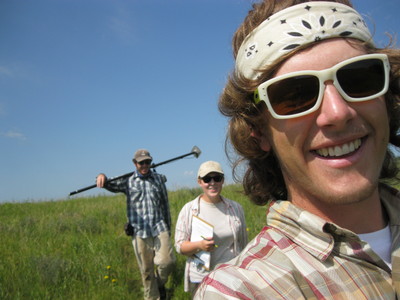
Here’s a picture of Josh, Amber Z, and I out in the field (having a lot of fun).
My days of research at the landfill are coming to an end! I’ll be doing the last of my crosses there tomorrow and observing the results on Monday.
For the Coreopsis, I didn’t end up with much data about style persistence. Each head has about four rows of styles and dries up soon after it finishes flowering. Since I’ve only been visiting the landfill every three days, I didn’t get a chance to see what happened to most of the styles I pollinated before all the florets just turned black and fell off.
The good news is, I will be able to collected many of the flower heads I pollinated, so someone can assess their seed sets in the fall. (I was worried that when the florets fell off, they might have taken the seeds with them, but Stuart reassured me that the seeds are still there!)
I also have lots of data about Heliopsis style persistence. I’ll upload it here once I have the data in from my last few pollen crosses.
|
|