Categories

Flowering species in experimental plot C2

A quick list of flowering plants I noticed while assessing phenology in Jennifer’s experimental plot at Hegg Lake WMA on 10 July. I list only plants observed in the plot. Asclepias speciosa is flowering just outside the SE corner of the plot.

F = flowering
X = done flowering/in fruit
N = not yet

Heliopsis helianthoides F
Amorpha canescens N
Coreopsis palmata F
Rosa arkansana F
Anemone cylindrica X
Silene F
Asclepias syriaca F
Amphicarpea bracteata F
Morning glory sp F
Apocyanum F
Tragopogon F
Cirsium arvense F
Lathyrus venosus XF (almost all done flowering)
Galium boreale F
Psoralea argophylla F
Medicago sativa F
Linum sulcatum F
Carduus acanthoides F
Senecio X
Liatris N
Achillea F
Zizea X
Red field clover F
Yellow fl lactucid F
Potentiall arguta F
Desmodium F
Physalis F
Dichanthelium leibergii XF

No Phlox pilosa in the plot!

Flowering in Jennifer’s Phenology Experiment

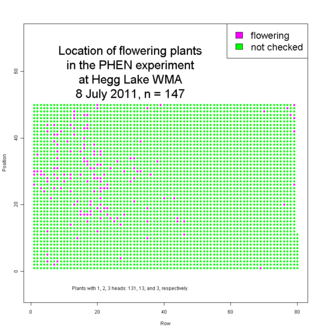
We found 147 flowering plants in Jennifer’s Phenology Experiment during a thorough, but not exhaustive, search on Friday. Most of these plants have buds only and will start shedding pollen later. I posted a map of locations of all plants to flower this year.

c2Phenology2011initial.png Click on thumbnail to see a larger map.

Jennifer planted this experiment to investigate heritability of flowering timing (phenology) in spring 2006.

Last year eight plants flowered and about 2700 plants were alive. Read about measuring last year.

Assuming that almost all of those plants are still alive and that we didn’t find all the flowering plants, then about 6% of surviving plants will flower this year (>147/2700).

For kicks, I made maps of the paths of data enterers. We usually worked in pairs and used one person’s PDA to enter data. Here are the paths…

Josh D’s visor, Amber E’s, Nicholas G’s visor, Gretel K’s visor, Lee R’s visor, Callin S’s, Stuart W’s visor, Maria W’s visor, Amber Z’s visor. For the record Katherine M’s visor had only one record and we didn’t use Karen T’s visor.

Stuff seen on Thursday

For Lee, I found that there is a good deal of Heli. heli at Aanenson – most bloomed the center head but not the sides.
For all, there wasn’t much Ech blooming at RRX, LC, RI, or YOH as I remember in years past.
For whomever is interested, west of YOH and not IN Douglas county but there is a good deal of Rudbeckia? – I was moving pretty fast and didn’t stop to look close – just a lot of yellow flowers!
I don’t know if matches up to the BOB MAHONEY RESTORATION, but its there to be seen.

Phenology in Common Garden & 1st Day of Dichanthelium Seed Collecting!

Hi everyone, Maria here again. Today was a particularly happening day in my opinion. Everyone had something to do. Amber E. is back from Alaska with Ruth! Karen arrived from Evanston in the afternoon!

In the morning those of us who hadn’t finished our Stipa searches in the common garden finished that! (So Stipa is done! – we scaled back though and only searched for the 2011(?) cohort). After that Gretel, Ruth, Amber E and I put Position/Row signs in the common garden and made the signs face East/Westwards so now it’s so much easier to read the signs while you are walking in the common garden. Then we got started on looking at the phenology of Echinacea in the common garden. We systematically walked through each row, looking out for flowering Echinacea with emerged anthers and pollen, twist-tying the heads and recording them in our visors. Josh joined us when he finished his Stipa searches. We found quite a few flowering heads – bet there’ll be more soon.

While we were looking for flowering Echinacea, we saw Stuart, Callin, Amber Z and Nicholas crowded around ‘Joe’ – the pet name given to the prominently flowering Echinacea at row 28, position 860. As described by Callin in the previous post, they were practicing bract-painting for their independent projects on Joe.

When we finished looking at all the rows, it was time for lunch and short presentations of our projects. It was good to hear about everyone’s projects and talk about my own projects and get feedback. After lunch, we got started on our independent projects or worked on the New Media Initiative.

Gretel and I headed to Hegg Lake to look for Dichanthelium (Panic Grass) seeds for my second project. This summer I will be collecting seeds from Dichanthelium plants from different remnants, including Hegg Lake and Loettler’s Corner (I might not have spelt that right – sorry). My plan is to collect seeds from 30 individuals from each “site”, as there are several places at Hegg Lake that seem to have a lot of Dichanthelium. After collecting the seeds, I will be bringing them back to Chicago Botanic Garden and do more work on them in the fall/later.

Click here for the
Google doc of my summer project proposals

I am super super indebted/thankful/grateful for Gretel. Without her guidance, I’d probably be in a big mess/not knowing what to do/still be at Hegg Lake as this is my first time doing independent field work.

When we reached the place at Hegg Lake (it was near the road, area with ditch, south of the parking lot), a lot fo the Dichanthelium seeds had already fallen off the culms. It was quite disheartening. We walked a little north and found a patch of Dichanthelium with most of their seeds intact, then we laid out the tape measure for 20m in a roughly north-south direction (I kept thinking it was 2m while Gretel patiently corrected me ^^;;). Initial plan was to do every plant within arm’s length from transect, or every other plant if population was dense. However, that was not quite possible given the circumstances. After Gretel and I collected seed from the first plant and did all the measurements, she continued measuring/collecting while I picked ~30 plants near the transect (more than my arm’s length) that had at least one culm with 8 or more seeds to collect from and flagged them with a blank flag. I started measuring/collecting after I finished flagging. Around 4pm, Lee called – reinforcements were coming! Ruth and Lee arrived with Karen and they helped us finished the rest of the plants (by that time Gretel had completed 17 plants (!!) and I was on my 6th plant). It turned out that we had 31 flags so 31 envelopes with data and samples! We also collected some “random” samples – ie seeds from various random plants away from transect. Finished around 5pm – thanks to Gretel, Lee, Ruth and Karen! Really excited to get the first 30 done!

Take a look at the simple data entry for today’s collection for more technical details if you’re interested. I might also do the seed count for today’s samples just to see how many seeds we can get from 30 plants using the ‘8 or more’ rule. (I just need to be rreally careful not to lose any seed >.<)

Dichant_DE-HL1001-31.xlsx

We left 11 flags (labelled with sample number) at the site that we will return to later to collect more seeds from.

Now that I have more experience, I’ll definitely be more systematic+efficient about it.
Notes to self for tomorrow/next time:
– “just-in-case” extras (extra equipment, envelopes, pens, sharpies, flags) do come in handy! Meter sticks are probably more efficient than tape measures. More flags would be good. Maybe use a different color for “done” or for extras.
– Extra samples are good too. Maybe do 32 plants per site?
– Bring a plastic bag/something to put a plant specimen in – I need to get a sample of the other Dichanthelium species (“hairy leaved”) to press and identify.
– Equipment list would be useful esp when I have more than 5 things to remember.

Lesson of the Day: Having an experienced person around and helpers is always always always helpful! =D

Thanks again to Gretel and everyone who helped!

Practice for Cross Pollination Experiments

Amber Z, Callin, and Nicholas all practiced the bract-painting, pollen-collecting, and pollinating procedure in the common garden today (7 July, 2011). This Echinacea plant now has a nice makeover.

The plant is at row 28, position 860.

IMG_0125.jpg

Recruitment Protocol

I wrote this up last week, but neglected to post it on the flog. Here is a detailed protocol for the 2011 recruitment searches. See Wagenius et al. 2011* for a description of the seedling recruitment study.

RecruitmentProtocol2011.doc

*Wagenius, S., A.B. Dykstra, C.E. Ridley, and R.G. Shaw. 2011. Seedling recruitment in the long-lived perennial, Echinacea angustifolia: A 10-year experiment. Restoration Ecology.

and the Flog is restored!

Hurrah hurrah!

The flog is back and running! All the links should be working and all pages formatted nicely now!

The credit goes to John, my friend from home, who has been troubleshooting and coming up with the solutions to the problems…..super super indebted to him 🙂

But the flog team is not totally done yet…now that our Twitter account is up, we’ll need to add a Twitter button on the flog. We’ll also continue to sort entries into categories. Also note the new description of the field log (credits to Lee)!

Comments on the flog are most welcome!

Last Week’s Adventures

Team Echinacea got a lot done this past week. On Monday we finished seedling searches, and on Wednesday we finished recruitment surveys. We’ve also made a lot of progress with the New Media Initiative: We now have a Facebook page and a Twitter account.
Then on Thursday, we started stipa searches. We looked in the Common Garden experimental plot for stipa that were planted as seed in the past two years. This means we were looking through bunches of grass to find this one specific kind of grass, which posed quite a challenge. As Stuart put it, it’s like looking for a needle in a needlestack. But we persevered! We found quite a few stipa plants, and will continue searching this week.
We also began aphid searching, as Katherine mentioned. I was glad that I didn’t find too many aphid infestations on our lovely Echinacea plants. It was a very satisfying way to end the work week.
Over the weekend, we had a 4th of July potluck-picnic celebration at Elk Lake. The food was all so delicious! And a construction team directed by Per made a formidable sandcastle fortress. Below are some pictures that Maria took. Happy (belated) 4th everyone!

IMG_9555.JPG
IMG_9590.JPG
IMG_9598.JPG

Research Draft 3–Callin and Amber and Maria

Here are google doc links to the most up-to-date proposals by Callin, Amber, and Maria

https://docs.google.com/document/d/10Rxr9ucX6qGznUU0Dv1HFfdcgL2WRkXOHZhoJCfYSlA/edit?hl=en_US&pli=1

https://docs.google.com/document/d/1WJw0YH_KUgAH-gJFxL2lQQOA0ofHuRT-pXlIEASULdc/edit?authkey=CPOpx2E&hl=en_US

N. Goldsmith research proposal draft 3

After checking at Hegg Lake again, it appears there are enough Echinacea pallida plants to be able to do reciprocal crosses. I have attached my updated proposal.

Echinacea Project Proposal 3 Jul2011.doc