As per a request from Daniel, here is a presentation I gave to Team Echinacea way back at the beginning of the summer. Enjoy reliving the magic!
|
||||
|
I received the camera today so I had to test it out since the opportunity presented itself. The picture is taken through a stereomicroscope at 45x magnification of a live amphipod from the Big Sioux River. On a qualitative stream survey, we found our water to be very clean. So the camera isn’t just for live pollen anymore. School is going well. I find myself saying “protocol” instead of lab instructions sometimes. Must be a remnant from the prairie. Hello,
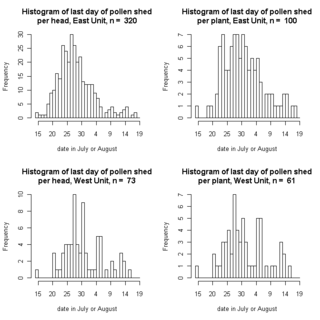
Thank you all for your hard work when we measured my Hegg Lake common garden a week back. It was by far the fastest the Hegg garden was ever measured and there were no rechecks besides can’t finds! Below is some information regarding the Hegg garden. Echinacea plants on our transect at Staffanson Preserve are done shedding pollen for the year. A few still have persistent, receptive styles, but August 18th was the last day pollen was shed. This graph show how many heads (left panels) or plants (right panels) finished on each day. The earliest heads finished on 15 July. I divided the preserve according to the burn unit: burned East (top panels) and unburned West (bottom panels):
Final date of flowering for 393 heads on 161 Echinacea plants
from a burned and unburned unit of a prairie preserve This graph is based on preliminary, raw data, but I wanted to share. Click on the thumbnail to see a larger version of the graph. DATA Here is a copy of my excel file with all my data. The sheet labeled corrected data for analysis is the file with all the data for each treatment. The sheet labeled baggins has a list of all the heads I used that need to be harvested, this was also posted in a separate post called “Baggins.” The ones labeled “donor” do not need to be harvested but should not be expected to have high seed set as they were bagged for most of their flowering time. Pollination interference data (data entry 2).xls I need all of the heads used in my project (the ones that are painted) to be harvested in egg cartons (located in the shelf above the sink in the Hjelm house). Please label the compartment of the egg carton with the row, pos and tt color of the head. The egg cartons should be packed so that they wont be disturbed during travel and please be careful with the heads so no seeds fall out! Gretel has a list of all the heads to be harvested and its posted on the flog in July (“Baggins”). Please mail the packaged heads to: 119 School Street, Keene, NH 03431 LANDFILL SPECIES I have been collecting plants at Landfill this season and have started to compile a list of the plants I have either seen or collected there. If Megan and anyone else would like to add plants to that list that would be great! Or check my identification. This list is very rough at the moment but I will continue to update it as I get more plants identified. Just a quick note to say that Stipa planting was completed by lunch on Wednesday. We were able to plant the vast majority of seeds where they were randomly assigned in the CG, 10 cm north of existing Echinacea positions on the whole meter throughout the garden. I think only two seeds were not planted at all; one was lost off the board and one was missing its awn and ID sticker. About a dozen seeds had to be assigned new locations, either because there was a hole or a rock in the way or because the plant/staple/can’t find flag that we were measuring from could not be located. Not bad! To assign new random positions, I simply grabbed an ID sticker from the sheet of leftover, unused positions, removed the old sticker, stuck the new and marched around the garden planting the last of my legacy to the Echinacea project. The final task will be to replace the can’t find flags that are associated with a Stipa seed with short pins. Hopefully, this will up the chances of finding seedlings next summer. To this end, we also put a toothpick 1 cm north of every seed. Best of luck to the crew put to this test! Howdy gang! I hope everything’s going well in MN! It sounds like lots of progress has been made since I left. I thought my poster presentation went pretty well back in Chi-town. The final version of it is in a previous flog post. Thanks again to everyone…I certainly could not have done this without all of your help. I hope the field season ends well. Keep in touch. Oh and here’s an interesting paper I came across recently: brown bj loosestrife comp.pdf Here is a draft version of a protocol for seedling re-finds in the prairie remnants. Please read and critique. Protocol for seedling refinds 2009.docx |
||||
|
© 2026 The Echinacea Project - All Rights Reserved - Log in Powered by WordPress & Atahualpa |
||||
-thumb-320x240-10991.jpg)