As of 25 July 2008:
1422 of 1850 heads have started to flower in the common garden.
171 heads are done flowering.
194 of 1033 plants have not started to flower.
Here is a graph showing the number of heads that started to flower on each day.

|
||||
|
As of 25 July 2008: 1422 of 1850 heads have started to flower in the common garden. 171 heads are done flowering. 194 of 1033 plants have not started to flower. Here is a graph showing the number of heads that started to flower on each day.
Here are some clarifications about how mfl and immfl should be filled in for heads in and past the flowering stage. Selecting status “Flowering” means that the last day of flowering is certainly 4 days away or longer. If the last day of flowering is 3 or fewer days away, then select “End of flowering.” Status Flowering It is not necessary to fill in mfl, ffl, or immfl. (mfl and Immfl are presumed to be well over 11). End of flowering Fill in mfl and immfl! (Both may 11.) Last day of flowering Fill in mfl and immfl! (immfl should be zero.) Done flowering Fill in mfl and immfl! (mfl & immfl should be zero.) Note 1: When the action is xxxx, then fill in a status (usually: flowering, end of flowering or done). Note 2: When status is “Flowering,” “End of flowering,” “Last day of flowering”, or “Done flowering” then don’t fill in ffl!
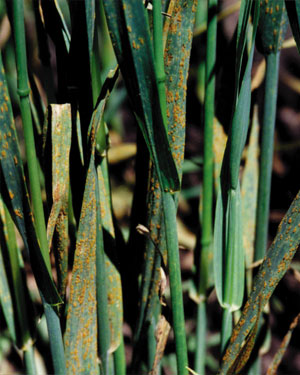
Hello, all! This is Denise. =D =D Lani and I are starting our posters. We’re doing one that targets the field work and one that targets the lab work. We’re hoping to fill it up with mostly photos like this: Since I got back, I’ve been staying at Carey’s house. His step-mom has a garden, and guess what I recognized? ECHINACEA! Loads and loads. ^o^ Anyway, we saw a sickly plant in her garden and were hoping for some feedback as to what it could be. There’s some discoloration on the leaves and the heads don’t look too healthy as well. Here are some photos:
=( Unhappy echinacea, yes. What could it be? Here are some other plants from another part of her garden that look much better: Team Echinacea: A grad student, Emme Bruns, from UMN is studying crown rust. She has been noticing heavy infections of rust on some of the Bromus and Elytrigia (Agropyron) grasses around the twin cities and was wondering if similar infections are occurring up here. Have you seen anything that looks like a rust pathogen on either of these species? If the pathogen is present, she would like to visit to survey disease incidence and collect isolates. Let me know if you see anything like this–and make a mental note or note in your visor where you see it. Thanks!  Last week’s scandal recedes from the public eye following the disappearance of two bees from the south end in broad daylight on Thursday. Common Garden residents are now locking their doors and speculating about the identity of the killer in their midst. Well….. not all of them. Hi all, Ben, Lecia, and Julie, I had a great time working with all of you and I wish you the best of luck in your future ecological endeavors. Everyone else I will see you back in Chicago or in Minnesota in the near future. Have a great rest of the summer Team Echinacea and we will keep you posted on our progress here in Chicago. Lecia and I have begun to identify our collections. Here’s a list of the species we found at some roadside remnants with links to their USDA PLANTS Database descriptions: Native species Galium boreale Heliopsis helianthoides Anemone cylindrica Anemone canadensis Rosa arkansana Introduced species Lotus corniculatus Melilotus officinalis Medicago sativa Further info on some of these species can be found at efloras.org and vplants.org. Project pollinator competition is going well, although it has had its issues, mostly involving my camera/pole/counterweight apparatus. I have chosen my plants and four sites, all roadside: Nessman, Railroad Cross, East Elk Lake Road, and Northwest of Landfill. I am surveying plants that have flowered synchronously except for Nessman where I can survey the entire population. In total, I will record data for about 26 plants and 33 heads. It was very difficult to get my camera high enough to get a 3 m radius around the plants. Hence, I will be taking multiple pictures of each plant to try to get the distances from the potential competitors to the Echinacea. I’ve done some test shots in the field, and using 1m white “x”s made previously by the kite team has helped a lot to orient myself in the photos and to see how many pixels (not “pickles” like I said to a friend on the phone) are in a meter in each picture. I shot pictures for one of my study plants at Railroad Crossing and also took field measurements for distances from one plant to the other. I repeated the measurements with ImageJ and found that there is only a 2-6% difference in the methods, so I can use them interchangeably! I’m super pumped! This makes much more sense for sites that have few surrounding plants.
A couple plants at East Elk Lake Road. Each of the Xs are uniquely marked, and the cardboard next to the plant is its tag number.
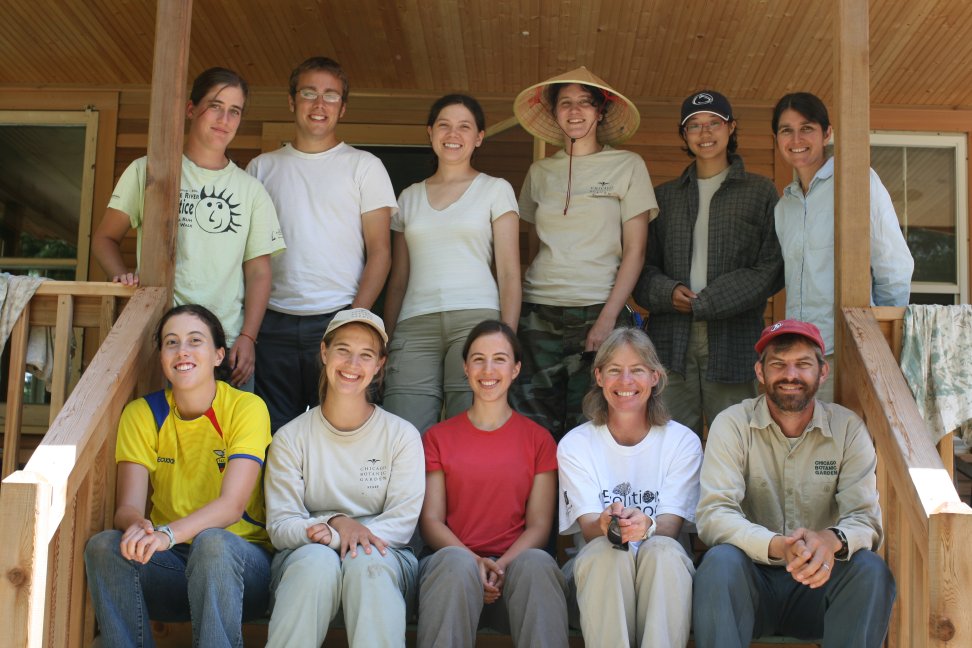
Today, Lecia and I went out to take field measurements. We measured the distances to each potential competitor and the number of florets on those competitors. We used this method for all of the plants at East Elk Lake Road and Railroad Crossing because the competitors are not as dense. But not to worry, for Nessman and Northwest of Landfill I will use the aerial photography. I counted style persistence on all of my plants except for Nessman, which Ben and I did two days ago. Neither are ready for the cameras yet, since some of the Nessman plants have yet to flower and the NWL plants are only on their second day. Stuart asked for a timeline: Thats the plan! Today marks the halfway point for the summer. Five weeks down, five to go. We’ve accomplished a lot and much more remains. After a long afternoon of measuring plants, we had some watermelon and carbonated beverages to cool off, mark the 1/2way, and wish the Chicagoans well. Three of our team members are leaving tomorrow for Chicago (Jennifer, Lani & Denise). They will keep us posted about the analysis of the bee-tracking field data and how it relates to their pollen flow study. Here’s a photo of us on the porch of the Hjelm house today, just after lunch. |
||||
|
© 2026 The Echinacea Project - All Rights Reserved - Log in Powered by WordPress & Atahualpa |
||||