|
|
We had a slow start to the flowering of Echinacea in the common garden for the 2008 season. Being one who gets excited about the abundance of Echinacea heads, I’m pleased to post the numbers of plants and flowering heads so far.
The total number of plants flowering in the common garden as of 17 July 2008 (which is sure to increase as we find more hiding in the tall brome or decrease as they are grazed by deer):
1027
The total number of flowering heads identified as of 17 July 2008 (many still just buds):
1868
As of 17 July 2008:
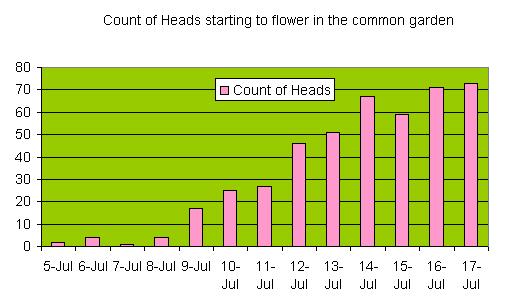
447 of the 1868 have started to flower. (They are still far from peak flowering!)
Here is a graph showing the number of heads that started to flower on each day.

It was an exciting day on the prairie. After a soaking morning rain, it felt hot and steamy. Just before noon the plants started flaunting their pollen and the bees took advantage. There was plant sex and bee sex and Team Echinacea jumped into the fray trying to keep up with the frenzied activity. Every team-member broke a sweat trying to keep up with all the bees. It was a crazy scene and the excitement in the air was palpable. The bees eventually outmaneuvered and outlasted us, but we had a great time. We left around 12:50 looking forward to another exciting day.

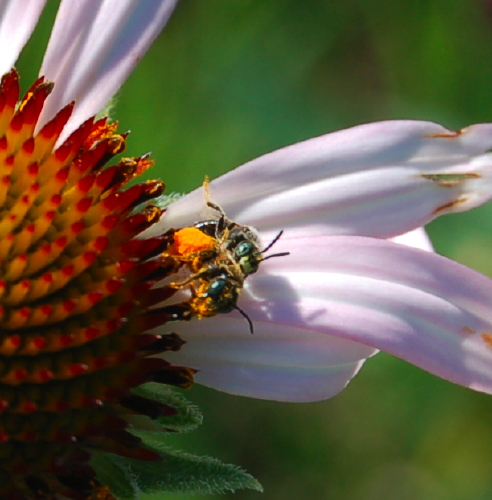
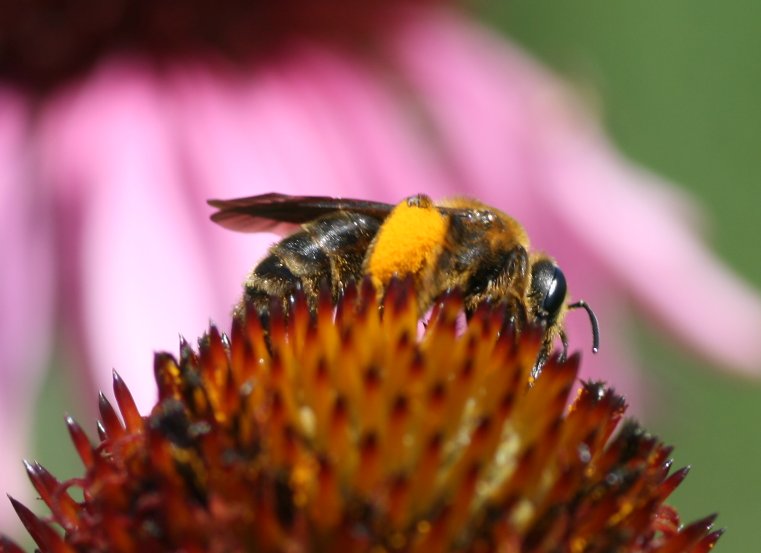
Unlike most of the shy bees, this rascal loved the cameras. She gave quite a show flying from head to head, daring us to follow. We caught her here spreading pollen all over her legs.
I just posted photos of prairie insect specimens from our collection, including many bees that pollinate Echinacea. Enjoy!
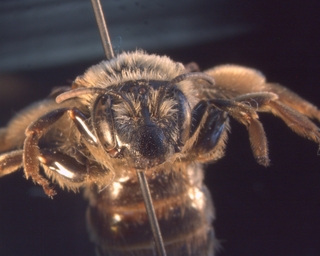
Here’s a photo of a specimen of Andrena rudbeckiae (Female). Click to enlarge.

So, there is a lot more to do to improve the web interface to these photos. Let me know your suggestions!
The pages are static html right now. Bianca, CBG science web design hero, made a dynamic version using MySQL and PHP. Her way is the way to go. However we don’t have a good permanent home for a MySQL database: UMN won’t allow phpMyAdmin, Bianca’s software of choice. And CBG doesn’t really support websites for scientists (yet).
More photos will follow and we’ll post more info for each specimen too. I hope to make these update when we have a dynamic, public site, but wanted to get something out now because I am submitting a paper that refers to these specimens.
Hi all,
Since this is my first flog entry of the season at quick intro for our new readers. My name is Jennifer and I am a Ph.D. graduate student at University of Illinois-Chicago in an integrated program called LEAP (landscapes ecological and anthropogenic processes) . I just finished up my third year and have been part of the Echinacea project for longer than I often like to admit. If you are an avid flog reader you may remember be from such classic 2007 entries like “Fishing in Minnesota�? and “Microsatellites in Echinacea…they do exist.�? Today I am going to discussing my plot at Hegg Lake. In the summer 2005 we followed the DAILY flowering phenology of the 224 flowering plants in the main Common Garden. We took the seeds from the flowering heads and germinated and planted around 4,000 (3,942 to be exact) and planted them in the spring of 2006 at a new common garden site at on DNR owned land near Hegg Lake (about 7.5 miles from the main Common Garden site). Hegg Lake is a beautiful site and it is, fortunately, on top of a small plateau so there is nearly always a breeze and the mosquitoes stay away.

Measuring at Hegg Lake 2008
We have just finished measuring and rechecking Hegg and I have final survival and growth info for this year. Unfortunately the last winter was really rough on my poor little plants and death was much higher than I would have liked. This also meant measuring and rechecking Hegg took a long time this year. Next year I must come up with a better method for measuring and rechecking. My current plan is to buy 50 meter tapes and measure along the 50 meter tape…I think this will dramatically reduce the time. Below is info for the last three years of survival and growth data. The first number the the year, then the average number of leaves, then the average height of tallest leaf (cm) and finally percent survival (cumulative).
2006- 2.13- 6.36- 94%
2007- 2.14- 13.24- 85%
2008- 2.07- 13.61- 76%
As you can see my plants barely grew (and that is only the ones that survived) and the average number of leaves actually went down. More disappointing is the survival which took at hit with the really long cold winter. That is it for Hegg this year…glad it is done…hopefully next year, with a site burn, my plants will grow more and death won’t be as bad.
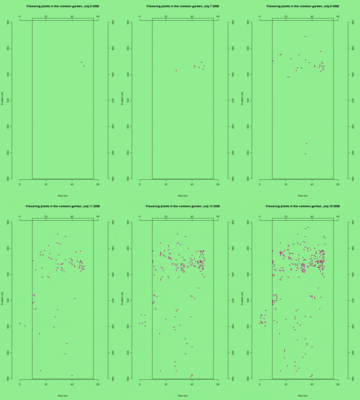
This animated GIF file is a map of all plants that flowered in the CG on each day from July 5 to July 15th. Each dot represents a plants that’s flowering on the day (see upper right corner).
 Click on the thumbnail to see a full-sized image. Click on the thumbnail to see a full-sized image.
 This legend shows plants with 3, 1, and 2 heads flowering (left to right). This legend shows plants with 3, 1, and 2 heads flowering (left to right).
We had a busy day today. Reinforcements arrived to help on all of our projects. Ruth Shaw (U of MN) helped with phenology, bee tracking, PX caging, collecting pollen and crossing. Elliott Graham (Madison, WI) helped with bee tracking and PX caging. Jack Kiefer (Wadsworth, IL) is leading the plumbing initiatives and made progress on several fronts including connecting the main water line to the Hjelm house!
Great forward progress on a sultry day. Well, in late afternoon it was still with air temp of 85 degrees F and a dewpoint of 57 degrees F.
Thanks to all for a great day!
Less than 10% of the heads that we think will flower this season had started flowering as of Sunday. Flowering is so late this year! We’ll walk through the Garden systematically tomorrow (Tuesday) to see what’s new. It’s possible one head (49.33 946.33 grn) will be done flowering tomorrow.
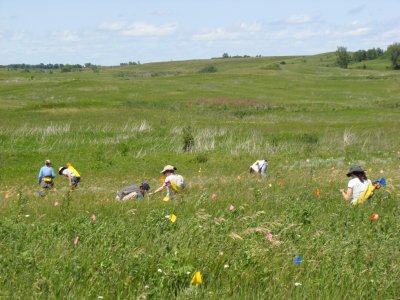
There’s always something new and exciting going on when Team Echinacea is in full swing. After we all pitch in to assess flowering phenology tomorrow, Amy will work on her large-scale crossing experiment that requires erecting pollinator exclusion cages, collecting pollen & hand crossing. The fun doesn’t end there. We are tiling and plumbing the Hjelm House, photographing floral development on Echinacea heads, measuring plants at the Hegg Lake CG and the main CG, taking ladder-high aerial photography of flowering plants in the prairie remnants, and chasing bee pollinators in the CG. And that’s just tomorrow!

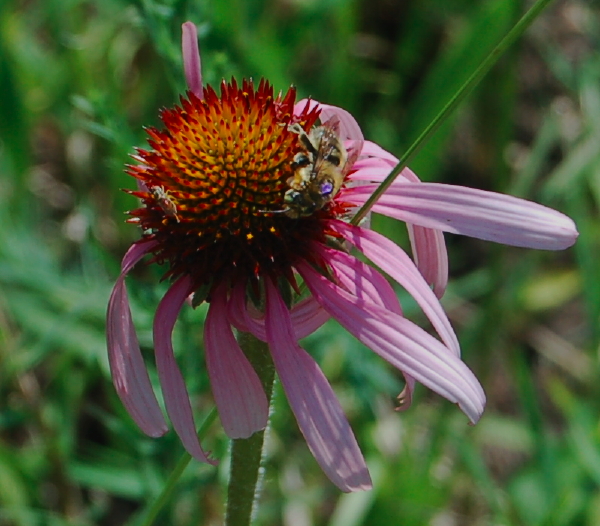
These bees thought it would add some excitement to their lives if they hired Team Echinacea to stand around them watch their… relations. Naive as they were, they didn’t realize that there was a camera in the crowd and the photos would inevitably be leaked to the Internet. This is sure to cause a scandal among the insects of the common garden when they read of it in the tabloids tomorrow.
Here’s one of this year’s painted bees. It’s big enough to see (sometimes) when it flies around, which is a plus.

As for the day-by-day flowering sequences of Echinacea, I’m trying to figure out a way to put them together without exploding my computer.
|
|

 This legend shows plants with 3, 1, and 2 heads flowering (left to right).