|
|
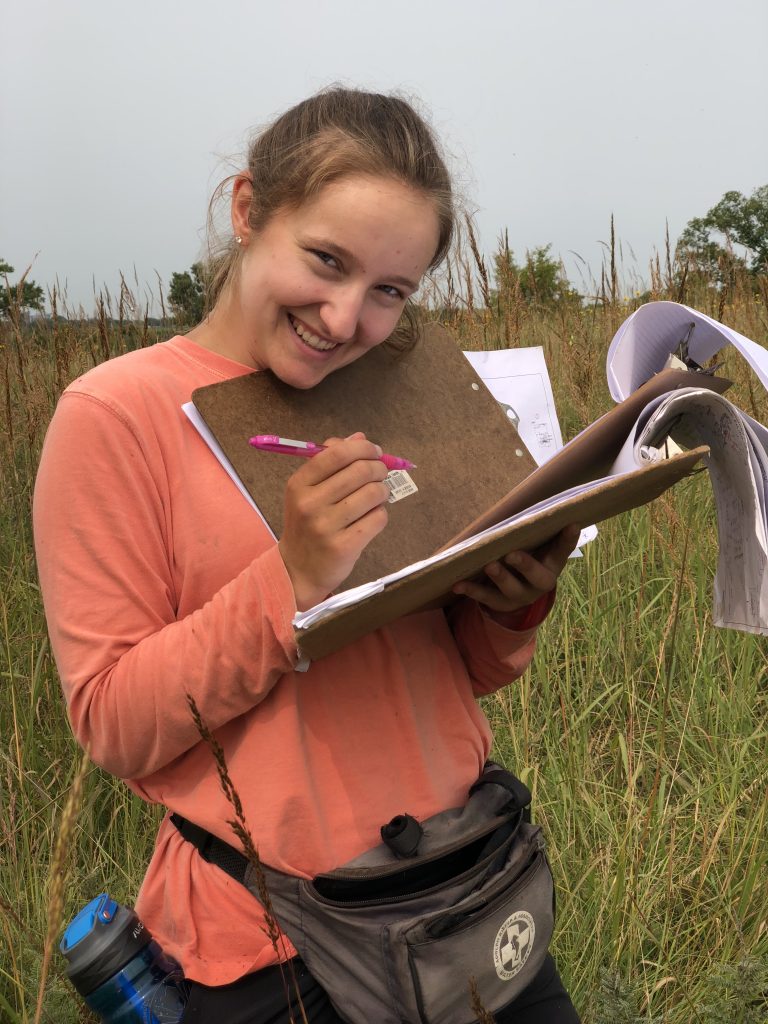
Today was my last day this summer with Team Echinacea. I had an amazing summer and am sad to leave all of the great people I’ve met.
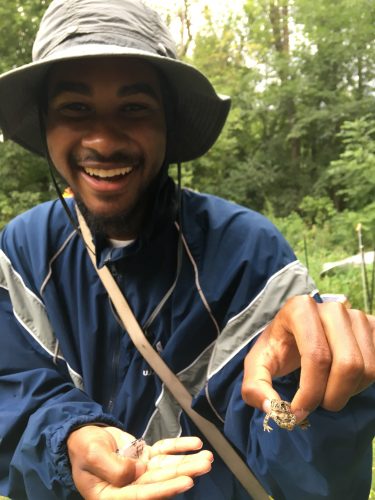
In the morning, we did measuring rechecks in P1, attempting to find missing plants. The plot was quite soggy and everyone ended up pretty soaked, collecting a lot of water in their boots. Andy made the apt suggestion that touching the electric goat fence could help us all get dry. We made the executive decision not to follow this advice. While in P1, I saw a few frogs clinging to Indiangrass stems.
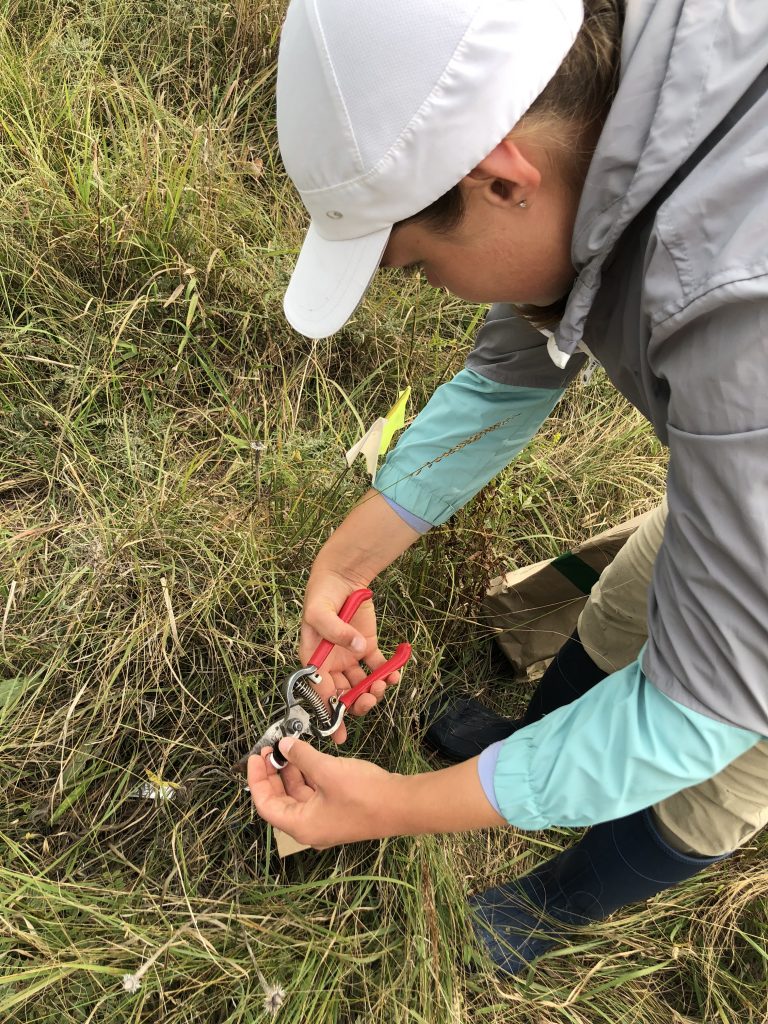
 Ribbeting After rechecks, Anna and I went to Staffanson to monitor Liatris and harvest heads from the Echinacea I used for phenology. These seeds in each head will be examined for embryos in order to determine the relative reproductive success of each individual Echinacea. I hypothesize that there will be more embryos in the seeds from the burned section of the prairie.
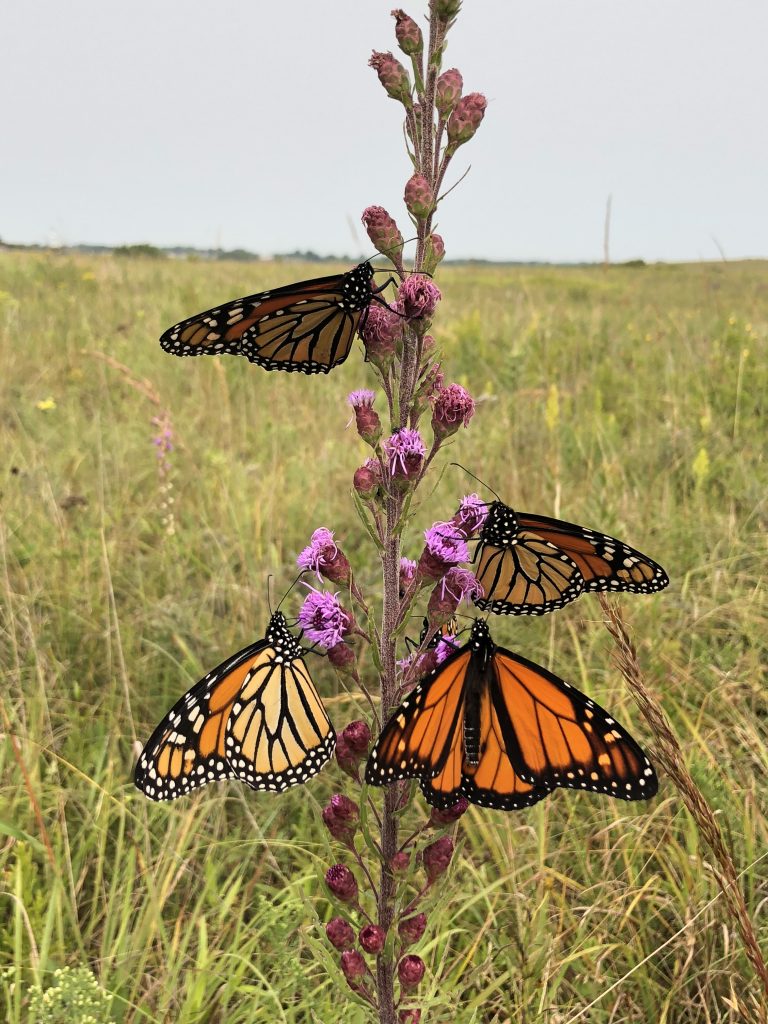
We saw some Phlox which was still flowering (one could say it was a late bloomer, literally). We also saw a preponderance of butterflies. There were butterflies on almost every Liatris in one section and as we walked through, they all flew up in unison. I think it might have been one of the most beautiful things I’ve ever seen.
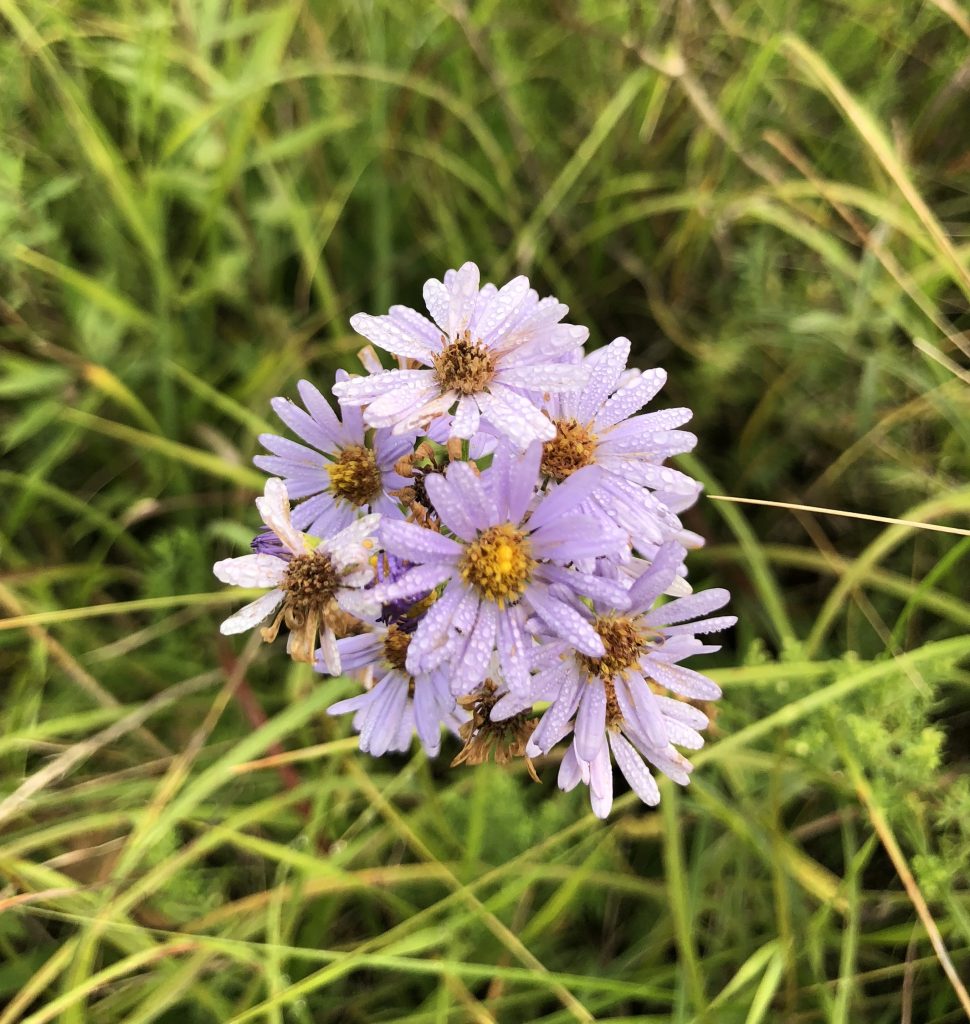
We also saw some sky blue asters which are some of my favorite flowers!

The harvest went well except that many of the heads were missing, due to some rodent or herbivore.
Anna harvesting Echinacea There was a lot to carry and I’m definitely grateful that Anna came to help.
 Is this science? At lunch Anna and I gave research update presentations for our independent projects since it was both of our last days. Anna revealed some preliminary results regarding soil hardness in different types of land treatments (agricultural fields, prairie remnants, restorations). My presentation reported that distances between flowering Echinacea tended to be greater on the unburned section of the prairie, suggesting that fires help decrease the spatial isolation of flowering Echinaceas (the density of flowers is greater on the burned side).
In the afternoon, we harvested Bouteloua in P1.
I will truly miss this project and everyone I have met this summer!
Following the departure of Team CowBee, the rest of team Echinacea has had an eventful two days. On Wednesday morning Brigid, Riley, Michael, Kristen, and I moved into our new lodging at Andes Tower Ski Area. While the ski runs are not open in August, we get to enjoy a scenic view of the hill from our front door.
 A large spider in the section of p1 planted in 1999 The Hjelm house feels much less crowded without the Wooster contingent of the team, but there is still plenty left to do in the field season. Today, for instance, was the first full team harvest session. In groups of two we visited every single of the more 900 heads in p1. Of these, quite a few were already ready for to be harvested.
Hello Echinacea Project readers! My personal project is actively taking place in experimental plot 7, a hybrid plot planted in fall of 2013. The primary purpose of the plot is to assess relative survival and fitness in Echinacea angustifolia and pallida, as well as hybrids of the two species. Data on survival, number of leaves, and size of these plants has been collected over the years. I will be using this data in an aster analysis to determine which cross type is the most fit. Unfortunately, only one individual has flowered over the time this plot has been around, and it was a pure E. pallida. From preliminary looks at the data, conspecific angustifolia seem to have the lowest survivorship and have the smallest average leaf length!
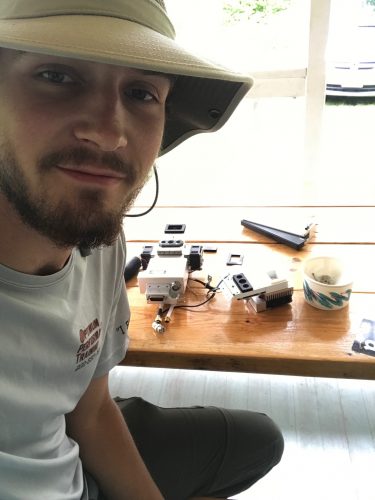
The other part of my project is assessing the physiology of these plants. For this, I have been using a Licor Li-6400xt, which can assess rate of carbon assimilation as well as transpiration (loss of water) in leaves. Getting the machine to work properly on Echinacea leaves took a ton of stress and time from me, but luckily it is up and running now. Using these measures can hopefully give us insight into why pure angustifolia crosses have lower survival than others. As I post this, I have made many observations on what factors affect photosynthetic rate the most in the plants. More shaded, thinner, lighter leaves, and partially consumed leaves all seem to display lower efficiency! I am really excited to integrate all of this data and ultimately analyze it!
Taking apart the Licor chamber to get it to work on Echinacea leaves… This was stressful.  A tiny basal Echinacea in pt7. The variation is incredible!
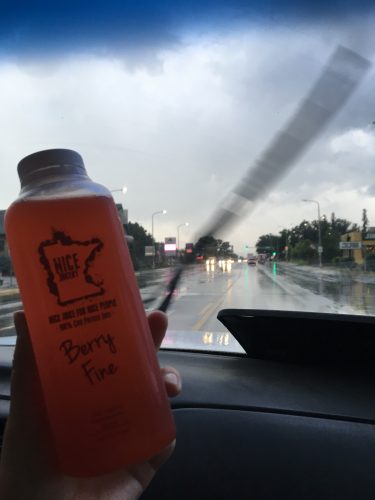
Today was a momentous day, it was the last day for the remaining members of Team CoW Bee. It started out with the rain we celebrated by getting juice from the local juicer in Alex. Then Michael, Andy, and I when out to P2 to do phenology and harvesting. It was nice to be able to see P2 one last time even though it was quite cloudy. While this was occurring teams were sent out to collect soil samples, collect tents, and demo. After all of the teams returned for lunch we played an amazing game of werewolf. Morgan who has never played the game before not surprisingly won as the werewolf. Towards the end of the game, the thunder began to rumble so we quickly moved the goats, this was a short yet efficient task. Just as it began to rain we closed the fence, then we ate cake and ice cream. We then had an interesting discussion about finding jobs and the application process. The rain did not let up so we called it a day. After work we did a lot of packing and cleaning at The Roost, we went out for the last supper to celebrate this monumentous day.
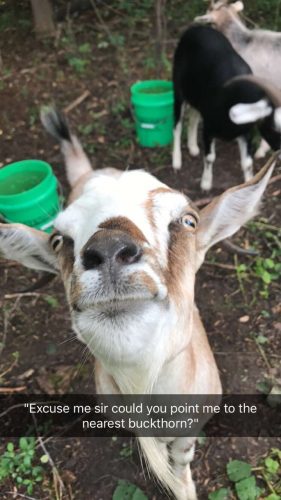
Some fine juice on a wet morning. Evan found a toad AND picked it up!(monumentous I tell you) A monumental view from P2 Some momentous clouds That monumental feeling when the goats accept your buckthorn(or when Stuart tells you that there are cake and ice cream!): I would like to thank all members of team Echinacea for this amazing summer I have had, it would not have been as awe-some without all of you. This has been a great experience and I have learned so much! I still have a fair amount of work to do for my project so this is not goodbye flog, just see you later!
Mia
This will be my last Flog Entry of the field season so along with summarizing today, I’ll also include a summary of what (Zeke and) I have worked on this summer (Hopefully tommorow).
It was a normal day. In the morning, the team went out to P1 to do rechecks (nothing better than rechecks in P1 under the morning sun). After completing a few rows in P1, we split into smaller groups for the remainder of the morning. Morgan, Michael and I went to Riley (the site, not the person) for demo. I had quickly become a master using the GPS, Darwin, over the summer, but Chekov is a whole different beast. After a few points, I relinquished the reigns of Chekov and let Michael handle it. After demo, the three of us returned back to Hjelm for lunch where we talked about the project status update form that needs to be completed before we leave for the summer. Zeke and I figured that (once again) we would collaborate and write ours together. In the afternoon I went out to Staffonson to help Kristen and Julia move their traps. Being the trap master that I am (because of all the training that I’ve had at the CBG), Kristen, Julia and I were able to move the traps in a timely manner. Back at Hjelm, I harvested some Bouteloua before heading back to The Roost with Brigid and Zeke.
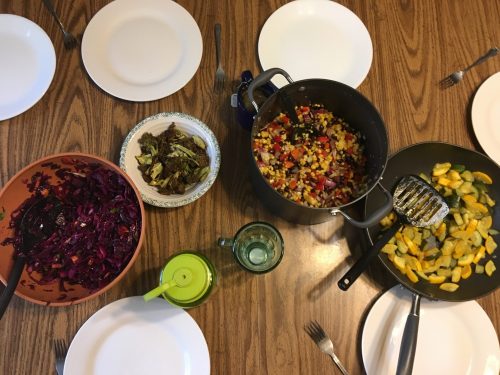
The team picking fresh Balagadoo from P1 On our car ride back we thought about whether or not we would want the ability to see into the future (very deep stuff). Back at The Roost Mia prepared her last meal of the summer, which was delicious. After finishing dinner, Kristen came by, which means we were forced to put our phones away and socialize.
An aesthetically pleasing meal
Hi flog,
On Saturday morning, some of the roost went out to breakfast at the traveler’s inn in Alexandria. We had coffee and eggs, and pancakes and discussed pies at great length. After breakfast walked to the local bakery and looked at baked goods, but decided against getting a pie, or any other baked goods. Next we walked through Alexandria’s bustling downtown to the nice Juicery and got very fancy juice with apples and charcoal and celery.
In the afternoon we went to the Tesoro across the street and filled up inner tubes for floating, and bought firewood.
For dinner Kristen, made avocado pasta.
At night we drove to Glenwood and had a fire in the park. We made s’mores threw around the Frisbee and talked about our summer research experience.
On Sunday a few of us went floating on the Long Prairie River. Despite the warm weather I started to get cold towards the end and was happy to get out of the water and warm up in the sun on the black tar road.
After floating we went to Zabar’s and had dinner. The food was good, I think the many letter zed’s made it even more delicious.
After dinner we watched an art film, some vine compilations and a few episodes of Seinfeld.
I’ve had a great summer and am immensely grateful for the opportunity I’ve had to do research here.
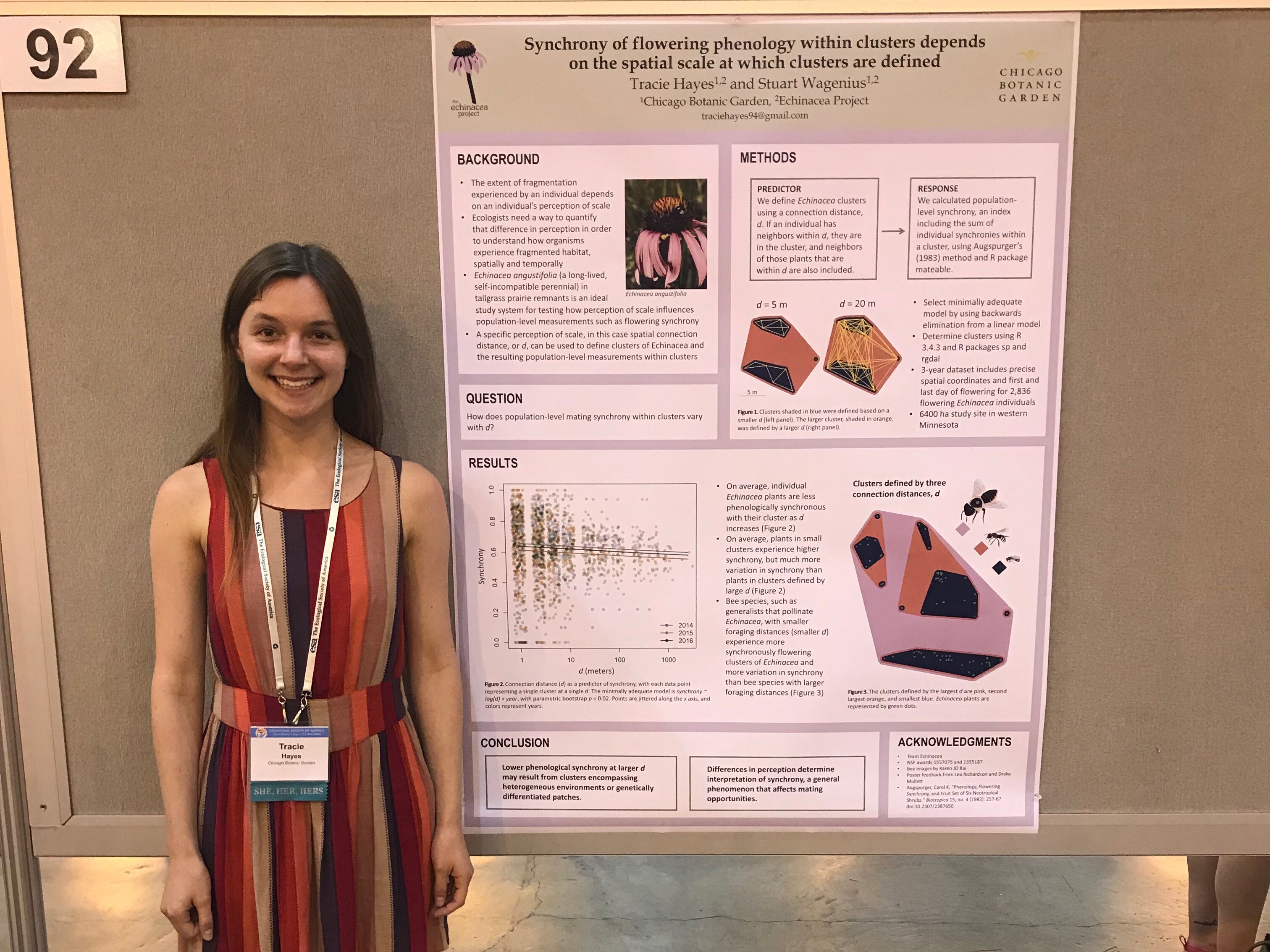
Last week, I attended ESA for the first time and presented a poster on a project I’ve been working on for the past few months: how the synchrony of flowering phenology within clusters of Echinacea depends on the connection distance used to define those clusters. I presented on Tuesday, August 7, 2018 in PS 18: Habitat Structure, Fragmentation, Connectivity from 4:30-6:30, board #92 (just feet away from Will’s poster). My main results are that clusters of Echinacea defined by a small connection distance tend to have lower synchrony on average than clusters defined by larger connection distances. Clusters defined by smaller connection distances also have more variation in synchrony. In terms of a bee’s perspective, this could mean that bees with smaller foraging distances are experiencing more synchronous clusters of Echinacea as they travel from one plant to the next. However, the experience from one small bee to the next is variable. Larger bees with larger foraging distances might be experiencing clusters that are more asynchronous, so as they travel from one Echinacea to the next, plant flowering times might not be overlapping as much.
There was an almost continuous flux of people coming by, and even though I was nervous at first, these couple of hours were probably my favorite part of the conference. Even if some of the listeners didn’t ask me specific questions at the end, just describing my project over and over made me realize what parts I wanted to continue thinking about and working on. I had scientists come by that I recognized from talks I had seen, Team Echinacea alumni interested in what we are doing now, and people I didn’t know that just came because of the title! It was all really exciting and I have a page of notes with questions and ideas to think about as I move forward with this project.
The conference as a whole was a really great experience for me, because I could start to see how both this specific project and my general interests fit in with the rest of the ecology world. It helped me to start to define the questions I want to ask as I think about grad school and the future.
Tracie and her poster at ESA 2018 🙂 Stay posted for more updates on this clusters project!
Link to PDF of Tracie’s ESA poster
Today was another warm day on the prairie, but the temperature was not the only thing the team noticed. Due to wildfires in Canada, dust has drifted into Minnesota making the sky appear hazy. This afternoon an air quality alert was also dropped announcing that there could be dangerous conditions until Sunday. Luckily, the Hoffmann/Kensington area was alright and all members of Team Echinacea are still living and breathing!
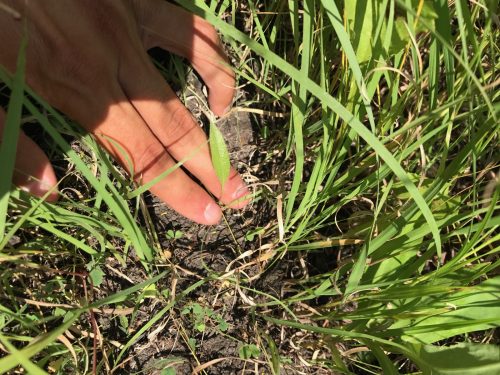
So what made this a quality Friday were all the tasks accomplished. This morning rechecks in P2 and other phenology checks were completed. Rechecking plants can be a little mentally taxing since you are looking for something that was previously determined to be gone. However, everytime someone finds a plant, they get to do a little celebration shout. So far popular ones have been, “YASS!”, “YEET!”, or “Huzzah!” Mia even found a plant during rechecks that was only 4 cm tall! ( She did a little celebratory dance on the side of her “YASS!”).
Demo at multiple sites was also finished throughout the morning and afternoon. Harvesting and rechecking head records took place later in the afternoon. And not to forget all the individual project work that went on in between!
 P2 and Mia’s plant! Finally, watermelon rounded out this quality field day before the weekend!
Hello from New Orleans!
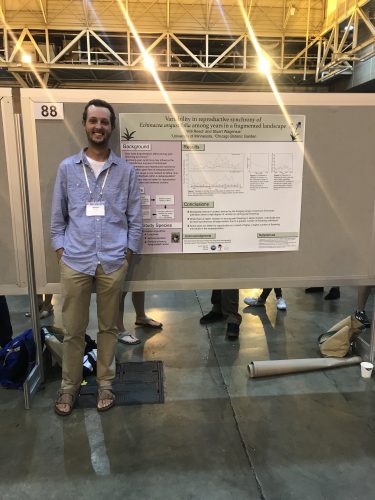
Yesterday I presented my poster on the general patterns of Echinacea flowering in our study area! I found that there are patterns of high and low flowering across all of the remnants that we study. I also found that there are good years to flower for the metapopulation that we study (and bad years..). What could be causing lots of echinacea to flower in the same year?
I presented my poster at Poster Session 18 – “Habitat Structure, Fragmentation, Connectivity” from 4:30-6:30. I had lots of visitors stop by to hear about my results and got to meet several Echinacea Project Alums!
Me and my poster <3 Here is my poster:
Wills ESA Poster PDF
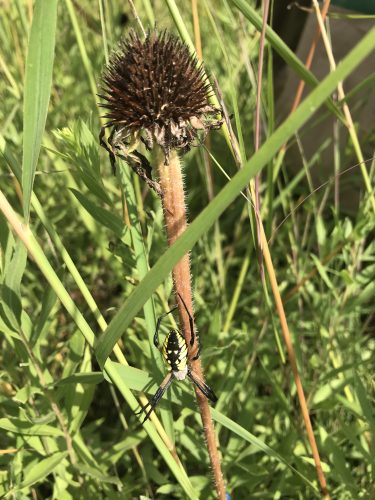
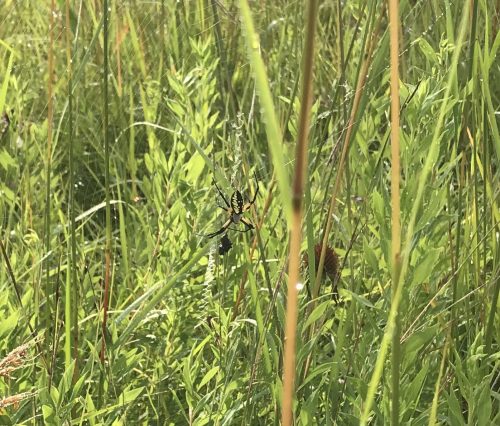
began the day with syncing visors in preparation for measuring plants at experimental plot 2. The majority of the team convened there at 8:30 and proceeded to measure, do phenology, and harvest heads at pt2. Some of us stayed back and finished measuring experimental plot 1 – specifically in the dreaded 99 South Garden. To add to the general dread, we saw a garden spider hanging out in the garden on some Indian grass!
 The big garden spider (Argiope aurantia) in 99 South was a bit scary at 9 in the morning! In the afternoon, I worked on measuring the functional traits (photosynthetic rate and transpiration) of hybrid Echinacea in experimental plot 7 with the Licor Li-6400XT named Helga. I’m very excited to finally have finished one row of measuring with Helga, as I have greatly struggled with equipping her to effectively measure Echinacea leaves.
I take apart and make modifications to the measuring apparatus on Helga, the Licor (Truly one of the more stressful moments of my life). The rest of the team dispersed for the afternoon, and a lot was accomplished in a little time. Some people went to do demography in the remnants, while others did their independent projects in the various sites within Solem Township. The day ended with a number of us harvesting ripe side oat seed from experimental plot 1. The goal is to eventually spread the native seed in experimental plot 8. The night ended with me cooking a dinner for the roost and then the crew watching the season finale of the Bachelorette! Go Garrett!
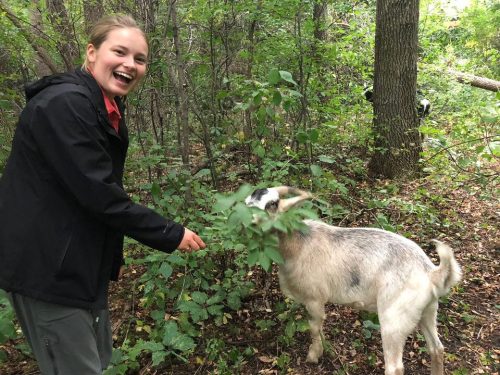
P.S. The goats are great fun to have close to the Hjelm House and pt1!
 A rather self-explanatory picture of Style.
|
|