Over the course of four Wednesdays spread throughout November and October, we in the Echinacea lab were fortunate enough to have two students from Lake Forest College’s plant biology course. These students, Daniel and Kyle, looked at this year’s (2015) flowering plants that were in the aphid addition and exclusion experiment. They dissected, scanned, counted, and x-rayed the seed heads to determine seed set in these plants then made a poster and did a presentation for their class. It was wonderful to have them here and their contribution to the Echinacea Project will be very useful as we move on with the aphid addition and exclusion experiment.
|
||||
|
Busy as a bee this week! In my battle with native bee identification I was honorably defeated. I will prevail and try again, but in the meantime there is much to do. The bee specimen are now organized and looking beautiful. In total we have 43 different species visiting Echinacea, and a lot of my time this week was spent cooped up in our beautiful little library soaking in the natural light and learning endless fascinating facts about these many species. For example, the big and blustery Bombus fervidus is known to pursue potential threats for hundreds of yards. The Hylaeus bee carries pollen in a special, stomach-like organ in her abdomen rather than on her legs and then regurgitates it back when she reaches her nest. And this is the one that really got to me: The female Ceratina will guard the entrance of her brood chamber and die right there over the winter from the cold, but her body continues to block the entrance, thus keeping her brood safe. Also, this species can produce eggs without mating. Ceratina has got it all figured out. Next week I hope to get all this information online for everyone to peruse! Bee prepared!
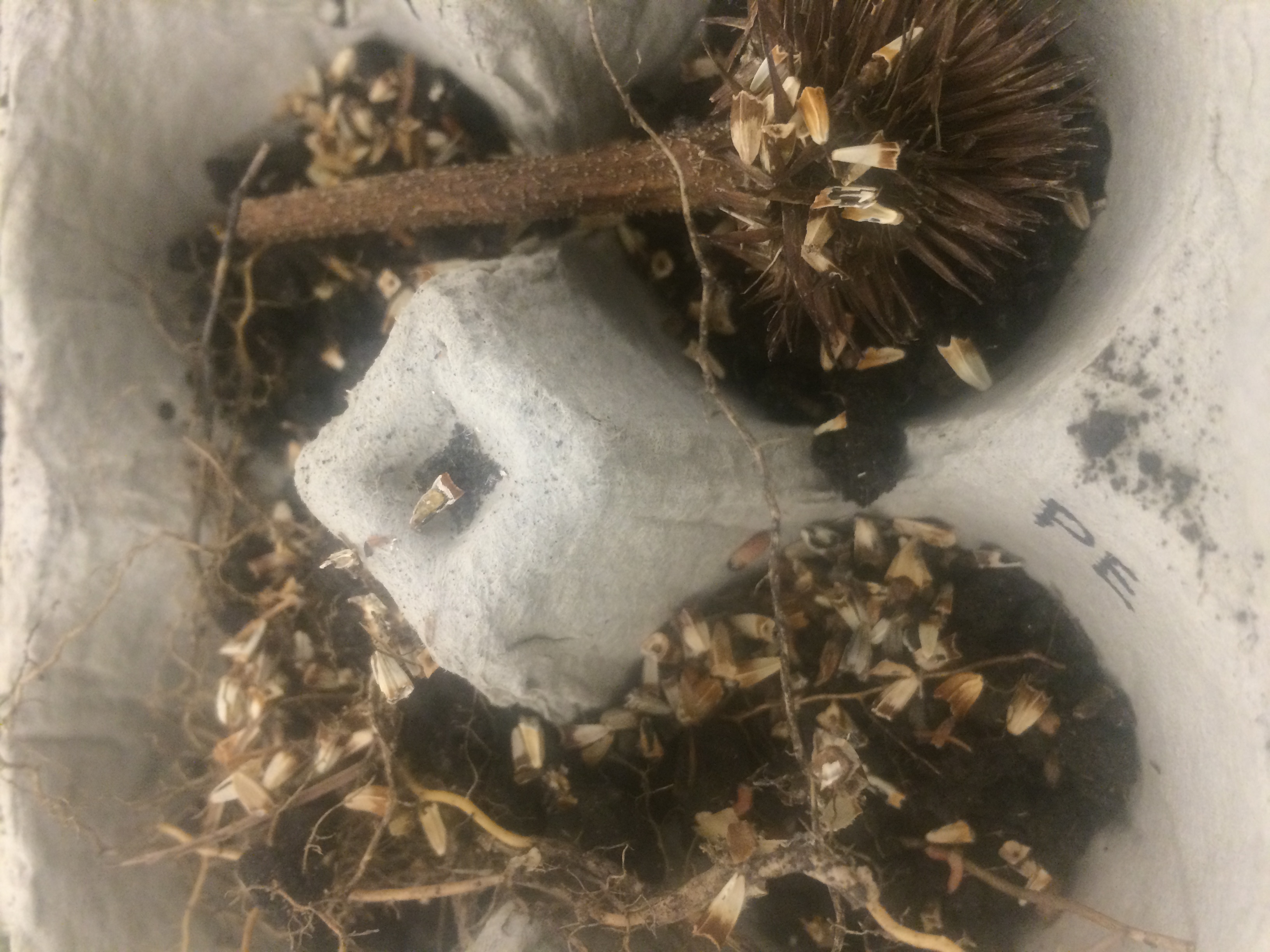
It’s been almost a week since I was extracted from my nice, cozy seed head: the only home I had ever known. Sometimes I still miss it- I had chewed through at least a third of the achenes there, and made nice holes in the base. I don’t know if I’ve ever been more comfortable than when I was firmly lodged within an achene. I also don’t know if I’ve ever been more uncomfortable than when I found myself squished in the grasp of a pair of tweezers. Suddenly, my home and everything I’ve known fell away, and I landed in a pit with lots of others like me. The floor was cluttered with achenes, but the structure was nothing like my old seed head. Moreover, the walls were clear. It looked as if escape would be quick- it is not, believe me, I tried. Something about plastic just doesn’t connect well with my prolegs. Speaking of prolegs, I, and all my kin, have four. It’s a trait characteristic of us caterpillars. Those silly humans probably thought we could have been flies or beetles before looking at our prolegs. Today is significant, because our numbers have grown to the point where our measly petri dish jail was no longer doing us justice. After a rough and tumble fall into a new container, we’re all feeling a little better. Here we’ve been given a seed head and soil, just in case we decide either of those places are where we’d like to pupate. Things are starting to look up. (Q: Wait, where did 84 come from? A: We have found about 14 caterpillars, each of whom has 6 pairs of eyes.) (Q: So, what species are the larvae? A: We still don’t know. It’s possible they are codling moths, but those tend to prefer fruits like apples- more juicy than achenes. It’s also possible they’re banded sunflower moths, which appear just as pink in later larval stages as these larvae do),
Hello! The poster version of the webpage displaying parts of an Echinacea seedhead is now available online, in pdf form. The poster displays the parts of an Echinacea seed head and the types of chaff that might be found while cleaning a seedhead, with many pictures. The link can be found here: https://echinaceaproject.org/wp-content/uploads/2015/12/Echinacea-Seed-Head-poster-pdf.pdf. Here’s the poster that Jackie and Audrey made in their GIS class.
Things are truckin’ along in the lab. Belle has kept on organizing and categorizing the bees, making slow but steady progress. Audrey and Jackie have kept on cleaning seed heads, and finding a significant amount of those hungry, yet unidentified little larvae. In fact, the two have found more larvae than has been found on any seed heads for the past ten years. Needless to say, something interesting definitely happened with this insects’ population this past growing season. Everyone is pretty excited to see the final distribution of seed heads damaged with characteristic chewed up achenes. Audrey and Jackie, while they are certainly excited to try to solve the larval mystery, are doing their best to mitigate and keep careful track of the effect this predation might have on their seed set data. Hopefully, by trying to raise multiple larvae under varied environmental conditions, the team can get a couple to live and develop into adult stages, where they’d be much more easily identified.
Fun fact: the Echinacea Project has collected over 1000 bee specimen and each is more beautiful than the next, especially when viewed from under a high-powered microscope. My task over the three weeks of my externship is to inventory and organize these lovely little pollinators and then create a database on the Echinacea webpage that project members can refer to in the field when they observe a pollinator visiting a purple coneflower. So far, no easy task! Most of the bees have been previously identified, but some remain nameless and nomadic, species-less and in need of a home. Thus, a crash-course in bee identification was necessary. I think I’ve gotten pretty good at, if not identifying native bee species, then plowing headfirst into identifying native bee species and confidently writing down the complete wrong answer. Notable characteristics that are friends when identifying native bees include the colors of the mandibles (not the “jaw”, Belle) and the color of the little fuzzy hairs on the top of his or her head. More difficult characteristics whose identification I have yet to master include the specific color of the hair in between the T3 and T2 apical bands, above the rim but sometimes moving towards the center, and not characteristically white. Honestly, it’s Greek to me at this point and when this is all done I have a bone to pick with whoever wrote out these characteristics on DiscoverLife, but I hope to learn the language over these next three weeks. The fun part is that each bee is special in its own persnickety little way, which allows for little battles with these little beasts all day long as I try to reason with them. Currently, I am not winning. In the next few weeks I hope to wrangle these bees into their place and get them neatly organized and classified. Hopefully I will post some close-up views of these hard-working ladies and gents from under the microscope soon, but it seems the lights have had enough today and need a bit of a break before turning on again. But I bee-lieve in them.
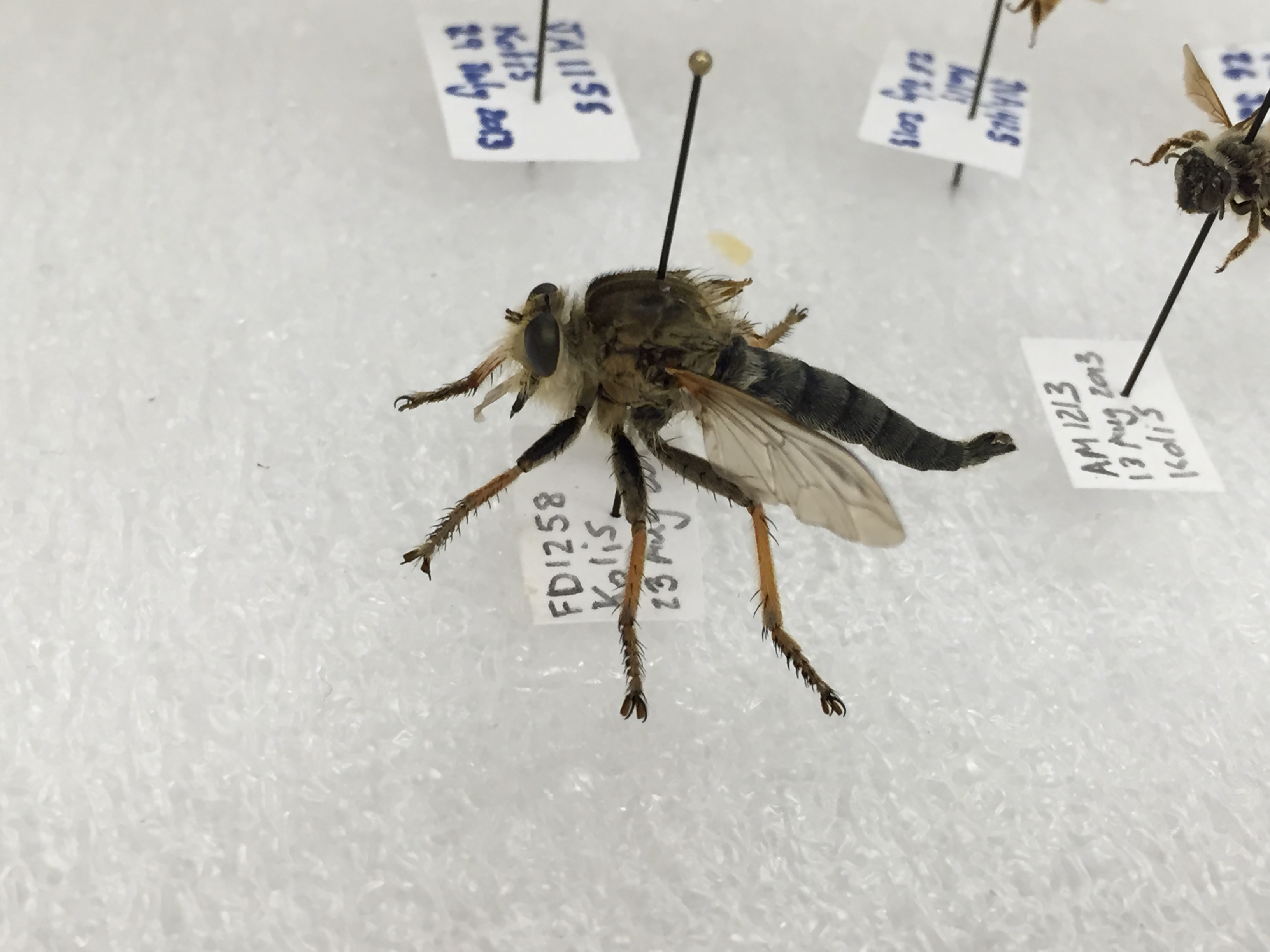 Jurassic Bee (or a “bee killer”)
This summer, Gina Hatch and Abby VanKempen continued a project examining the effects of aphid herbivory on Echinacea angustifolia survival and fitness. This year they found 70 of the original 100 study plants (33 addition and 37 exclusion). Starting July 14th going until August 20th, Abby and Gina visited plants twice each week for a total of 12 visits per plant. On each visit, the plant received its treatment: either adding aphids from other plants if it was in the addition group or removing all aphids if it was in the exclusion group. At the end of the summer, Abby and Gina used the number of leaves with chew marks and holes (signs of foliar herbivory) to quantify herbivory. There was not a significant difference in herbivory between the two treatment groups, where herbivory was measured as the proportion of damaged leaves (p = 0.74). On September 14th and October 15th, Ali Hall took measurements of senescence including number of brown and purple basal and cauline leaves. These have not yet been incorporated into an analysis.
Read more posts about this experiment here. Start year: 2011 Location: P1 Overlaps with: Phenology and fitness in P1 Products: Fitness measurements were collected during our annual assessment of fitness in P1. A list of focal plants and addition/exclusion datasheets are located in Gina Hatch’s Dropbox folder and can be found here. Gina created a poster and presented at Carleton’s summer research symposium and her poster can be found here. Abby plans to present at the Elbow Lake Library. The senescence data can be found here.
Gina made a poster for Carleton’s summer research symposium. The symposium happened a while ago but you can relive the experience by looking at her poster! Effects of the specialist aphid, Aphis echinaceae, on overall herbivory of Echinacea angustifolia |
||||
|
© 2026 The Echinacea Project - All Rights Reserved - Log in Powered by WordPress & Atahualpa |
||||