|
|
Today we spent the morning doing remnant phenology. It seems that we are getting to the end of flowering and phenology is going faster and faster. During phenology we collected pollen that will be freeze dried and used for crosses next summer! Woah! While I was collecting pollen from the single flowering plant at the DOG site, the elusive three legged dog came to visit me. She fell down by me and panted while I collected the pollen. 
In the afternoon we furiously measured Experimental Plot 1. Gretel and I raced other groups aswell as each other, finishing four rows before we called it a day and headed in.
I can’t believe how quickly the past eight weeks have passed. Both my fellow Team Echinacea crewmembers and I have had great successes with our group and individual projects.
In exciting individual project news, Keaton and I have finished collecting observation data for my pollinator efficiency project! We were able to record over 175 visits, more than triple the number recorded last year. The work isn’t over yet though, as we still have to re-watch and re-name files for over 175 visits and analyze a (beautiful and majestic) mountain of data.
Here are some of the big numbers:
Greatest number of shriveled styles:
Date: July 23rd
Head: 10-13-grn
Pollinator: Andrena
Visit Duration: 3.25 minutes
Number of Shriveled Styles: 71
Longest Visit (based on videos watched thus far):
Date: July 23rd
Head: 17-26-yel
Pollinator: Andrena
Visit Duration: 12.15 minutes
Number of Shriveled Styles: 5
All though we still need to climb a few more pitches on data mountain before we can say with certainty, it appears as though long visits by Andrena do not necessarily result in more shriveled styles. Based on field observations, we believe this is because Andrena bees normally spend longer on the first heads they visit when their pollen baskets are un-filled with the compatible pollen required to cause style shriveling. The ideal visit duration seems to be 2-5 minutes for Andrena.
Well I better put my harness on and get back to climbing. The peak is in sight, but it will take some real finger strength and mental fortitude to reach it.
Cheers!
Maureen Page
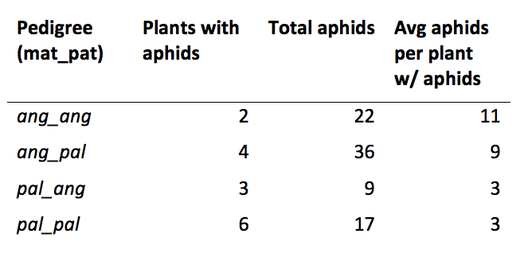
These are my preliminary results after adding 2 aphids to each of the 80 plants in my experiment (20 of each variant) and checking on their survival after about a week:

The most interesting result is that aphids were able to survive on each variant, including Echinacea pallida (“pal_pal”). Lauren Hobbs and Hillary Lyon found that aphids did not survive on E. pallida in their experiment. If the aphids persist, it could challenge the species’ status as specialist. If they eventually die off, it could provide an insight into what makes E. pallida inhospitable to them.
Another result is that, while E. pallida had the most plants sustaining aphids and E. angustifolia the least, E. angustifolia had the highest average aphid load and E. pallida the lowest. Perhaps it is harder for aphids to colonize E. angustifolia but easier for them to persist once present. It is important to note that the plants in this experiment are only a year old, and so perhaps aphid survival is more affected by plant size than pedigree at this stage.
I am continuing my additions and observations with extra gusto, because I can’t wait to see if these trends bear out over repeated trials, or whether new ones will emerge.
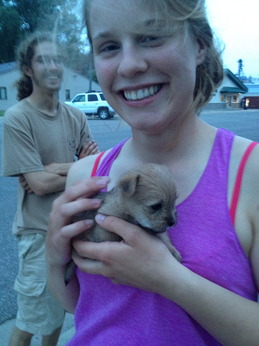
The small town of Kensington received five new adorable puppies last week. After some sleuthing and chatting with the friendly locals, team Echinacea received the chance for some much needed puppy playtime.

But what’s more exciting than puppies? Proposals and updated procedures!
Pollinator Efficiency Proposal 2014 .doc
Pollinator Efficiency Procedure.doc
PolObDatasheet_2014.xls
Attached to this post you will find team pollinator’s original proposal as well as an updated procedure and an updated datasheet. The past three weeks have flown by and we have already conducted observations on 175 heads! This means that we are only 25 heads short of our goal just in time for the end of flowering. It is also amazing how much we have learned and how much we have had to change our procedure. I hope that someone will pick up this project next summer and this updated information will help them to avoid some of the problems we’ve encountered.
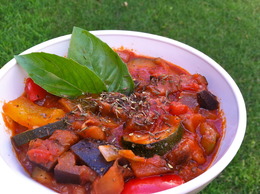
In other exciting news, tonight I cooked Ratatouille for the team. Thank you Gretel and the Wagenius garden for the delicious basil!

My favorite French dish + my favorite people = the perfect end to a relaxing Sunday.
We spent the morning working on our personal projects. Elizabeth assessed style shriveling on her crossed flowers at Yellow Orchid Hill, where, she reports, flowering has recently passed its peak. Meanwhile, Claire and Jared performed crosses on the focal plants on the west unit of Staffanson. In P1, Will worked on his pollen preservation experiment and the Pollinator Posse (Keaton, Maureen, and Jennifer) surveyed P1 phenology. Further afield, Alli continued her flowering community analysis.
But the real action was at Hegg Lake, where I finished my first round of aphid additions to Echinacea angustifolia, E. pallida, and their hybrids in P7. I have almost doubled my efficiency since starting the additions, performing 20 additions in a little over an hour. I also surveyed the phenology of the 18 E. pallida flowering in the restoration nearby. Aphid survival and flowering phenology may seem pretty disparate topics–and they are–but they both inform our understanding of the consequences of introducing a non-native but closely related Echinacea species. Do they support the same aphids? How about their hybrids? How likely are they to hybridize? How much does their flowering phenology overlap? It’s hard to stick to just one question.
Doubtless inspired by my example, the rest of the team came to Hegg in the afternoon, where we measured plants in P2. Many of us we were able to increase our efficiency by working alone instead of in pairs, and row by row we progressed eastward. Less than an afternoon’s work remains.
With nearly all of our plants mapped at Staffanson, Claire and I have taken a little sneak peak at the spatial data we collected (it’s like Christmas in July, we just couldn’t wait to open our presents). I have included a graph depicting the the average distance from each flowering Echinacea plant to its kth nearest neighbor. The distribution of distances were nearly all skewed right so I plotted the natural log-transformed distances +/- the SE. There are clear differences between the East and West units (note that the East unit was burned in 2014).
knnspp2014.pdf
Although this graph does not necessarily reflect distances to the true nearest flowering neighbors (we only included distances for plants mapped on our sampling transect), these data are consistent with our hypothesis that fire increases the density of flowering Echinacea. More to come soon…
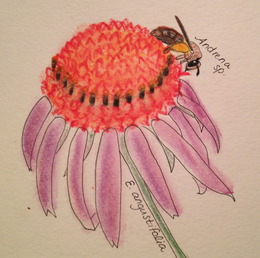
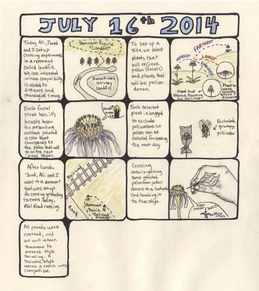
The field season is heating up for Team Echinacea both literally and metaphorically. Much of the metaphorical heat comes from the awesome work everyone has been putting into group and independent projects. However, a small portion of this heat also comes from a budding relationship between Andrea and I that was sparked at experimental plot 2 a week ago. On my day off, I missed her so much I simply had to draw a picture of her.

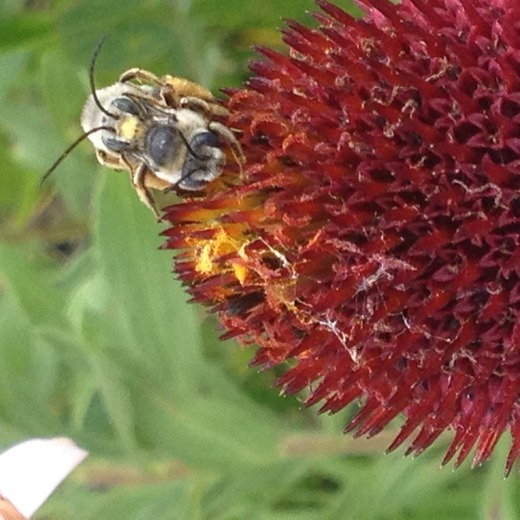
Why is Andrea so special to me? One important reason is that she is an Andrena bee and Andrena seem to be the most efficient pollinators of Echinacea angustifolia based on our preliminary findings. Another reason is that she is absolutely adorable and very photogenic.

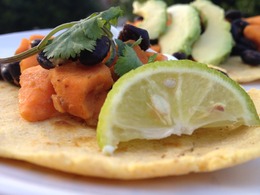
Aside from missing Andrea, I also made dinner for the team. I decided on sweet potato black bean tacos with homemade tortillas. Mmmm…..
With Echinacea’s flowering reaching its peak, there isn’t a better idiom to describe the team’s work schedule for the week. Remnant phenology, independent projects, and a large scale compatibility project are just a few of the tasks being carried out on a regular basis. As for the pollinator project Maureen and I have been working on, things are going great. After alternating back and forth between P1 and P2, we have accumulated over 60 observations, which is a little over half of what we are aiming for. Towards the beginning, we saw mostly small green bees, but recently we have started seeing more and more of the larger bees, such as Melisodes and Andrena. For example, we added 7 more Andrena observations just today, which more than tripled the Andrena observations we had up to this point. Things may be a little hectic at Team Echinacea headquarters, but this doesn’t mean we are all work and no play. Just tonight we enjoyed a post work bonfire with s’mores, badminton, and croquet. You might even say it was the…… bee’s knees!
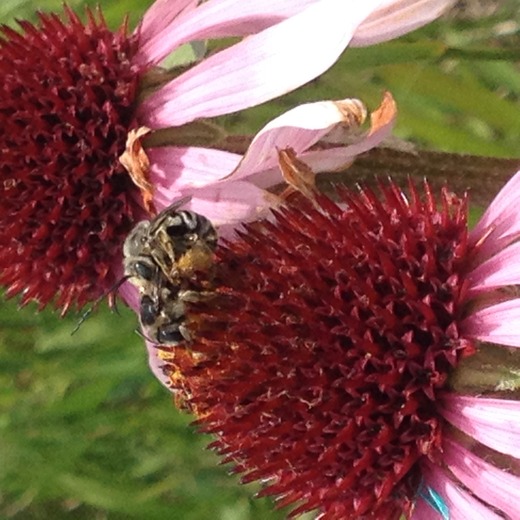
And just in case this post didn’t contain enough corny pollinator references, here’s a couple of pictures of a pair of Melisodes teaching us a lesson about the Birds and the Bees.

Today marked the first weekday of the peak week of flowering for Echinacea. We are working on phenology at all the remnants as will as P1. Several flowers are already on their last day of flowering. Despite the cold and blustery conditions of today the team did crosses for the compatibility project at Loeffler’s Corner and set up the project at East Elk Lake Road. Cam and I worked on my exhaustive crossing project at Yellow Orchid Hill. We weren’t able to collect pollen and cross until after lunch, but fortunately the pollen was not blown away by the wind! Tomorrow will be more phenology and compatibility!
|
|

-thumb-260x195-194150.jpg)