|
|
As August draws to a close, we have been busy wrapping up phenology, making progress on demography, and harvesting Echinacea heads. While Claire, Elizabeth, and Stuart harvested heads at Hegg Lake, I mapped a patch of Echinacea angustifolia located a couple hundred meters west of P2. The patch centers around a small knoll ringed by poison ivy. I shot GPS points for 7 plants on the periphery of this Echinacea patch. Within the patch, I found 30 Echinacea flowering plants with a total of 37 heads. Most plants were located on the southwest slope of the knoll. Although I did not find any individuals on the north or east slopes, these hillsides should offer good Echinacea habitat.
In preparation for the fall burn at Hegg Lake, we set up a small project to monitor a patch of Hill’s Thistle (Cirsium hilli). We identified, shot GPS points, and measured the basal rosette diameter for 28 individuals. After mapping and measuring the thistles, we split the patch into two plots and mowed burn breaks around our plots. The north plot will not be burned in the fall. Like Echinacea, C. hillii inhabits dry prairies but Hill’s thistle is somewhat rare and is listed as a Species of Special Concern in Minnesota. Fire is thought to be necessary for maintaining the native plant communities of dry prairies but little is known about C. hillii responds to fire.
I’ve attached some goodies for everyone today, which are strategically placed at the end of this post. I am heading back to California on Tuesday and this will be my last flog post. I am go grateful to have been given this opportunity and I will miss lovely meals, Gretel’s chocolate cake, and all of the wonderful people I’ve met. I could list many other things that I will miss, but I suspect everyone is anxious to get to the sweeter section of this post.
AKA: EVERYTHING ANYONE COULD EVER WANT/NEED TO REPEAT THE POLLINATOR EFFICIENCY EXPERIMENT
My original proposal (with preliminary protocol):
Pollinator Efficiency Proposal 2014 .doc
Revised Procedure:
Pollinator Efficiency Procedure.doc
The observation datasheet we used in the field:
PolObDatasheet_2014.xls
Observation Data for P1:
PolObData_P1_2014_Final.xls
Observation Data for P2:
PolObData_P2_2014_Final.xls
Video ID Data for 2014 in P1:
P1_videoIDdatasheet_2014.xls
Video ID Data for 2014 in P2:
P2_videoIDdatasheet_2014.xls
Video ID Data for 2010, 2012, and 2013:
VideoIDdatasheet_2010-2013.xlsx
Metadata for Datasheets:
Metadata for videoIDdatasheet_2010-2013.doc
Metadata for PolObData_P2_2014_Final.doc
Metadata for PolObData_P1_2014_Final.doc
Metadata for P2_videoIDdatasheet_2014.doc
Metadata for P1_videoIDdatasheet_2014.doc
Dataset used for Analysis:
Taxon_Styles_Years.csv
R-File for Statistical Analysis (thanks in large part to Jennifer/Jared):
MLP_Pol_Eff_Analysis.R
My CBG Presentation:
Pol_Eff_Presentation_MLP_2014 (1).pdf
An Abstract (which could be sent to funders):
Maureen Page Pollinator Efficiency Abstract.doc
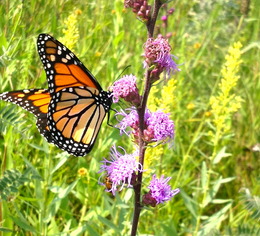
PLUS HERE IS A PICTURE OF A MONARCH!!!

I hope everyone enjoys their summer and I’m excited to see what happens in the months and years to come!
Cheers!
Maureen Page.
This afternoon the whole team ventured out to Staffanson prairie and collected demographic information on Echinacea plants. In addition to the 140 plants already flagged for phenology, we staked and collected data on roughly 200 additional plants!
While we put a substantial dent in the demography we need to do at Staffanson this afternoon, we still have a ways to go. Between 2010 and 2014 Team Echinacea mapped 1074 points, including 649 unique tag numbers. We will revisit all of these plants this summer in order to continue building a longitudinal demographic database.
I attached a graph to illustrate the temporal distribution of Echinacea tags at Staffanson. Note that all tags in the 19000s were placed in 2014, tags in the 18000s were placed in 2013, and tags in the 17000s were placed in 2012, etc. We have 410 unique tag numbers placed between 1996 and 2009 on our list of plants to stake!
sppDemoSummary.pdf
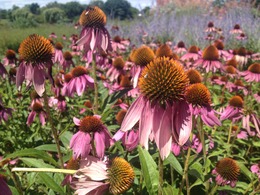
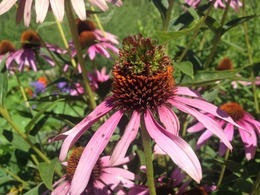
This weekend has been very busy and exciting. Last Wednesday I left the comfort of Town Hall for the hustle and bustle of Chicago. On Thursday I had a chance to visit the beautiful gardens and meet the other CBG REU participants. The Chicago Botanic Gardens are stunningly beautiful and they have plenty of Echinacea purpurea.

I even saw some that looked super funky.
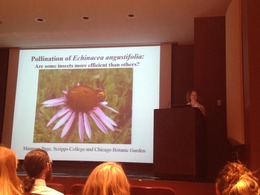
On Friday I gave a presentation on my project at the Chicago Botanic Garden / Field Museum / Morton Arborium Symposium. The presentation went well and I received more questions than any other speaker! I was very impressed by the other presentations as well and it was great to see the different types of projects that students were working on while I was in Minnesota.
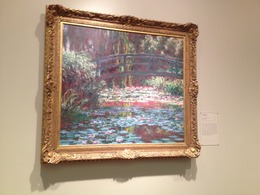
Saturday was my day to be a tourist so I took the opportunity to visit the Art Institute of Chicago. Viewing Monet’s lily paintings was a pleasant compliment to seeing the real thing at the Chicago Botanic Garden.
Although it was great to have the chance to explore the city, I am very ready to return to the Field to harvest achenes, do some (far more relaxed) data analysis, and help out with the other projects. I miss everyone terribly and am excited to see the rest of the crew in just a few hours!
Stay tuned for the posting of my poster/final data!
With love,
Maureen Page.
Today was a great day for Team Echinacea! After a quick morning of remnant phenology, we finished measuring Lydia’s Experimental Plot 09!!! On the Northwest Phenology Route, all flowering Echinacea at East Elk Lake Road and North West of Landfill have finished flowering. It is pretty cool to think of how long we have been returning to these sites for phenology, and now many of them are wrapping up (and quickly!). In the afternoon Elizabeth, Gretel, Jared and I were busy working on demography at East Riley, Riley, Railroad Crossing, and North of Railroad Crossing. Other team members went to KJ’s to look for seedlings that teams have been following in years past.
On the pollinator note comes a follow up from Steve Ellis’s talk with us last Friday. I recently came to learn that the city of Shorewood, MN has passed a law banning the use of neonicotinoids!!!! Shorewood now joins the all too small list of cities banning neonics, including Eugene, Oregon and Spokane, Washington. Although this is a small step towards protecting the bees, Shorewood has made a very important statement. Check out the Star Tribune article about the recent ban, along with a post on the Beyond Pesticides Daily News Blog!
http://www.startribune.com/local/west/269627281.html
Around the middle of peak flowering, a new character began appearing on Echinacea
heads. This is the ambush bug, the endearing name given to this insect, which looks like either a preying mantis or a miniature T-rex. As I do phenology I incidentally happen upon these bugs. Often times I will see an ambush bug on the same head over multiple phenology days. It appears that they prefer heads that are mid-flowering and they sit on the styles which are present below the row of anthers that are presenting pollen that day. I think that there may be a connection between a lack of shriveled styles and the presence of ambush bugs. Ambush bugs- members of the subfamily phymatinae- are predatory insects which lie in wait for other insects to land on the Echinacea head and then pounce. I enjoy taking advantage of this instinct by waving my pen in front of an ambush bug which will bat at the tip with their claw like front legs.
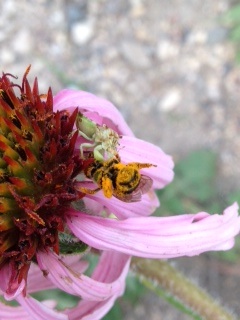
On August 2nd I found an ambush bug with prey in hand on a head at Steven’s Approach. You can see in the photo below that the ambush bug trapped a pollinator. The pollinator was still wiggling its leg bug the ambush bug maintained its grip.

This photo gives evidence of a potential mechanism for the hypothesized interference of style shriveling caused by ambush bugs. If the ambush bug pounces on a pollinator before said pollinator makes its rounds on a head, the styles will not receive compatible pollen and so will not shrivel. I think that the relationship of the ambush bug, pollinators and style shriveling would be a very interesting independent research project in the future.
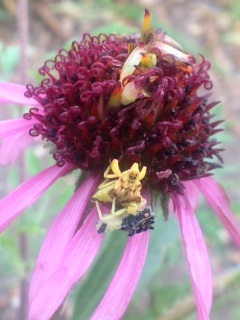
Below is a photo of two mating ambush bugs. I first spotted this pair on August 8th on a head at East Riley. I was surprised to find that these bugs were in the same location two days later on August 10th. In this photo you can see the abundance of persistent flowers on this head. In addition, you can see that some of the florets are engorged and pushed up. This is most likely the result of a caterpillar or larvae predating on the flower or growing below the florets. Stay tuned to hear more about the saga of the ambush bug!
Nancy Braker and Marie Schaedel came to visit today! Nancy is the director of the Cowling Arboretum at Carleton College and Mary was a member of Team Echinacea 2013. They are also good friends of Jared’s and mine and prairie enthusiasts–so there was no disagreement about how we should spend our time.
We spent the day on a grand tour of three of the area’s largest and most diverse prairie remnants: Staffanson Prairie (right here in southwest Douglas County), Seven Sisters Prairie (near Ashby in Otter Tail County), and Strandness Prairie (Pope County). All are owned and managed by the Nature Conservancy. Every few steps we would find a new wildflower, grass, or insect to inspect, identify, and appreciate. It was a nice reminder of why we spend our days toiling in experimental plots and roadside ditches: to preserve the vibrant beauty of the healthy prairie.
Here are a few photos from our journey:
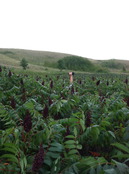
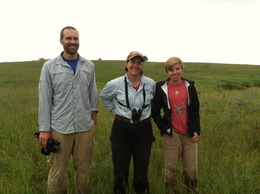
The sumac forest at Seven Sisters swallowed all but Jared’s binoculars.

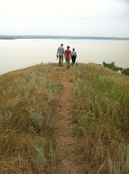
In western Minnesota, a little elevation goes a long way (on top of Seven Sisters, 190 feet above Lake Christina).
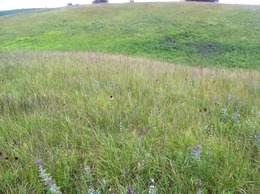
Echinacea at Strandness Prairie. They look a little weird without flags and tags.

Prairie peeping makes for happy campers. (Strandness Prairie.)
While gazing up from measuring Dichanthelium today I spotted a large patch of fruiting sumac. The past summer I had been itching to make some sumac lemonade, and the abundant stand of smooth sumac (Rhus glabra) presented an irresistible opportunity!
After a quick and easy harvest of the fruits (called drupes) that are found in compound clusters at the end of branches, some team members and I returned for brewing.
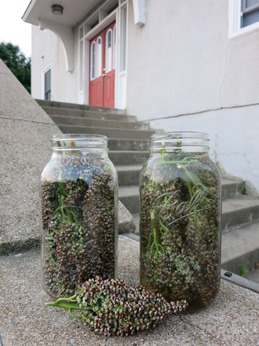
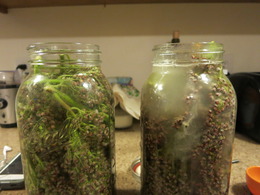
There are many methods for making sumac-ade on the world wide web. The variables are sumac berries on or off the stem, the temperature of the water, and the duration of the soaking time. I decided to try out two at first, both leaving the fruits on the stem, one adding cold water and a longer wait time, and one where hot water is added and steeping only lasts 30 minutes. (Sumac is pictured below, jars thanks to Gretel and Stuart)
After many test rounds, two taste testers and I agree that the colder, longer brew time results in a more palatable, tart, and less bitter final product. The hotter, shorter method heats up the stems and causes them to release bitter sap. (In the picture below the sumac in the jar on the right was submerged in boiling water, and it is actively releasing sap).
Future projects include sumac-ade popsicles, as well as fruit drying for winter use and spice grinding.
|
|