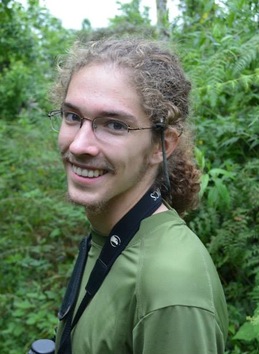
My name is Cam Shorb, and I’m a junior Biology major at Carleton College. Click here for more about me and my summer research interests.
|
||||
|
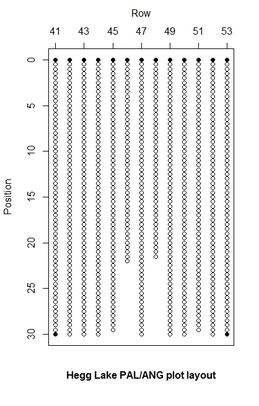
My name is Cam Shorb, and I’m a junior Biology major at Carleton College. Click here for more about me and my summer research interests. Join the summer fun in West Central Minnesota! Kensington Runestone Days Old Settlers’ Reunion, Barrett Heritage Days, Starbuck Ashby Appreciation Days Grant County Fair, Herman Waterama, Glenwood Flekkefest, Elbow Lake Show White & The Seven Dwarfs Prairie Fire Children’s Theatre, Barrett Hoffman Harvest Festival Douglas County Fair, Alexandria Don’t forget the Minnesota State Fair! Gia gave a presentation at the NU research expo. Here are the details… Hallaman, G. “Ant Diversity for Six Western Minnesota Tallgrass Prairie Remnants: The Connection between Ants and Echinacea angustifolia.” Northwestern Undergraduate Research and Arts Exposition, June 2, Evanston, IL USA, 2014 (Oral Presentation). We had a very quick and efficient planting last week. Stuart and I drove up to MN on Thursday morning, picking up Katherine Muller on the way in St. Paul. We arrived in Kensington on Thursday evening, and immediately got to work. We broadcasted our remaining little bluestem and side oats gramma grass seeds in the South Field (where we planted our qGen2 achenes this fall, aka CG-8). We walked E/W throughout the plot and each broadcast seed over a 5m area. We also broadcast seed around the edge of the plot. Here’s an inventory of how much we broadcast from each of the collection sites: Peninsula – 1 quart We then headed to Hegg Lake to scout out a planting site for the sprouts. We settled on a spot near the parking area, to the west of Amy’s, Caroline’s, and the recruitment plots. The plot is 12m x 30 m with 13 rows and 60 positions. There is a meter spacing between rows and half a meter between positions. We returned the next morning and began planting by 9:30am. With three of us we were very efficient and finished our last row by 3:30pm. We we lucky to have beautiful weather, it was sunny all day with temperatures in the low-mid 70s and a consistently strong breeze. All positions in the plot were plant-able. Here’s a diagram of the plot:
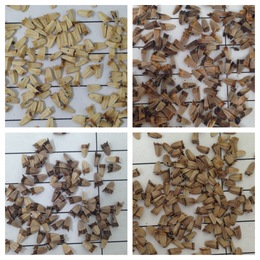
Empty circles indicate positions where a sprout was planted and black dots indicate positions where there are nails. Plants begin at position 0.5 in every row. Row 41 is the most western row, and position 0 is closest to the road (and north). There are empty positions at the ends of rows 46 and 48. There is a bent over flag at each of the 4 corners of the plot. I’m excited to have the sprouts in the ground and to have participated in my first planting. Fingers crossed we have high survival! Sarah Baker presented “Flowering phenology of Echinacea angustifolia in Minnesota tallgrass prairie remnants over three years,” the results of her summer 2013 REU project, at the National Conference on Undergraduate Research, University of Kentucky, on 4 April 2014. We like to tell anyone that volunteers or works in the lab that Echinacea achenes come in all shapes and sizes. Here’s an example:
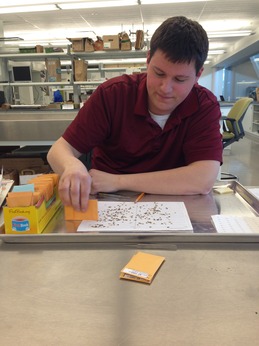
Now if you can’t already tell, these are not the achenes you may be used to seeing. These are all achenes from Echinacea pallida, a purple cone flower species not native to Minnesota but planted in some restorations within our field site. These specific achenes come from Hegg Lake, and they are some of the same achenes that Grace and Aaron, our interns from December, weighed and x-rayed in their analysis modeling hybridization between E. angustifolia and E. pallida. We are going to germinate and grow up some of these plants to see if hybridization is occurring in nature. Nicolas and Shona demonstrated hybridization between ANG and PAL was possible and viable through their artificial crosses, Dayvis concluded that the two species have overlapping flowering phenologies and pollinator assemblages, and Grace and Aaron modeled seed set of PAL and ANG heads collected this year and concluded that the model that best explains their data is one where the two species interbreed. So do they?!?!? We’ll let you know. It’s not actually madness in the lab right now. But we do have a few new things going on. Alex, a senior from Lake Forest College, starting working with us last week. He’ll be analyzing the achenes from heads in our aphids experiment. If you recall, this is an experiment that Katherine began in 2011 that involved adding or excluding aphids from 100 plants in the common garden. We’re interested if aphids have any effect on plant fitness and Alex will be looking at achene count and achene weight to see if there’s a difference between plants in our addition or exclusion treatments. He just started randomly sampling 30 achenes for the weigh machine today!
In other news, we’ve got our volunteers hard at work cleaning and counting. We’re still working on counts from 2011, BUT we’re making progress. Check out this episode of Prairie Yard & Garden. Stuart was interviewed this summer for this half-hour long public TV show about the Echinacea Project. The episode is called “Prairie Flora: History and Future” and it aired yesterday in western MN and the Dakotas.
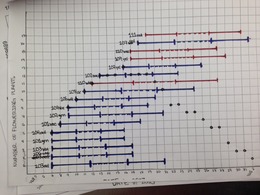
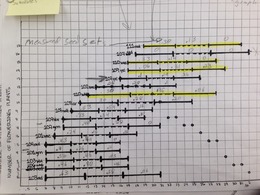
Please help spread the word about prairies! Here’s the link: http://goo.gl/qU4bcN The whole interview and much of the footage is from the main common garden experimental plot. Check out the awesome final report that Aaron and Grace wrote about their work during their December internship. It details how they modeled hybridization between E. angustifolia and E. pallida from Hegg Lake. Cool stuff! Happy 2014 everyone! Here’s the latest news from The Echinacea Project. Grace and Aaron, two students from Carleton who spent their winter breaks in the lab, finished up their internship on Friday. They did some great work with the E. angustifolia and E. pallida heads we collected from Hegg Lake. If you recall from the summer, Dayvis looked at the flowering phenology and pollinator assemblages of these plants. In short, Grace and Aaron followed up on Dayvis’ work by examining seed set (via x-ray AND weigh machine!) of the top, middle, and bottoms of each head. They were interested in determining the likelihood of hybrization occuring naturally between pallida and angustifolia and modeled this likelihood with the Dayvis’ phenology data from this summer. They created some beautiful, hand-drawn flowering schedules (shown below) and they’re working on finishing a report that we will post soon.
Above: flowering schedule with pallida heads shown is blue and angustifolia shown in red. Below: flowering schedule with seed set of each section of each head written in pencil.
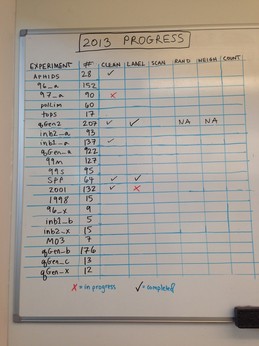
We’re now tracking the progress of our 2013 heads with this handy-dandy white board chart. On the left we have all our experiments in the common garden and the number of heads in each experiment. The chart may look mostly empty, but that doesn’t mean our volunteers aren’t hard at work! We had people come in on Christmas Eve and New Years Eve! What dedication! We will keep you updated as this chart begins to fill up!
Stay warm! |
||||
|
© 2026 The Echinacea Project - All Rights Reserved - Log in Powered by WordPress & Atahualpa |
||||