|
|
We hope everyone had a good Thanksgiving and is embracing the cold weather and snow! A couple big things have happened in the lab over the last few weeks.
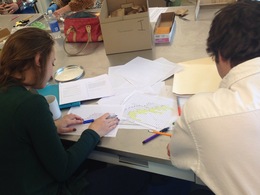
We have two interns, Grace and Aaron, from Carleton College who are working in the lab during their winter break.Their main project has been deciding how to proceed with the Echinacea pallida and E. angustifolia heads we harvested from Hegg Lake this fall. Dayvis observed pollinators and took phenology data on these heads during the summer for his REU project and now we’re interested in seeing if these two species have actually hybridized in nature. Grace and Aaron are currently working on making flowering schedules for the heads we collected.

Stuart heard back from the NSF with good news! They’re funding the proposal he submitted this summer! With this grant money he plans to examine constraints on reproductive fitness of Echinacea in remnants by combining data on spatial isolation, flowering phenology, and mating compatibility. Really cool stuff!
Other than that, it’s business as usual here at the Chicago Botanic Garden. Our volunteers have been working hard cleaning heads and counting seeds. We’re definitely making headway on this year’s harvest!
Stay warm!
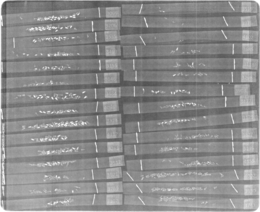
We took some high-quality images of Echinacea achenes for our q2 experiment this fall; an example is below. Notice how easy it is to distinguish empty achenes from those with embryos. By darkening the room and removing the opaque film, we were able to use lower levels of xrays for a shorter duration than we have previously. This plate was exposed to 12kV x-rays for 4s. We used long, thin glassine envelopes to facilitate counting. Notice also that the laser-printed labels reveal the packet IDs.

X-ray image of 30 packets of achenes from
Echinacea angustifolia. Click on thumbnail to enlarge.
Final consolidated file of ech. ang. flowering phenology data from 2011
Edit: now with sppe and sppw differentiated
2011DataFINAL.csv
We are preparing to plant a new experiment this fall. We are cutting down ash trees (Fraxinus pennsylvanicus) in an abandoned agricultural field that was planted with Brome in the 1980s. We will plant Echinacea angustifolia seeds from our experimental crosses this summer. We will hand broadcast two native warm-season grasses: Bouteloua curtipendula (sideoats grama) and Schizachyrium scoparium (little bluestem). Keep up-to-date on progress on this experiment via twitter.
Dwight, Lydia, & Ilse with tools of the day: chainsaw, loppers, brushcutter. Not shown: paintbrush.
Hey Everyone! Here is my final conglomerated data (mine, Andrew’s and Katie’s). As well as my excel file with all the extra information. I will also be posting it in my dropbox as well.
Kory Kolis Final Data.csv
Poll_Efficiancy_Data Kory Kolis 2013.xlsx
What is a typical radiation dose experienced by an Echinacea seed when we x-ray Echinacea fruits to assess seed set?
We usually put the seeds on the bottom tray and the setting 10 s @ 18 kV. According to the documentation on dosage for our x-ray machine 18 kV outputs 292.6 R/h when the dosimeter probe is 57.2 cm away (that's the shelf with 1:1 magnification). The dose unit quote here R is Roetngen.
A little arithmetic can tell us total Roentgens for a ten second exposure:
( 10 s frac{1 h}{60 min} frac{1 min}{60 s} 292.6 frac{R}{h} )
In R code, that's
10 * 1/60 * 1/60 * 292.6
## [1] 0.8128
0.8128 R (Roentgen)
We may put the seeds on a higher shelf for more magnification, maybe 1:1.5 or the 1:2. We can enter dosages from each shelf from the documenation on exposure levels by shelf to estimate how much higher the dose is.
lvl <- c(1, 1.5, 2, 3, 4, 5)
RPM <- c(7.815, 20.55, 42.55, 115.45, 232, 397)
data.frame(shelf = lvl, dose = RPM)
##   shelf    dose
## 1   1.0   7.815
## 2   1.5  20.550
## 3   2.0  42.550
## 4   3.0 115.450
## 5   4.0 232.000
## 6   5.0 397.000
The dose on the 2x magnification shelf is RPM[3]/RPM[1] = 5.4447 times greater than the dose on the 1:1 shelf. Doubling the magnification generally should increase the dose by a factor of 5.4. Let's check: the dose on the 4x shelf is RPM[5]/RPM[3] = 5.4524 times greater than the dose on the 2x shelf. Also, the dose on the 3x shelf is RPM[4]/RPM[2] = 5.618 times greater than the dose on the 1.5x shelf. Close.
The expected dose at the stadard settings is 0.82 R on the bottom shelf and 0.8128 * 5.5 = 4.4704, or about 4.5 R on the 2x shelf.
After leaving June first to the Societyy of Wetland Scientists conference at Duluth, MN, I am definitely returning to the coolest city in this country “My sweet home Chicago” today. It has been a very interesting and special summer for me. I have had tons of good experiences. I certainly had the best experiences in the Star of the North (Minnesota). Specifically, with the Echinacea Project. Thanks guys of the Echinacea team 2013, Gretel, Stuart, and family.
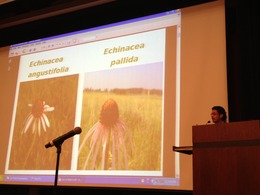
On August 26th, Marie and me had the opportunity of sharing our respective research in the Field Museum of Chicago. We found a very receptive audience for the Echinacea project. I had good amount of very interesting questions. Overall, people liked the fact that several students have been working in research that complement each other. This is the case of Shona in 2012 with Marie and me in 2013.
Now, I am preparing to present this research again in my university symposium on September 20th and as a poster presentation at the SACNAS National conference at San Antonio TX next on October 4th.
Again, Thank you very much to everybody who is or has been part of this fascinating enterprise called the Echinacea project
Flowering phenology data from summer 2013. This version contains data collected from 7 July, 2013 to 26 August, 2013. PhenDataMASTERcsv_28-Aug-2013.csv
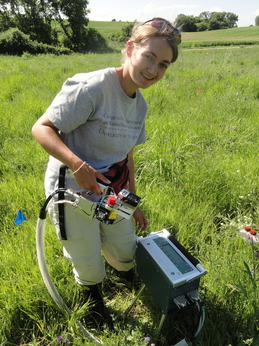
Although it is not yet noon, today has been busy for three team members. Mike, Pam and I have spent the day packing and backing up data as this afternoon we depart from Kensington, the Hjem house, and all the beautiful prairie remnants. It has been an enjoyable summer researching the Echinacea plants. The Li-Cor machine was especially helpful in our data collecting. We could not have done it without her. Sadly yesterday was Helga’s last day up here. She is now resting in a deep sleep until she is needed again.

As we leave, only four members remain at the town hall.
Today marked the second to the last day of mine and Reina’s stint in Kensington working with Echinacea. The past week we have been remeasuring photosynthesis with Helga our LI-COR 6400 and today we finally finished. Pam and Reina were the lucky ones who spent this last week outside working with Helga while I took wet weights of leaves and pressed them so we can obtain dry weights later. It has been a little strange this week remaining separated from the group, even at lunch time. Oh well, it was necessary so that we could finish!
Today the rest of the group spent the morning crossing and finishing measuring the common garden, an arduous task that required quite a few days. After their lunch, they continued to work on seedling refinds, a important but often frustrating task. It will be sad having to say goodbye to the whole group tomorrow, but school is about to start, and so perhaps it really is a great time to be heading home. That’s it for today, and goodbye Team Echinacea!
|
|