|
|
We had a great party on Tuesday night–Dayvis & Marie’s last day. We enjoyed excellent food, played croquet, and ate s’mores around two bonfires. Very enjoyable. The garden is late this year–no tomatoes or cucumbers yet. I regret I didn’t take any photos, but here’s the menu…
corn on the cob
pesto pasta
Pam’s pasta salad
quinoa salad
fresh sourdough bread
black bean dip
corn chips
deviled eggs
kohlrabi slices
brownies
iced tea
s’mores makings
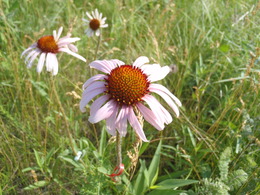
For many of our experiments we want to harvest Echinacea heads when they are as ripe as possible, but before any achenes have dropped.
The standard harvest indicators are as follows:
- Phyllaries (involucral bracts) are brown
- Bracts that subtend each disc floret are brown and sharp
- Flower stalk (peduncle) is brown (not purple)
- 1st (uppermost) cauline lf is brown (note: 1st lf may be close to hd!)
Once harvest indicators 1 – 4 are positive, or if a head has loose achenes or is in some way deformed and you think achenes may be lost before the next harvest, harvest the hd! Make sure to look for loose achenes at the top of every hd with brown bracts.
Harvest a head by cutting it off and placing it carefully into a labeled bag. When cutting the hd off, hold the head firmly in one hand and cut the peduncle with the pruners 3-5 cm under the hd. You don’t need to open the bag all the way and the hd doesn’t need to go all the way to the bottom of the bag.
That’s our standard harvest protocol! Everything’s flowering so late this year, we won’t be harvesting for a while, but I wanted to post this while I was thinking about it.
Hi flog readers,
I have finished collecting my final data for my independent project. Included in this post is the data sheet containing measurements on all one year-old plants in the Hegg plot and their parents.
-Marie
AllData.csv
(updated file)
It was another hot day on the prairie front. We all broke off into little groups today to take care of business. This morning Reina, Mike, and Pam assed herbivory in INB1 and INB2. Kory, Marie, Sarah B, and Dayvis were all scattered about working on their independent projects. Lydia and Sara Z assed the maternal plants in the common garden that are to be involved in the crosses of the quantitative genetic experiment, and on the other side of things Gretel, Shelley (Gretel’s Mother), Ruth and I went to Landfill Core to gather pollen from the sires that are to be involved in the crossing experiment. We used toothpicks to scrape off the pollen into vials that will be used for pollenating the maternal plants in the common garden. We were able to get pollen from about 40 of 55 plants at the site. The 15 others were just a little too immature to collect pollen from today.

This afternoon encompassed an hour of stipa searching for some and then continuation of some independent work on projects. Herbivory assessment continued as well. Stuart, Gretel, Ruth and I went for a nice long walk around SPP. We walked a U-shaped transect and used a randomized scheme for assigning sires to be used in the quantitative genetics experiment. We caged/bagged heads that were to be used and gps-ed the plants.
What a busy day!
Having dodged the misfortune of convening on Friday the thirteenth, Team Echinacea had a fruitful day in the field.
The morning was occupied by independent projects. Kory, Jennifer, and Jon went to CG2 at Hegg Lake to look for pollinators visiting flowering Echinacea. Dayvis and Marie also went to Hegg Lake to gather data for their respective projects. Sarah B. once again visited multiple remnants to monitor flowering dates. Meanwhile, Lydia, Ilse, and Gretel assessed phenology and flowering head count in the Common Garden and ’99 South Garden to gear up for this summer’s pollination experiment.
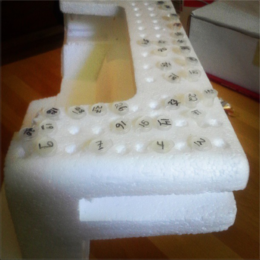
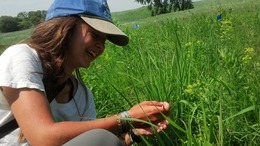
In the afternoon, Pam and Reina finished taking measurements of plants in INB2 for their study. The progress of their work benefited greatly from the recent acquisition of a Red Flyer wagon. Lydia (shown below) braved the wrath of protective ants in her quest to acquire blue aphids for her addition/ exclusion experiment. The rest of the team returned to CG2 to finish measuring plant fitness traits.

After a long day’s work, Dayvis cooked up a delicious meal of split pea soup and arepas (Venezuelan corn cakes). Many crew members are experiencing discomfort due to chigger bites, although some are more prone to vocalize their displeasure than others.
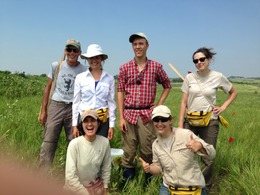
Today was a great day for Team Echinacea. Most of us began our mornings searching for stipa and then went out to Hegg Lake where we finished measuring plants in Jennifer’s common garden! Woot woot! I took an photo of the group and was so excited that my finger made it into the photo…whoops! Dayvis continued to observed pollinators and Reina and Pam were super productive measuring photosynthetic rates of plants in INB2 (maybe it’s the new wagon they got for lugging around Helga).

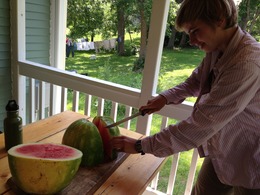
At lunch Kory updated us with his progress on his pollinator efficiency project and Jennifer surprised us with a delicious watermelon as a treat for finishing up stuff at Hegg Lake. Marie did the honors of cutting up the watermelon (little did we know it was her first time).
The afternoon felt a bit like deja vu of the morning. We did another round of searching for stipa (rumor has it we’re just about half way done!) and then returned to Hegg Lake. Turns out we didn’t actually “finish” measuring plants…now it’s time to double check all the ones we didn’t find the first time. Looks like we’ll finish that up tomorrow though, and then be actually done with Hegg Lake for the weekend.
Happy Thursday!
Today, the weather was beautiful and the team was able to make a lot of progress on several projects. In the morning, twist-tieing the heads in the common garden was finished up after several days of working on it. Most of the team then headed out to Hegg Lake to make a ton of progress inventorying the status of all the echinacea plants in common garden 2. My day consisted on making huge strides in gathering data on photosynthetic rate of the echinacea in the INB2 part of the common garden. We are almost 2/3 of the way done measuring! Later that day and back at the town hall, the team feasted on some delicious fajitas that Sarah Z. prepared for supper. 
-Reina
Today in Douglas County, Minnesota, Team Echinacea labored under a cloudless sky and oppressively high temperatures and humidity levels.
First thing in the morning, Sarah B. visited the remnants she is monitoring to study flowering phenology. Dayvis also departed to work on his own project, and was not seen again until 1pm. Today is the second day of flowering for Echinacea pallida at Hegg Lake, and Dayvis appeared elated to finally observe pollinators at work. Kory and Jennifer also went to Hegg Lake in the morning to visit Common Garden 2.
Those who did not have morning projects to attend to flagged and twist-tied flowering plants in the Common Garden. After lunch, the team departed to CG2 to measure plants. Throughout the day, Pam and Reina measured photosynthesis rates in the basal leaves of Echinacea in INB2. Marie and Reina also made/improvised pollinator exclusion cages. The technique for doing so remains unperfected.
This morning, I went out to Staffanson to collect flowering phenology data and saw my first flowering Echinacea of the summer! Some had started flowering yesterday but a few started today. Awesome! 😀
Sarah B
What a week it has been! I arrived last Sunday to Kensington, MN and moved into the Town Hall. It’s no longer used as a public building, it was converted into a residence and is holding 9 Team members this summer. My room is a newly added loft space overlooking one of the basketball nets in the main room.
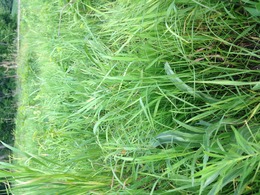
I started my first day on the project learning the ropes. I had a great introduction with “searching forStipa”. What does that mean? Well, looking for a specific grass in the tallgrass prairie. It was difficult to spot at first (and still kind of is) but it is a very distinctive grass. Not much is known about the biology of this grass which is why it was planted in the experimental Common Garden so that it could be observed and recorded. Can you find the Stipa in the picture below? Follow my Twitter feed @summerofscience for the answer (posted July 2).
I have travelled outside of the Common Garden to Hegg Lake twice, once with Marie and once with Kory. I helped Marie measure her F1 (first generation) hybrid Echinacea. I went with Kory and visiting scientist Jennifer Ison to learn how to capture and identify pollinators. I also visited Staffanson with Sarah B and Stuart. We tagged and flagged flowering Echinacea and Stuart gave us a tour of the prairie.
I am learning lots of new science and gaining valuable field experience. A typical day starts around 7 AM, I don’t need to get up this early but it lets me take my time getting ready and having breakfast. We carpool to work which starts at 8:30. Stuart gives us the run down for the day and we usually start off with Stipa or Echinacea searches in the morning until lunch. After lunch, we work on our individual projects until the end of the day around 4:30. Since I do not have a project yet I spent this week learning about current projects and visiting the other field sites.
Conditions in the field are, well…different from the classroom or a lab. Mornings are nice and cool, but if it is damp the mosquitos are swarming. Since insects are of interest in this project we cannot wear repellant in the field. The skies have been clear lately, so as the day goes on it warms up quite a bit and the rays from the sun are pretty strong. We have to wear long pants because we are in a tall grass prairie with insects, snakes, and prickly plants. If we don’t want to get our arms scratched or bit we should wear long sleeves. Long sleeves + long pants + sun = sweaty scientists. I’ve ditched the long sleeves but I have paid the price with a few scratches here and there.
Since it was a big and eventful week for I treated myself to a Saturday getaway to hike at Maplewood State Park about 70 miles away. I have never been to a forest that remote before and although I stayed on the trails I still saw a lot of wildlife. Turtles, dragonflies, birds, muskrats, and maple trees, of course. Even with a map and compass I still managed to get lost but I was able to admire the beauty of nature until I found my way back.

After the hike I was starving and craving Thai food, something you can’t get near Kensington. So I drove to Fargo, North Dakota (yes, like the movie) and is the largest city within 100 miles of Kensington. I didn’t see much to do after lunch and was getting tired after hiking all day so I made the 93 mile trip back to Kensington.
Don’t forget to check in for daily updates from the rest of the team on the flog and stay tuned for my next post.
-Miss Z
|
|