
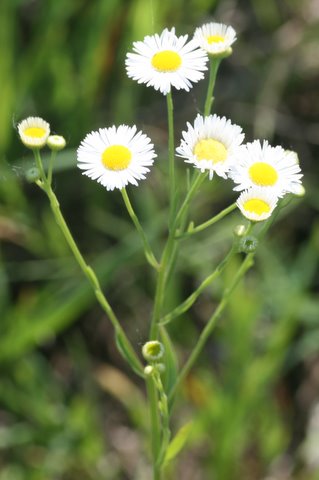
Here are the locations of E. strigosus plants in the common garden:
32 953, 33 954, 38 960
Plants have just started to flower!
|
||||
|
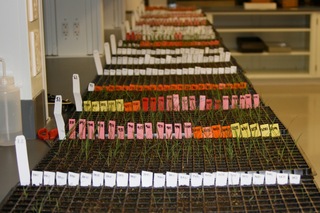
Here are the locations of E. strigosus plants in the common garden: Here’s a picture of a Stipa seedling in the Common Garden. I’m about to create a form for entering data on our seedlings. We are debating if we should count and measure each leaf or count leaves and measure the length of just the longest leaf. Most of our time will be spent finding the plants and/or the toothpicks that we put in to mark them. So, taking the measurements of each leaf shouldn’t add that much time. Any thoughts? Stuart and I did an initial investigation of about 30 locations where Stipa was planted. We found plants at 40-50% of the locations! Caroline, what was your estimate for germination of these seeds? Josh, Gretel, Hillary, and Ian are also trained on the TopScan to collect the GPS data. The ideal is that the radio signal is at 100% and the designation of the location is described as Fixed – (Float will do and Auto works if you are unable to connect to a radio signal) Exciting news! Amy and Hillary found some seedlings at a Hegg Lake plot, the one thats on a hill (the hill with all the phlox on the side) near that blind corner. Anyway, there were nearby flowering plants so its great their reproducing! There were also a couple seedlings found outside the frisbee sized circle area. here are the pics:
This one is a close up of the shriveled cots (with an achene next to it), can you see it!?! The seedling finders, working hard! This was in the morning, getting ready for work: This is just a prairie lilly (Lilium philadelphicum) that I spotted at Staffenson. First time ever seeing one and I think their beautiful!
Lastly, this is a reminder for me to show Stuart my preliminary data collection sheet: -Katie Broken up from the previous entry so as to not make things too messy in the Stipa category.
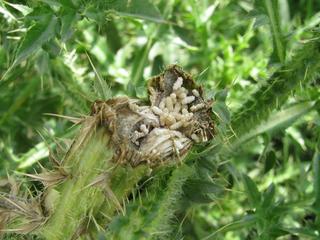
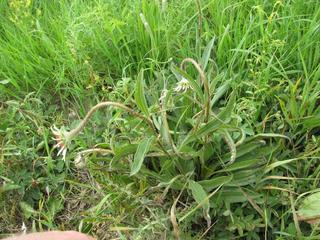
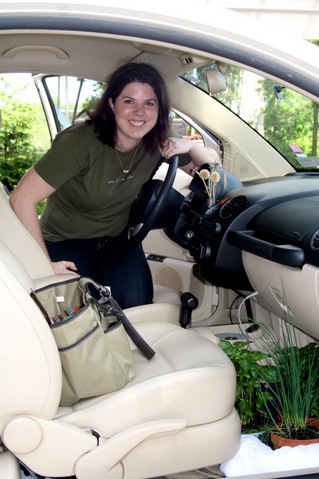
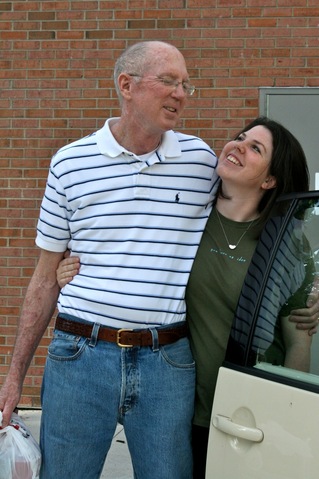
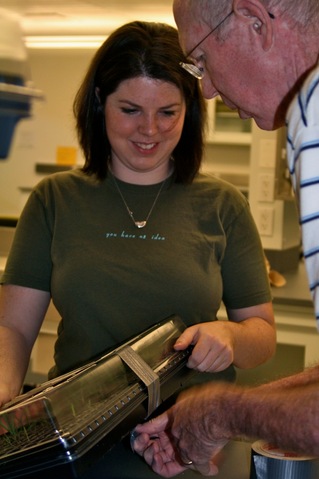
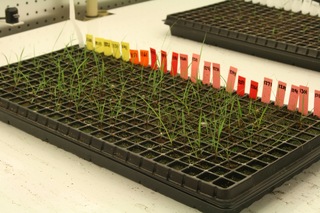
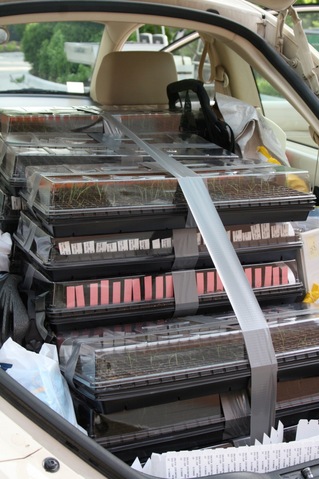
This sad-looking Echinacea was out at NW of Landfill, along with other bent over and crummy-looking Carduus and others. The grasses and legumes around it looked pretty OK, so I’m wondering if perhaps these were hit by some herbicide overspray earlier in the season before the grasses grew up around it. Stipa collection is going pretty well, aside from the Topcon being flaky and not connecting to the data network for improved accuracy (it should be good enough for refinding tags along with the metal detector). We’ve collected from 85 out of the desired 300 so far, with different averages of seeds collected depending on the site. Landfill and Staffenson both had rather high averages, somewhere around 9 or 10 (no math here, just guessing based on what I was entering in the data fields) while some of the scattered remnants were closer to 5 or 6. As for today, I’ll be out with someone to go search at other sites, hopefully, but the weather is looking a bit questionable today. We’ll see! Here’s a list of plants that are available for Katie to use in inb1: Well, I was the last to arrive this summer, same as last summer. With the help of my lovely parents I was able to pack all of my plug trays (18) into my 2007 New Beetle. I have attached pictures of this amazing feet. After a 9hr drive, I arrived in Kensington and finally met the rest of the group. We have a great team this summer, so that makes everything better. Unlike last summer, I got to enjoy Runestone days in Kensington this year, which was very fun. We watched the parade, and I think it was the longest parade I’ve ever witnessed, which is ironic because Kensington is the smallest town I’ve ever lived in for any period of time. I think other floggers will be posting parade pictures, but I would just like to note that the giant Norse ship with the mini-vikings inside (i.e. kids dressed as vikings, shiny swords and all) was my favorite part. Anyway, today is Monday, so back to the grindstone. To do: Other work: Well that should keep me busy. Attached are some pictures and last years Cookbook. We had a pretty eventful weekend with the Runestone festival going on in K-town! We checked it out Friday night and saw fireworks, had a pancake breakfast Sat morning (all except Ian), talked to the locals, and had fun sniffing candles at the crafts fair. Then on Sunday we watched the parade and biked to the lake in Hoffman!
-Katie This afternoon I spent some time with Terrasync, getting a data dictionary together for Hesperostipa seed collection. What does this mean? This means I can take the GPS out, throw down a tag, collect some seed, then, while taking GPS points, put the various bits of information about the seed that I want directly into the Trimble. Geospatially referenced data with little effort! Making sure that the GPS Pathfinder Office’s transfer utility is pointed at the right device (GPS Logger on Windows CE, in this case), you click “Send”, “Add” a data dictionary and browse to the file and Transfer All. You did create your data dictionary, right? No? Well, take a step back and click on Data Dictionary Editor in the Utilities menu. From here, it’s pretty straightforward to create your very own data dictionary. Add the Features you want (features being the kinds of points you want. I added one for Stipa individual). From there, you add Attributes. These are the fields you want to take data on: whatever would be on your paper data sheet. Annoyingly, text fields are limited to a mere 100 characters, so keep that in mind for your comments fields (always have one; you never know!). Useful ones for me were Numeric (tip! if you want to widen the number entry field from the measly default of 2 characters wide, put some large number as your maximum value; you won’t be able to go above that, but that’s not a problem for my tag and envelope number fields. Certainly nothing will be above 1000000), Text, and Date. After getting your dictionary squared away, save it somewhere and transfer it to the Trimble. At this point you should take the new data dictionary for a test run. Restart the Terrasync software on the Trimble and start anew. Create a new file and start taking a point. See if the dictionary suits your needs. If not, go back, fix your dictionary and retransfer, overwriting the old one. Now you’re collecting with style! For the collection dictionary, I selected the following fields: |
||||
|
© 2026 The Echinacea Project - All Rights Reserved - Log in Powered by WordPress & Atahualpa |
||||

-thumb-320x240-45985.jpg)
-thumb-320x405-45988.jpg)
-thumb-320x240-45993.jpg)
-thumb-320x240-45997.jpg)
-thumb-320x240-46001.jpg)

-thumb-320x240-45742.jpg)
-thumb-320x240-45745.jpg)