|
|
Hey All,
Long time no post, I know. Things certainly have been busy around here. As you all probably know, I finished making slides a while back – 372 slides total. WooHoo!!
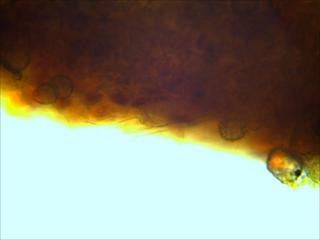
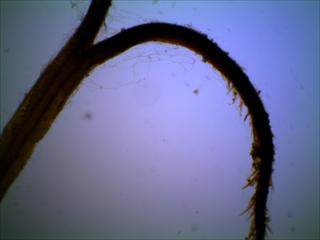
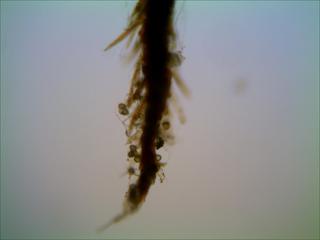
Now, onto the next step, taking pictures of these slides. I took my very first pictures today, just a couple to get the hang of things, they are attached to this post. From my fiddling around today, I can see that this is going to be a lot more work than I thought. First off, the pollen is hard to find, it’s not all at the same level of view, some of them are on top of the stigma and then they’re really hard to see. Also, it’s challenging to focus in enough to where I can ID pollen grains. Stuart suggested working on a random sample of my slides for the rest of the summer, and completing them this fall at the CBG. The only issue there is the change of machinery, but hopefully we can figure something out.
As for the rest, I think I’ll be taking 1-2 shots of the entire style, and labeling them thus: stylevialID_site_date/time_A# – so A1, A2, etc. Then I’ll zoom in and proceed to take pictures at sites B through F on the style, and for each change in focus will be another number. The question is whether I should attempt to get a good sense of the exact number of pollen grains on the stigmas or try to ID the pollen types. I’d like to be able to do both, but I think for this summer at least, I’ll try to get a handle on the former rather than deal with the later.
On that note, Caroline suggested using a clicker to count the number of pollen in a picture, and that seems like an excellent suggestion. Does anyone know if we’ve got one?
Anyway, enjoy the pictures that I took so far:

-Kate Monster
Here are two spreadsheets with information to be made into visor forms.
The first is a list of Echinacea positions we will measure from, in order to plant Stipa seeds. The relevant worksheet is the first one. In the visor form, I would like to be able to see row, position, Echinacea plant status and a column for notes. Breaking this list into multiple forms would be fine.
Complete list of Stipa positions81409.xls
The second is information for the “Next generation rescue” August seedling refind. I would like block, row, position and number of seedlings in May visible and would like number toothpicks, number toothpicks with no seedling, number new seedlings, longest leaf lengths and notes as editable fields.
Nextgenresc-For Aug 09 visor form.xlsx
And finally, Stuart, could you check out some Stipa bunches in Staffenson and decide how close we could comfortably plant seeds next to the Echinacea in the garden?
Here is my dataset that I am working on analyzing in R as a .csv file.
halverson.data.091.csv
Stuart, here is my R script so far:
halverson.data.analysis1.R
I made new columns in the .csv spreadsheet for the factors and levels we discussed. I will work on a list of hypotheses to test. I think I changed the definition of “y” when I did my 24 hour analysis. Can I give “y” a different name for each analysis? Or does the code need to read a defined “y” each time?
Thanks for the help and check out the graph of 24 hours and the summary m2.
Allegra
Here are the data on the three pollen types and the protocol for measuring.
I used the same plant/pollen from each plant and measured at least 30 different pollen grains from each. I didn’t use any pollen if its pole faced forward – only if it was sideways.
Bad news – the Ech. ang. and Heli. heli. are very close. Good news – maybe the pollinators and plants can’t tell them apart either.
Book1.xlsx
PS – I am in SE Minn and the Monarda Sunflower and Miss. Goldenrod are in full bloom all over.
Protocol for slide image recording and measuring.docx
So, for another update from the luxurious Hjelm house, which is THE place to be this summer. We recently had the wireless router in the basement stop allowing people to log on to the network wirelessly, so Stuart ordered a new wireless router, along with an 8 port switch so that we can have more than 3 computers connected at the same time. They got here yesterday, and I took them downstairs to set up.
The entire process of setting up took about 20 minutes, and everything worked like a charm. I hooked the cable modem up to the router, set up the router DHCP (Dynamic Host Configuration Protocol, used to assign IP addresses to computers on the network), and hooked the router up to the switch, after mounting them on the wall. However, I wanted to see if we could get wireless access in the Wagenius house, about 60 metres away.
Setting the router up near the window in the basement did not work, so I moved the router upstairs. After a couple hours trying various spots, it was placed in Stuart’s office, which offered easy access to an Ethernet jack, as well as a convenient window.
In order to enable both the wireless router and the wall jacks, while preserving the network, I had to disable DHCP on the new wireless router, and place the old one downstairs to act as a DHCP distributing thingy for the house. It took me a couple hours to figure this out as well, since I thought the wireless router could perform the same function through the switch.
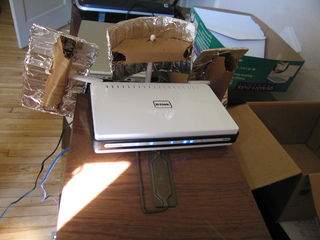
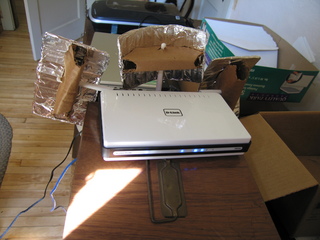
Anyway, to cut a long boring story short, the new router upstairs fell just short of the Wagenius house computer’s range, so using the excellent resources of (Lifehack.com, I made three parabolic reflectors out of cardboard and tin foil to boost the signal. They worked like a charm! They are originally the idea of this site: http://www.freeantennas.com/projects/template/, and I got the template to build the antennas from here: http://www.freeantennas.com/projects/template2/index.html.
Some pictures of the new wireless router:
So sadly, it looks like I won’t be able to come back to Minnesota again this summer. It’s taking much longer than I anticipated to score slides and time is really running out (is anyone else wishing they had a few more days this summer? I sure do..).
I was hoping someone could remove my bags from the ground sometime this week. I’ve posted a file with all the individuals who should have a bag located just south of the plant. I hope this isn’t a very busy week for you guys! The bags can definitely wait if that’s the case.
dataSheetMycorrhizae_8_12_2009.xls
I think Amanda should still have a file on her computer with labels for each individual plant. Coin envelopes were the perfect size for the baggies so hopefully there are still some of those left in storage.
Also, some of the bags may rip when you pull them out of the ground. To retrieve the membranes you may have to dig so you should have a trowel ready. You won’t have to dig more than 5 cm to find the brightly colored mesh with the membranes. Thank you so much for your help!
-Andrea
So, I know I have been missing from the flog lately, but that is only because I was saving up all my flog posts to make one huge, wonderful one! But this is not that post. First of all,
AphidSearch09FinalVersion.mdb
Here is the aphid search data for the past 6 weeks. Each plant has a unique RecordID that identifies it though all three tables. The UnitID field, while it might seem repetitive, is just from the format used on the Hjelm house computer. We have found 263 plants so far, but about 20 of them were can’t finds in following weeks.
This still lacks the transect searches that we will do next week, at which time I shal post an updated version. Note that even though this says Final version, this is just where I save all the final versions of my tables, as opposed to the working versions I use to sort out the tables.
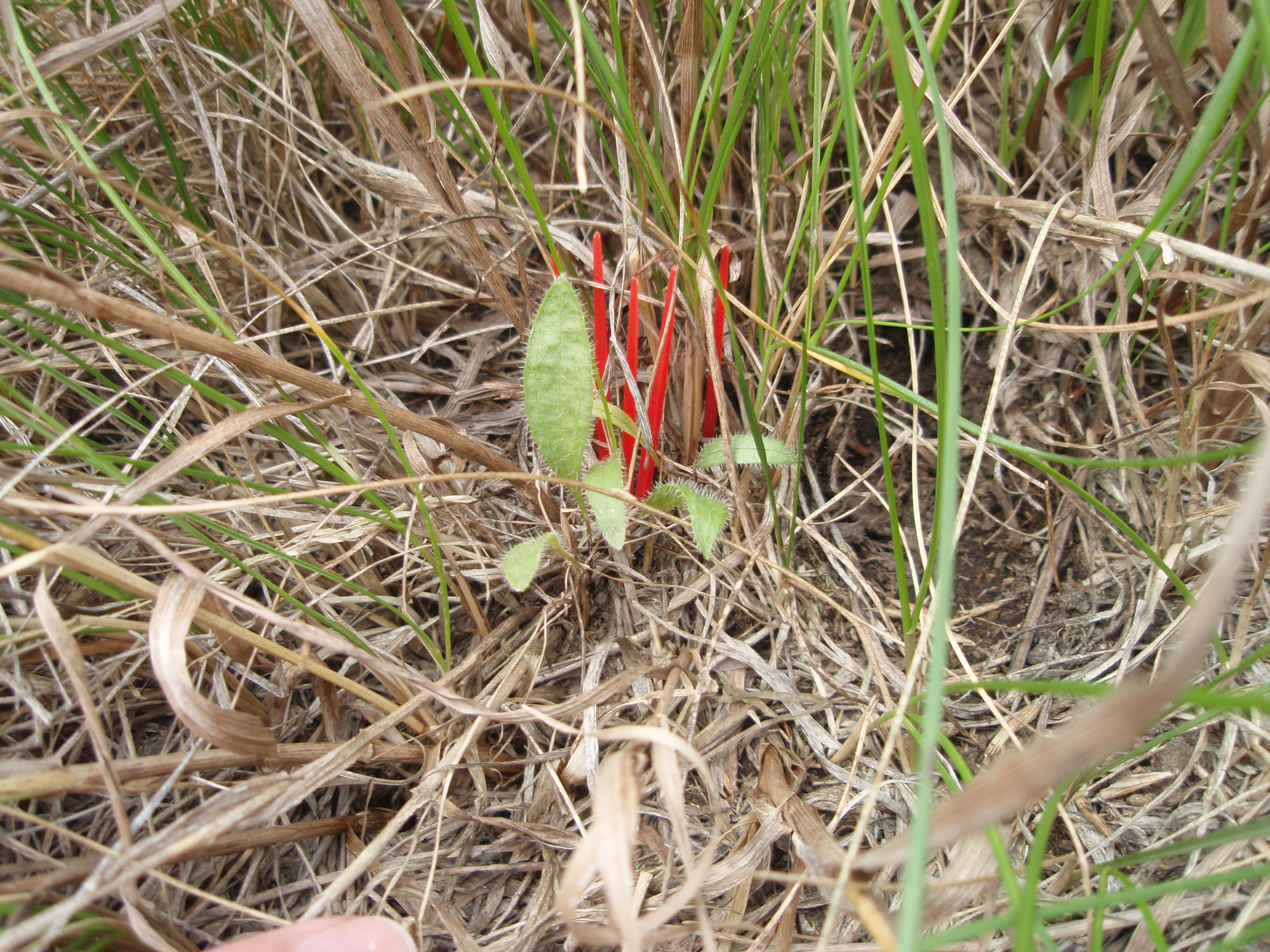
Today I found some healthy-looking Echinacea seedlings at my experimental plot in Perch Lake WPA near Leola, SD.
View image
The DNR sprayed this area (including my plot) last week, in an effort to eradicate yellow toadflax. It seems that my seedlings were shielded by the tall grass. It’s also likely that the seedlings are not in a rapidly growing stage, so they may have been less vulnerable than other broad-leaf plants.
Here’s another picture:
Come to the farm for a picnic celebrating the near end of the Echinacea season. I’ll be making pesto and roasted zucchini and yellow squash. Jean is making brownies. We’ll provide drinks and s’more necessities-including a monster burn pile. Hope to see you 6:30ish.
Until I get the website done, this list of measurements is all I can offer you. The measurements are in pixels. The measurements were made from multiple pollen on a single slide.Slide list.xls
|
|