|
|
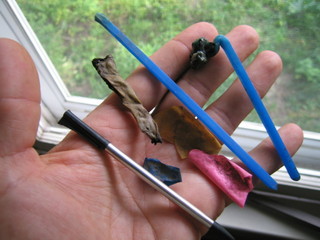
I found a few things besides Echinacea plants, while searching for plants that may have died in the common garden. I found a fossil shell. I gave it to Per and he held on to it for a while but dropped it. Someone else will find it! I found a stylus (for a handspring visor). It’s probably Gretel’s; she lost hers earlier this year. I found a snake skin with an intact top of head–the eyes were transparent-cool! Per gave to Hattie, I think. I found a mouse in a mouse nest (right on top of dead Echinacea leaves from last year). The mouse bounded away. Also, Ruth called while I was searching to say that she had just found the serial cord for the survey station data collector that we couldn’t find–we had been looking for that for a few days. Wahoo! Finally, I emptied my pockets of litter that I had picked up: three pieces of flagging, one melted plastic plug label, and 2 blue plastic cocktail stirrers.

Stuff from Stuart’s pocket: stylus (1), flagging bits (3),
melted plastic plug label (1), blue plastic cocktail stirrers (2)
We are making great progress on annual measurements of plant in the common garden. On Monday we finished measuring all plants (~10000). On Tuesday we finished placing staples at all locations where plants died overwinter in 2007-2008 (>700). Today we made a huge dent in “rechecks.”
Rechecking is when we revisit all the locations where we recorded a “can’t find” and left a flag while measuring. We placed about 1500 flags. About 700 of those “can’t finds” were stapled this year. So, we just verified that staples were in the correct locations and pulled flags. Some locations had staples from previous years that a measurer didn’t find. We pulled flags there too. Then there were the plants that were alive last year. We rechecked those and found quite a few plants. Each time someone found one, they yelled “wahoo” and the rest of us responded with a whoop and a holler.
Shucks, it was fun!! Actually I was burned out by the end. Next year we should plan two 2h sessions instead of one 4h session.
Perplexed by Stuart’s question – a trip to the hilltop here in Watertown, and Mimi’s poster, I checked again on the amorpha pollen – it is NOT bean shaped. But I do have reliable pictures – (Amanda don’t bother getting its pollen tomorrow)
What keeps amorpha and medicago sativa from occupying the same locations? Legume wars underground? Does Andrea have insight?
Here’s a snippet of R code showing how to extract info from the shrivel character data (a file is below…
df <- data.frame(shrivel.txt =c("x", "xoxx", "xxxx", "oooo", "xoooo"))
df      # start off with this data frame
str(df)

df$shrivel.count <- nchar(as.character(df$shrivel.txt)) #add column

vx <- gsub("o", "", df$shrivel.txt)  # replace o with ""
vx
df$shrivel.xs <- nchar(vx)           # make a new column in df

vo <- gsub("x", "", df$shrivel.txt)  # replace x with ""
vo
df$shrivel.os <- nchar(vo)           # make a new column in df

str(df)
df      # final data frame
codeForAllegra.r
Yesterday we finished measuring in the Common Garden! Here are some details about the protocol used for 2009:
Gardens: Inbreeding & INB2 we used the same form as in 2008. Basal and Flowering Rosettes were counted separately. Crisp leaves were included in the leaf counts.
Gardens: 2001, Monica’s, SPP, Big Batch, and 96-99 we used an abbreviated form. We did not record data on insect damage. Insects on all rosettes (basal and flowering) were recorded on the main form. Insects on the heads were recorded on the subform. Cauline leaves were not counted. The longest cauline leaf (longest leaf on the tallest flowering rosette) was recorded on the main form. For basal leaves, crisp leaves were included in leaf counts and also noted, as were leaves that were “gone.” Pips or duds with no florets were only recorded if there was a peduncle long enough for a twist-tie collar.
Staples mark positions in the Common Garden where plants have died. Our policy has been to add a staple to a position where a plant has not been found for 3 years. This year, we’ve followed that protocol for the Inbreeding and INB2 gardens. However, we have added staples in Big Batch, 2001, SPP, Monica’s, 1996, 1997, 1998, 1999, and 1999s where plants have only been “Can’t Find” for TWO years. This should minimize the time it takes to search positions. We hope that plants and staples won’t both be found at the same position in the future.
In response to Caroline’s request for more locations to plant Stipa in the common garden, I have selected 208 new locations at random. This map shows the new locations in green. (Blue dots are the previously selected locations.)  Click this thumbnail to see a full-sized image. Click this thumbnail to see a full-sized image.
Here’s a file listing all 208 location. It’s suitable for making 208 labels for 208 seeds! stipaSeedLabels2.csv
I went on a fantastic bike ride yesterday and saw a large prairie restoration on the east side of county road 7 between Moe Hall Rd SW and Tower Hill Rd SW. I also saw a population of Ratibida and Desmodium on the west side of County Rd 15 between MN-27 and Tower Hill Rd SW. Sorry I couldn’t be more specific with my directions but if you bike or drive those sections of road you will definitely find the spots.
2 graphs that are basically the same as the one with alfalfa on my poster, bu tusing sweet clover and amorpha instead. Although amorpha is the most common native species in floral neighborhoods per unique plant, there are only 43 plants that had either just amorpha, just echinacea, both , or neither. For sweet clover, the sample size is 82, but the graph isn’t very impressive either….
Do you think either one is usable? I originally wanted to use the most common native and the most common exotic (alfalfa and amorpha).
ecan amca meof comparison graphs.xls
Hey yall,
Back in Chi town finally after about 10 hrs of traveling. I said “Get er done” to someone today out of habit and got a weird look. Thanks guys. I’m also going through baked goods and other delicious foods withdrawal.
Final version of poster: Jenkins REU09.pdf
Hope everyone’s doing well in K-town! I miss yall already…and my bike 🙁
ps. I knew Roxy would come through for us. Warren should’ve known better after the snake incident.
|
|