Categories

Breeding Systems Update

August looks like it will be my busiest month this summer. I’m currently working on four species, and will expect to start two more before the end of the month. Here’s the status of my species so far.

Pediomelum esculentum- I have collected fruit from all of my experimental plants. I have not started to count seed yet.

Dichanthelium oligosanthes- I have finished collecting fruit and am in the process of counting seed. From what I’ve seen so far, D. oligosanthes is SC, although I can’t rule out agamospermy.

Asclepias viridiflora- These plants are also in fruit. Of my selfed flowers, only one has remained on the peduncle. I doubt it will turn into a fruit, which could mean one of two things: A. viridiflora is SI, or I’m not qualified to be an Asclepias pollinator.

Potentilla arguta- My plants have finished flowering and are in fruit. I’m waiting for them to mature so I can start collecting.

Panicum capillare- I have about twelve inflorescences bagged and am trying to get the “styles on agar” method to work.

Cirsium altissimum- There are lots of plants and will be over a hundred heads to work with out at Hegg Lake. At this point none have flowered yet, but I have them all flagged, twist-tied, and ready to go.

Potentilla pensylvanica- I have been pollinating these at Glacial Lakes State Park for a few days now. They don’t flower a lot and they are nearing the end of flowering, but I believe I will manage to get enough pollinated before they finish. Either way, Glacial Lakes is a beautiful place to be doing field work!

Teucrium canadense- While checking out some Carex yesterday I discovered Teucrium growing at the back hill. There were enough plants to work with and not yet done flowering, so I flagged and bagged today. Tomorrow I will begin pollinations.

I also expect to be working with at least Muhlenbergia cuspidata and Solidago speciosa before the summer ends.
More Stipa

I’m about half-way through scanning Stipa seeds and organizing them for planting, and may have underestimated how many we have! I thought we’d have approximately 6 seeds per maternal plant and, if we collected from 400 maternal plants in the field, that’s 2400 seeds. Stuart picked ~2600 positions to plant in. Plenty, right? Well, after assigning positions to seeds from 208 plants, I have 214 to go. That means I underestimated the number of plants we collected from. Also, we’re averaging more like 6.4 seeds per maternal plant. Another underestimation. I think we need another 200 positions to comfortably assign all seeds to their new homes the garden. What do you think?

Warren R.I.P.

Warren ventured into the Hjelm house again today. Gretel and Hattie & I tried to urge him to leave. Warren tried to hide, but Roxy found him and escorted him out.

Teucrium found

We went out for a family hike this afternoon and near a nice little wetland found a patch of Teucrium that’s still flowering. Details available upon request!

Compiled pollinator observation/capture data

Hello friends,

We just finished a rousing lunchtime discussion on the virtues of archiving, so I thought this might be an appropriate time to post our compiled data set from all four days of pollinator observations and captures.
compiledpollenobs2009.xls

species richness in floral neighborhoods

Here are files with presence/absence of species within the 2m floral neighborhoods
fnc10mNeighborhood.csv and within 10m floral neighborhoods fnc2mNeighborhood.csv. The first is just a reorganization of FNC.csv and the second includes info from FNC.csv and from WITHIN10M.csv.

Pressed plants and painted bracts

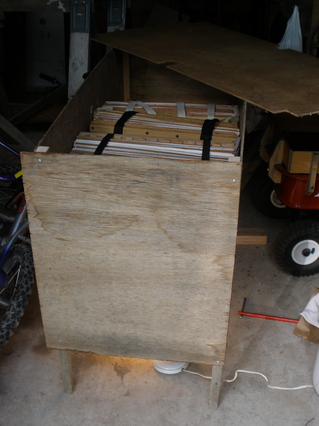
Here’s a photo of the box I built for drying plants with generously donated materials from the Wagenius family.

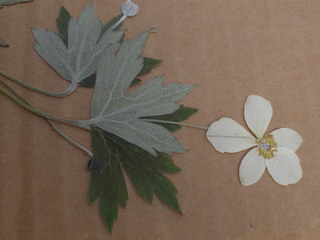
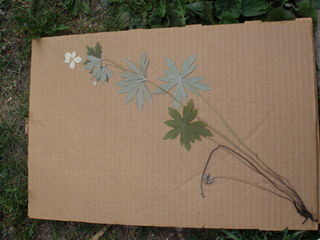
A pressed specimen of Anemone canadensis collected at Hegg Lake with Greg.

P7300576.JPG

P7300578.JPG

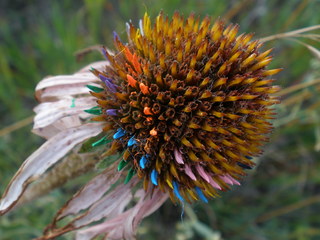
One of my painted heads after being repainted this week. Each paint color identifies a pollen treatment.

P7300584.JPG

Thanks to Mimi for letting me use her camera!

Giant Cribbage Board?

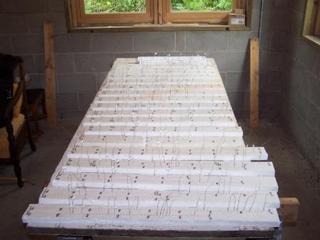
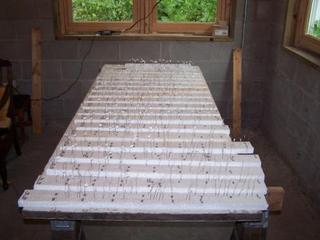
I am slowly moving up from the basement to rejoin the world at ground level. Thanks to Caroline for the labels – three sets of slides of co-flowering plants of E. ang. are complete. The pictures are waiting to appear online. Meanwhile, succession of the Hjelm house basement table (door) occurs. As a flowering plant replaces another on the prairie, Stipa spartea seeds have replaced the slides.
Can you see a difference between the pictures?
Wouldn’t you like to peg some Stipa and populate the board?
I think Someone (codename: drone or riddler) may offer a 6-pack to the person who fills the last seed in each hole of each styrofoam “board”. It would be more fun than chasing a chipmunk out of the Hjelm house.
ADCR.JPG
ADCR2.JPG

Baggins

Here is a list of the plants I used in the common garden for my experiment on pollen interference/competition. I used 20 randomly selected plants in the 96 garden with 12 pollination treatments on each plant. The heads I harvested are also included in this spreadsheet, but here they are again: 39 952 blu and wht heads were harvested on 7/24/09.

Baggins.CG.09.xls

The preliminary results seem to show that the only treatments that consistently did not shrivel were:
silver-the control, no pollinations
white-Carduus acanthoides pollen only (thistle)
pink-Coreopsis palmata pollen only

All of the treatments that received echinacea pollen (either am or pm) showed somewhat consistent shriveling…. will it hold up to the stats…. we will see!

the most interesting treatment is…..
purple-Heliopsis helianthoides pollen only- this one had a mix of results, which may be due to differences in the amount of pollen arriving on the styles or some other factor. but it certainly did not show consistent style persistence. hmmmmm…..

Just as a reminder, style shriveling indicates that compatible Echinacea pollen has arrived on a style, and can be a good predictor of seed set. Style persistence indicates that compatible pollen has not landed on a style. In the case of some of my treatments which had both Echinacea pollen and another type of pollen, shriveling may not indicate seed set. This will be tested by dissecting the heads and weighing the seeds later this year.

More results to come soon…

pollen load progress

Listen up, Echinacea fans!

I’ve now finished making slides and taking photos of the first 68 insect visitors–only 107 left to go.

Here are some photos of the process:

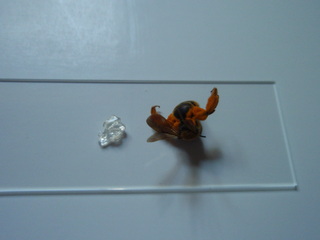
1) Here is an insect carrying LOADS of pollen (haha! get it?) which I am about to transfer onto a small agar cube on a microscope slide.
P7151455.JPG

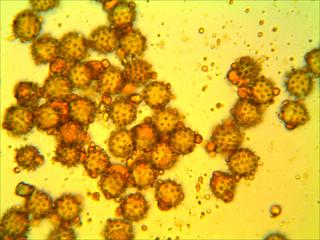
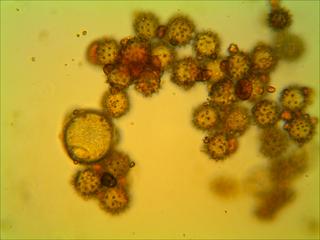
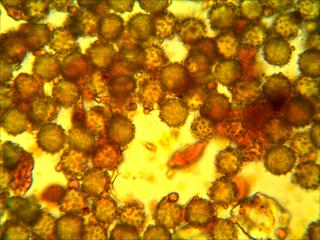
2) I heat the slide, complete with pollen-covered agar cube and cover slip, on a hotplate. Next I throw the completed, labeled slide under the microscope camera and take photos like theseYL1304N119-5b.jpg:

LS1212J124-4.jpg

LS1212J124-9b.jpg

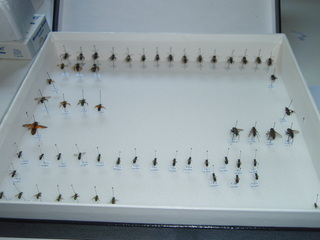
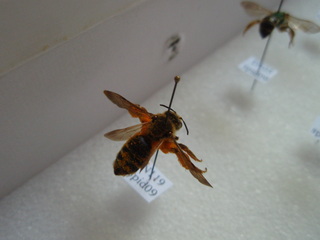
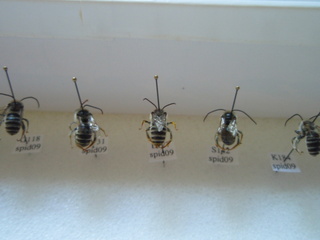
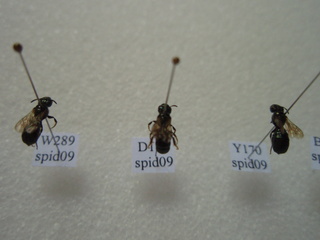
3) I’ve pinned each specimen with a unique ID code that corresponds to its vial ID number.
P7281460.JPG

P7281461.JPG

The most common genera near as I can tell from the reference collection are…

Male Melissodes sp.
P7281462.JPG

And Ceratina sp.
P7281463.JPG

Please leave questions or comments and I’ll do my best to respond!

-Amanda