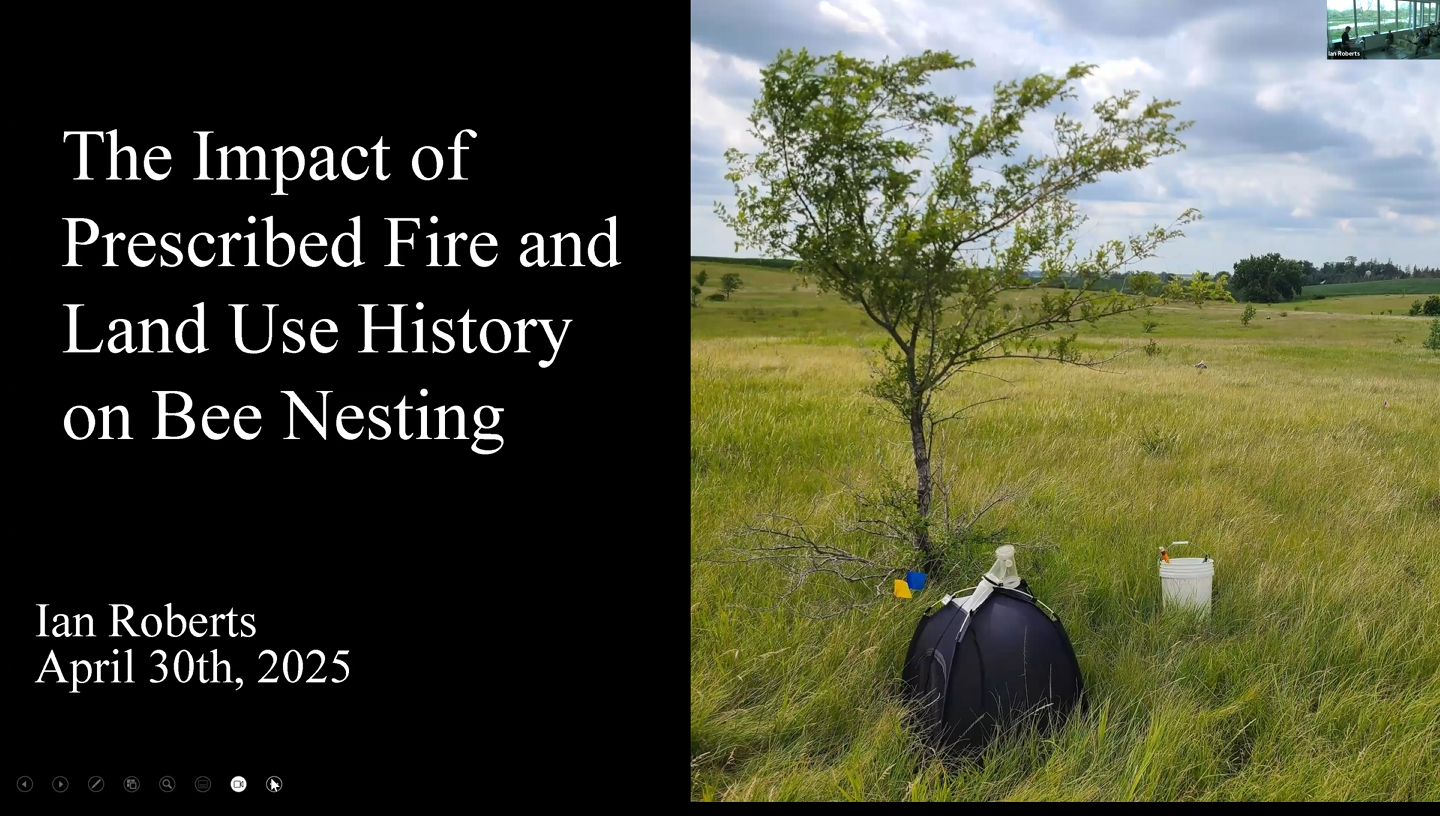
Ian Roberts presented his thesis research “Impacts of Prescribed Fire and Land Use History on Ground Nesting Bees” at the Chicago Botanic Garden on April 30th. The presentation was well received by those attendees in the room and those who attended via zoom. After the public presentation, Ian successfully defend his Masters thesis for the program in Plant Biology and Conservation at NU. Congratulations, Ian!
Ian’s research advances our understanding of ground nesting bees, prescribed fires, and nesting habitat for bees in remnant and restored tallgrass prairie. Stay tuned for a publication and recommendations for land managers!
This is part of our project “How Do Prescribed Fires Affect Native Prairie Bees?”
Funding for this project was provided by the Minnesota Environment and Natural Resources Trust Fund as recommended by the Legislative-Citizen Commission on Minnesota Resources (LCCMR).
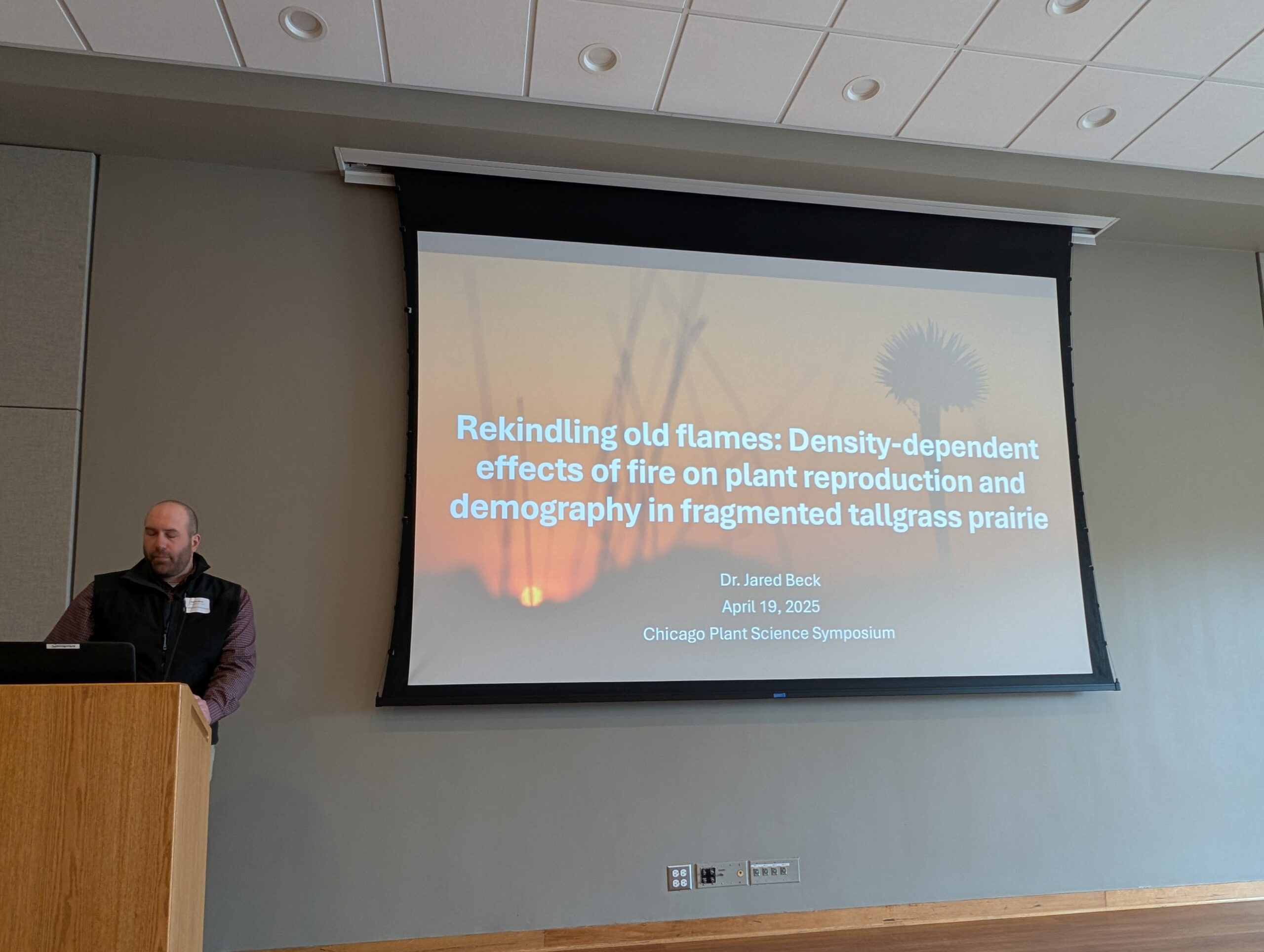
Jared gave a presentation at the Chicago Plant Science Symposium on April 19th about our big prescribed fire experiment. He focused this talk on fire effects on plant reproduction & demography.
This is part of our project “How Do Prescribed Fires Affect Native Prairie Bees?”
Funding for this project was provided by the Minnesota Environment and Natural Resources Trust Fund as recommended by the Legislative-Citizen Commission on Minnesota Resources (LCCMR).
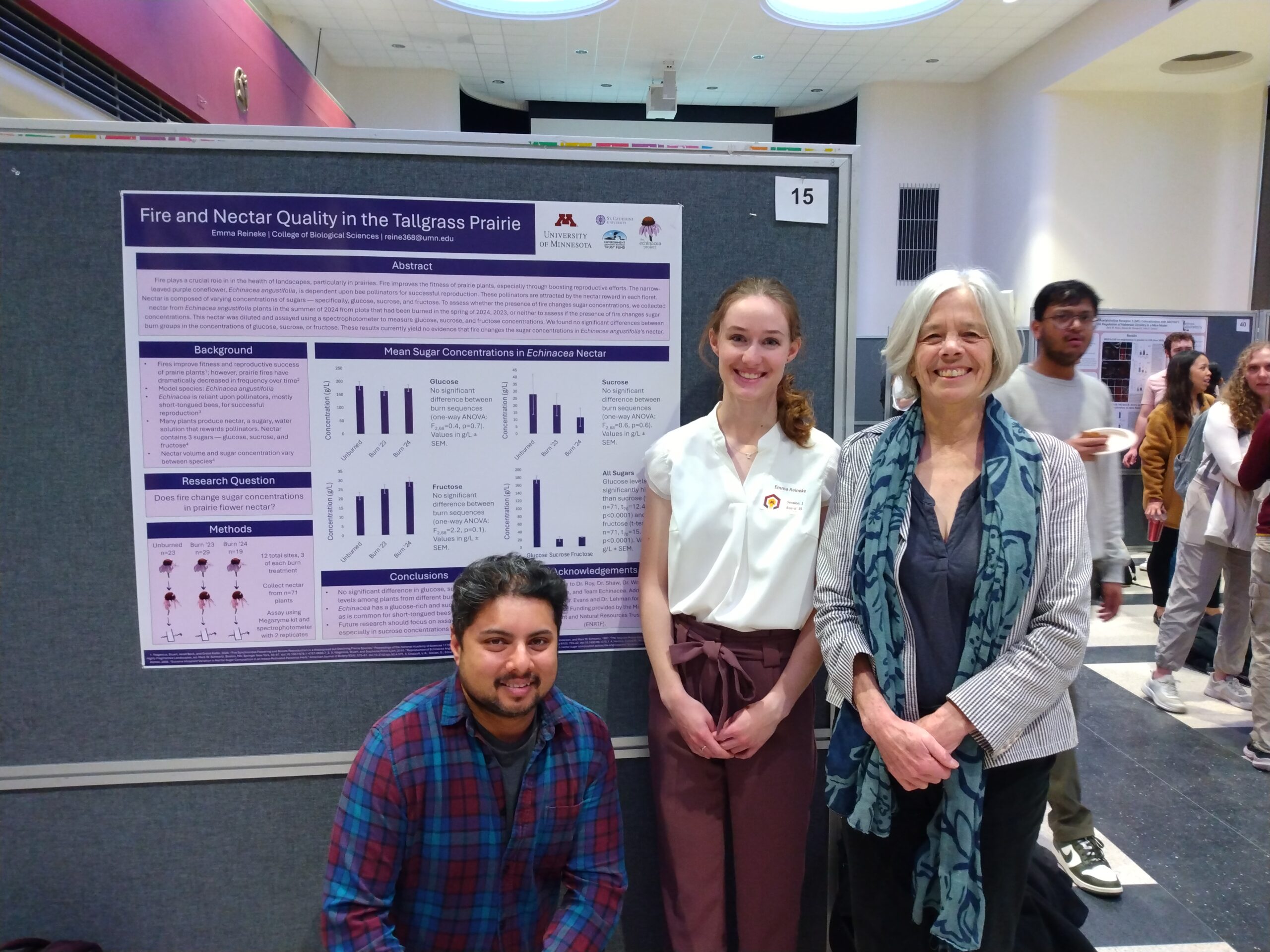
Emma presented results of her honor’s project at the poster symposium on April 15th at the U of MN. Emma assessed concentrations of several types of sugar in nectar collected from tiny florets of Echinacea plants. We are learning how prescribed fire affects sugars in nectar because nectar is an important food for pollinators, like bees. Emma worked in the lab of Dr. Rahul Roi at St Catherine University and was advised by Dr. Ruth Shaw at University of Minnesota. We are so proud of Emma!
Emma presenting her poster with Rahul & Ruth.
This is part of our project “How Do Prescribed Fires Affect Native Prairie Bees?”
Funding for this project was provided by the Minnesota Environment and Natural Resources Trust Fund as recommended by the Legislative-Citizen Commission on Minnesota Resources (LCCMR).
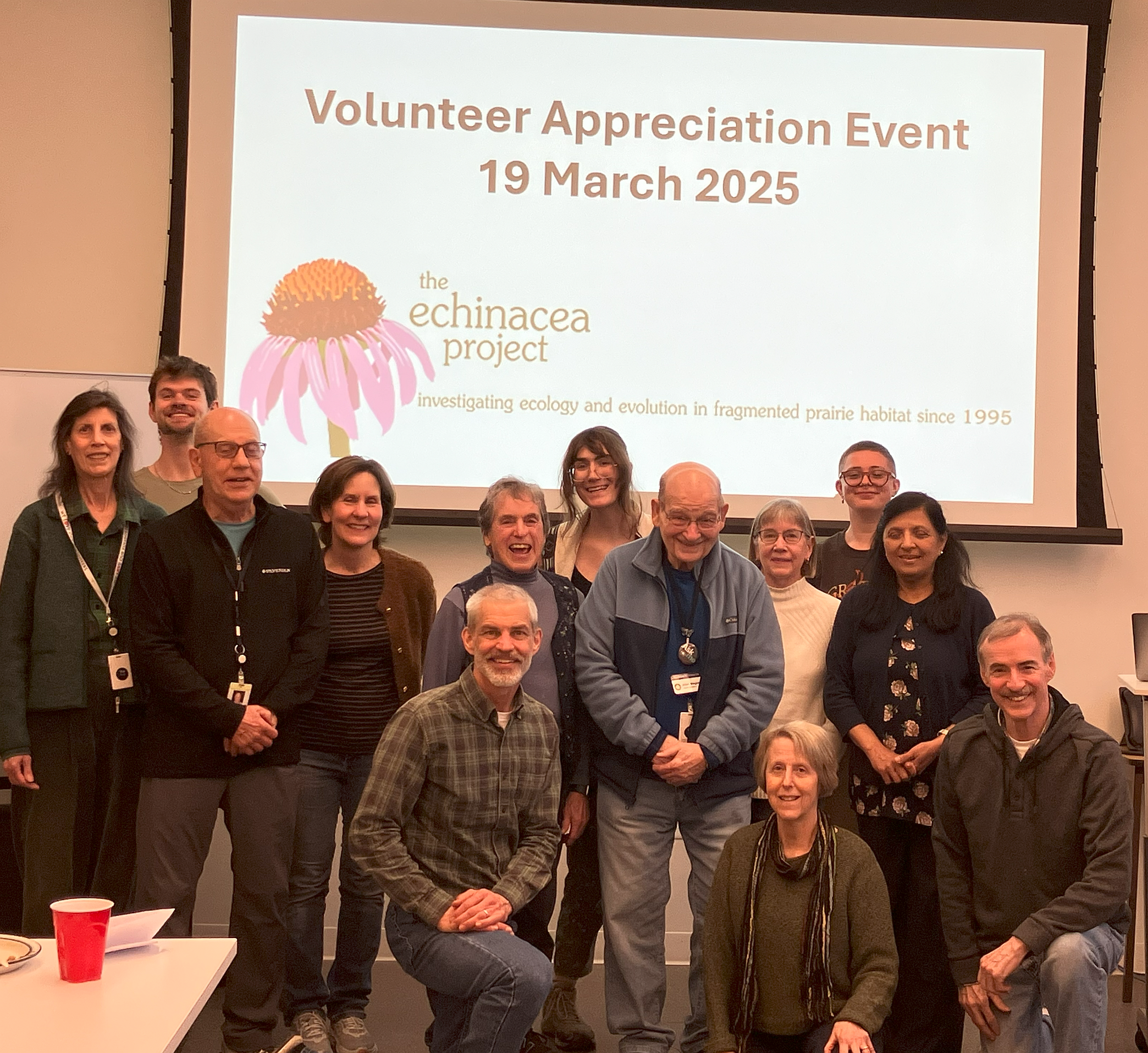
Wednesday evening (March 19) we gathered to share a meal & review many of our recent lab accomplishments. We made numerous advances in science, conservation, and education. This evening we focused on all the achenes we have been separating from heads & chaff, scanning, counting, randomizing, xraying, and classifying–all with the aim of estimating reproductive effort and success of Echinacea plants in our experimental plots and in select prairie remnants. Ian, Maddie, and Wyatt gave updates on projects they are working on.
Members of Team Echinacea went to the Stand Up For Science rally in downtown Chicago today. It was good to be in solidarity with folks who care about science, our country, and our future.
Here’s a photo of Maddie, Ian, Wyatt, and Fannie taken by Stuart. We saw Mike and Shannon at the rally. Did Team Echinacea rally in other cities?
Learn more about attacks on science and what you can do to help:
Team Echinacea includes many volunteers who help in the lab. Volunteers contribute to all steps in the ACE process to estimate reproductive effort and outcomes in Echinacea plants from experimental plots and observational studies. During 2024, our 16 volunteers devoted 2192.5 hours to the Echinacea Project! Here is a summary of hours.
initials
hours
aw2
886.0
cak
31.5
cs1
177.0
dstc
71.0
eem
7.0
jln
132.5
jrd
56.0
kja
121.5
ljb
55.0
lc2
47.0
ml
106.0
mnm
24.0
mh2
97.0
mdk
3.0
pp
98.0
scb
280.0
TOTAL
2192.5
We are very thankful for our incredible team of volunteers, the Echinacea Project would not be possible without their hard work and dedication!
We’re interested in investigating what resources are available to Echinacea visitors and learning more about the pollen and nectar Echinacea produces. We hope to learn if the nutritional resources available differ before and after burns. In 2022, Britney House developed methods for collecting nectar from Echinacea using microcapillary tubes. Read more about her methods here.
During the summer of 2024, the team collected pollen and nectar samples from Echinacea angustifolia at 12 sites in and around Solem Township, MN. We searched for and shot the ~10 plants (or, if few were available, as many as we could find) at each site that were closest to a random point. We then bagged up to five of the heads with pollinator exclusion bags for those 10 plants. Throughout the duration of their flowering, we collected pollen from all bagged plants and nectar from five of them per site.
We removed bags from pollen/nectar plants and backup plants when they were done flowering, and we collected until a a limit was set of a cumulative 10mm of nectar from each plant. This year we also collected immature florets from each bagged head at the start of sampling.
Following some experimentation, we conducted nectar collection only in the afternoons, while pollen collection could be done any time of day. In total, we collected vials of pollen, nectar, and vials containing immature florets from 60 plants. Pollen and nectar tubes were given to Rahul Roy at St. Catherine University in St. Paul, who will be doing pollen and nectar analysis. Tubes containing immature florets were sent with Grace Hirzel at North Dakota State University in Fargo, ND for pollen grain count and size analysis.
Data entry for collection datasheets is ongoing. Pollen data entry is started and nectar data is a little over half done with the help of Emma Reineke. Emma will also be using part of this dataset for her senior thesis project at the University of Minnesota.
Scans can be found at: Dropbox/teamEchinacea2024/z.pollenNectarDataEntry/scans.
Start year: 2024
Location: Various prairie remnants around Solem Township, MN
Team members involved with this project: Summer team 2024, Rahul Roy (St. Kate’s), Emma Reineke (University of Minnesota), Jarrad Pasifrika and Grace Hirzel (North Dakota State University)
Products: pending
Funding: ENRTF
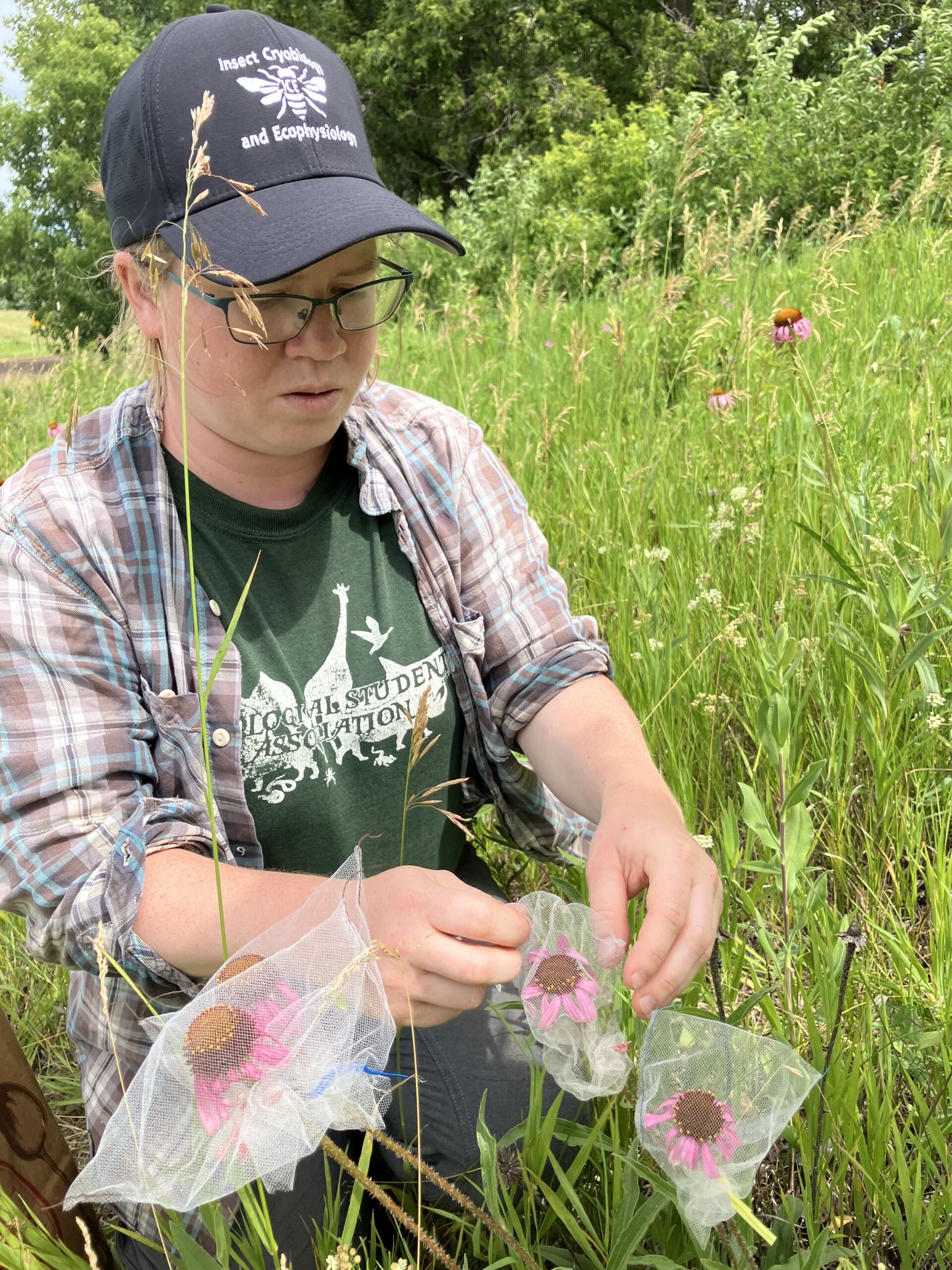
Grace Hirzel taking off a pollen excluder bag on an Echinacea angustifolia plant.
During the summer of 2024, Team Echinacea completed the second year of its ENRTF funded project to better understand how prescribed fire influences ground nesting bee habitat, food resources, and diversity. Understanding the associations between land management methods and ground nesting bees is essential for providing reccomendations to policymakers and practitioners interested in native bee conservation.
We surveyed solitary bee diversity and nesting habitat before and after prescribed fires in a subset of 30 prairie remnants and 15 prairie restorations to determine how prescribed fire affects solitary bee nesting habitat and abundance. We used emergence traps to sample the community of solitary ground nesting bees. This was complemented by detailed measures of soil and litter to characterize how prescribed burning influences the nesting habitat (read more here).
2024 REU student Zach Zarling deploys an emergence trap at a site near Hoffman, Minnesota
We deployed emergence traps at our random “burn and bee points”(BBPTs) in prairie remnants and restorations from early June to mid September. Our deployments spanned three rotations (4-6) of BBPTs and we put out a total of ~1,159 emergence traps. On reccomendation from Dr. Alex Harmon-Threatt, we also performed 10 minute “pollard walks” on deployment to estimate the number of foraging bees at each site. These foraging numbers will be compared to nesting incidence as part of Ian Roberts’ thesis project.
As of December 21st, specimens caught in this year’s deployments have been pinned, labeled, and transported from Chicago Botanic Garden to the University of Minnesota, where Zach Portman, a bee taxonomist, will identify them. Team Echinacea also collected lots of non-bee bycatch while processing specimens collected in the traps: including millipedes, flies, and even a prairie skink! To avoid wasting these specimens, we plan to categorize this bycatch into broad taxonomic groups (like Dipterans, Orthopterans, etc) and examine potential associations between our experimental treatments and general arthropod diversity across our study sites.
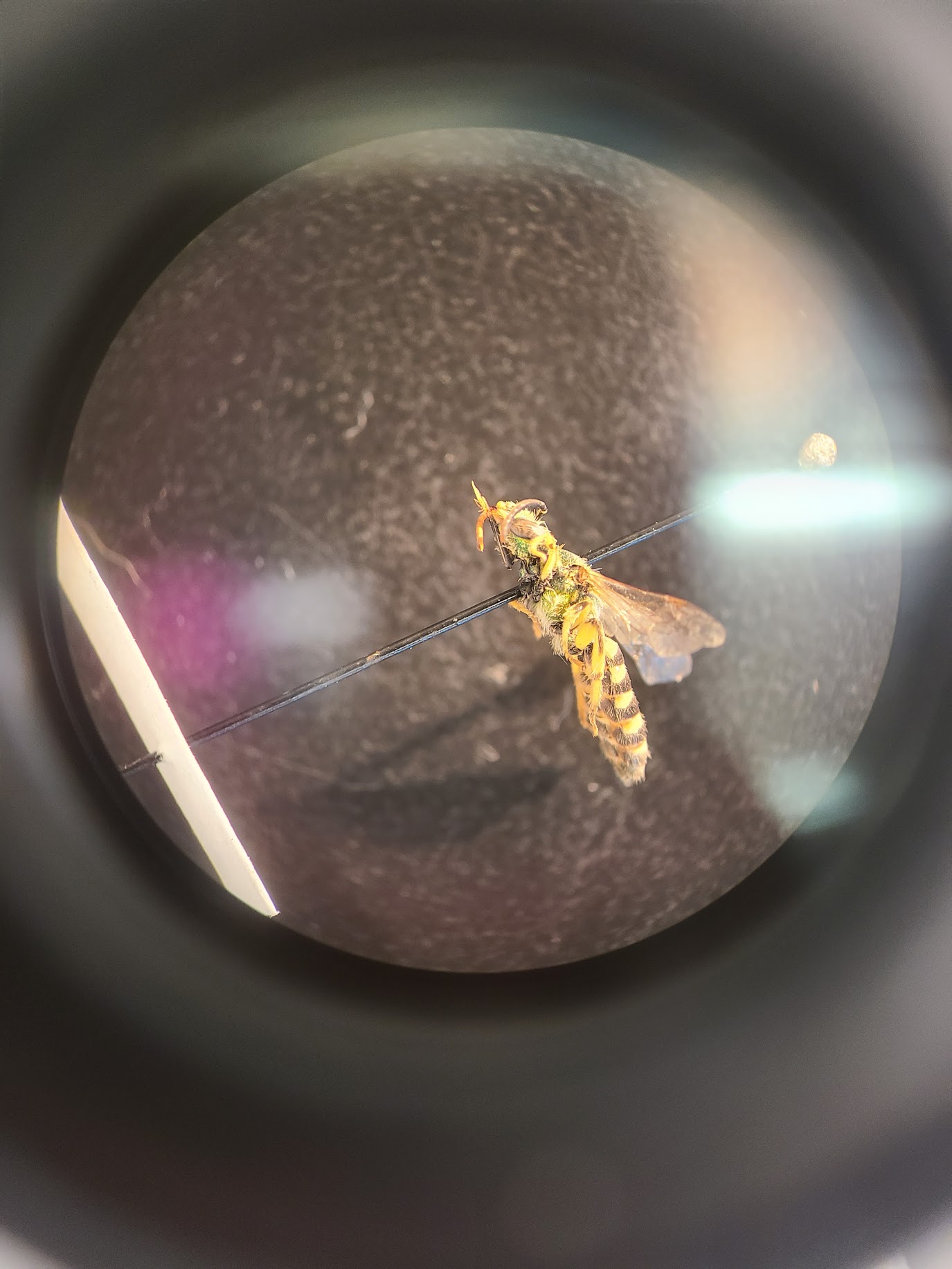
Pinned specimen from 2024’s emergence trapping, likely an Agapostemon virescens.
While working on pinning and processing specimens, Ian Roberts produced a poster containing analyses from the 2023 emergence trapping data to present at Entomology 2024. The poster can be viewed here. Future data analyses will feature data from both sampling years, as well as microhabitat measurments and and diversity indices.
Start year: 2023
Location: prairie remnants and restorations in Solem Township, MN.
Data collected: insect samples, counts of foraging bees
Samples or specimens collected: Pinned bees are currently being identified at University of Minnesota. Bycatch is in the freezer at Chicago Botanic Garden.
Products: poster presented at Entomology 2024 (see above for link)
During summer 2024, Team Echinacea continued to collect data on local environmental conditions in order to understand which environmental factors are associated with good habitat for ground-nesting bees. These data complement emergence trapping for our ENRTF funded research on fire’s influence on ground nesting bees habitats. We sampled local environmental conditions near randomly placed “burn and bee points” (BBPTs) in prairie remnants and restorations.
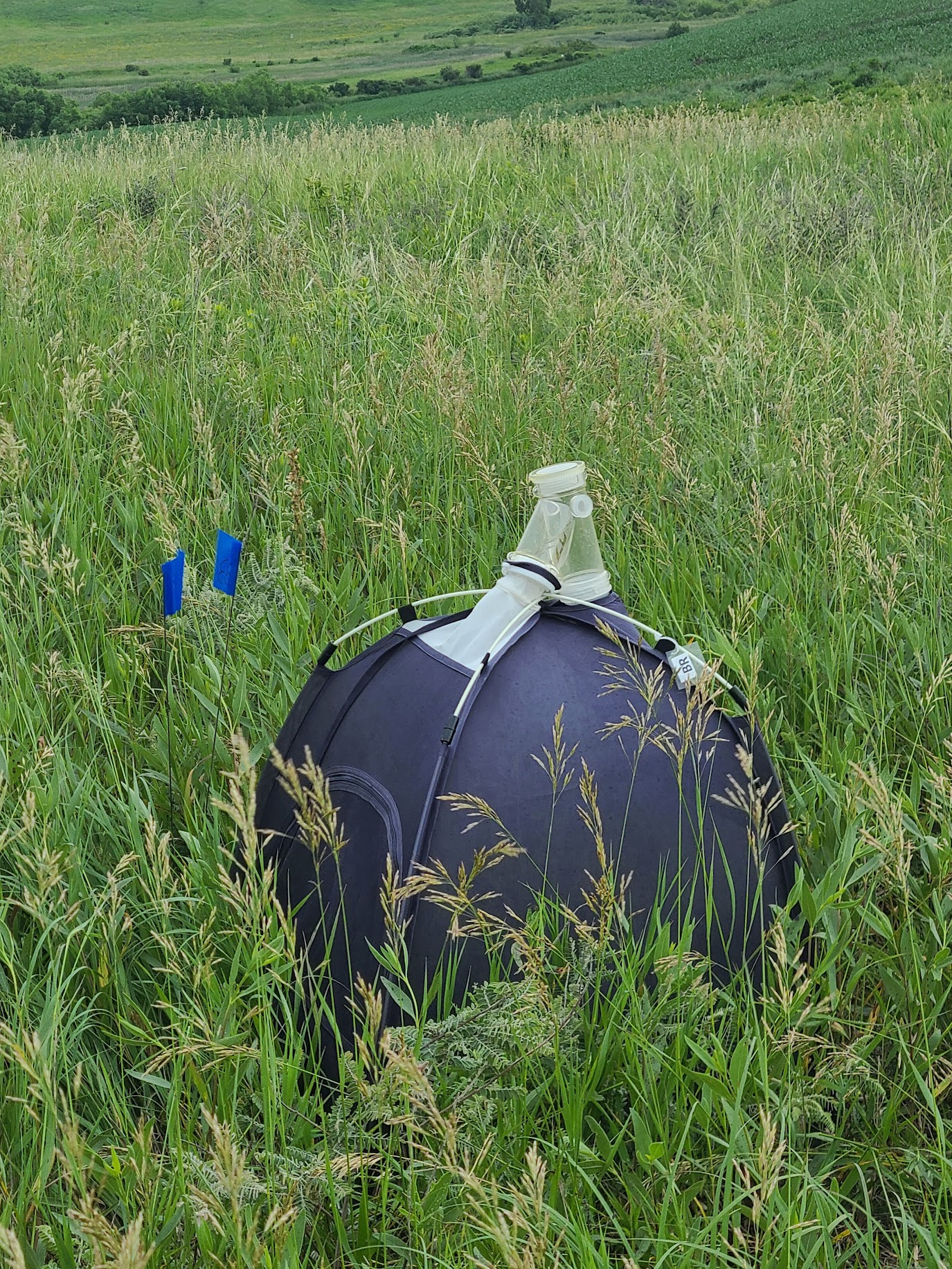
A deployed emergence trap next to a set of marking flags. Microhabitat data was sampled within a meter of these marking flags.
Unlike the 2023 season, we did not collect data on light levels at BBPTs this year. Instead, we measured soil temperature just under the surface using a digital thermometer, along with soil compaction via a penetrometer and litter depth via a meter stick.
Team Echinacea conducted microhabitat assessments for remnant prairies at rotation 4 BBPTs. Over the summer, we took microhabitat assessment measurements at a total of 241 measurments.
Start year: 2024
Location: prairie remnants and restorations in Solem Township, MN
Today we’re closing the lab for a two week break. Team Echinacea has had a fun and productive year. We worked really hard in the lab and it’s time to take a well-deserved vacation.
We made great strides in the lab this past year quantifying annual reproductive fitness of plants from many experiments, mostly Echinacea angustifolia–the narrow-leaved coneflower. We estimate fruit counts and seed counts in hundreds of heads we harvest each year using the ACE protocol: cleaning heads, rechecking heads, scanning fruits, counting fruits, taking random samples, x-raying samples of fruits, and classifying radiographs. We were way behind because the lab was closed during the pandemic. We are catching up. In the past two months we moved all heads harvested from one experiment in Sept 2024 all the way through counting all fruits of each head three times. We have a really great data set.
Thank you to the volunteers who contributed so much to our science and conservation endeavors. Thank you, everybody. Enjoy your vacation–you deserve it. I look forward to working with everyone in 2025!