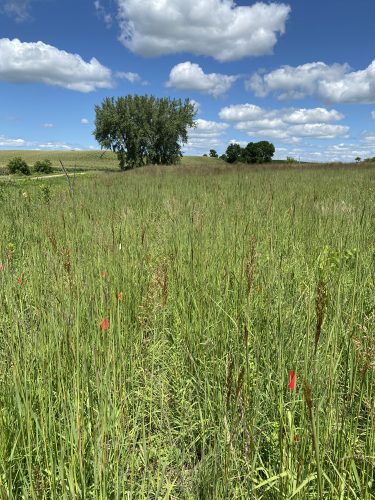
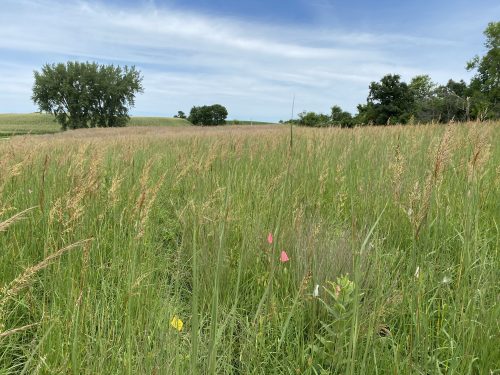
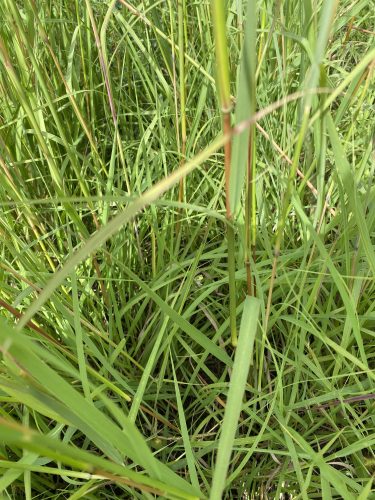
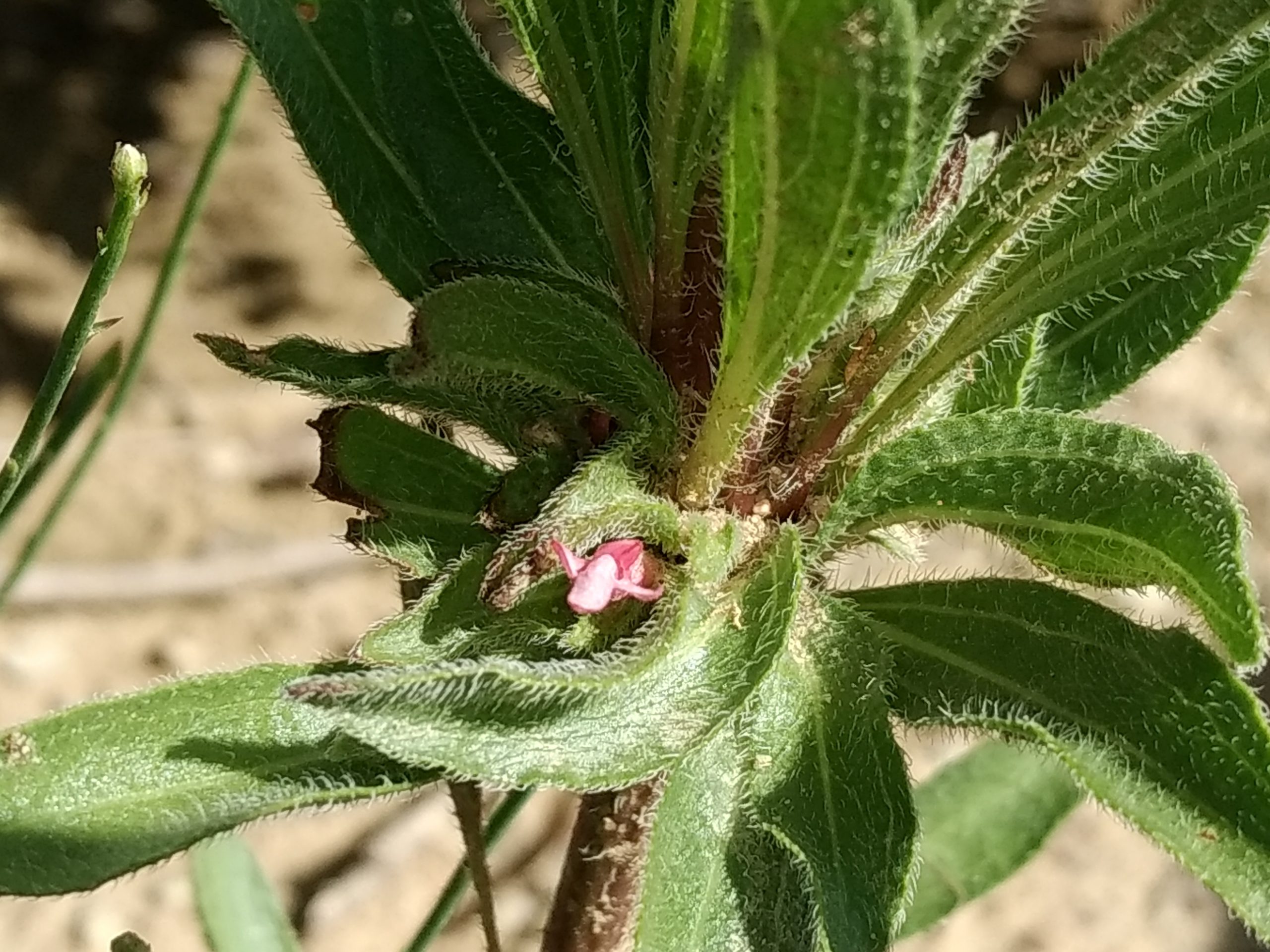
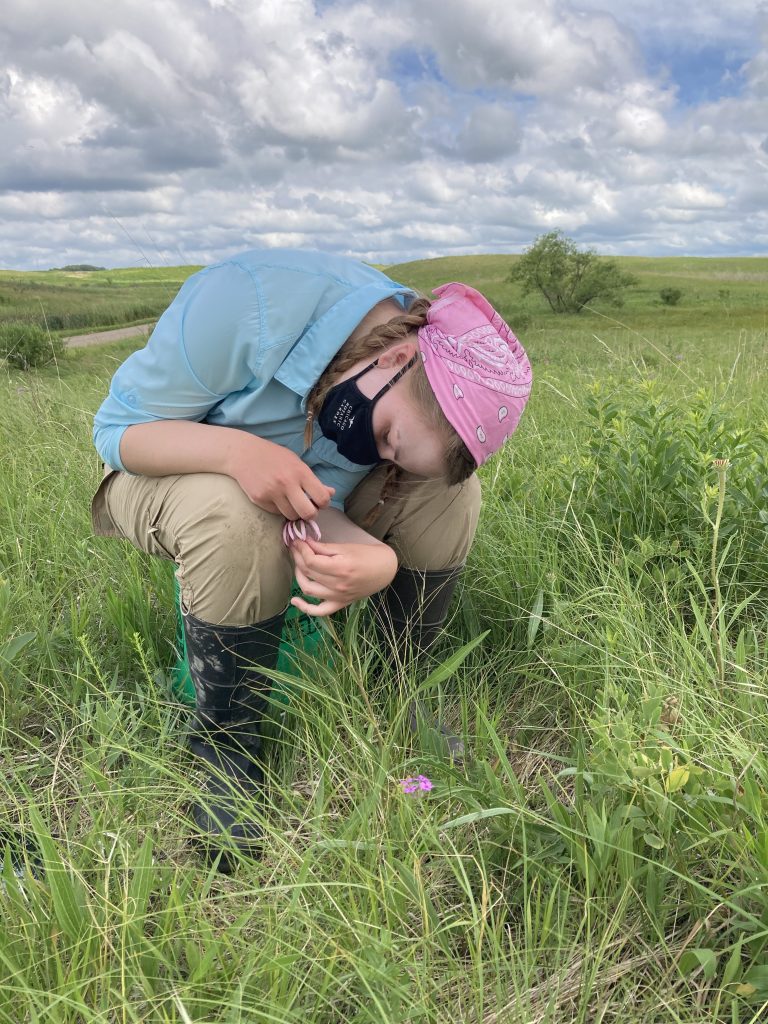
Sporobolus heterolepis, or prairie dropseed. I included some Sporobolus seedheads in my independent project sampling this morning at Staffanson, and I appreciated seeing a grass that I hadn’t much since last summer. Last summer I learned that S. heterolepis provides good habitat for the endangered Dakota Skipper butterfly, along with other mid-height grasses like Schizachyrium scoparium (heart eyes). It grows in bunches, has many long, thin leaves, and has nice airy seedheads. I’m glad I got to reacquaint myself with an old friend on the prairie! Staffanson is always good for that, and for introducing me to new ones.
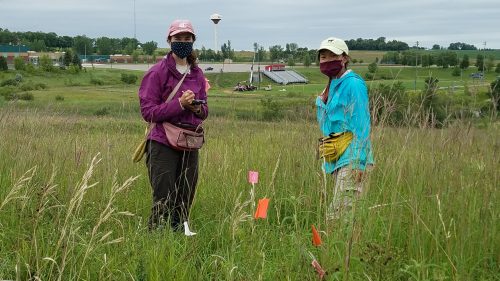
I was having some GPS troubles yesterday and this morning, but it turns out it was operator error (to borrow a phrase from my high school ski coach), and I owe it to Lea for helping me figure out what I was doing wrong. Now that I know I need to make sure the GPS is set up to read Ax and Ly coordinates in the same order as they’re set up in my stake file, I don’t think I’ll make that mistake again. Frustrating but a lesson learned and I’m glad there are people willing to help.
After a good morning working on my project, I hung out with John in P1 to harvest some more heads. We had a good time I thought, and we saw a pretty wild looking bug that I did not recognize!! Since I’m not taking an entomology class this fall I don’t know if I ever will…this is going to bother me, I can tell. The tall Sorghastrum nutans grass in P1 was swaying in the wind, creating an effect similar to seasickness as I walked through it. P1 harvest round 2 is almost done, but I couldn’t help thinking about Mia taking it on again next week, possibly solo…
All in all it was a pretty good Monday; it was nice that Stuart was back and shout out to Anna M. for passing her drivers test today!
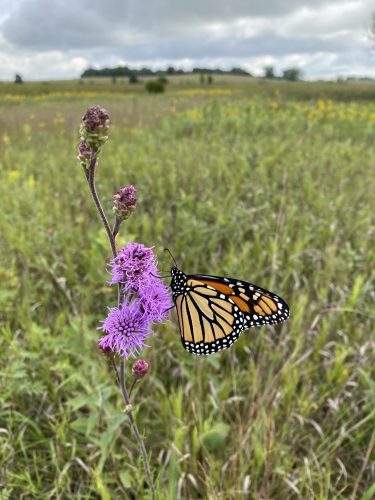
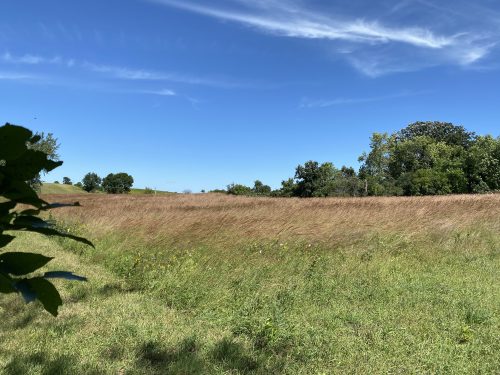
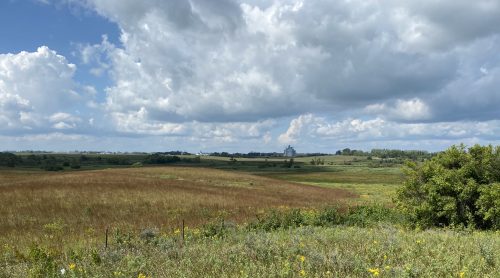
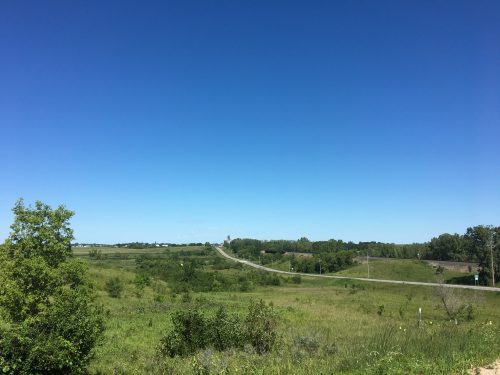
Monarch on a Liatris aspera (rough blazing star) at RKW, a small site near Kensington that I did demo at on Friday! Getting to the site involved threading the needle between a pond and a patch of trees but it was worth it for all the cool things I saw back there (including the biggest patch of Schiz I’ve ever seen!).Made me think of the Grass Sea the Dothraki ride in from Game of Thrones 🙂The view from Yellow Orchid Hill on Friday––how about that red hill of Sorgh!
It’s my zen moment of the day, my flog update. This week has been tiring, to be honest. The GPS is back up and running, which has been a huge positive, since it’s important for Sling, demo, and my project. I had a good time starting to train Mia in on demo, she will be a pro in no time. Mia, Anna, and I visited some “obscure” sites for the demo training trip this week, including No Tag/No Pla City aka Randt, and the recruit sites near Kensington. I hope I have enough time to go back to Kensington Recruit-W before I leave––it looks like rainboots and some bushwhacking will be necessary but I relish the idea!
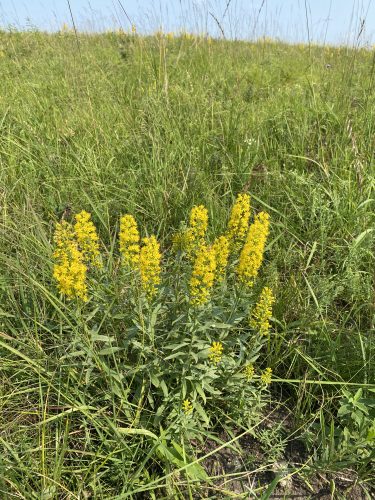
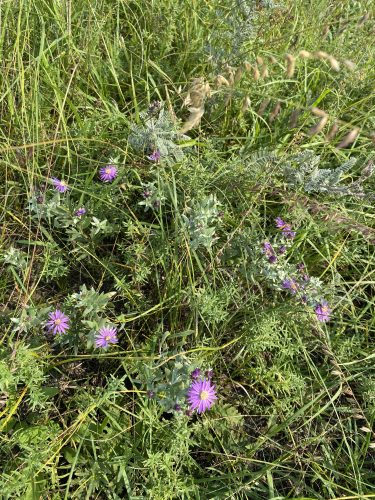
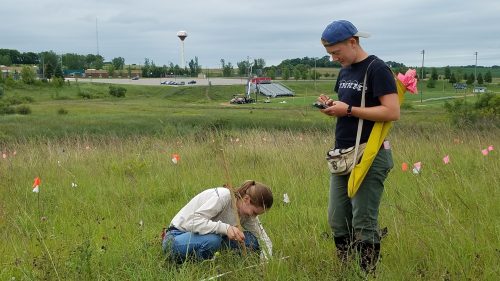
Besides that, I’ve been glad to spend some time on my independent project this week. I have about 20 more sling circles with surviving seedlings to survey this week, and my work will be cut out for me next week to finish data collection on the “seedlings dead” half of my sample. I’m collecting microhabitat data, including plant community composition and flowering plant community, within a 1-m radius of sling circles to see if there are differences in microhabitat between sling circles with living and dead seedlings. I’ve learned a lot of new plants that I’ve seen flowering, which is rewarding to me! Jared introduced me to some asters when he was here a few weeks ago, Symphyotrichum ericoides and laeve. I’ve also worked on learning the ins and outs of a rogue’s gallery of goldenrods, including Solidago rigida, canadensis, nemoralis, and speciosa. It’s great to be adding on to the plant species knowledge I gained last summer!
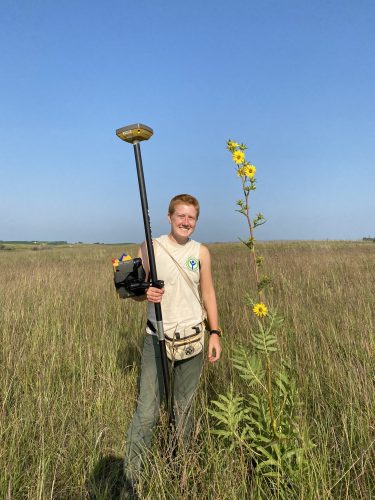
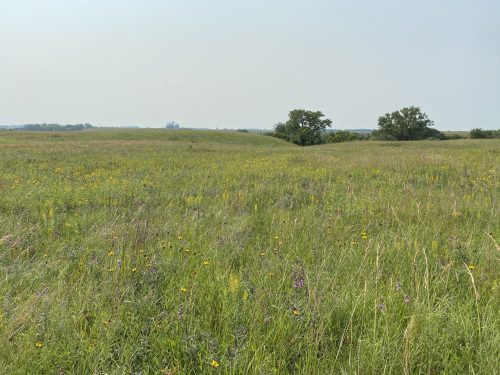
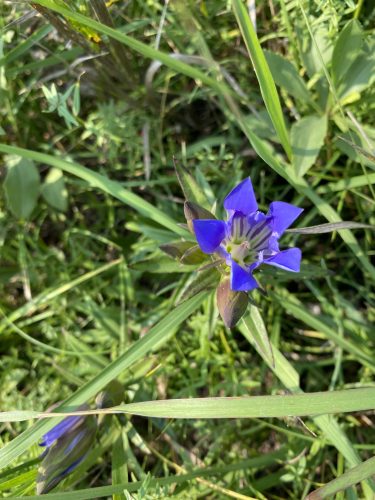
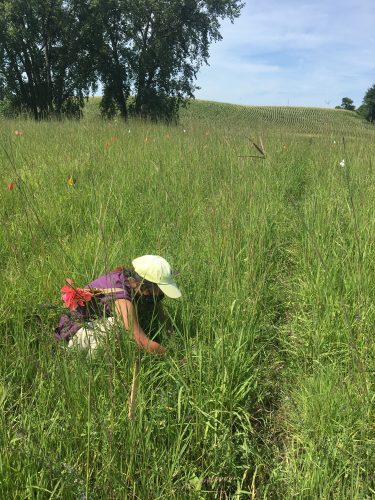
The Hegg restoration’s tallest compass plant! And its tallest GPSThe trek into Staffanson West unit really took it out of me but it was so worth it! So diverse it looks like photoshopOne of the rogues––Solidago speciosa. I like its upright flower stalksLea’s favorite––silky aster!Downy gentian, Gentiana puberulenta. I was taken aback (in a good way) by its bright color! Thanks for the show, Staffanson
This is my first weekend Flog—so it’s a good thing I did something kind of interesting this weekend! After work on Friday I drove out of the storm and into the sunny and windy far western Minnesota evening. I camped for the weekend at Big Stone Lake State Park, right on the MN-SD border. The lake makes up part of the curve of that bump that sticks out of the central west edge of the state, and I could see South Dakota from my campsite.
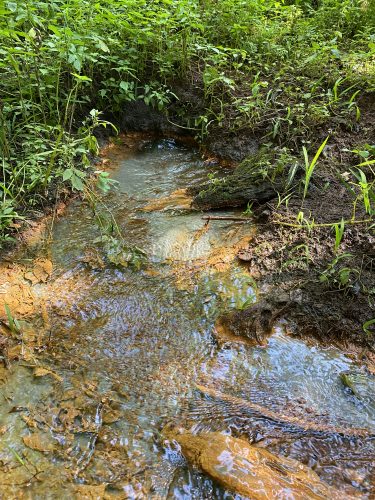
It doesn’t beat the Boundary Waters but it was a nice change of pace for the weekend. I enjoyed spending time by myself, reading, running a little, and exploring the state park some. The park’s north unit, the “Bonanza area” (Even Cowgirls Get the Blues, anyone?), has some prairie restorations on dry, gravelly hills, and some treed areas near the lake. Not to sound like late-1700s Quaker explorer and botanist William Bartram, but I saw about 40 leopard frogs on one beach and estimated a frog density of 10 per square meter at some parts in the woods! The best thing I saw in the woods there was a spring/groundwater seep with clear, cold water coming out and running in a little stream to the lake. The spring and streambeds were full of reddish buildup, indicating the presence of iron-oxidizing bacteria, just like I learned about in a paleobiology class a few years ago! Sadly, the clear spring water was too good for the green, nutrient-loaded Big Stone Lake.
Some of the prairie-type areas I saw had lots of native grasses and plants, while others were more weedy, invaded by brome, woody plants, and some thistles—including one plant that towered over my head, yikes! I have always rolled my eyes at the Aldo Leopoldo quote about the ecologist seeing “a world of wounds,” thinking that I still appreciated invaded areas as preferable to concrete, but to my dismay this trip I found myself looking with a disappointed eye at the less healthy and diverse prairie sites I saw. This was probably bound to happen at some point the more time I spend in prairie ecosystems and thinking about their health and vigor, but I did not think I was going to become that person! I guess it’s a good reminder that opinions aren’t set in stone and to make space for yourself and others to learn and change!
I did learn from a knowledgeable woman who worked for the park that the mass of aquatic plant matter by the swimming beach was made up of mostly native species, so that’s something anyway.
Iron spring––note the red buildup!Nice evening at the campsite. I finished my book!
Hi Flog! The week is going by fast, and we did some interesting things today in spite of a rainy start to the morning.
I’ll start off with some Grass Corner announcements––two cool P1 updates. The native grasses there continue to take off, with the tallest Andropogon gerardii stem measured this week maxing out the meterstick at 2.02 m! Not to be outdone, the Sorghastrum nutans flowering heads are pretty radiant this week, getting tall and showy in their half of P1. If you ever come across one, try and touch it––they’re very soft.
P1 last Monday (8/3/20)P1 this Tuesday (8/11/20). A major surge in S. nutans!
This morning Allie and I tackled demo at KJ’s, our second-to-last “annual sample” demo site, meaning it should be one of our last bigger ones. We’ve made so much progress and I’m excited to see where we are with it in another week and a half!
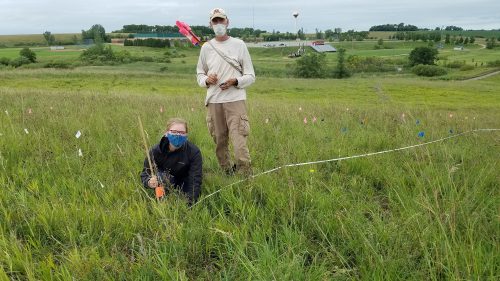
We had some fun and thought-provoking ABT’s and progress updates on summer projects at lunch, which was a nice chance to check in with how things are going for everyone and to practice explaining my own project. The big afternoon project was a whole-team measuring visit to P10, a set of experimental plots by the WCA high school that John uses for teaching his high school classes (sounds like an awesome teacher!!). The difference between plots that had been burned and not was stark, with immense, productive Andro in the burned plots rising feet above the neighboring vegetation. The Echinacea plants here were not as vigorous, though, since they were only planted a few years ago. Their small size made for some quick measuring when we could find them! Hopefully the high school students will think of some interesting ways to take advantage of such a cool resource.
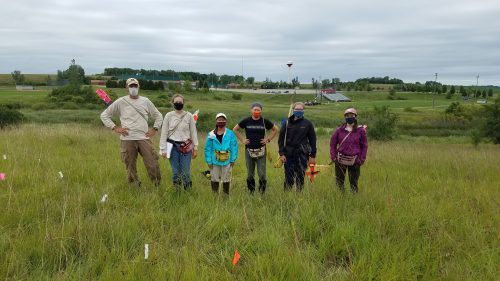
Anna and John finishing a rowAllie and Amy, smiling behind their masks Mia and Emma, staged photo 😉A team of prairie measuring pros!
And it would be wrong not to leave you with, as promised, the frog on the flog. I saw this tree frog clambering through P1 yesterday, just a little baby!
Aww! Can you spot him?
That’s it for now––goodnight moon, goodnight grass, goodnight flog.
Today was a solid day’s work with a small crew––we worked on phenology, demo, and P1 measuring, mostly. Everything went smoothly overall––there’s lots of P1 to go, but flowering is really on its last legs which makes for diminished phenology personnel needs. This meant I got to go and use the GPS (“Darwin” to close friends) and work with Allie and Anna M. on demo at Railroad Crossing! We shot 112 points in about 2-2.5 hours, and there were minimal technical difficulties which was a relief since GPS guru Erin is off to greener (NCSU) pastures! I’m looking forward to continuing to work on some other big sites with people the rest of this week. Thankful for a reliable and hardworking team in the face of adversity!
Found a couple new plants at Loeffler’s Corner today…these surprise Echinacea stragglers to the flowering party keep me young!Master measurer Allie kicking butt and finding staples in P1 last week. Shoutout to her for coming in clutch to help Anna and I finish our row at the end of the day today!
This morning started with brisk remnant phenology routes for the team—flowering is winding down, so things go more quickly with phenology by the day as more plants shift to being done flowering. In the afternoon everyone worked on independent projects, which included a fruitless search for aphids (and by “fruitless,” I mean aphidless), some pollen collection in P1, and reading up on plant community monitoring methods.
We ended the workday with a Zoom call where we heard from Scott, a former Echinacea Project team member and current grad student at UC Boulder, and current team members Drake and Devon. Scott gave a practice presentation for a talk he’s giving at the North American Congress for Conservation Biology later in the week about fire and survival, reproduction, and recruitment in small Echinacea populations. The conference is for a conservation and land management audience, which I thought was really cool—I’m always excited when I see science and management coming together because collaboration between these two “sides” is critical to effectively caring for the planet, and is really interesting to me!
Devon gave a cool update on her project, which involves investigating the probability of Echinacea seedlings occurring at varying distances from maternal plants (“dispersal kernel” was the new phrase I learned today). Amy Dykstra, a researcher who’s been a leader with the Echinacea Project on the Sling project Devon’s analyzing data from, made a good point that if maternal plants’ stalks tend to falls over, where their seedheads land might determine the distance of many seedlings from that plant. I really liked Devon’s visualizations of her preliminary findings and I’m looking forward to seeing more!
Drake’s update was good news—the transplanting into P1 stage of his project is finished, and the parasitic plants Pedicularis canadensis and Comandraumbellata are doing okay in their new common garden locations. The overall goal is to determine if these parasites are keystone species in prairies. Among other types of data collection, it sounds like there could be some clipping and sorting of biomass in Drake’s (or someone’s, maybe an extern’s?) future!
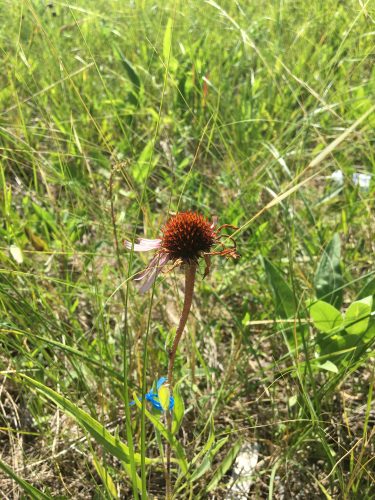
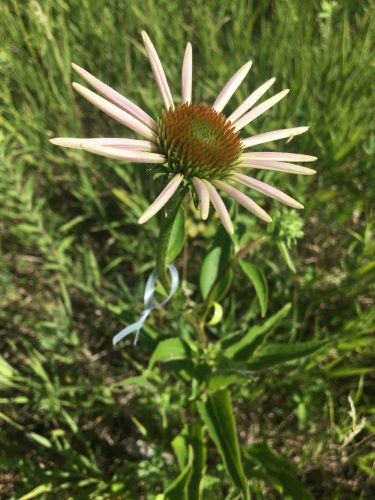
The withered state of many Echinacea angustifolia that are done floweringThis Echinacea purpurea sighted at Yellow Orchid Hill on the other hand is only at the “rays spreading” stage. Its and leaves (and phenology this year) are very distinct from those of Echinacea angustifolia!
This week we began gearing up for staked demo, where we use Darwin to search locations in the remnants where mature Echinacea have been found in the past. The team has tackled lots of flowering demo this summer, but now it’s time to take on new challenges like no tag no pl and equivloc records.
Anna M. and Emma contemplate the maps and scenery at EELR
Emma and I were challenged in a different way when we found this monstrosity of a plant at South of Golf Course. It’s newly flowering this year, though we kind of wish it wasn’t, since its bushy leaves and rogue “armpit tooth” florets are uncomfortable to behold. It seems to have a cousin at Loeffler’s Corner with a similarly demented growth habit.
Fearful asymmetry
After all the lake excitement on Friday afternoon, we had a comparatively quiet Saturday. Gooseberry is in town, so Allie and I took her for a walk to the park where she drank puddles and sniffed everything within reach. In return, Goose kept me company as I worked on reconciling demap.
In the evening we enjoyed takeout from Mi Mexico and a rousing discussion of what the world would be like if society was reorganized into five sects, each with their own physical limitations, like having clams for hands or being perpetually confined to an Olive Garden. Goose did not contribute much to the discussion but did partake in some heavy belly rubbing action.
Hey star children, last night Amy, Allie and I adventured out at 11PM to check out NEOWISE, the once-every-6000-years comet currently zooming within naked eye spotting distance of the Earth. Out here in the field we have the advantages of few trees and limited light pollution to aid in spectacular views of NEOWISE! The comet is visible in the northwest sky, under the Big Dipper. Here are the resources we used to plan our trip– we found them super useful and we learned a lot about amateur astronomy!
The Clear Dark Sky website houses clear sky charts which include forecasts for weather, darkness and other factors influencing celestial body visibility.
The Clear Dark Sky website also has a light pollution overlay that you can use to determine areas of high light pollution to avoid during stargazing. You can adjust this in the map view of all clear sky charts in an area using the light pollution slider just over the map. Check out how dark the intersection of 27 and 54 is, 10 miles west of Hoffman– that’s where we went last night!
We also used Stellarium to determine when and where the comet would appear over the horizon.
I wanted to make a post detailing my experiment this summer with hybrid Echinacea plants at Hegg Lake. As a student, it was my goal to design, execute, and analyze an experiment with Team Echinacea this summer. Because I’m interested in genetics, I wanted to create something that would connect inheritance with population control among Echinacea. With the help of some seasoned Team Echinacea members (Riley T and Mia S), I was able to construct an experiment that would study the reproduction potential of hybrid Echinacea, crossed between E. angustifolia and E. pallida.
In the history of experimental plot 7, two Echinacea plants have flowered. Most recently, a hybrid Echinacea flowered this spring. This allowed us to cross the hybrid’s pollen with a variety of E. angustifolia and E. pallida in the Hegg Lake area. In order to assess reproduction potential, styles were painted, pollinated, and later observed to look for shriveling. Although styles may shrivel for a variety of reasons, shriveling usually indicates reproduction. In the winter, we will assess the seed-set of these individuals to determine reproductive fitness.
When new species from non-prairie remnants are introduced to new areas, the risk of hybridization among plants of the same genus arises. E. pallida, which has shown to out-compete E. angustifolia in our experimental plots, therefore has the ability to pass on its genes through hybrids. If hybrids are able to reproduce, and continue to pass on E. pallida genes, the risks of genetic swamping increase. Therefore, over time, hybridization could eventually exterminate E. angustifolia from its native prairie.
A picture of me painting bracts for our hybrid crosses. Photo credit to Mia S!
In order to assess reproduction, we hand-crossed a variety of sample pollen with E. angustifolia, E. pallida, and hybrid Echinacea. In this experiment, a shriveled style is a sign of successful reproduction. Because Echinacea plants are not self-compatible, the reasons for a style not to shrivel could vary. Reasons could be that the hybrid was not compatible with this type of Echinacea, or because the specific Echinacea plants were incompatible due to inheritance patterns.
An example of hand-crosses from Shona Sanford-Long, 2012
Our sample size was also effected because only one hybrid Echinacea flowered this summer. In the end, we cross-pollinated our hybrid plant with three E. angustifolia plants, and three E. pallida plants. If more hybrids flower in the future, we will be able to expand our sample size and cross variety. For this reason, we hope to continue this experiment in the following summers if hybrids continue to flower.
Overall, we saw that hybrids were more compatible with E. angustifolia rather than E. pallida. While hybrid reproduction passes on E. pallida genes, a greater chance of reproduction with E. angustifolia keeps native genes (and hopefully, native traits) in the prairie gene pool.
In the future, I will share more updates as we continue to analyze and reassess the data.
Thanks for joining me on this exciting, new experiment!
Friday morning was a delayed start so that the orchid trip team could try to catch up on sleep and get the visors synced and ready to go for the day. Erin and I had an even more delayed start after we locked ourselves out of the Hoff House while putting on sunscreen in the morning. Luckily, Erin had her phone, so we radioed the rest of the Hoffman House who had already left and Amy came to let us in. If Erin didn’t have her phone, it would have been a long walk to Hjelm with no shoes.
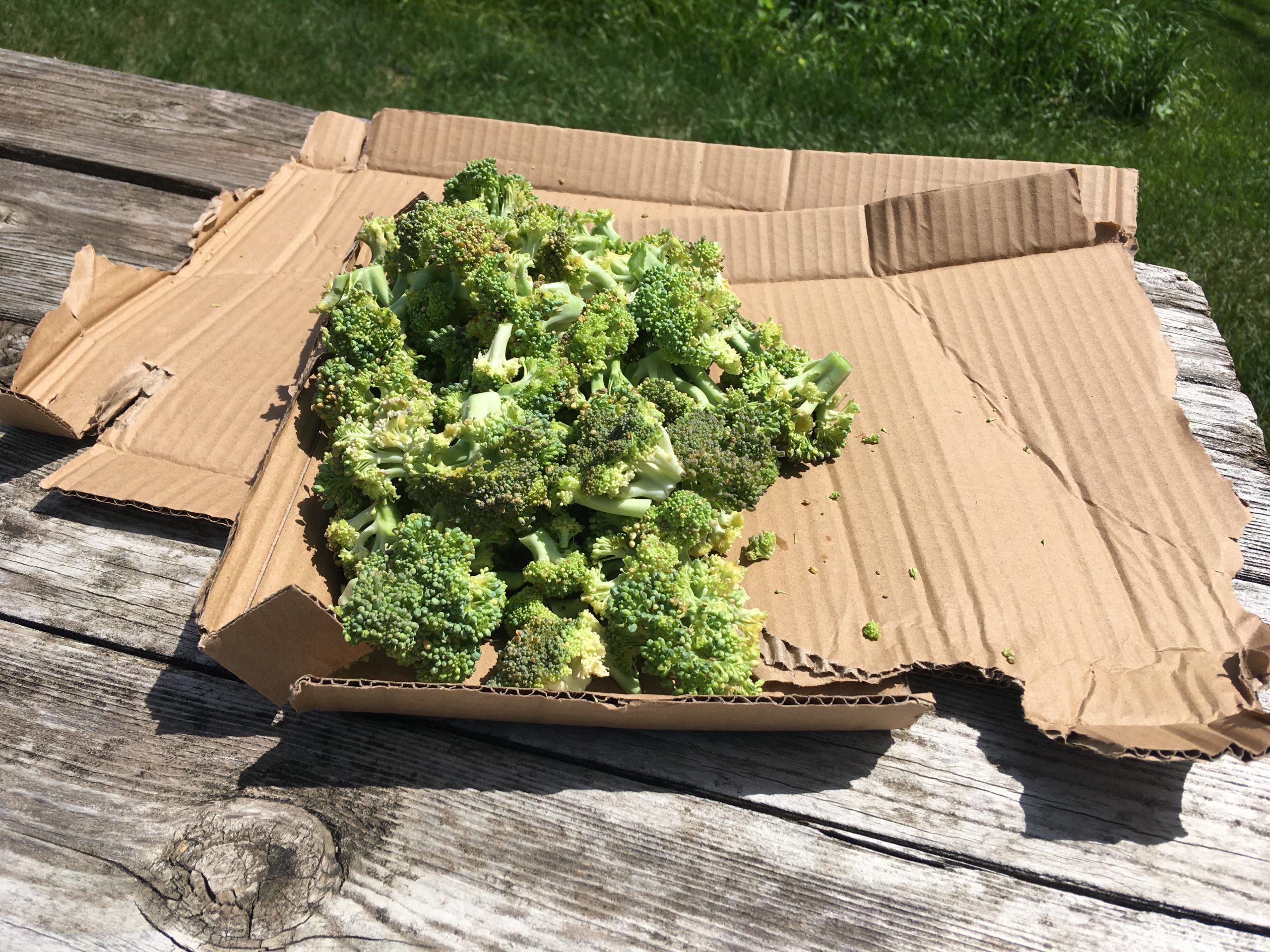
We spent the morning in the prairie remnants taking phenology. Many flowers are now reaching end flowering. John and Anna M. were gifted some broccoli during the morning, which we had for lunch.
Fresh broccoli for the team
In the afternoon, everyone scattered to do various projects. John and I headed to Staffanson to collect pollen for Amy. We visited about half the plants before we had to head back for a Zoom meeting.
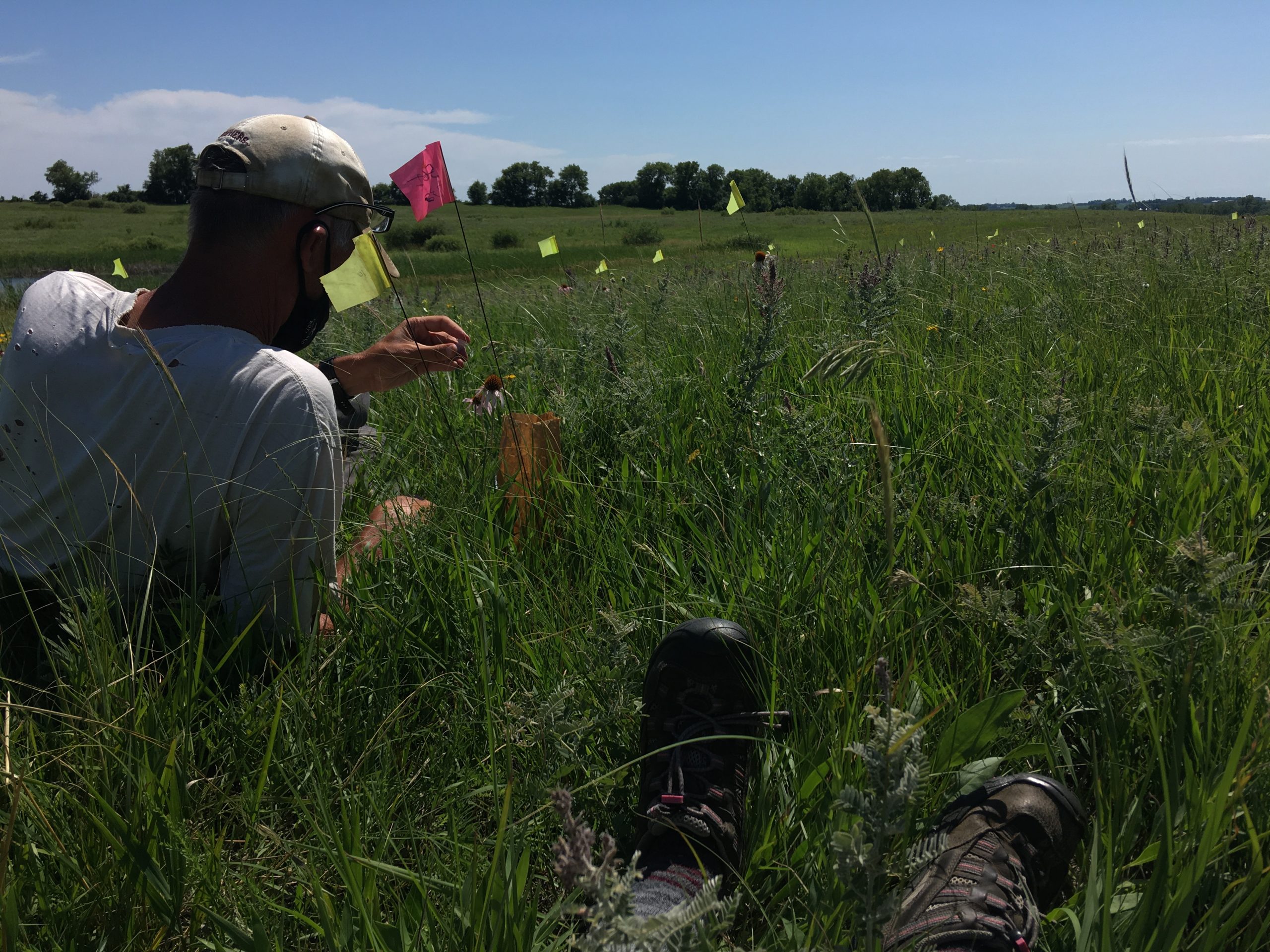
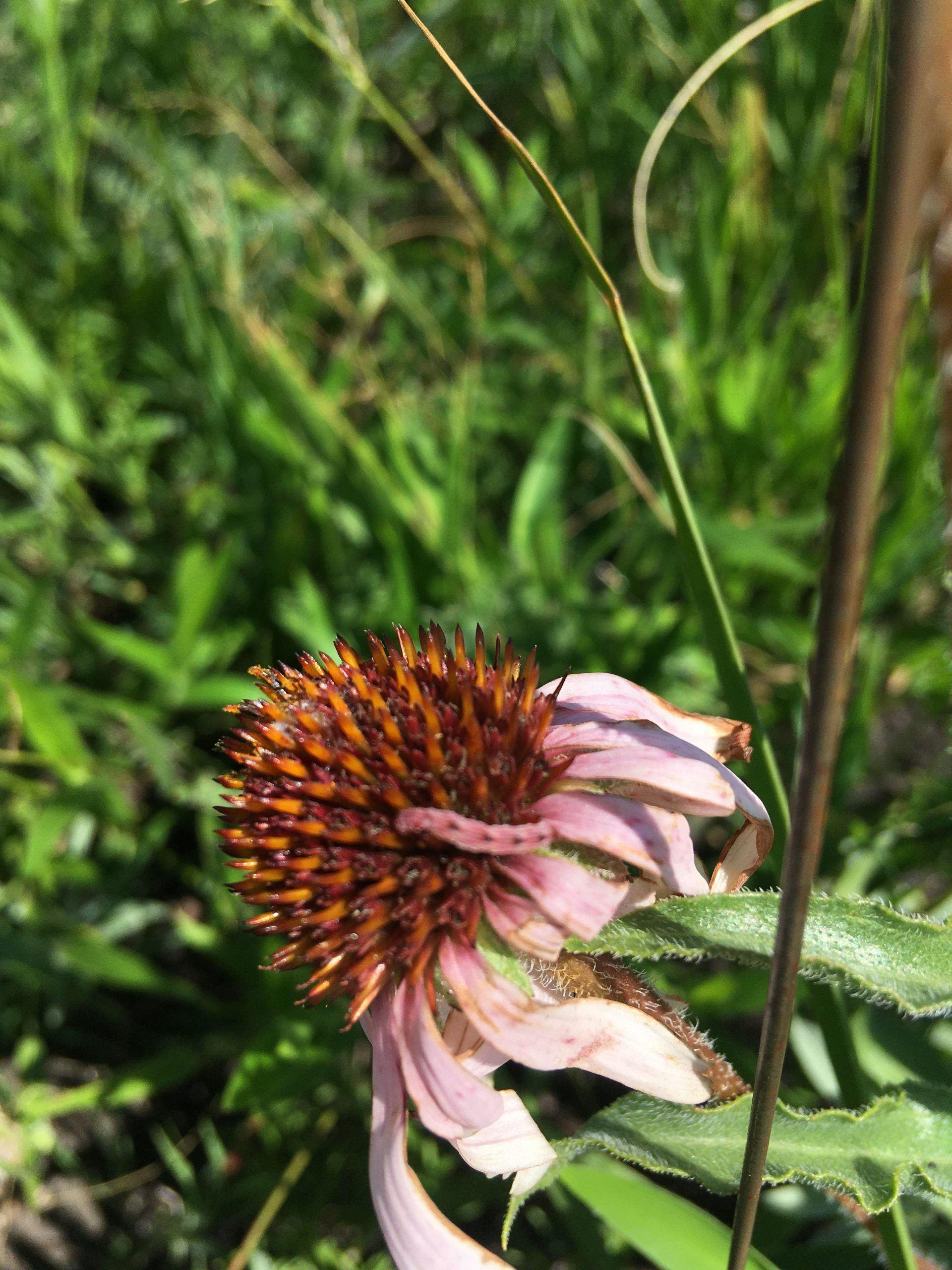
John and I collecting pollenAn Echinacea head with a tiny pink inchworm
We heard from Anna M. and Devon about their projects for this year. Kristen, a former team member, also gave a presentation on the project she did while she was here in 2018.