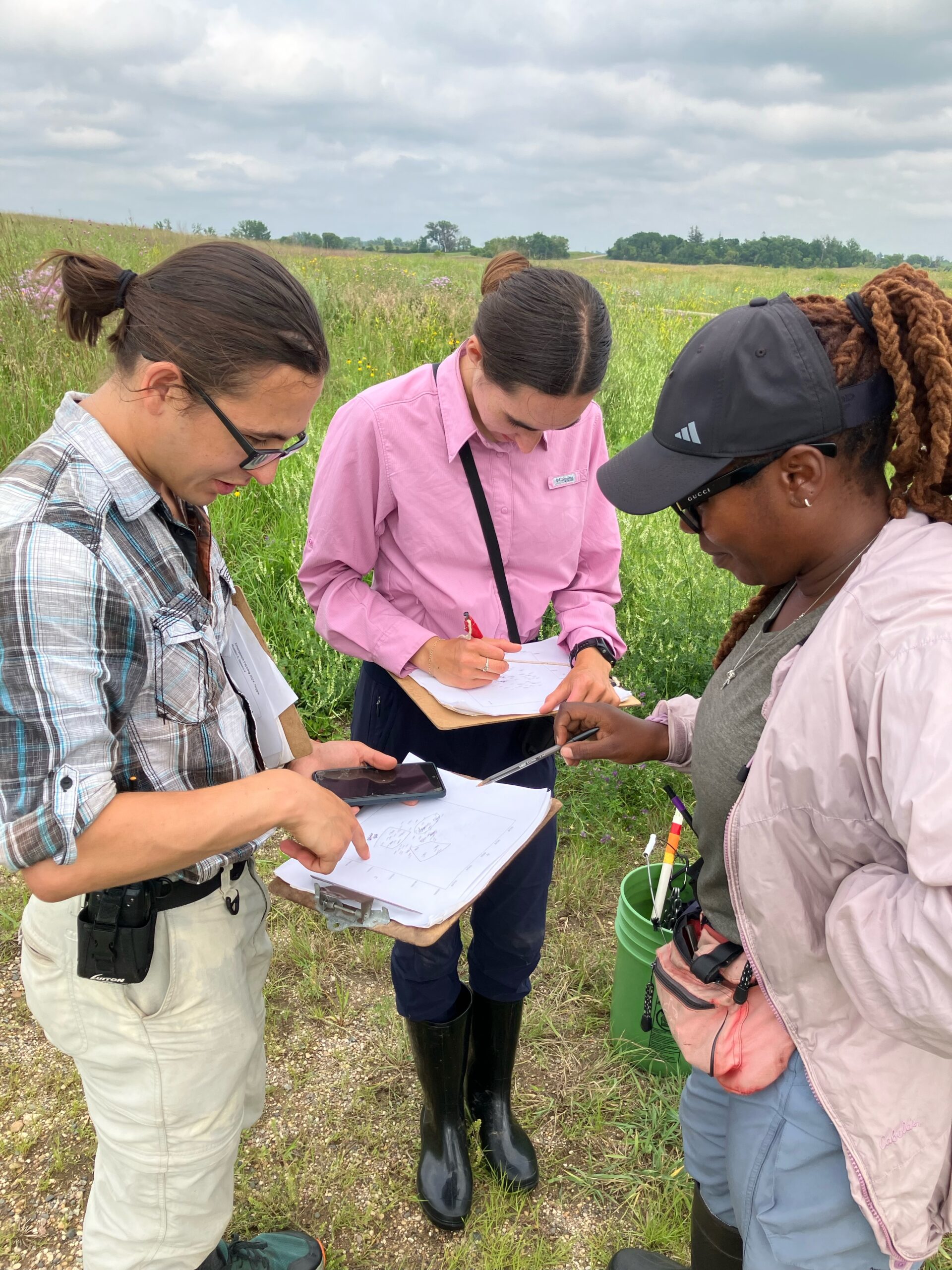
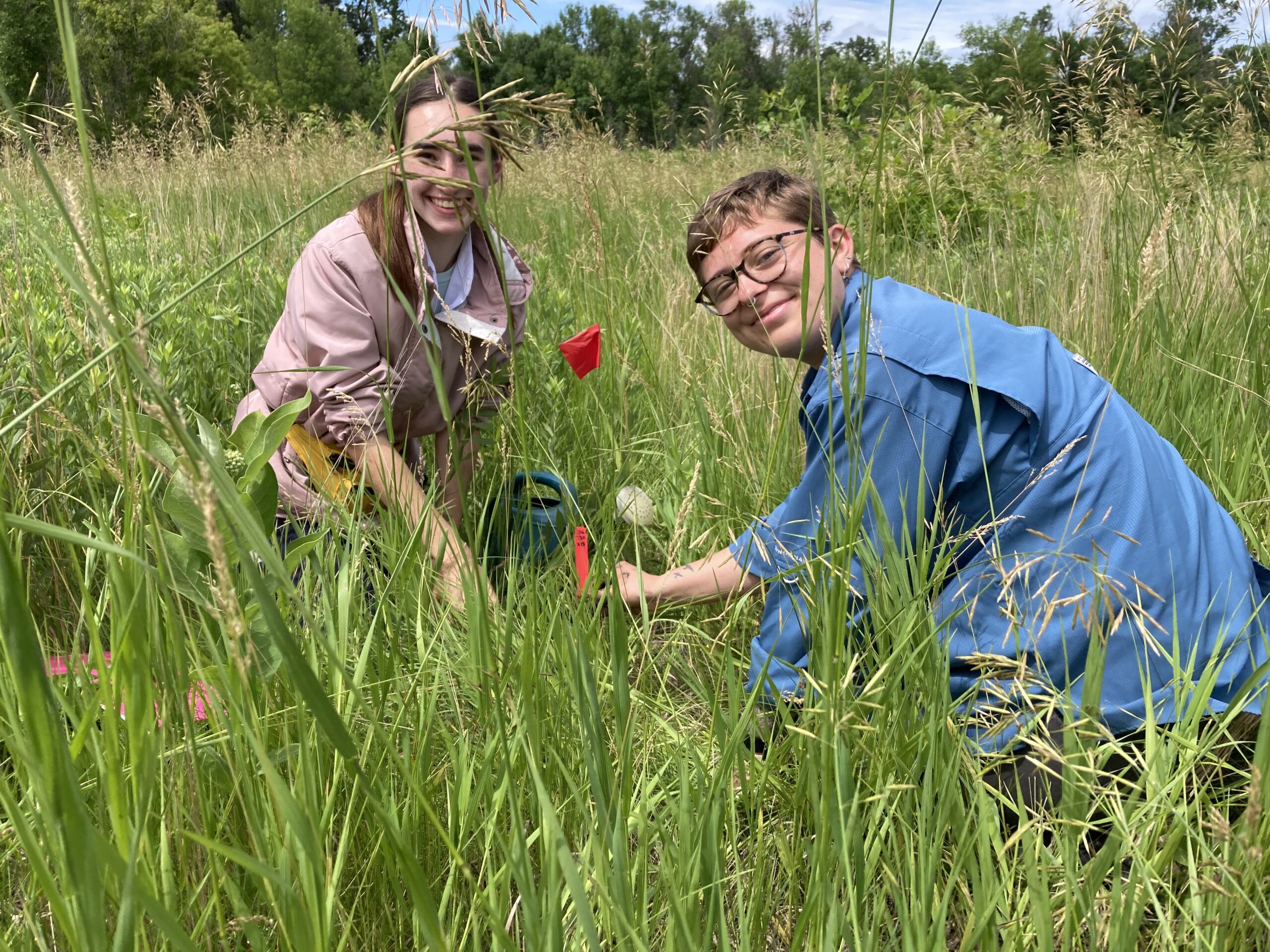
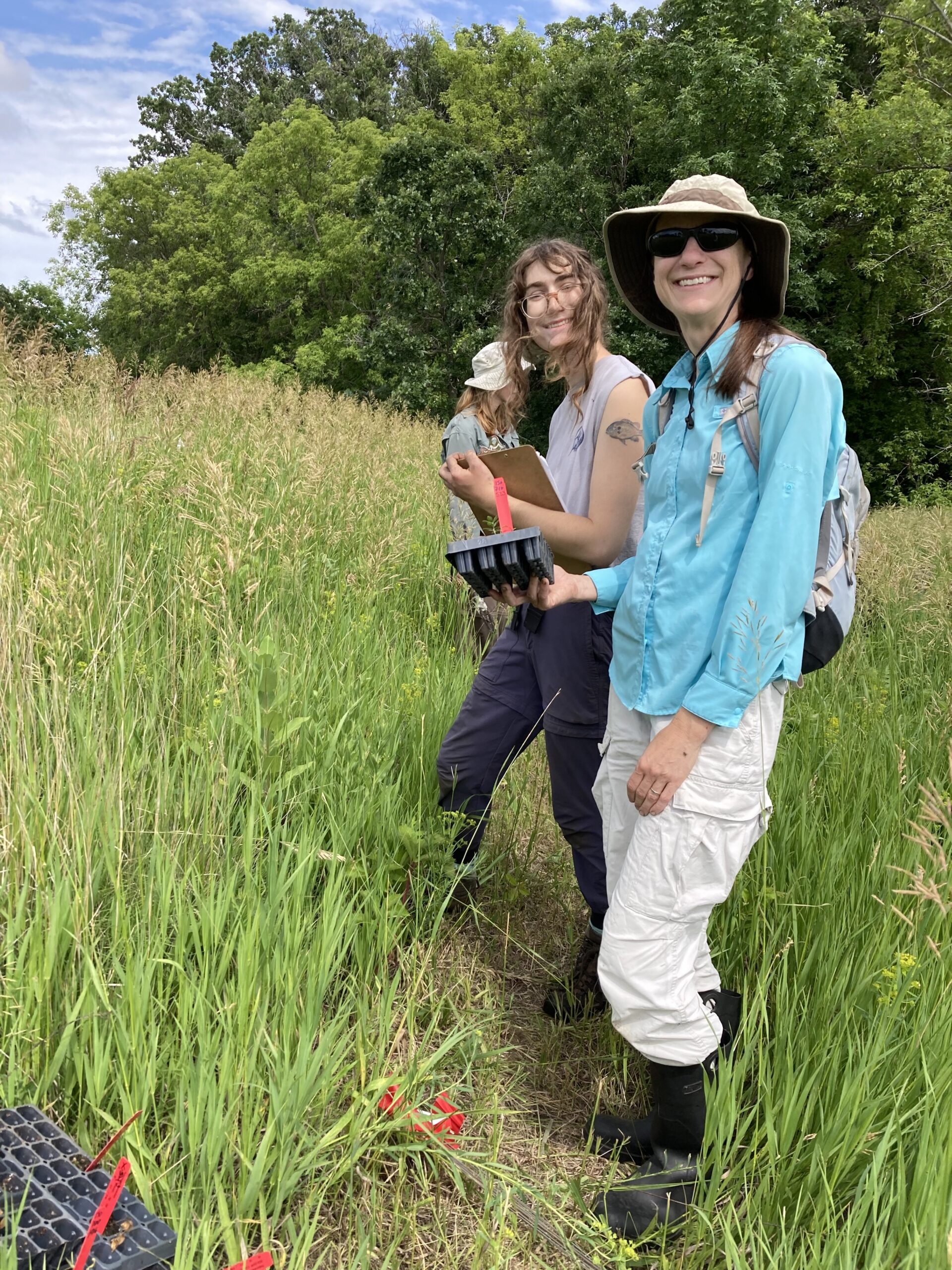
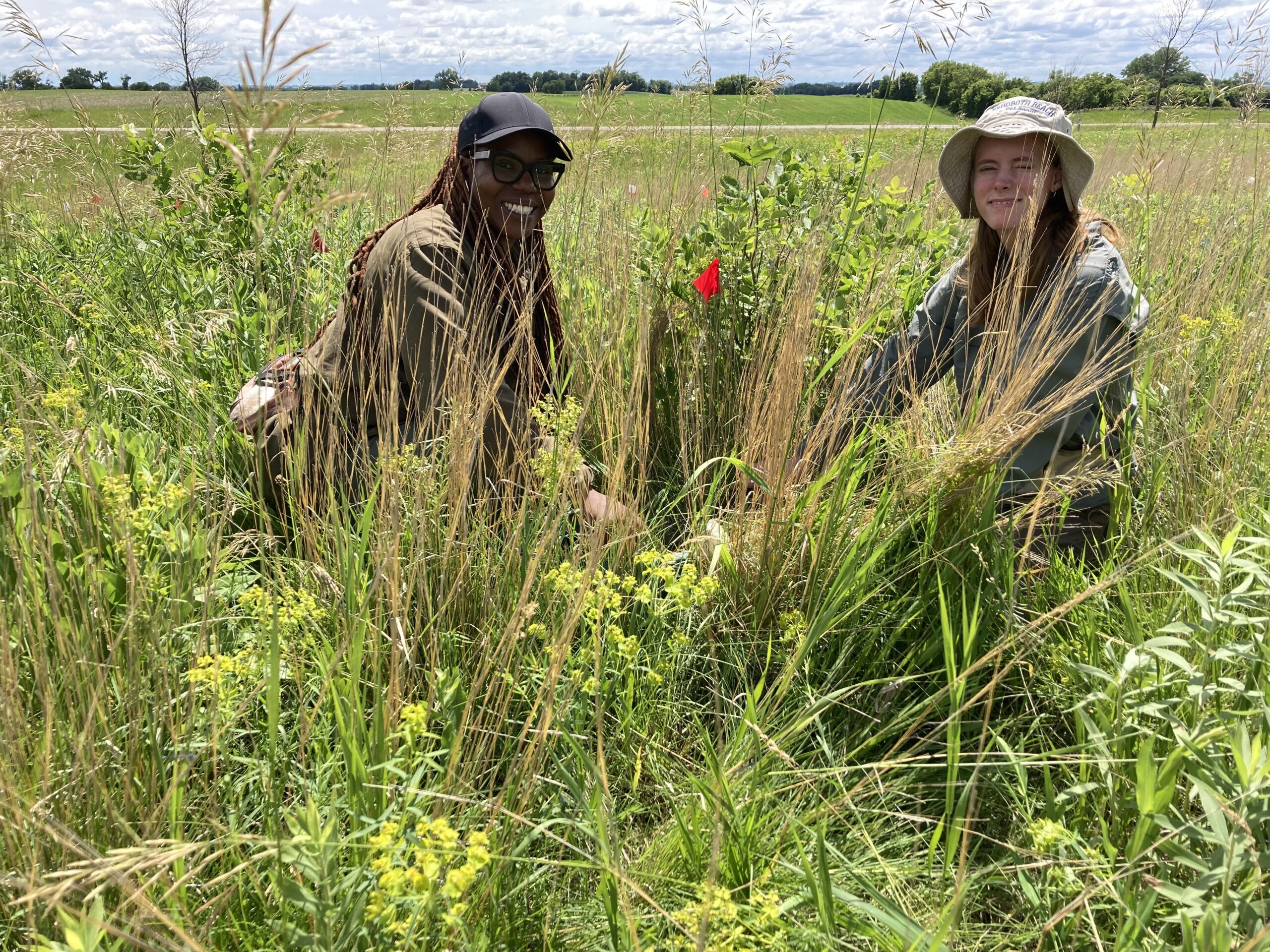
Total demo has commenced! Team Echinacea began to assess demography of flowering and non flowering Echinacea today!
We started at tower, a site with a rich demographic history. We payed special attention to tag 9301- a plant first tagged in 1996. Many members of Team Echinacea have met this plant before. Including me last year. This year, 9301 is basal and has 4 rosettes. I hope it has many more fruitful summers in store.
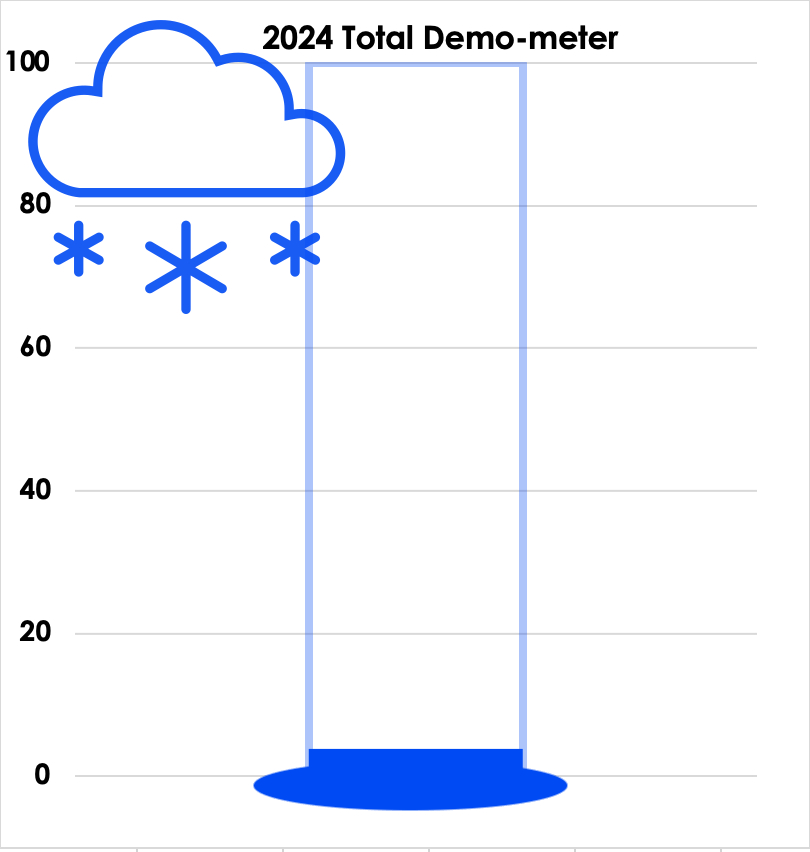
We’ve got 2,640 locations where we will search for Echinacea in 2024. Our work is cut out for us, but after just one morning in the field, we are already 3.75 % done!
Today Team Echinacea continued to wrap up the pollen and nectar collection. Only a few focal plants are still in flower. Another group worked on flagging and recording demographic information for every flowering Echinacea plant in every remnant site. Some of these plants have tags dating back decades! In the experimental plots, Stuart trained team members to find and measure all Echinacea. This data will help us understand performance of E. angustifolia x pallida hybrids. Round 5 of emergence trapping started recently. The team members are now pros at deploying and retrieving the traps.
It’s heating up in western Minnesota! Temperatures and humidity were high today. In the morning, much of Team Echinacea performed the pollinator observations we learned about yesterday with Dr. Ison. These involved recording the pollinator with a camcorder, describing its activities, and attempting to ID to morphospecies level.
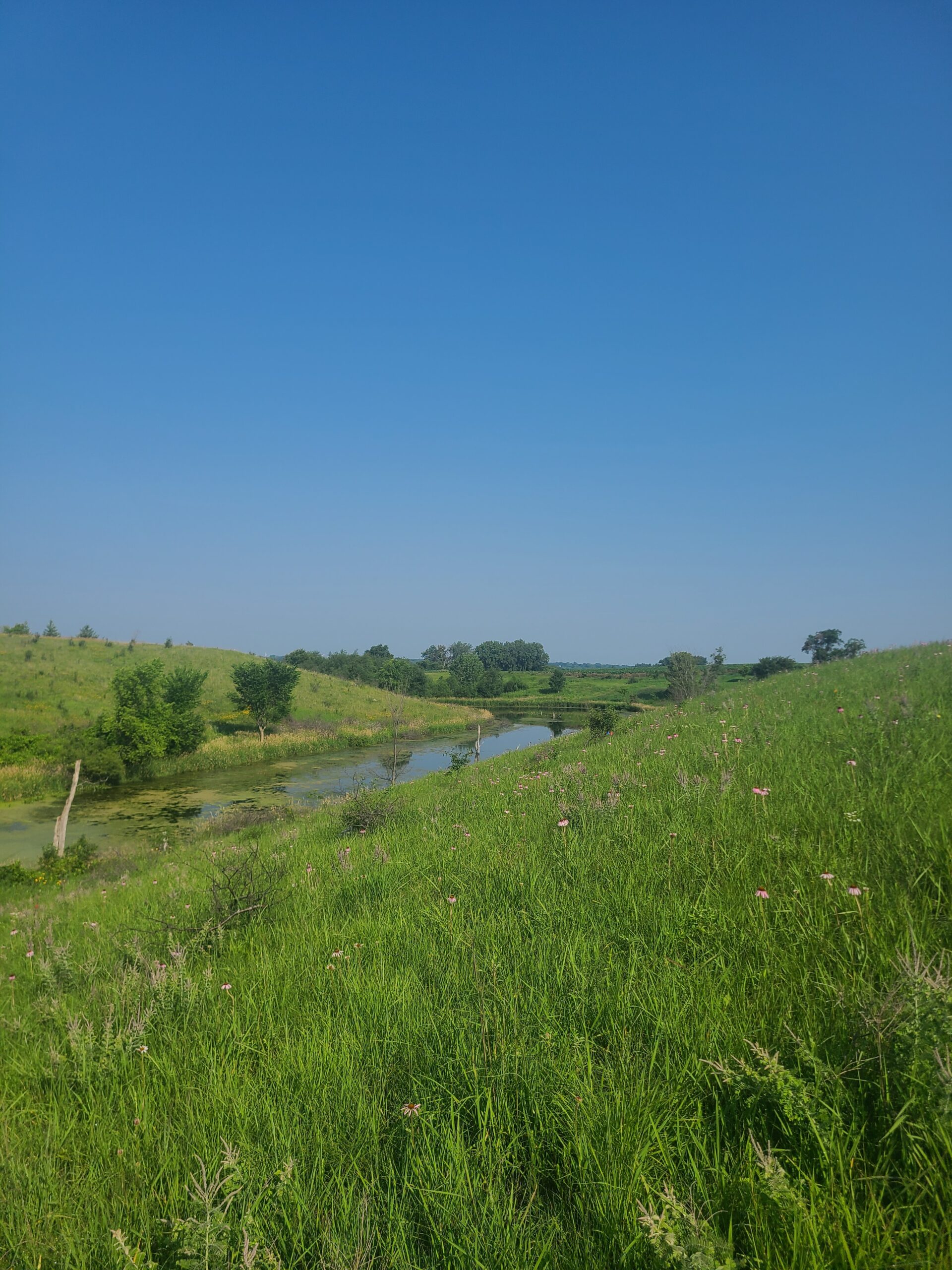
Lots of echinacea in bloom at Torgeson north.
In the afternoon, emergence trapping crews had a great session of deployments and retrievals, while others worked on phenology in the common garden plots, and others gathered nectar. It’s exciting to see new species starting to bloom: two major species of prairie clover are just getting started, as is the wild bergamont and wild licorice.
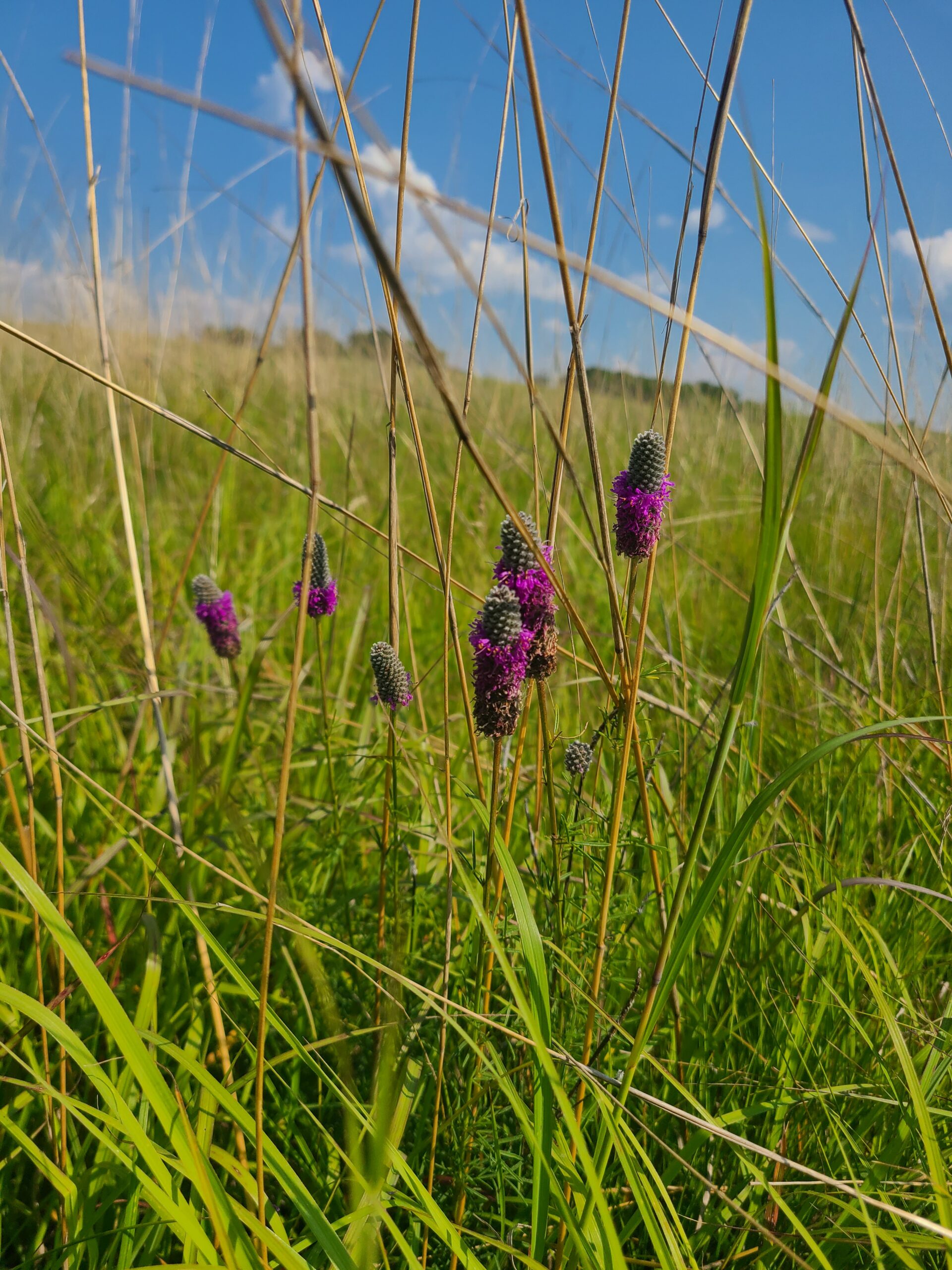
Daleapurpurea, or purple prairie clover, in bloom at Hulzbos CRP north.
Once everyone was back from the field, we enjoyed some ice cold watermelon and headed home. Another great day in the field!
This week was a busy Monday for team Echinacea. Jennifer from College of Wooster joins us this week along with her research assistants Max and Indigo! This morning started off with round 2 of sweet clover pulling, and was promptly followed by a crash course in pollinator observations. We tried our hand in collecting species in small tubes for ID and then release. A big part of this was learning how to differentiate between flys and bees as some flies can look realllyyy close to a bee. But don’t be fooled! To round out the morning we went out in groups to collect pollen for our pollen and nectar study specifically looking at echinacea angustifolia.
After lunch, half of us went and deployed another round of emergence traps while the other half went out and did nectar collection for the pollen and nectar study.
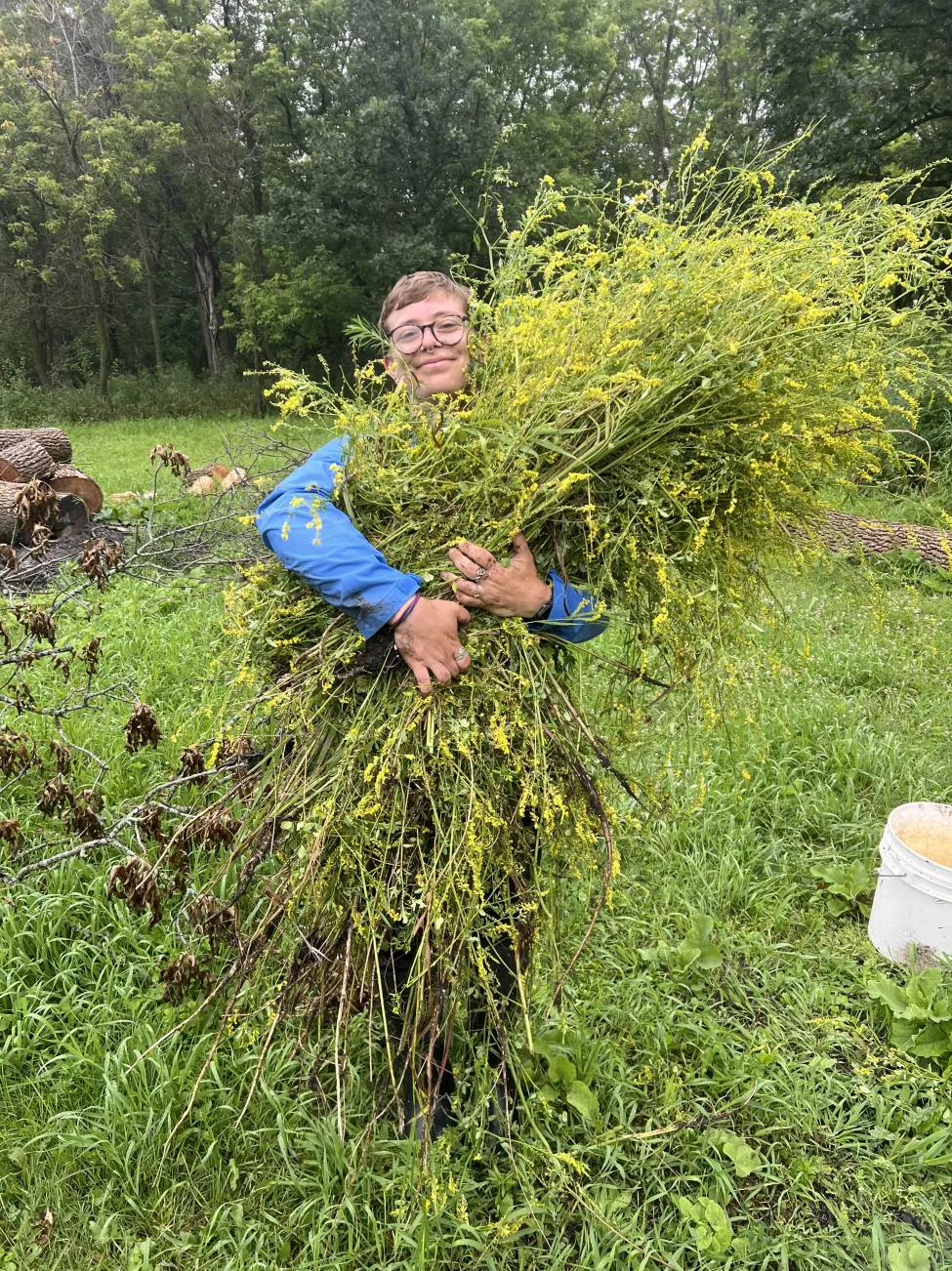
Maddie with round 2 of our sweet clover pulling bounty.
Jennifer prepping us for our crash course in pollinator observations.
Zach holding a micro-capillary tube with a whopping 7mm of nectar!
This morning the whole team got together to pull as much sweet clover as we could from p01. After the drippy morning faded, we split up to collect pollen from Echinacea angustifolia at sites throughout the area. This is part of an MN ENRTF funded project to help determine the impacts of prescribed burns on pollen and nectar quantity and quality in echinacea. After lunch, some people went to retrieve and deploy emergence traps and the rest of us went to collect nectar from echinacea plants. To collect the nectar, we are using tiny glass microcap tubes carefully inserted into the florets. Overall, we had a productive day, and enjoyed the nice weather after a wet 4th!
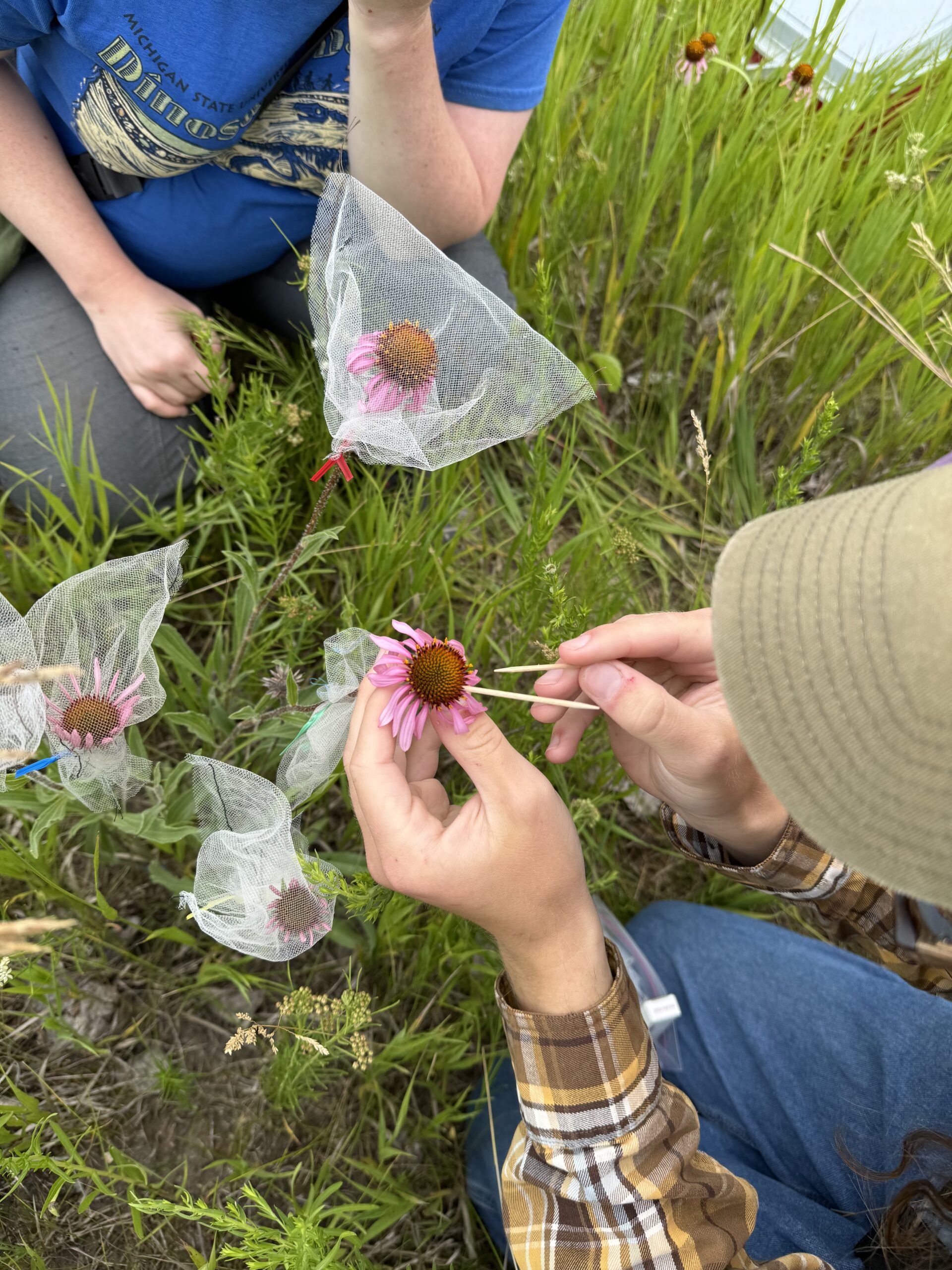
The beginning of flowering for Echinacea angustifolia means it’s time for Team Echinacea to get collect Echinacea pollen and nectar! This project is part of our MN ENRTF funded research to understand fire’s impacts on ground nesting bee habitat and food resources. It’s our second year of sampling and we have made some modifications and improvements to our protocol.
This year we are collecting from a total of 62 plants across 12 sites (some burned in 2023, some in 2024, and a few not burned in either year). Where possible, we are collecting from plants that we also collected from last year, which will make for some interesting comparisons. Many plants did not re-flower in 2024, so Wyatt and I bolstered our sample by randomly selecting other focal plants.
On Monday, Wyatt and I visited our first flowering focal plants with Grace and Rebecca from NDSU and tested out methods. We learned how to sample immature florets, a new method we are using to assess pollen quantity this year. We also brushed up on nectar and pollen collection.
Wyatt collects pollen from the anthers of a flowering Echinacea
By Tuesday we were able to train the whole team in on the protocol and start collecting! So far our data sheets have worked pretty well, and we are figuring out ways to improve efficiency in the field. Stay tuned as more of our focal plants begin to flower!
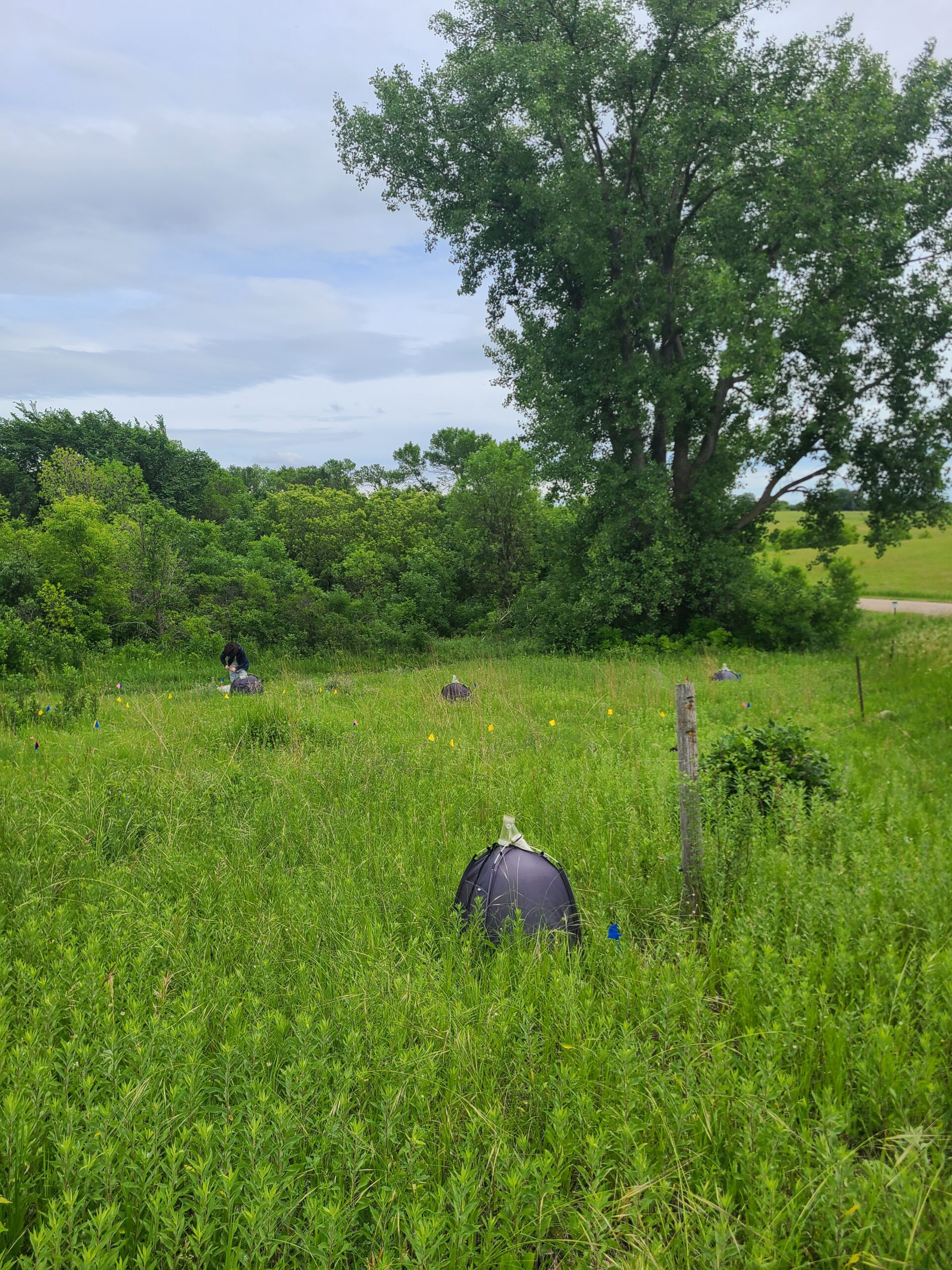
A smooth start to the first emergence trapping deployment! Today we placed 23 traps at three sites, making good use of our new color-coded flagging system. So cool to see our work from the last few weeks starting to pay off!
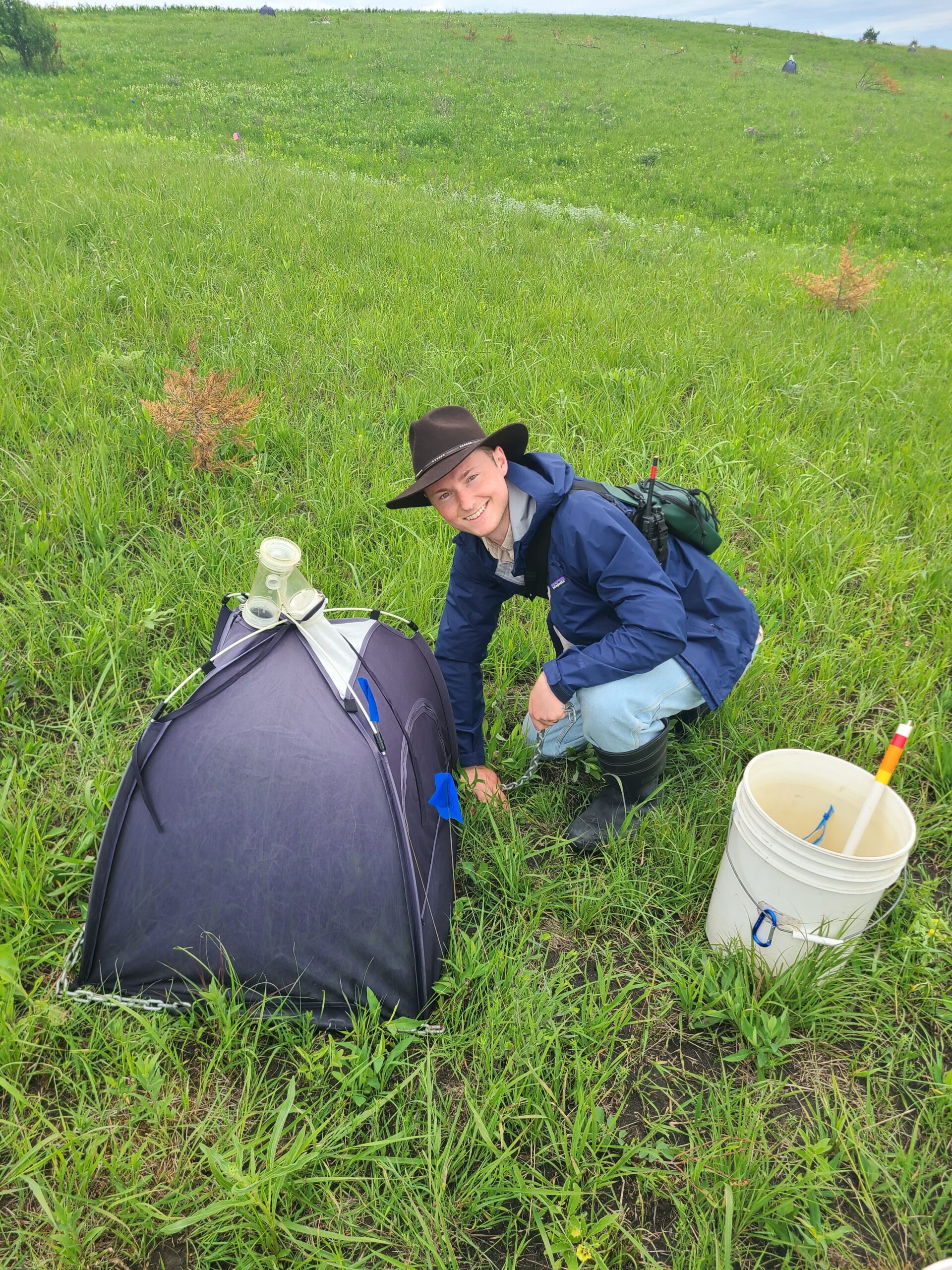
Some emergence trapping sites are a lot smaller than others! It will be interesting to see whether size is associated with catch rate. Do bees prefer to nest in big sites? REU student Zach deploys a trap at our first site of the day. This site was burned earlier in the spring, can you see how short the vegetation is?
These traps will be out for four days, then emptied and sent back out to new sites on Monday. Fingers crossed we’ll see some bees!
NOTE: Funding for this project was provided by the Minnesota Environment and Natural Resources Trust Fund as recommended by the Legislative-Citizen Commission on Minnesota Resources (LCCMR).
Today was a full day for team Echinacea! Not only is it Elise’s first day on the team, but it’s also summer solstice. This morning Brittany and I went out to Staffanson Prairie Preserve West to finish shooting bb-points. While another team started flagging/planting P8 for a new experiment. The new common garden experiment being added to P8 involves planting prairie turnip to learn how to grow and measure the species while establishing a basis for future studies.
This afternoon was busy finishing up planting in P8 while a handful of others went out and set the first emergence traps for the season! Woot woot!
Many more updates to come, along with daily posts from other members of the team.
Hailey (left) and Maddie (right) flagging in P8.
Wyatt (left) and Elise (right) standing with some prairie turnip plugs.
Brittany (left) and Emma (right) planting some turnips in P8.
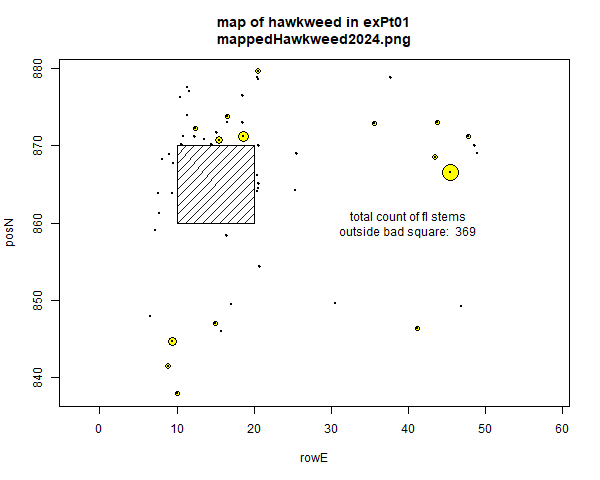
We have a patch of an invasive weed in our main experimental plot. We have been trying to keep this non-native hawkweed from spreading for several years. This year we did a really good job. First, we found all the satellite patches and used the opportunity to practice reading and making maps. Then we pulled all the flowers stems–we estimated 369 stems. Here’s a map of all hawkweed patches and the main infestations is the 10m x 10m square.
Then we pulled all the stems in the square of infestation, counting as we pulled. Here are the counts & the total in the square:
After we counted and pulled, we each made an independent estimate of the number of flowering stems we missed. We could have missed stems that were trampled or difficult to see with the current light conditions. Here are our counts with the mean and median:
Stuart went back when it was cloudy and found 47 stems in the infestation square, mostly trampled. The next day he systematically walked the square and found 4 more. So that’s 51 missed. One person had a pretty close estimate (48). All but one of our estimates were optimistic about our thoroughness.
round(c(37,51)/(1265+51), 3)
[1] 0.028 0.039
We estimated a miss rate of 3% and our actual rate was closer to 4%. We practiced estimating, pulled a lot of stems, ~1700, and have maps to go back and get the plants later this season. Good work, team!
I’m a junior in Environmental Science at Western Washington University, expecting to graduate winter quarter 2025.
Pronouns: He/Him
Research Interests
I’m very interested the ecology of botany, mycology and soil. I’d be very interested in learning about how invasive species and fire ecology affect community structure of prairie ecosystems.
Statement
I’m currently going to school in Bellingham, WA but I grew up in Eden Prairie, MN, glad to be back in the plains.
In my spare time I like to rock climb and kayak, birdwatch, forage mushrooms, read, and play banjo and guitar.