|
|
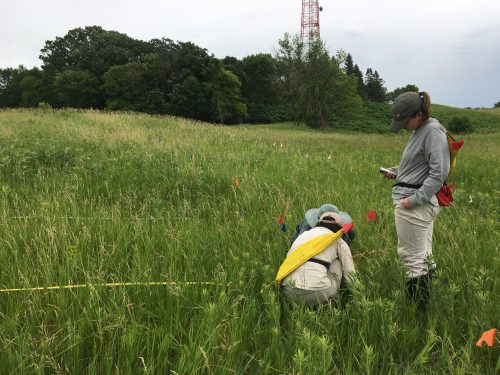
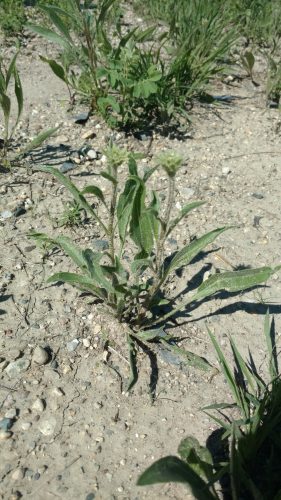
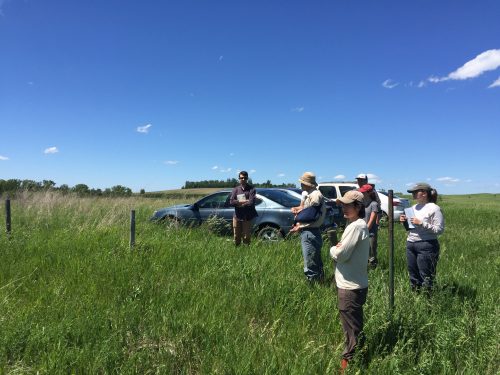
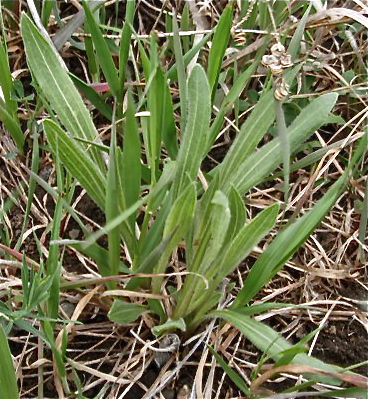
Today was the third day in the field for Team Echinacea 2017. We all started out in P1, where we split up and did various tasks. Alex and Ashley took on the riskiest task and weeded some invasive bird’s foot trefoil around the plot that was among some poison ivy. Will, Lea, Wes, and I got the 10-meter signs and flag markers up and organized. Stuart and Anna started taking on the invasive hawkweed that has been getting into the plot and spreading, and eventually all of us were wrestling with it. The hawkweed has some incredible rhizomes that spread around to nets and nets of rosettes. Will and I found an estimated 45% hawkweed cover in one part of the plot. Here are some of the comments you might have heard from all of us while trying to get these out of the ground:
“Anytime you think you’ve found them all, you haven’t.”
“You will be champion of the longest rhizome!”
“I think I am becoming allergic to hawkweed.”
Weeding was fun, but I think we were all ready for lunch when it came around. At lunch we talked about doing a yellow pan trap experiment this year to catch and identify bees and see how their abundance and diversity relates to surrounding vegetation. Lea also gave an intro to her experiment for the summer, and we talked about potential REU projects.
After lunch we headed over to P8 and started learning how to collect data on the Echinacea growing there. Returners helped the newcomers start to get a hang of navigating the plot site, collecting data on visors, and finding and measuring Echinacea. We finished the day with a watermelon on the porch.
It was a great week. I’m excited for more.
Tracie
 Lea, Gretel, and Ashley in P8.
Echinacea Project 2017
Biology B.S. & Studio Art B.A., University of North Carolina at Chapel Hill 2017
Research Interests
My general ecological interests involve macroecology and biogeography. I am fascinated by patterns that can be discovered across large geographic scales or over long time periods. With the changing climate I have become interested in how temperature can affect the phenologies of plant and animal species. In my time with Team Echinacea I hope to study prairie plant phenology, plant-pollinator interactions, and the effect of prairie fragment size on community characteristics.
Statement
I am from Charlotte, North Carolina, a day trip away from either the beach or the mountains. I am constantly making art, whether it is weaving, painting, or woodworking. I also love hiking, birding, collecting rocks, and eating sushi. I am excited to join Team Echinacea and experience a new ecosystem!

Hello Echinacea Project Fan Base!
Today the group split up as we continued getting oriented with the project. Five of us went out to examine Railroad Crossing and Loeffler’s Corner prairie remnants. We split into two groups and analyzed each remnant to determine the species makeup, disturbance history, and land history of each remnant. After taking time in each of our groups, we came together and discussed what we saw and learned. Alex was our wonderful guide and was able to give plant information. After remnant analyzing, Alex gave us a driving tour of a couple of other prairie remnants during which we stopped to examine some Echinacea angustifolia whose buds were showing. Yay flowers!

Before and after lunch, Stuart gave everyone a power point presentation on details of the project and past and current results and data. Next, we weeded Bird’s-foot Trefoil from the roadside near an experimental plot and created a path from Hjelm House to that same plot. We then went over the organization of some experimental plots and learned how to use our high-tech data collection devices (see attached image).
Hopefully more sun is ahead!
Wes
Today was the first day in the field for Team Echinacea 2017, and it couldn’t have been a better day! This weekend was hot, humid, and stormy in MN. Today was much cooler with a pleasant breeze all day. We started the morning with introductions and learning about safety and general Echinacea info. We learned about all of the dangerous plants and animals in our study site. The worst by far must have been death camas which you shouldn’t eat because it will kill you. After learning about safety we headed out to Staffanson Prairie Preserve to see some of the native (and non-native) plants that we will see during the summer. We spent the majority of the morning meandering around Staffanson pointing out new plants and discussing the history of the land, and then headed in for lunch.
We assessed everyone’s various skill sets at lunch so that we could form the Ultimate Team Echinacea by building on eachother’s strengths and skills.
Hegg lake WMA was our second stop of the day where we discussed the differences in the plant communities within the site and between the site and Staffanson. We then said our good-byes for the evening.
Goodnight Flog,
Will
Team echinacea learns.
Echinacea Project 2017
I will be a senior at Minnewaska Area High School this next fall. Our district is fairly small and located between Glenwood and Starbuck.
Research Interest
I am interested in learning more about plants and prairies in general. I would also like to learn more about the types of plants I live around and ways to protect the prairies we have in Minnesota. So far, I am undecided on exactly what I would like to study in college, but I am heavily considering plant science or biology.
Statement
I live in Glenwood, Minnesota where my family owns and operates Dorrich Dairy. Growing up working on a farm I have a passion for the dairy industry and agriculture in general. I enjoy gardening in the summer and spending time with friends and family. Some of my other hobbies include baking, eating pie, tennis, traveling, and 4-H.

I am currently studying Biology and Japanese at St. Olaf College in Northfield, MN. I am expecting to graduate in in June of 2018.
Research Interests
I am interested in learning about prairie fragmentation and using Echinacea to find out more about different prairie plant species in the same ecosystem. I’ve done guided research and group research in a college setting and I am excited to have new research experiences outside of a laboratory setting.
Statement
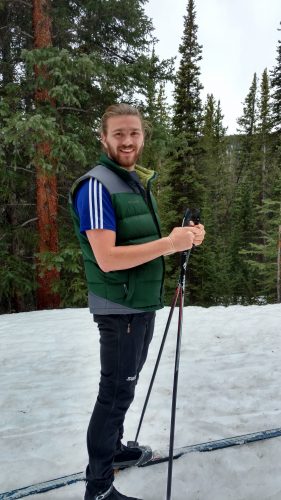
I went to high school in Northfield, MN, and (after graduating) I took a gap year in which I went to high school in Japan for a year on a Rotary Youth Exchange scholarship. After my gap year, I returned to Northfield to attend school at St. Olaf College. In my spare time I like to play tuba, canoe, cross-country ski, hike, and knit.
Greetings! I am an environmental science major with a biology emphasis and an honors interdisciplinary studies minor at the University of Central Arkansas in Conway, Arkansas. I will graduate in 2019.
Research Interests
My love for plants stemmed from working in my family’s gardens as a kid. In high school, I had a great botany teacher, and ever since, I’ve been interested in plant science. Specifically, unusual plant reproduction, plant carbon sequestration potential, and weird flower morphology fascinates me. Recently, I have become interested in plant-pollinator ecology and biogeography, and I hope to study the efficiency of pollinators in fragmented habitats this summer.
Statement
I grew up 20 miles south of Fort Smith, Arkansas, and I enjoy living in the Natural State. In my free time, I like writing, baking, working in my small garden, painting, playing Scrabble, and hiking. I also enjoy spending time with my dog, family, and friends. I’m excited to spend my summer in Minnesota and be a part of Team Echinacea!
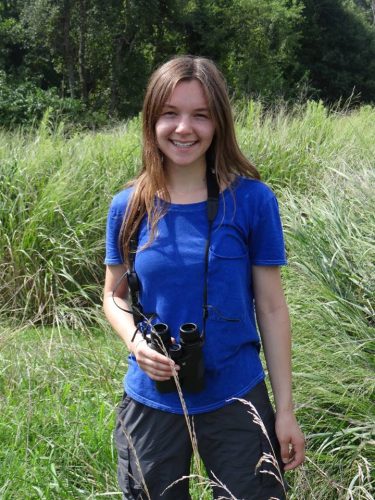
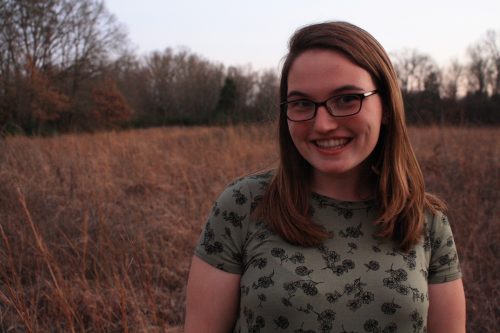
 Me in the Jewel Moore Nature Reserve prairie on the UCA campus.
We had a great time at our annual lab potluck on Tuesday. We celebrated all the people in the lab, including all of the undergraduate interns. Scott told us about the smoke experiment. Then Amy explained the pollinator study from 2016. Lea talked about her projects on flowering phenology. We reviewed some of our many accomplishments in the lab, including: 1) cleaning and randomizing all 1233 heads from exPt2 in 2015, 2) counting 478,069 achenes from 3078 heads, 3) scanning 1710 images, 4) assembling 198 xray sheets. This year Lois, our reigning “achene queen,” counted her 800,000th achene and Sam counted his 250,000th! This summer we have ambitious plans for the field and lab. It was a lot of fun and the food was great–an incredibly diverse spread of tasty dishes.
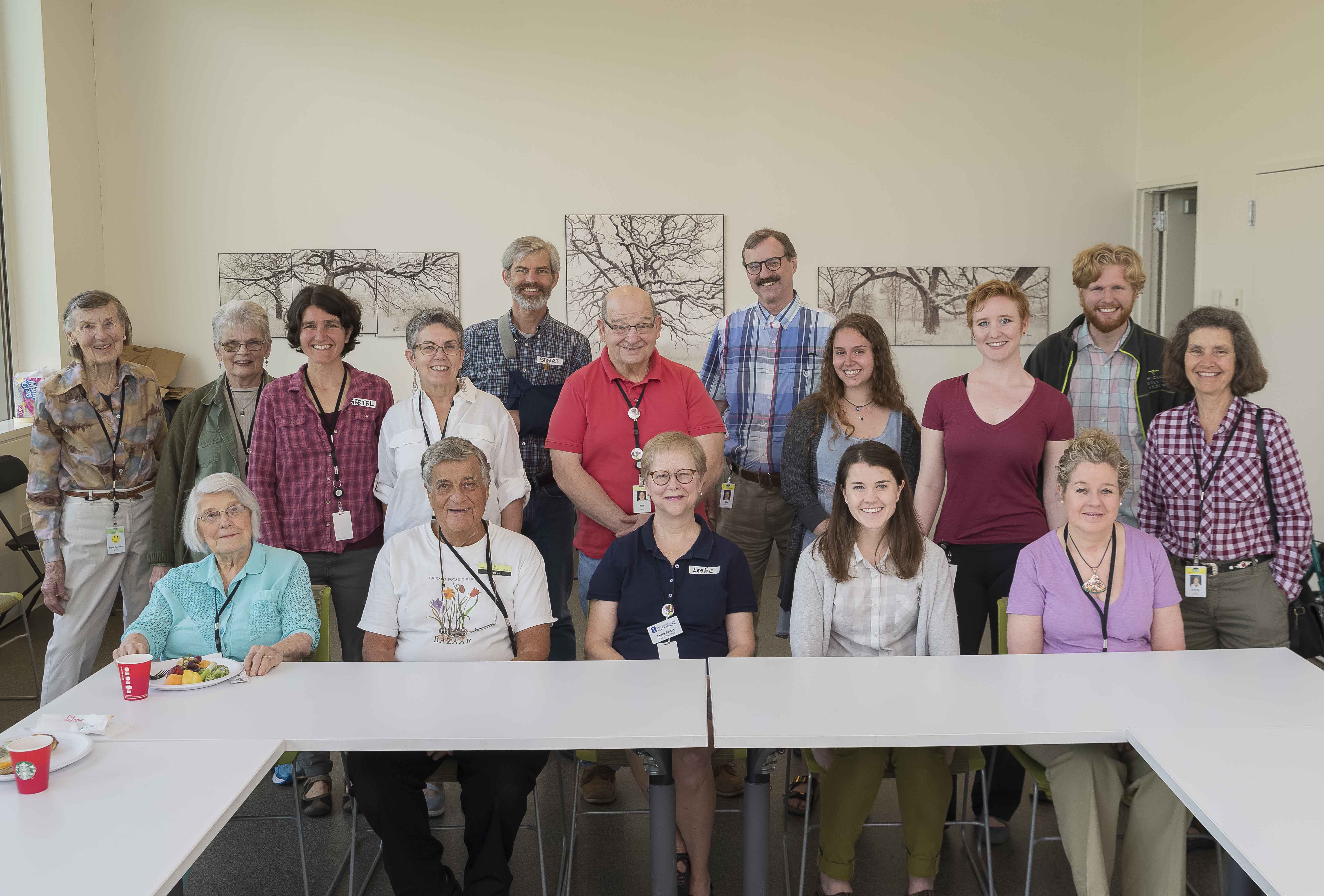
We took a group photo:
 First row (L to R): Lois, Art, Leslie, Amy, Laura; Second row: Susie, Char, Gretel, Anne, Stuart, Allen, Mike, Ivy, Lea, Scott, Shelley. Not pictured: Aldo, Susan, Michele, Marty, Naomi, Sam, Kathryn, Lou, Suzanne, Nicolette, Sarah. Thanks for a great year!
Christopher Lortie presents ten simple rules for successful short and swift presentations in this PLOS Computational Biology paper.
10 simple rules:
1. Plan a clear story
2. Provide only one major point per slide
3. Limit use of text
4. Use simple visuals
5. Develop a consistent theme
6. Repeat critical messages twice using different visuals
7. Use the principle of parsimony in explanations
8. Allocate more than one slide to effectively end the narrative
9. Use the final slide for contact information and links to additional resources
10. Use timed practice
Read the article.
 We observed that 95% surviving members of the 1996 cohort were basal in 2016 Does receiving the maximum amount of pollination vs. no pollen at all affect a plant’s longevity or likelihood of flowering in subsequent years? In this experiment we assess the long-term effects of pollen addition and exclusion on plant fitness. In 2012 and 2013 we identified flowering E. angustifolia plants in experimental plot 1 and randomly assigned one of two treatments to each: pollen addition or pollen exclusion. When plants flower in subsequent years they receive the same treatment they were originally assigned.
Across all experiments, 2016 was a low flowering year. Only four plants flowered of the 29 plants remaining in the pollen addition and exclusion experiment. We continued experimental treatments on these plants and recorded fitness characteristics.
Start year: 2012
Location: Experimental plot 1
Physical specimens: We harvested four flowering heads from this experiment that will be processed with the rest of the experimental plot 1 heads to determine achene count and proportion of full achenes. The labels for these heads, beginning with the letter “p,” identify them as part of the pollen addition and exclusion experiment.
Data collected: We recorded data electronically as part of the overall assessment of plant fitness in experimental plot 1. We recorded dates of bagging heads and pollen addition on paper datasheets.
You can find more information about the pollen addition and exclusion experiment and links to previous flog posts regarding this experiment at the background page for the experiment.
|
|