|
|
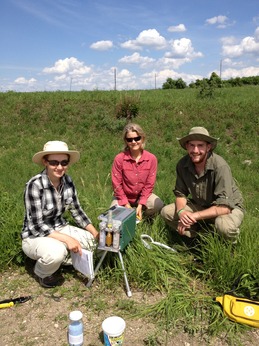
 Reina, Pamela, and Mike with the photosynthesis machine used in Kittelson et al. (2015) In 2015, we continued to study the effects of inbreeding on Echinacea angustifolia fitness. This experiment was planted in 2006 where each plant was produced from one of three cross types: between maternal half siblings; between plants originating from the same remnant, but not sharing a maternal parent; and between individuals from different remnants. We continued to measure fitness and flowering phenology in these plants.
This year, of the original 1443 plants in INB2, 561 were still alive. Of the plants that were alive this year, 8.3% were flowering and 76.3% have never flowered – we’re still waiting! Among the plants that were flowering, mean head count was 1.53 heads, with a maximum of five heads.
Read more posts about this experiment here.
Start year: 2006
Location: Experimental plot 1
Overlaps with: Phenology and fitness in P1
Products: Fitness measurements were collected during our annual assessment of fitness in P1.
The following paper was published in summer 2015 based on fieldwork conducted in 2013.
Kittelson, P., S. Wagenius, R. Nielsen, S. Qazi, M. Howe, G. Kiefer, and R. G. Shaw. 2015. Leaf functional traits, herbivory, and genetic diversity in Echinacea: Implications for fragmented populations. Ecology 96:1877–1886. PDF
With all of my data collected and visualized for the heads from Staffanson Prairie Preserve from 2015, it is now time to start with some initial data analysis. As I mentioned in my last post, I will be using R for all of my analyses, taking advantage of skills I learned in Stuart’s class at Northwestern this quarter. I will be creating statistical models based on the data to look for relationships between variables that may influence mate availability and reproductive success. The variables I am specifically looking at are:
- Distance to the kth nearest flowering neighbor. This is a measure of spatial isolation, with greater distance indicating greater isolation. Stuart has found a significant relationship between distance and reproductive success in Echinacea previously (that study can be found here: https://echinaceaproject.org/pub/wagenius2006.pdf)
- Start date and flowering duration. Flowering phenology, the timing and duration of flowering, is perhaps more important than spatial isolation in determining availability of compatible mates. If two plants are very close in space, but they do not flower at the same time, there is no possibility for mating. Previous data has shown that plants flowering earlier in the season have higher reproductive success (https://echinaceaproject.org/pub/isonAndWagenius2014.pdf)
- Section of head from which the achene originated. Because florets at the base Echinacea heads begin flowering first, and the ones at the top flower last, it is possible to examine how reproductive success, and thus the mating scene, differ for a single head across time. The bottom 30 achenes, the middle achenes, and the top 30 achenes are separated to represent the beginning, middle, and end of the timing of flowering.
- Seed set, or proportion of achenes that contain a seed, will be used to quantify reproductive success. This will be the that the model I create will try to predict using the variables I listed above.
In order to create a model, I will be using a technique known as backwards elimination as described in Statistics: An Introduction Using R (Crawley 2015). I will start by creating a statistical model containing my response variable (seed set), and all of my explanatory or predictive variables (isolation, phenology, section of head), along with all interactive effects between the explanatory variables. I will then eliminate a single predictor or interaction at a time and perform an analysis of deviance to determine whether or not that predictor was important to the predictive value of the model. If it is important, I will leave it in, but if it’s not, I will take it out. This process continues until all predictors and interactions left in the model have a significant effect on the response. This model, known as the minimal adequate model, is the simplest model that still includes all important variables.
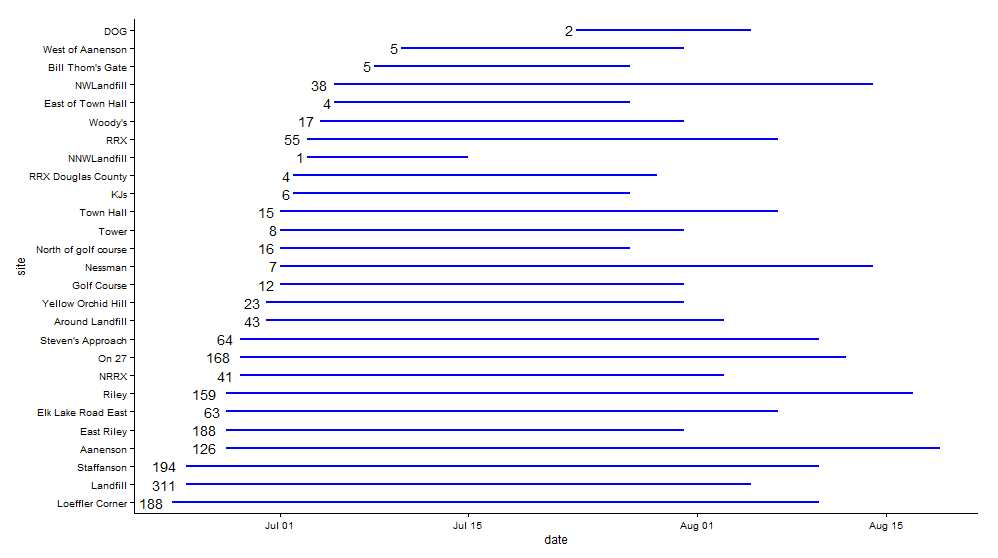
Beginning in 1996, Team Echinacea has monitored the flowering phenology of Echinacea angustifolia in remnant populations around Solem Township. The number of populations and plants we visit has varied over the years; a summary of which populations were monitored in each year can be found at this link. In 2015, we monitored phenology of 1763 heads on 1384 plants at 27 remnant populations. Whew! That is about 400 more flowering individuals than in 2014 although we monitored the same populations. Populations with big increases in numbers of flowering individuals from last year include Aanenson, East Riley, Landfill, and On 27. At each population, we identify all flowering individuals and track their development over the course of the season, gathering data on start and end dates of flowering for every individual. Flowering began at Loeffler’s Corner on June 23rd and ended at Aanenson on August 19th. We will use this data to describe temporal flowering patterns within and among remnants and relate this to potential for successful mating in populations.
 Blue line segments indicate the period of time that at least one individual was flowering at each population. The numbers to the left of the lines indicate the number of individuals that flowered from each population in 2015. Click to enlarge! Look here to read previous flog posts about this experiment.
Start year: 1996
Locations: roadsides, railroad rights of way, and nature preserves in and near Solem Township, MN
Overlaps with: mating compatibility in remnants, demography in remnants, phenology in experimental plots
Team members who have worked specifically on this project include: Amber Zahler (2011), Kelly Kapsar (2012), and Sarah Baker (2013), although gathering phenology data was a whole team effort in 2014 and 2015. Flog posts authored by Kelly, Amber, and other team members may provide additional details about day-to-day activities associated with our flowering phenology monitoring project.
Every year we keep track of flowering phenology in our main experimental plots, exPt1 and exPt2. Summer 2015 was a big year of flowering in both plots, especially in exPt2, where 1233 heads flowered between July 4th and August 26th. ExPt2 was designed especially to study phenology—you can read more about the team’s monitoring of phenology in the 2015 heritability of phenology project status update.
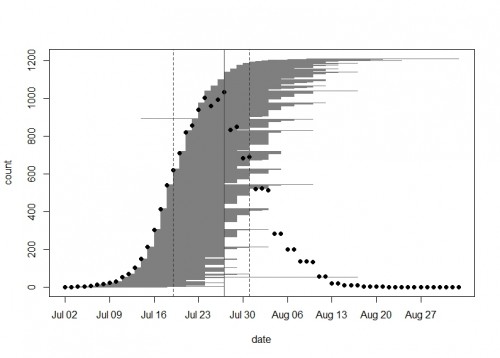
In exPt1, we kept track of 1212 heads on 649 plants (we left out the qGen_a ‘big batch’ cohort). The first head began shedding pollen on July 2nd and the latest bloomer shed pollen on September 2nd. Peak date in exPt 1 was on July 27th when there were 1034 heads flowering. At the end of the season we harvested the heads and brought them back to the lab, where we will count fruits (achenes) and assess seed set.
Read previous posts about this experiment.
 A plot of the 2015 flowering schedule in experimental plot 1 made with the brand new R package mateable–available now on CRAN! Each horizontal gray line segment on this plot represents the flowering time of one head. From bottom to top they are sorted by start day. Black dots show the number of heads in flower on each day. The vertical lines show the peak day (solid) and the days when half of the plants have started flowering and half have ended (dashed).
Start year: 2005
Location: Experimental plots 1 and 2
Overlaps with: Heritability of flowering time, common garden experiment, phenology in the remnants
Products:
These papers report on investigations of flowering phenology of individuals in experimental plot 1 in 2005, 2006, and 2007:
- Ison, J.L., and S. Wagenius. 2014. Both flowering time and spatial isolation affect reproduction in Echinacea angustifolia. Journal of Ecology 102: 920–929. PDF
- Ison, J.L., S. Wagenius, D. Reitz., M.V. Ashley. 2014. Mating between Echinacea angustifolia (Asteraceae) individuals increases with their flowering synchrony and spatial proximity. American Journal of Botany 101: 180-189. PDF
Taylor presented a poster of her summer research on fitness of native, non-native, and hybrid Echinacea plants at the Tennessee Louis Stokes Alliance for Minority Participation Conference. The meeting was held February 25-26, 2016 at the University of Tennessee-Knoxville. Taylor was awarded 3rd place in Science Poster Presentation category. Yay, Taylor!
|
|