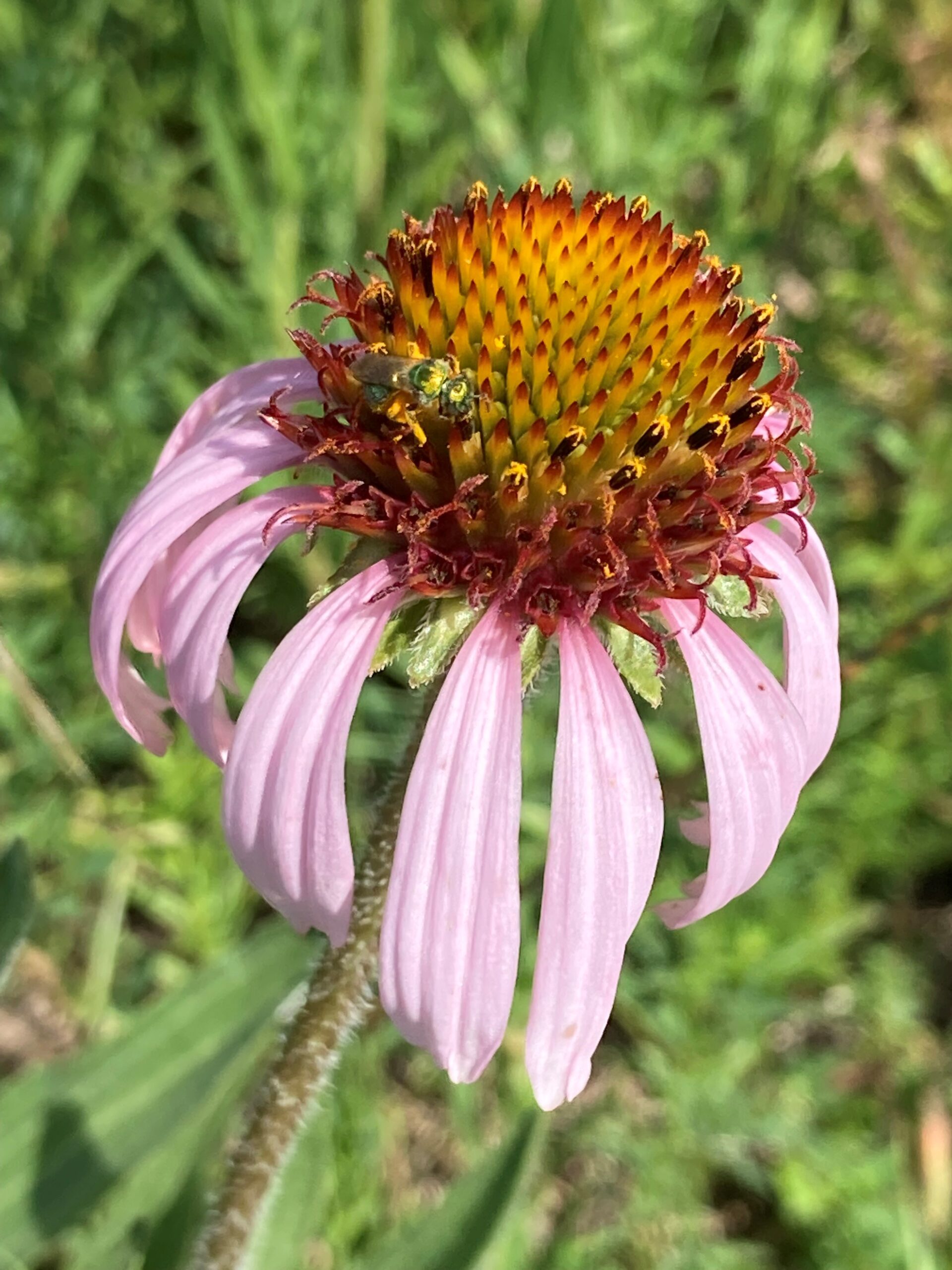
Location: Hegg Lake WMA. Start year: 2011. Echinacea pallida is a species of Echinacea that is not native to Minnesota. It was mistakenly introduced to our study area during a restoration of Hegg Lake WMA. Since 2011, Team Echinacea has visited the pallida restoration, taken flowering phenology, and collected demography on the non-native plant. We have decapitated all flowering E. pallida each year to avoid cross-pollination with the local Echinacea angustifolia. Each year, we record the number of heads on each plant and the number of rosettes, collect precise GPS points for each individual, and cut off all the heads before they produce fruits.
This year, we cut E. pallida heads on June 22nd. We installed pollinator exclusion bags on select heads of 10 plants rather than immediately cutting them as a part of our quantity and quality of Echinacea pollen and nectar experiment. Overall, we found and shot 73 flowering E. pallida plants, and 193 heads in total, averaging 2.6 heads per plant. These non-native plants were hearty with an average rosette count of 6 rosettes and an individual with a maximum of 20 rosettes! We only did surv on plants with new tags this year, a total of 4. We did not take phenology data on E. pallida this year.
You can find more information about E. pallida flowering phenology and previous flog posts on the background page for the experiment.
Location: near exPt8. Start year: Crossing in 2011, planting in 2012. Experimental plot 6 was the first E. angustifolia x E. pallida hybrid plot planted by Team Echinacea. A total of 66 Echinacea hybrids were originally planted. All individuals have E. angustifolia dams and E. pallida sires. In 2023, we visited 23 positions and found 17 living plants. This year, 3 plants flowered in this plot; this is the first year any plants have flowered in p6! These were allowed to reach day one or two of flowering in order to assess their pollen color before we decapitated them.
Flowering plant in exPt06! Note the paler pollen color compared to the typical E. Angustifolia
You can find more information about experimental plot 6 and previous flog posts about it on the background page for the experiment.
Location: Hegg Lake WMA. Start year: Crossing in 2012, planting in 2013. Experimental plot 7 is the second E. pallida x E. angustifolia plot. It contains conspecific crosses of each species as well as reciprocal hybrids, totaling 294 individuals. This summer, we visited 150 positions, and of these plants, we found evidence of 121 living plants. We did not use pollinator exclusion bags in exPt07 this year. There were 19 flowering plants this year; from these we harvested 32 heads. We have not yet used the pedigree data to see what number of these plants are hybrids or not.
You can find more information about experimental plot 7 and previous flog posts about it on the background page for the experiment.
Location: Hegg Lake WMA. Start year: 2014. Experimental plot 9 is a hybrid plot, but, unlike the other two hybrid plots, we do not have a perfect pedigree of the plants. That is because the E. angustifolia and E. pallida maternal plants used to generate seedlings for exPt9 were open-pollinated. We need to do paternity analysis to find the true hybrid nature of these crosses (assuming there are any hybrids). We did not use pollinator exclusion bags in exPt09 this year. There were originally 745 seedlings planted in exPt9. We searched at 292 positions and found evidence of 238 living plants in 2023. Of these individuals, 30 were flowering. We harvested 39 heads from this plot!
You can find out more information about experimental plot 9 and flog posts mentioning the experiment on the background page for the experiment.
Data collected for exp679: For all three plots, we collected flowering status, rosette count, leaf length, head count and head height. All measuring data can be found in the cgdata repository (~/cgdata/summer2023/measureGood). Measuring data should be uploaded to SQL database eventually, but it is not currently there for 2023. For experimental plots 7 and 9, we also took phenology data starting on July 7th and ending on July 12th, which we scaled back from previous years. This data can be found in the cgdata repository (~cgdata/summer2023/p79phenology).
Data collected for E. pallida demography: Demography data, head counts, rosette counts, GPS points shot for each E. pallida with a new tag. Find demo and surv records as well as GPS points in demap.
We’re interested in investigating what resources are available to Echinacea visitors and learning more about the pollen and nectar Echinacea produces. We hope to learn if the nutritional resources available differ before and after burns. In 2022, Britney House developed methods for collecting nectar from Echinacea using microcapillary tubes. Read more about her methods here.
During the summer of 2023, the team collected pollen and nectar samples from Echinacea angustifolia at 19 sites in and around Solem Township, MN (plants at Hegg Lake were Echinacea pallida). We searched for and shot the ~20 plants (or, if few were available, as many as we could find) at each site that were closest to a random point. We then selected ten of those plants to bag up to three of their heads with pollinator exclusion bags. Throughout the duration of their flowering, we collected pollen from all bagged plants and nectar from five of them per site.
Stuart collects nectar from an Echinacea head
Midway through the experiment (mid-July), we removed bags from some of the pollen only plants to adjust our sample size to only the five pollen/nectar plants plus two backups per site. We removed bags from pollen/nectar plants and backup plants when they were done flowering, we’d collected a cumulative 50 mm of nectar from them, or we had received less than 15 mm of nectar from the plant in the last three visits (the latter was more of a guideline than a rule, used to save time by eliminating plants that were unlikely to provide us with enough nectar for analysis). At the Hegg pallida restoration, any heads that were not originally bagged were decapitated, and all heads were decapitated upon the final removal of their bags.
Following some experimentation, we conducted nectar collection only in the afternoons, while pollen collection could be done any time of day. In total, we collected 856 vials of pollen and 580 vials of nectar from 104 plants. These were given to Rahul Roy and Margaret Medini at St. Catherine University in St. Paul, who will be doing data analysis.
Data entry for collection datasheets is complete, and verified csvs for each site can be found at: Dropbox/teamEchinacea2023/z.pollenNectarDataEntry/coreVerified. Scans can be found at: Dropbox/teamEchinacea2023/z.pollenNectarDataEntry/scans.
Start year: 2023
Location: Various prairie remnants and one restoration (Hegg Pallida) around Solem Township, MN
During the summer of 2023, Team Echinacea conducted floral surveys at randomly selected bb points in remnant prairies and restorations. We are interested in quantifying floral resources (i.e., food for bees) and we want to understand how fire influences the diversity and abundance of flowering plants.
At each focal point (bbpt) we identified species rooted within a 2 meter radius and recorded the furthest stage of development. We measured abundance by binning a range of floral units (i.e., 1-5 flowering units got label “5”).
Floral surveys were split into “visit group A” and “visit group B”. We surveyed different random points when revisiting sites. In total, we conducted 415 floral surveys across 45 sites.
Liam Poitra, a 2023 Summer Research Experience for Undergraduates (REU) Participant, contributed to this research project investigating the effects of fire on diversity and abundance of flowering plants. Liam assisted in fieldwork and data organization. Inventory, protocols, and blank datasheets for floral assessments are located in ~/Dropbox/enrtf/floralSurveys2023.
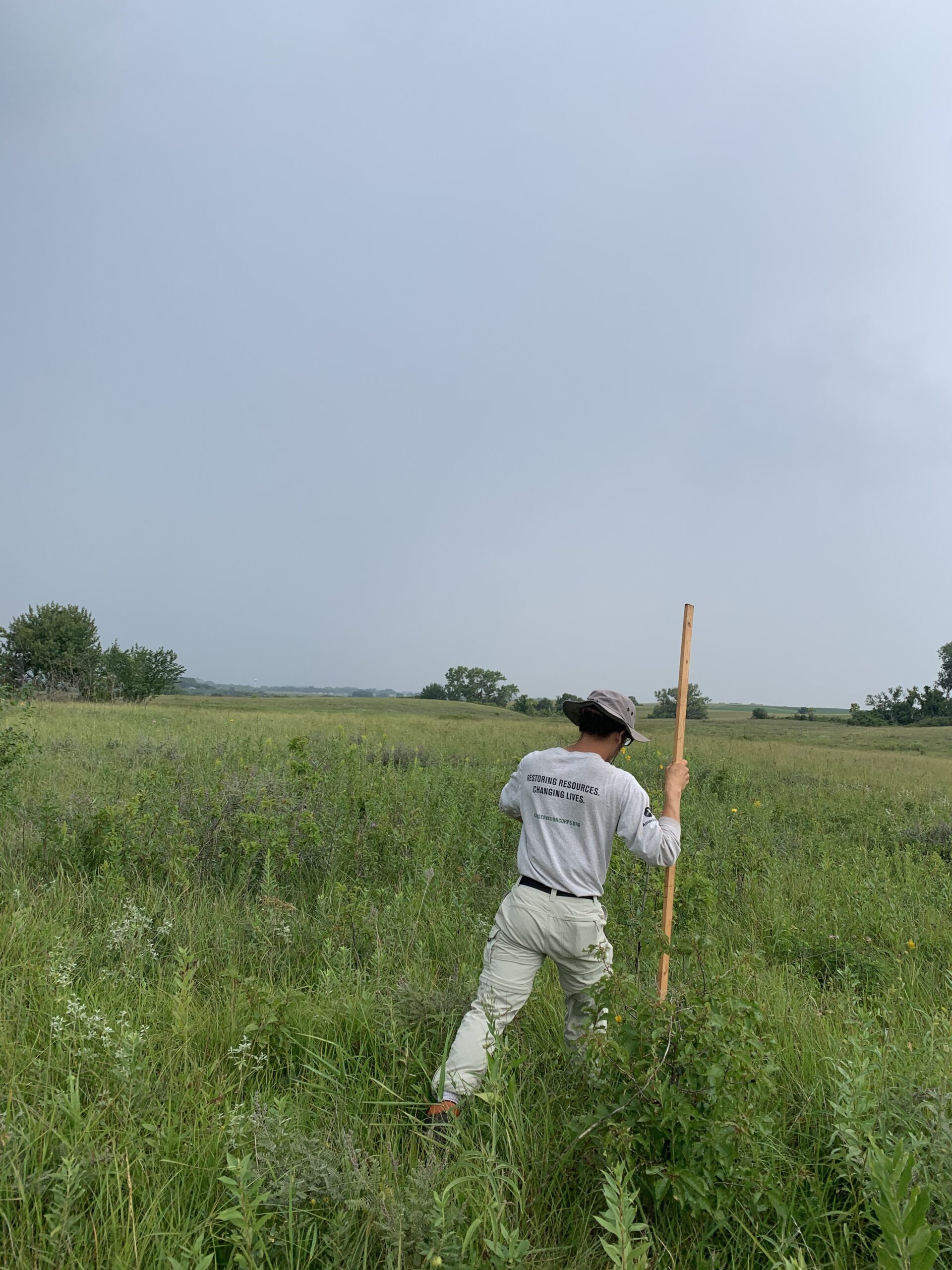
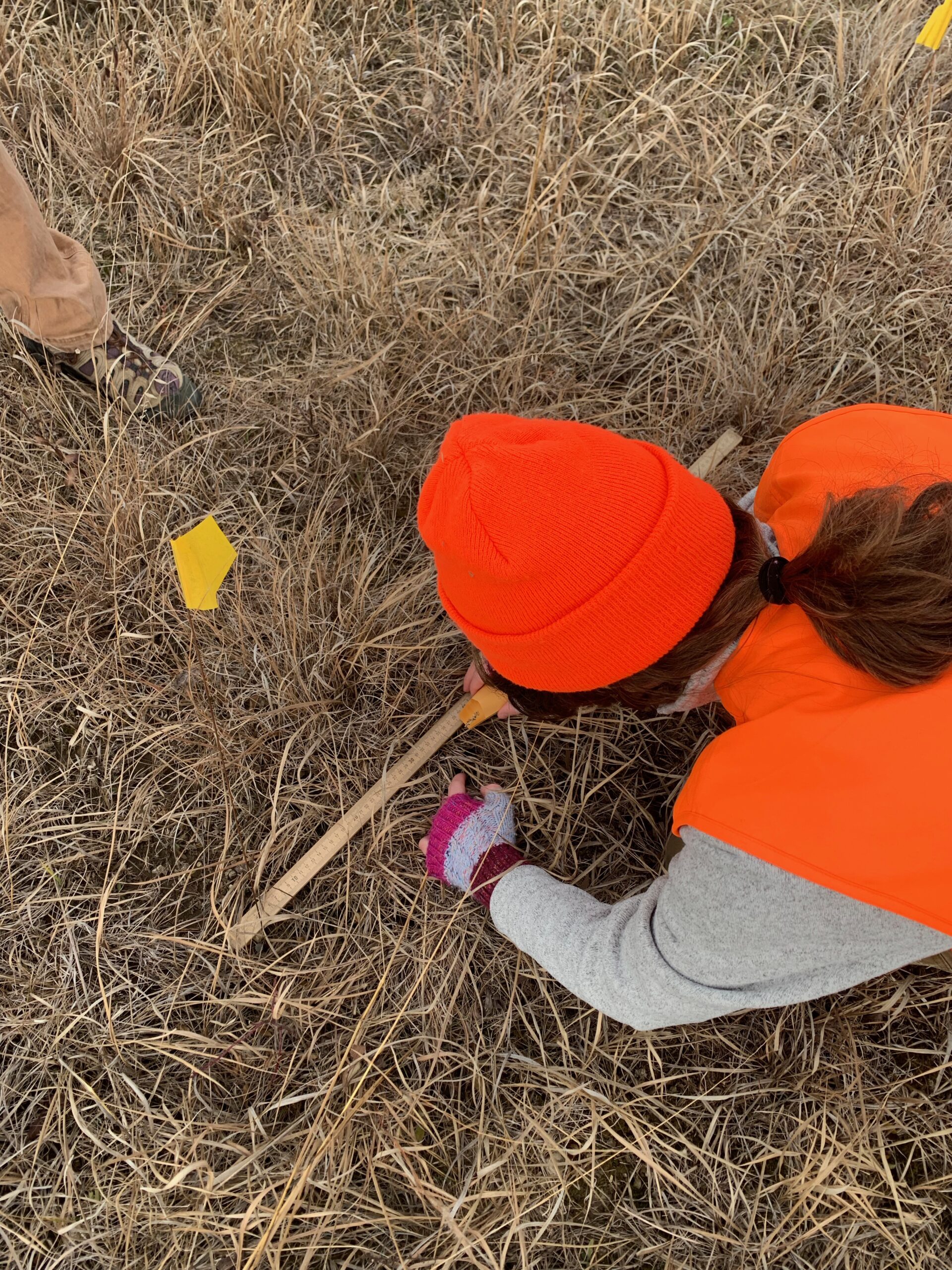
Liam Poitra, REU 2023, navigates to a floral assessment focal point at Staffanson Prairie Preserve. The 2-meter stick he carries will help keep track of what is in the bounds for survey.
Start year: 2023
Location: prairie remnants and restorations in Solem Township
In 2023, Team Echinacea did not conduct any fieldwork for this experiment.
Pollinator populations are declining worldwide, and pollinator habitat in western Minnesota has diminished over the years, but it is unclear whether the native bee community is changing as well. The Pollinators on Roadsides project, also known as the Yellow Pan Trap (YPT) study, is investigating how native bee diversity and abundance have changed from 2004-2022 and learning about whether the amount of agricultural land and grassland correspond to the nearby bee community.
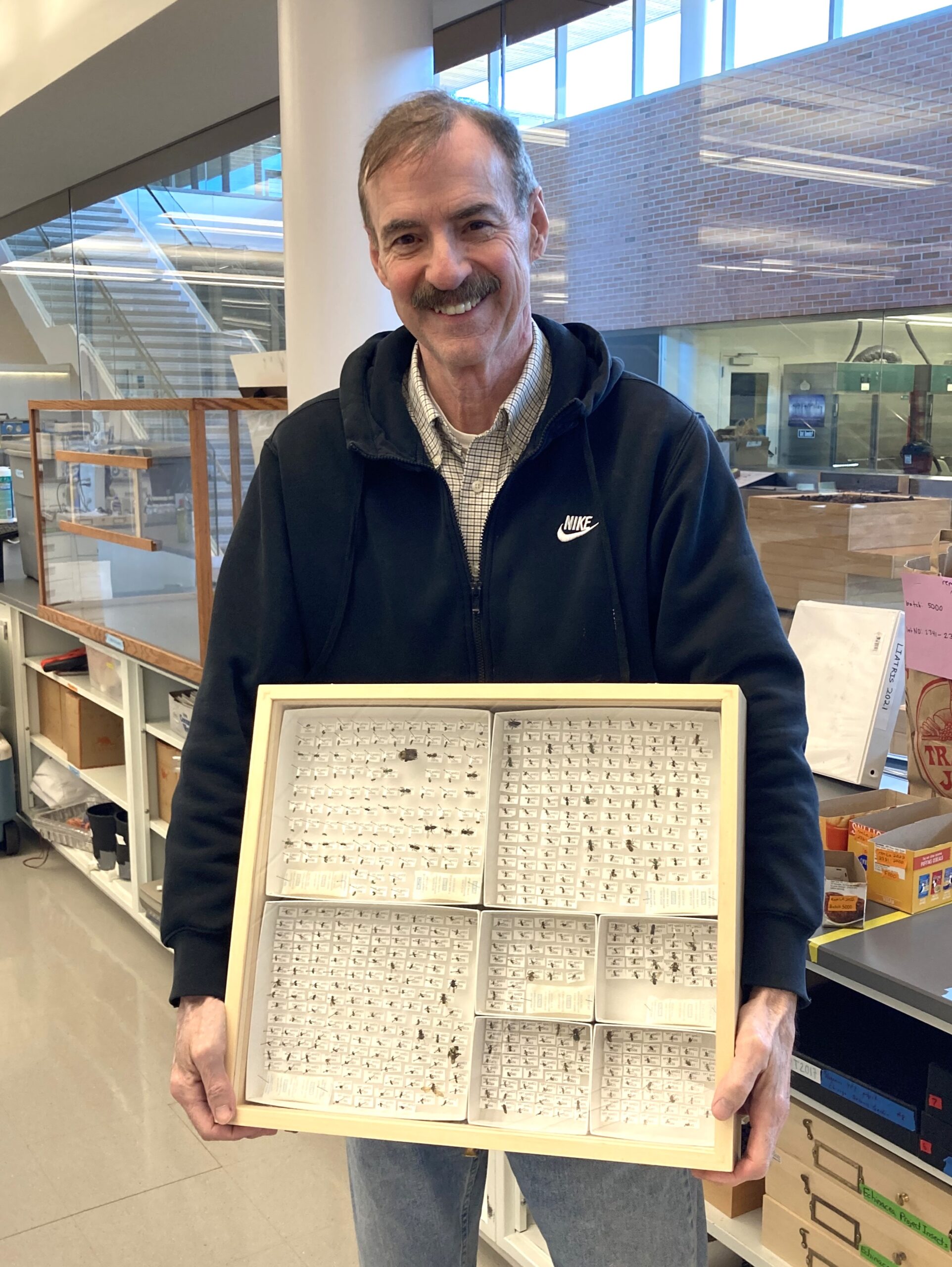
In the lab, rock star pinner and volunteer Mike Humphrey finished pinning all 789 bees from 2022 on 6 April, 2023. Intern Alex Carroll brought the bees to Zach Portman, the bee taxonomist at the University of Minnesota, for identification on 6 June, 2023. Zach recently reported that he’s all done with our 2022 bees, and we will be picking them up from UMN next chance we get!
Mike shows off a finished bee case
Alex worked to put datasets together (view in Dropbox/ypt2004in2017/yptDatasets/) for this experiment to prepare us for when Zach finishes his identifications. Alex also created this to-do list of next steps:
When Zach finishes identifying the 2022 specimens, fill in zachGenus, zachSpecies, and zachSex for 2022 spids.
Remove 2022 spids that are nonbees.
Update 2017 collectDate. In 2017, traps were put out one day and then collected the next day. Some of the 2017 dates are the day the trap was put out and some are the collection day. These should be standardized. MAS figured out most of the timeline here: ypt2004in2017/yptDataAnalysis2022/collectionDatesAndMowedTraps/2017listOfCollectionDatesAndMowedTraps-11-May-2022.csv These dates are based on the 2017 summer datasheets: ypt2004in2017\YPT2017\YPTsummer2017\ypt2017FieldDatasheets.pdf
Locate missing trap numbers for 35 bees, all collected on 07/26/2004. There is a memo for half of the traps collected on 07/26/2004, but half (the outerloop) are missing. See ypt2004in2017/YPT2004/yptMemos2004/ypt04-js.doc
Determine what to do about missing specimens. Some specimens were identified by Sam Drogee in the past, but we couldn’t find the bee. SW remembers that Sam took some specimens, so he may still have them. A few specimens have gone missing. See the notes column.
Summary
Start year: 2004, rebooted in 2017
Location: Roadsides and ditches around Solem Township, Minnesota. GPS coordinates for each trap are located here: ~Dropbox\teamEchinacea2022\YPTsummer2022\yptTrapLocations2022.csv
Zach Portman identified all specimens from 2004-2019, and the specimens are stored in eight cases at the CBG lab.
Mike finished pinning specimens from 2022 on April 6th, 2023. Alex delivered 2 cases of specimen to Zach on June 6th 2023. A little over a month ago, Zach said he had a backlog and wouldn’t get to them for a month. So, hopefully he’ll be working on them soon!
Team members involved with this project: Geena Zebrasky (2022), Mia Stevens (2020-2023), Alex Carroll (2021-2023), Erin Eichenberger (2019-2020), Anna Stehlik (2020), Shea Issendorf (2019), Mike Humphrey (2018-2021), John Van Kampen (2018-2019), Kristen Manion (2017-2018), Evan Jackson (2018), Alex Hajek (2017), and Steph Pimm Lyon (2004)
Funding for this project was provided by the Minnesota Environment and Natural Resources Trust Fund as recommended by the Legislative-Citizen Commission on Minnesota Resources (LCCMR). The Trust Fund is a permanent fund constitutionally established by the citizens of Minnesota to assist in the protection, conservation, preservation, and enhancement of the state’s air, water, land, fish, wildlife, and other natural resources. Currently 40% of net Minnesota State Lottery proceeds are dedicated to growing the Trust Fund and ensuring future benefits for Minnesota’s environment and natural resources.
You can read more information about the pollinators on roadsides project here.
I’m Rebecca Lerdau, a Junior at Carleton College. I’ve had a great time these past three weeks as a Carleton College extern at the Echinacea Project. I, and my classmate, Vo Dominguez were working with Jared Beck on the RemAg project looking at Andropogon gerardii’s (big bluestem) reproductive response to fire.
Having a good time counting the X-Ray images
A big part of our work has been with creating new protocols for determining Andropogon seed set. Previously, the main method for finding Andropogon seed set has been dissecting every floret, but this isn’t realistic on a large scale. Around half of Andropogon’s florets aren’t able to produce seeds, but it can be difficult to distinguish between the two types of florets. We wanted to figure out a way to use inflorescence mass to find total amounts of florets that can produce seeds. We were able to count awns and look at the relationship between awn count and mass. We found a beautifully linear relationship between awn count and seed mass (our R^2 = 0.96!) which allowed us to make an equation to use mass to determine the amount of fruiting florets. We set out to try X-raying Andropogon to determine seed counts. This was also successful, and we created a classification system for counting seeds with X-ray images.
We also got to try out our new seed set quantification system on some samples from the pilot RemAg experiment. We looked at the effects of burning on Andropogon seed set in 2022 from the pilot plots. While we were unable to find significant results with the data we were looking at, it was good to see that our protocols were working. The protocols are promising, and I look forward to seeing what happens with the larger RemAg project!
All in all, it’s been an awn-some experience working as an extern these past few weeks. I’ve learned so much. I’ve enjoyed getting to meet scientists and exploring CBG. We went on some lovely walks and got to see all sorts of cool plants. I had fun working with Andropogon and we even found a few seed predators! Thank you to Stuart, Jared, Wyatt, and Abby for this experience, and thank you to my fellow externs as well.
Biology Major with a focus in Ecology and Evolution, Carleton College, 2025
Pronouns: They/Them
Research Interests
Evolutionary ecology, prairie restoration with a focus on fauna community interactions to restored prairies, bees, anteaters, a number of other things.
Statement
I just had a great time working with the Echinacea project (or should I say Andropogon project) for a three week long externship with Carleton college.
My classmate, Rebecca Lerdau, and I were brought on to work with Jared Beck on the RemAg project, looking at big bluestem’s (Andropogon gerardii) response to fire.
We wrote a new protocol for assessing seed sets (the number of pollinated seeds divided by the number of viable fruits produced by an individual plant) for big bluestem. Previously, the only methods for assessing seedset in big bluestem involved dissecting individual seed cases. This method is extremely time consuming, and Echi-nation sustains too many seeds and not enough time or spare under-graduates for it to be a viable protocol for the scope of the RemAg project. Because of a lack of lab protocols for assessing big bluestem seed sets, this project has been sitting on hold in Jared’s office for a while, and we were really excited to help get it moving.
We found a strong relationship between the mass of subsamples of grass florets and the number of awns, a structure found only on perfect, viable Andropogon florets which allowed us to use mass to calculate awn count and awn count as a proxy for fruit count.
We also developed protocols for classifying florets and pollinated (containing a seed) or unpollinated (not containing a seed) from X-ray images. Using the number of pollinated seeds counted from the X-ray to calculate seed count and the awn count approximated by mass for the fruit count, we are able to efficiently classify big bluestem seed sets.
We used our methods to analyze some samples from a pilot RemAg study. Despite some issues with the study design, we were able to prove the feasibility of using our lab protocols to analyze RemAg data.
It’s been a great three weeks working with the Echinacea Project. I have greatly enjoyed making awn-some puns with my collaborators, meeting people at the botanic garden, inhaling Andropogon smut fungus, and proving to my family that I am a real biologist who knows how to use an x-ray machine. Thank you to Stuart, Jared, Wyatt, and Abby for making this experience possible.
I am an aspiring botanist. I am specifically interested in ethnobotany/economic botany.
Statement
I am from Newton Grove, NC. In my spare time I like to read, listen to sad music, cook, and try/make new hot sauces
Projects
During my Fall ’23 externship, I processed wmSP and wmS0 heads to be used for Wyatt Mosiman‘s thesis. I used the resulting reproductive data from said heads with the corresponding plant measure data to assess the relationship between cumulative vegetative effort over 5 years (2018-2022) and reproductive effort and success in 2023. The path to my materials is: ~/Dropbox/ccExterns2023/ioHarris
I want to study biology and learn more about plant science.
Statement
I am from Houston, Texas.
In my spare time I like to play the trumpet and play games.
Echinacea Research Project
Introduction
The goal of my externship was a research project about Echinacea where I asked two questions and then conducted a study. The first question is does having taller head height increase pollination rates by insects in Echinacea. My second question is does having more heads increase or decrease pollination by insects in Echinacea.
Background
Echinacea is insect-pollinated mainly by bees and other studies I found have shown that in plants like C. behrii and V. thapsus taller heads are more likely to be pollinated because they are more visible to pollinators. Since we don’t know if head height plays a similar role in Echinacea I am conducting this study to see if there is any correlation between head height and pollination rates in Echinacea.
Another study I found saw more heads leading to greater pollination rates. However, Echinacea is self-incompatible, meaning it can not pollinate itself, unlike the plants in that study so its possible that if an insect stays at a single Echinacea plant with more heads instead of moving on to other plants it could actually hurt its pollination rate. This led me to my second research question to determine if there is a correlation between number of heads and pollination rates in echinacea.
Methods
I used data from a sample of about 229 heads that were put through a data collection process aimed at separated and analyzing the achenes in Echinacea heads. Achenes are the fruit that contain seeds in Echinacea heads so by analyzing if they contain seeds or not we can gather pollination data for this experiment. In the first step of the process we cleaned the heads for achenes. Then we rechecked our first count for accuracy and scanned the achenes into the computer for counting. Lastly, we randomized our achenes, separated them to be x-rayed, and classified them to see which achenes contained seeds giving us our pollination rates.
Question 1
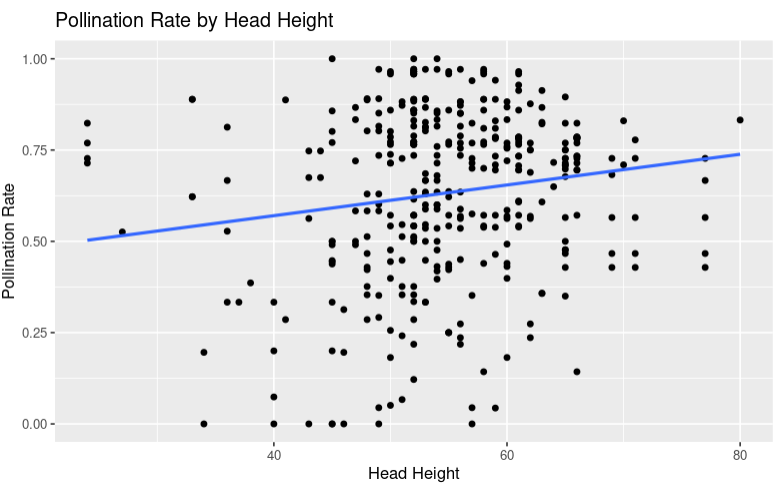
After the data collection process the data was compiled into spreadsheets that were uploaded into R. I put the data on a scatterplot with head height vs pollination rate to create a regression line that had a positive correlation but was also very scattered. To see if that correlation was significant I conducted a linear regression analysis and found that it was significant so taller head height does seem to be related to higher pollination rates.
Question 2
I used boxplots to visualize this data with number of heads for an individual Echinacea plant vs average pollination rate and the pollination rate seems to go up as number of heads increase, the opposite of what I was expecting with self-incompatibility. I then conducted an ANOVA test and found that the difference in average pollination rate by number of heads was not significant so number of heads does not seem to have an effect on pollination rates.
Conclusion
My results gave a positive correlation between head height and pollination rate and no correlation between number of heads and average pollination rate. However, a big limitation to my study was the sample size, especially for question two. Only having one data point for the 5 and 7 heads categories could have a large effect on the data. Lastly, since this was an observational study we can only infer correlation not causation so someone conducting an actual experiment would be a good direction to go in the future.
Acknowledgements and Bibliography
Bibliography-
Dickson, C.R., Petit, S. Effect of individual height and labellum colour on the pollination of Caladenia (syn. Arachnorchis) behrii (Orchidaceae) in the northern Adelaide region, South Australia. Plant Syst. Evol. 262, 65–74 (2006). https://doi.org/10.1007/s00606-006-0472-3
LORTIE, Christopher J., and Lonnie W. AARSSEN. “The Advantage of Being Tall: Higher Flowers Receive More Pollen in Verbascum Thapsus L. (Scrophulariaceae).” Écoscience 6, no. 1 (1999): 68–71. http://www.jstor.org/stable/42901102.
Ohashi K, Yahara T. Effects of variation in flower number on pollinator visits in Cirsium purpuratum (Asteraceae). Am J Bot. 1998 Feb;85(2):219. PMID: 21684905.
Wagenius S, Lyon SP. Reproduction of Echinacea angustjfolia in fragmented prairie is pollen-limited but not pollinator-limited. Ecology. 2010 Mar;91(3):733-42. doi: 10.1890/08-1375.1. PMID: 20426332.
Thanks to Wyatt and Abby for helping me with data collection, Stuart for helping me develop ABTs and to the National Science Foundation for providing funding.
Materials that were used for my project can be found in the filepath: ~/Dropbox/ccExterns2023/conlanRamirez
In July, 2023, a team from Minnesota State University, Mankato visited Team Echinacea to sample prairie soil. They are investigating how fire and management history influences physical, chemical and biological soil properties. Differences in soils may also help explain plant fitness and native bee nesting patterns. After three hot days, 263 samples were collected from 28 sites!
Back in Mankato, four undergraduate students processed the soil samples by sieving and weighing out the field collections. The preliminary results show soil bulk density is lower in remnant prairies compared to restored prairies. This makes sense in that remnant prairies have retained their organic-matter rich topsoil, infiltrated with plant roots and filled with pore spaces that develop over time in natural prairies. The soil bulk density is also lower on flat (no slope) topography, in part due to illuviation (deposition) of nutrients and organic material from nearby sloped areas.
The team hopes to continue its investigations to understand which soil properties are sensitive to different management histories and how the patchwork of fragmented prairies in the region vary in carbon, nitrogen and biological activity. These data should provide foundational information for many additional projects.
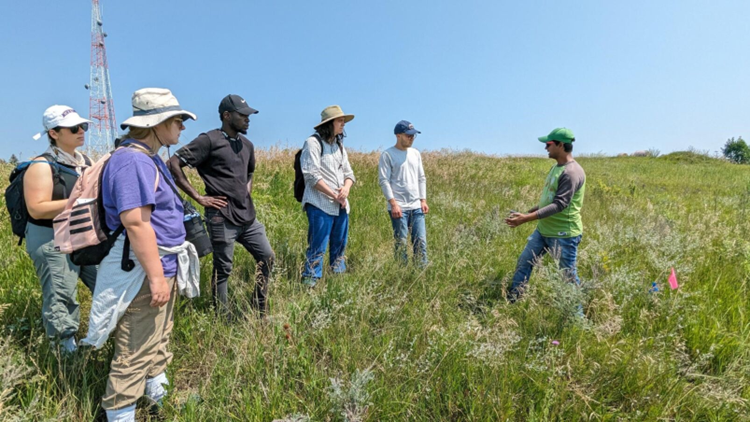
The Mankato soil team gathers around a bbPoint to discuss sampling. The team visited bbPoints in remnants and restorations over a 3 day period.
Start year: 2023
Location: : 28 study plots on private, federal and state land with different land use histories: remnant and restored grassland
Data collected: Soil bulk density, maximum water-holding capacity, gravimetric soil moisture content, soil aggregate stability (SLAKES), total organic C, total N, inorganic N (plant available forms: ammonium and nitrate), aerobic respiration rate (proxy for microbial activity and decomposition)
Samples or specimens collected: Topsoil bulk density and additional soil (top 15 cm) for each bee nesting trap
In 2021, Team Echinacea established 76 transects (each 4 m long) across 32 patches of remnant prairie in the study area. We planted seeds in one randomly selected segment per transect in fall 2021 but germination trials in the lab and seedling searches in the remnants during summer 2022 revealed that we had used a bad batch of seed
In fall 2022, we repeated seed addition experiment using seed harvested in summer 2022. Stuart, Lindsey, and Alex sowed seed within randomly selected segments in November 2022. For fall 2022, we added 12 seedling transects (beng, fern, hutch, torge) and eliminated transects at two disturbed sites with the goal of maximizing variation in fire history across the study area. We sowed seed in 84 transects across 36 remnant prairie patches in 2022. In 54 segments, we added 50 seeds and at 30 randomly selected segments, we added 100. This variation in number of seeds sown will allow us to understand the implications of seedling density.
Cut to 2023! In early June, Team Echinacea searched for seedlings once again, this time, with more success. We found 260 seedlings in total across our 84 transects during our seedling searches (we did two rounds).
In August we returned to our transects and assessed survival of the seedlings that had emerged earlier in the season. Stay tuned for more information on seedling mortality.
We also measured light availability (using a light meter) and soil compaction (using a soil penetrometer) at each of the segments along the transects. This information will give us a better sense of the conditions under which seedlings emerge and survive. And importantly, how does fire influence these conditions?
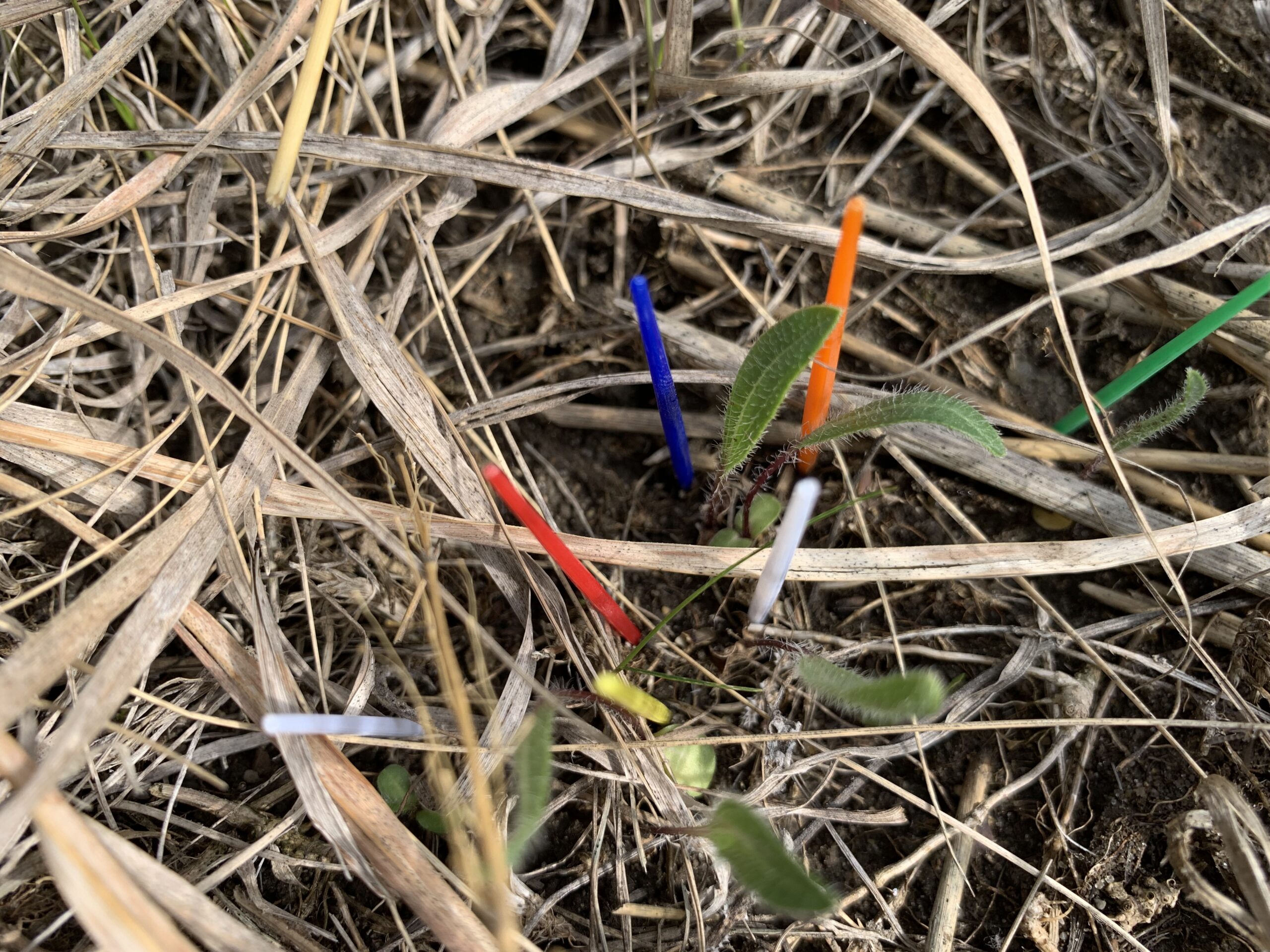
I spy seedlings! During our search for Echinacea Seedlings, we used toothpicks to keep track of individuals.
Team Echinacea didn’t stop there. In November of 2023, we went back to Minnesota and sowed seed in randomly selected segments in our 84 transects. Stay tuned to see what emerges in the spring!
Wyatt sprinkles seeds along a seed addition transect during a trip to Minnesota in November!
Start year: 2021
Location: 36 patches of remnant prairie in and around Solem Township, MN
Data collected: Seedling search data, par data and soil compaction data are all stored in ~repos/seedaddexpt. Additional information is stored in ~/Dropbox/burnRems/seedExp”
Samples or specimens collected: NA
Products: Daytona, summer 2023 high school research participant, used the data to ask, “does time since last burn treatment affect seedling emergence?” Materials for this project are located in ~”/Dropbox/teamEchinacea2023/daytonaHoberg”
You can read more about the Fire and seedling fitness in remnants experiment, as well as links to prior flog entries about this experiment, on the background page for this experiment.