|
|
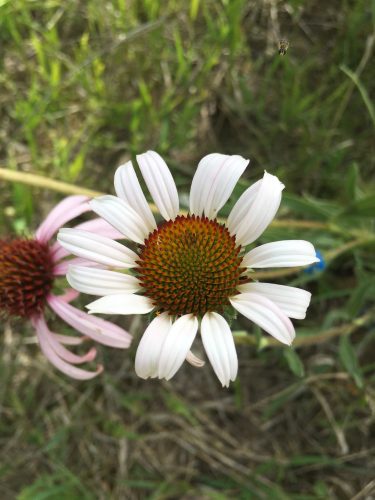
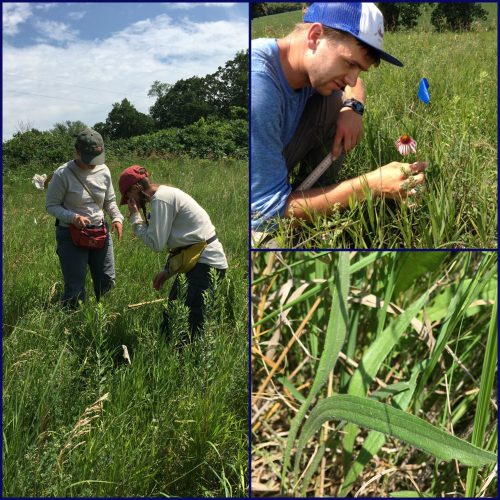
Another fun phenology Monday! We got a lot done this morning. The time it takes to get phenology finished has decreased as we have all gotten more efficient and many of the Echinacea are done flowering. Ashley and Gretel did p2, Wes did the Nessman/Aanenson route, Anna and Alex took Staffanson, and Will and I took the Around Landfill route. I was excited because my route today includes my favorite plant. It’s in the northwest corner of East Elk Lake Road.
 One of the heads on my favorite plant. First day flowering at East Elk Lake Road.
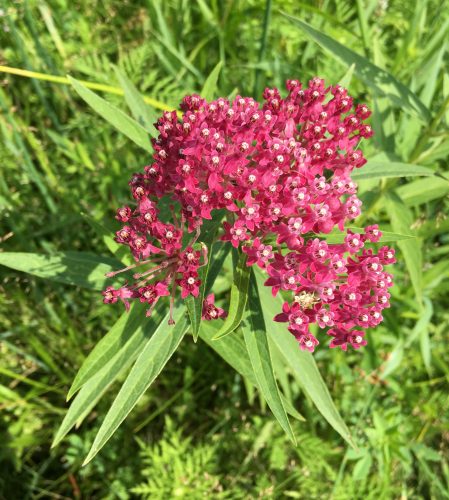
After finishing up phenology Will and I GPSed plants at the rest of the phenology remnant sites. As of now, all plants in the phenology dataset should have a matching location! We had a couple extra minutes before lunch, so we ventured into an island within a corn field near Stevens Approach. We found a lot of cool plants there, including some swamp milkweed.
 Swamp milkweed, a very beautiful milkweed.
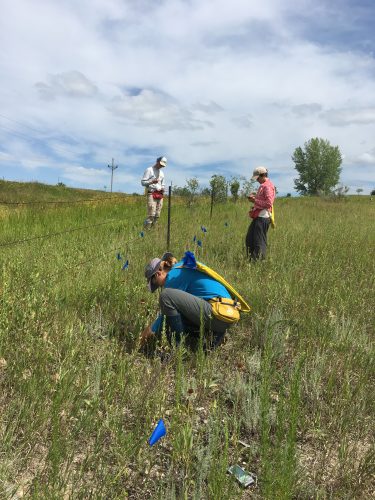
After lunch we headed out to do flowering demography at Loefflers Corner West. I liked being at a new site and seeing some new plants there.
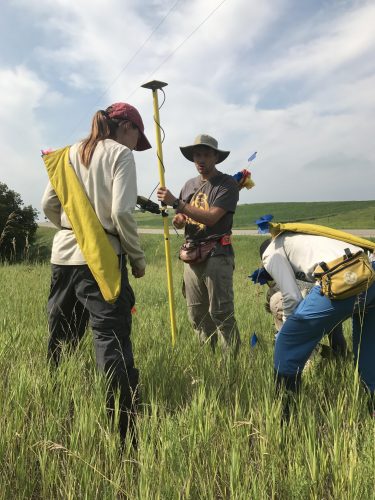
Anna, Will, and Gretel flagging and entering data on flowering plants at Loefflers Corner West.
See you tomorrow, flog!
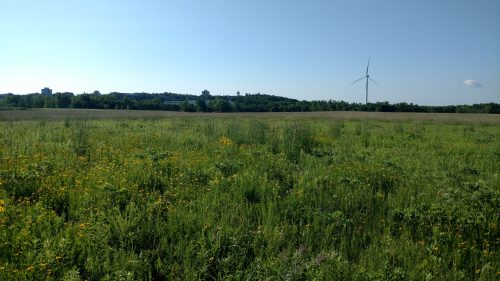
I went home to see my parents this weekend in Northfield, MN, and had a wonderful time! This morning my mom and I biked around the St. Olaf College Natural Lands to see prairie flowers in bloom. When we got home we had a big breakfast of blueberry pancakes with some family friends. Then we spent the day working in the garden weeding and picking ripe veggies. Yum!
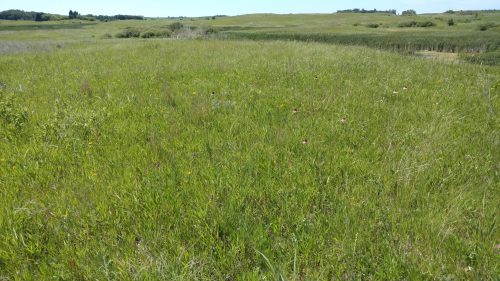
 The St. Olaf College Natural Lands in full bloom.
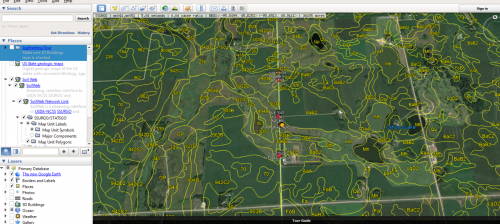
This summer I am going to be using Google Earth Pro and Rstudio to plot the GPS points of Echinacea plants. From there I will use an application called Soilweb to determine the type of soil where these points/plants are. I will then look into the different characteristics for that soil such as water holding capacity, nutrients, texture, or cation exchange capacity.
project prop. Anna V. Soil

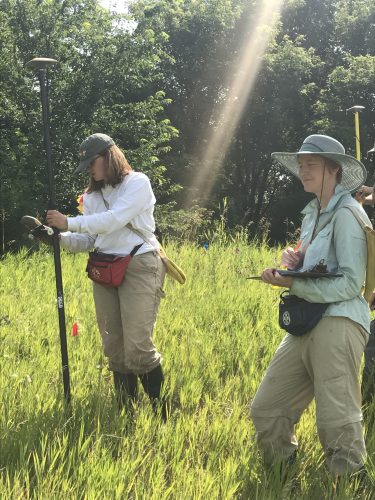
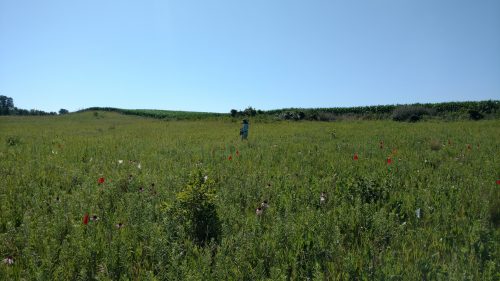
“I love PBORY” – exclaimed Lea as we headed out to learn the total demo protocol. PBORY is the acronym for the order we place flags at the locations of plants that we collect demographic data at. First a gps operator finds the plants using coordinates from previous years, they then place a flag at the location. The color of said flag is dictated by the number of the location they are at. If the location number ends in 1 the the operator puts down a pink flag, a 2 gets a blue flag, 3 gets orange, 4 gets red, and 5 gets yellow, hence PBORY. The acronym helps the team keep the locations straight and get the correct demographic info for each location. The demographers follow the gps operator and collect info at each of the locations.
All of the data we are collecting contributes to the over 20 year long demographic census of Echinacea angustifolia. Some plants have been alive the entire time!
Today we did total demo at our “south of golf course” remnant population which is new to much of the team since we are not collecting phenological data from that population.
We found lots of plants that were still alive from 10 or more years ago, some were even completely surrounded by poison ivy.
“I love PBORY” Wes , Tracie, Anna, and Gretel do Total Demo at South of Golf Course
It’s phenology Wednesday, and you know what that means! Team Echinacea headed out to our experimental and remnant sites to assess Echinacea phenology. Will and I took the Around Land Fill Loop, while the other teams tackled p2, Staffanson, and our other remnants.
On phenology days, I collect pollen as I collect data because my personal project requires ample pollen. That doesn’t mean the pollen is abundant, however. Today, while I found anthers with copious pollen at Around Land Fill, I had to battle ants off of the Echinacea heads, and to collect data, I often had to wait for ants and other critters to walk to the ray florets, away from the immature florets I needed to count. Collecting what I believed to be enough pollen wasn’t an issue once I had shooed the critters, and Will and I headed back to the Hjelm house to check p1 by 11:00.
About two-thirds of the way through collecting data in p1, I saw raindrops smearing my check marks on the clipboard. Will suggested we get our rain jackets from inside, and we started to head back, but we stopped to look at a few more heads. Then, Stuart advised us to go in, and thunder clapped. About 15 minutes later than everyone else, Tracie and Anna came in from Staffanson. To our dismay, Tracie had lost her phone at Staffanson, and the rain was incessant, meaning immediate recovery was delayed. While rain poured over the research base, lightening flashed, and thunder shook our chairs, Tracie and other team members strategist a way to recover her phone. The solution: a systematic search of the area where she last saw her phone. We ate lunch, visited with Amy and her student, and headed out to Staffanson to find Tracie’s phone. We searched for about 10 minutes; then, Tracie found her phone! Woohoo!
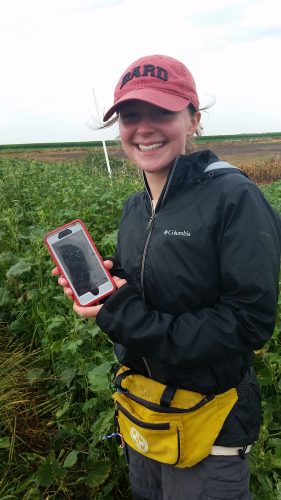
 Tracie moments after recovering her phone at Staffanson Because the search took a lot less time than we anticipated, Tracie helped me with my afternoon task of counting, pollinating, and painting my experimental plants. Pollination was going steady for the first 40 minutes, but then the rain set in, and my pollen started to clump, and I used a lot of the remaining pollen on a few styles. Half way through one of my pulse treatments, I ran out! Without much trouble however, Tracie and I drove to a nearby remnant to collect the rest of the pollen I needed, the rain let up, and I was able to finish my daily pollination.
After our field day, we came home and got ready for dinner: wing night at Angelina’s! We shared lively conversation, and met up with another research team in the area for cookies and socialization.
In the style of our new Twitter page @echinacea_rates, I give today a 12/10 for turning itself in a great direction.
Today everyone went to work right away on their projects. Ashley headed back out to Nice Island to do more pollination and she hopes to report more results soon! Wes headed out to Hegg Lake to continue his vegetation analysis- check out his project in the previous post. Lea and Tracie went around to some of the sites for Lea’s experiment and recorded data. Alex spent some time sorting, counting, and identifying the bees from his yellow pan traps. Will did some more work on R studio. And I spent some time learning more functions on R and becoming more familiar with the soil web application I am using for my project on Google Earth Pro.
 Ashley and Tracie measuring in p1, Wes determining the number of leaves on a flowering Echinacea, and a basal Echinacea plant in p1. After lunch, we all headed out to p1 to continue measuring. With everyone working hard, we completed the first page of measuring for the fitness experiment. Ashley and Tracie even found at 2 “rogue” plants. These were marked as staples last year, but this year were very much growing Echinacea! By the time measuring wrapped up for the day, we were almost half done with the next page for the 96′ and 98′ plants!
Also, make sure to follow “We Rate Echinacea” on twitter! And send in your pics of Echinacea angustifolia to be rated!
Tomorrow the game plan is phenology in the morning, a visit from Amy D., and demo.
Stay tuned and until next time!
This summer each of us are choosing a project to work on alongside the long-term Echinacea Project research. I am interested in plant communities and the interactions that occur within themselves and with other communities. The following is my proposal for a project investigating the plant communities at Hegg Lake Wildlife Management Area near Kensington, MN:
Braker_Hegg_Lake_Plant_Community_Proposal
-Wes
Hegg Lake with Echinacea
It’s phenology Monday!!!! Everyone headed out to different remnants and experimental plots to collected data on flowering Echinacea. Lea, Ashley, and I took care of experimental plot 2 at Hegg Lake.
Lea phenologizing P2 In the afternoon it was hot! We measured basal Echinacea plants in experimental plot 1, then we split up into different projects. Anna and I worked on the group aphid project by excluding and adding Echinacea-specific aphids to various plants. Ashley and Gretel pollinated and painted heads for Ashley’s project. Tracie, Will, and Stuart worked on data organization.
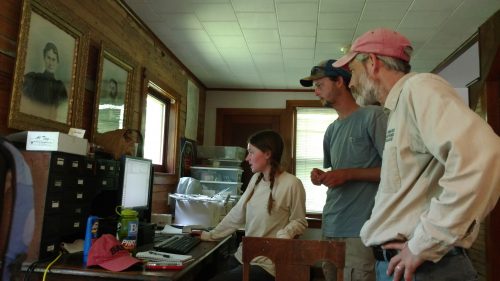
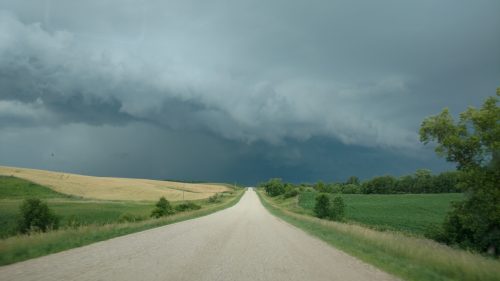
Tracie, Will, and Stuart mull over data. Just before we finished for the day a large thunderstorm appeared and moved in. It made for quite a beautiful sight on our drive home!
Thunderstorms over Solem Township Happy Monday!
Wes
Today the crew at Andes decided to go out to breakfast! We found a cute spot and enjoyed our large breakfasts and unlimited coffee. After grocery shopping and a variety of other chores, we ended up back at Andes where Tracie made an amazing dinner. She made an Indian curry, with home-ground spices and coconut milk, topped with puff pastry. It was amazing. Overall we had a fun and relaxing Sunday!
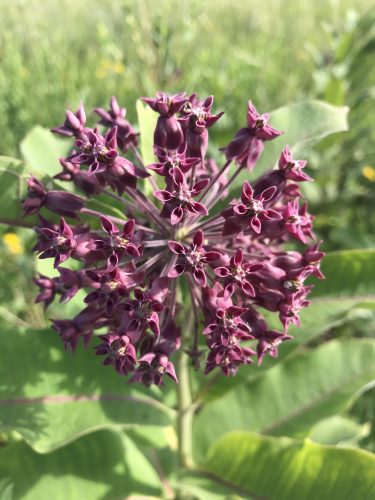
Flowering milkweed!
Today was a perfect sunny day in Minnesota!
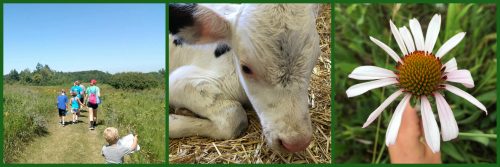
I went hiking with some cousins at Glacial Lakes State Park and saw some awesome native prairie. I then went out to the dairy and helped with some of the baby calves. Other members of team Echinacea worked on their projects and some traveled down to Minneapolis.

It’s hard to believe that July is half done! Looking forward to more flowering Echinacea and other fun!!
|
|