|
|
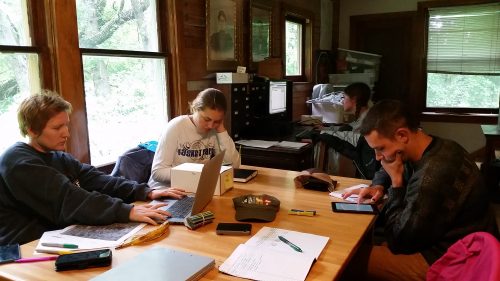
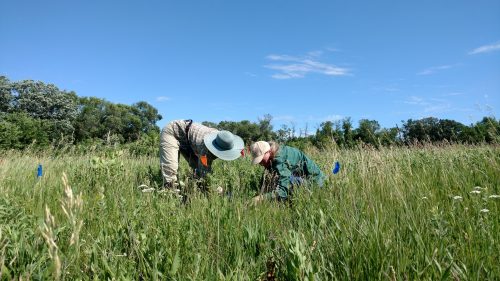
The Andes crew made it to the Hjelm house by 8:30 this morning, and we were all dressed in our warmest field work clothes. We sat down at the picknic table and planned out our day, which (at the time) included measuring in p8, collecting phenology data at Staffanson and some other remnants, and discussing summer research projects. We decided to start our morning, we would break up into groups and while one group visited Staffanson and started marking the belt transect, the others would begin GPS-ing and identifying Echinacea in other remnants. That was our plan. As soon as we gathered our flags, pouches, visors, and GPS units, we felt some light sprinkling. We all looked at each other. Surely the light rain would stop soon. Ten minutes later, we were inside working on our individual research projects as we waited out the storm that proved to last longer than we expected.
 Lea, Anna, Tracie, and Alex spent the rainy morning working on their individual research projects. Within an hour, the bout of rain had passed, so we once again gathered our flags and other materials. Alex, Will, and Anna went off to Steven’s Approach and Town Hall to find flowering Echinacea and collect GPS points. Between the time they left and the time my team was out the door, it began to rain again, so we stayed inside and continued to work on my project. Thirty minutes later, Anna, Will, and Alex returned soaked from the rain. Like the troopers they are, they stuck out the rain out as long as possible before it became unreasonable for them and the equipment.
Over lunch, we talked about how cold we were, and as soon as we finished eating, we went inside and made hot tea. Then, Lea, Alex, and Will gave presentations about their summer research objectives. Lea wants to use a drone to assess floral resources, and Alex wants to replicate the yellow pan trap experiment of 2004 to find out whether there has been a change in pollinator diversity in the area. As a group, we discussed the possibility of them working together to collect data.
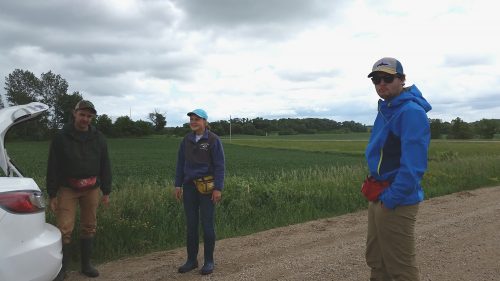
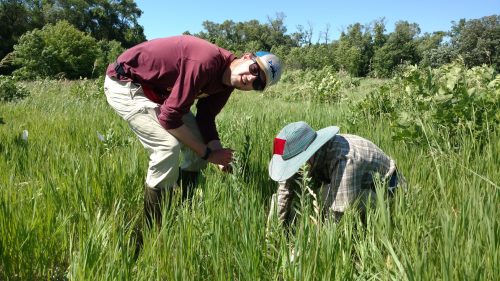
Finally, after lunch and our long discussions about summer research, we were able to collect data! I went with Alex, Anna, and Will to Steven’s Approach and Town Hall, but not long after we made it to the site, rain began to fall again.
Alex, Anna, and Will are sad after the rain starts again. Nevertheless, after the rain ended, we were able to collect all the data we needed for the day. I even found an 8-headed Echinacea! Woohoo!
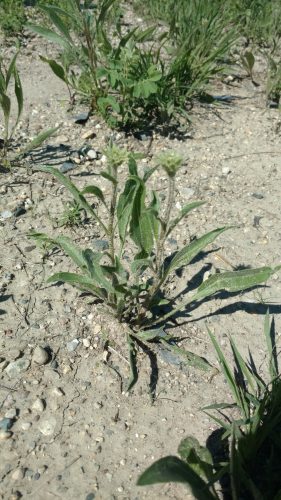
 One of the many-headed Echinacea I found today. What a beauty! We didn’t quite get to measuring in p8 today, nor did we get to Staffanson, but we will have time next week to complete our tasks.
That’s all for today,
Ashley
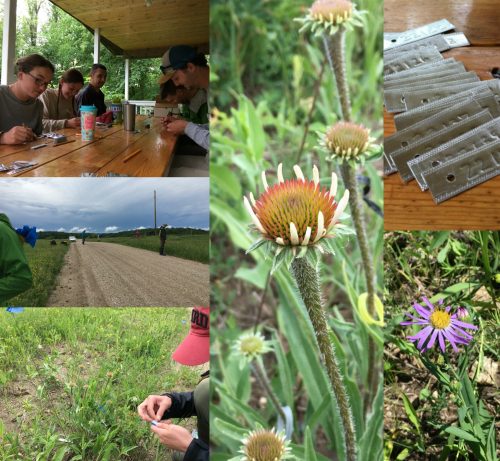
Our day began a little damp due to some rain that had passed through the following night. However, we made the most of the time and situation and started our day by making aluminum tags for flowering echinacea plants. After this, we ventured out into p1 to battle with more invasive weeds. This time our opponent was the anything-but-sweet, sweet clover. Luckily, it came out much easier compared to the hawkweed.
After we did some sufficient weeding, we moved on to tagging and recording of near flowering echinacea plants at Stevenson’s Approach. Each purple coneflower with a bud was marked with a flag, colored twist tie, and aluminum tag. There were multiple plants near flowering, but the big highlight was one with at least seven heads!
At lunch we listened to project ideas from Wes and Anna, and Ashley. Wes and Anna are looking into a project that would involve taking a vegetative analysis of Hegg Lake and some smaller remnants. After creating some sort of species list, they would look into some differences and possibly good areas to collect seed. Ashley is looking into creating an experiment that would test how style emergence and persistence impacts the seed quality of echinacea. Everyone took part in discussions about how each project could be improved or advice on different methods to carry out research.
By the afternoon, the sun was out and we headed to P8 to continue measuring plants in the q2 and q3 experiment. While measuring we came across a flowering smooth aster. They usually don’t flower until later in the summer, so this was a strange and fascinating surprise!
Hopefully some echinacea will be flowering soon!
 (From top left clockwise) Making tags, an echinacea with present rays, tags, the early smooth aster, and recording at Stevenson’s.
Ok….so…uhhhh… the title isn’t completely accurate. But everything there did occur today at some point.
We started off another beautiful day by finding and destroying all Hawkweed in Plot 1. Once all nasty yellow flowers and their basal offspring were dealt with, we all turned our attention to removing all flowering sinful plants (Bird’s Foot Trefoil) from the roadside and ditch surrounding Plot 1. This effort took most of the morning, with the remaining couple hours spent looking for toothpicks in a Brome field, with small Echinacea attached.
After returning to Hjelm House after measuring, we all had a relaxing lunch and then listened to Amy Dekstra give a talk on her research using Echinacea to look at population size and inbreeding and outbreeding depression. Super fascinating stuff!
In the afternoon we measured more Echinacea plants and found several new Echinacea plants that hadn’t been logged previously. Woot (Note the pure ecstasy on Will’s face)!
We were all treated to a personal snack-time with the goats that have returned to the farm to enjoy chomping on Buckthorn. The Andes crew headed to Alexandria to enjoy a dinner of chicken wings and good company.
Looking forward to more sunny days and blooming Echinacea!
WB
Hello flog!
My first day to post in 2017 was quite an exciting one. Ruth Shaw visited today, coming from the twin cities to help us with field work and explain some really cool results of research done in p1, the first common garden. As Ruth explained at lunch, there is still much to learn about evolution, particularly in learning how to predict future evolutionary potential in populations. Ruth and Stuart have been working for many years to understand how we might be able to do just this by studying “additive genetic variance” in the Echinacea planted in p1 and p8! Cool results are sure to come, so stay tuned for updates in the future.
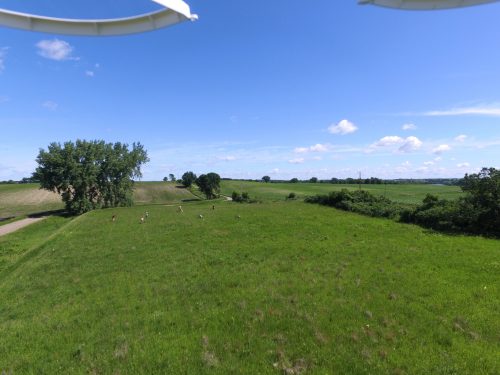
Another fun aspect of today involved getting the drone up and flying! This summer, I’ll be using the drone to try and quantify abundance of flowers in roadsides around Solem Township. Today I updated the firmware and tried a few trial flights over p1.
 This is what p1 looks like from above today! Flagging in p1! After work, I drove to Alexandria to pick up our first CSA box from Sundog Farms! Until next flog…
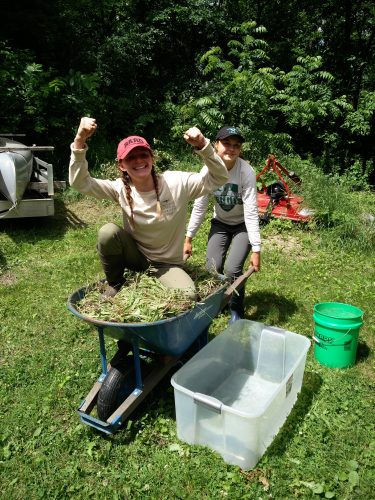
Hawkweed, hawkweed, hawkweed! We started off today pulling the invasive weed out of the P1 plots. For a long time, it seemed like wherever I looked, I saw basal hawkweed! The summer 2016 Echinacea Project team was best removed with hand tools, so this year we used garden knives to take out as much of the roots and runners that we could. We removed so much of this weed, we were able to fill a whole wheelbarrow!
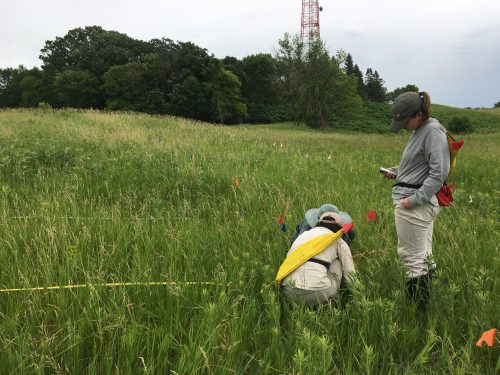
 Tracie and Anna goofing around on the hawkweed mobile (aka the wheelbarrow). (19 June 2017). After lunch, we set up the P2 plot at Hegg Lake. We first marked the beginning and ends of each row. We then placed flags every 5 meters along each row. It was a lot of work, but once we finished, P2 looked all ready for the rest of the summer!
Team Echinacea spent our Sunday morning relaxing around Andes Tower Hills. Over breakfast and coffee, we decided on a time to leave for the Runestone Days lunch buffet and parade. A bit later, I walked around the Andes property to investigate the nearby lake and enjoy the late morning’s cool breeze. Even though I’ve been in Minnesota for nearly a week, I am still refreshed by the temperate climate and the vast stretches of prairie-covered hills in this area.
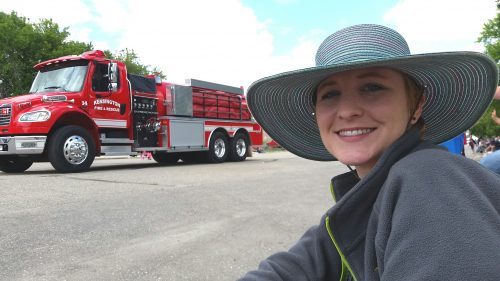
By the time I walked back to our cabin, the rest of the team was ready to head over to Kensington to feast at the Father’s Day buffet. Wes gathered his tuba, we all gathered our appetite, and soon enough, we were enjoying delicious fish, carrots, potatoes, and pudding. Yum! Around 1:00, Wes headed out to meet up with the Morris County Band, so they could rehearse before floating in the parade. The other four of us enjoyed the beautiful weather as we watched. We collected candy and ice cream treats distributed by parade participants, and we cheered for the Morris County Band when their float passed. What a fun afternoon!
Now, Leah is setting up her drone, others are relaxing, and I have plans to continue research on my REU project. I’ve enjoyed my relaxing weekend, but I’m ready to continue work in the prairies tomorrow!
Ashley
Leah watching the Runestone Days parade.
Today was our first day off since we started, I spent the day reading and drinking coffee at home in Alexandria, the rainy afternoon made it less desirable to partake in outdoor activities.
As for the rest of Team Echinacea, the world may never know what they did on their first Saturday at Andes Tower Hills, but Kensington Runestone days are this weekend and there were city wide garage sales that some members of the team planned to visit and search for treasures, maybe some miscellaneous viking artifacts. I will let them post about their exciting finds.
Will
Today was the third day in the field for Team Echinacea 2017. We all started out in P1, where we split up and did various tasks. Alex and Ashley took on the riskiest task and weeded some invasive bird’s foot trefoil around the plot that was among some poison ivy. Will, Lea, Wes, and I got the 10-meter signs and flag markers up and organized. Stuart and Anna started taking on the invasive hawkweed that has been getting into the plot and spreading, and eventually all of us were wrestling with it. The hawkweed has some incredible rhizomes that spread around to nets and nets of rosettes. Will and I found an estimated 45% hawkweed cover in one part of the plot. Here are some of the comments you might have heard from all of us while trying to get these out of the ground:
“Anytime you think you’ve found them all, you haven’t.”
“You will be champion of the longest rhizome!”
“I think I am becoming allergic to hawkweed.”
Weeding was fun, but I think we were all ready for lunch when it came around. At lunch we talked about doing a yellow pan trap experiment this year to catch and identify bees and see how their abundance and diversity relates to surrounding vegetation. Lea also gave an intro to her experiment for the summer, and we talked about potential REU projects.
After lunch we headed over to P8 and started learning how to collect data on the Echinacea growing there. Returners helped the newcomers start to get a hang of navigating the plot site, collecting data on visors, and finding and measuring Echinacea. We finished the day with a watermelon on the porch.
It was a great week. I’m excited for more.
Tracie
Lea, Gretel, and Ashley in P8.
Hello Echinacea Project Fan Base!
Today the group split up as we continued getting oriented with the project. Five of us went out to examine Railroad Crossing and Loeffler’s Corner prairie remnants. We split into two groups and analyzed each remnant to determine the species makeup, disturbance history, and land history of each remnant. After taking time in each of our groups, we came together and discussed what we saw and learned. Alex was our wonderful guide and was able to give plant information. After remnant analyzing, Alex gave us a driving tour of a couple of other prairie remnants during which we stopped to examine some Echinacea angustifolia whose buds were showing. Yay flowers!
Before and after lunch, Stuart gave everyone a power point presentation on details of the project and past and current results and data. Next, we weeded Bird’s-foot Trefoil from the roadside near an experimental plot and created a path from Hjelm House to that same plot. We then went over the organization of some experimental plots and learned how to use our high-tech data collection devices (see attached image).
Hopefully more sun is ahead!
Wes
Today was the first day in the field for Team Echinacea 2017, and it couldn’t have been a better day! This weekend was hot, humid, and stormy in MN. Today was much cooler with a pleasant breeze all day. We started the morning with introductions and learning about safety and general Echinacea info. We learned about all of the dangerous plants and animals in our study site. The worst by far must have been death camas which you shouldn’t eat because it will kill you. After learning about safety we headed out to Staffanson Prairie Preserve to see some of the native (and non-native) plants that we will see during the summer. We spent the majority of the morning meandering around Staffanson pointing out new plants and discussing the history of the land, and then headed in for lunch.
We assessed everyone’s various skill sets at lunch so that we could form the Ultimate Team Echinacea by building on eachother’s strengths and skills.
Hegg lake WMA was our second stop of the day where we discussed the differences in the plant communities within the site and between the site and Staffanson. We then said our good-byes for the evening.
Goodnight Flog,
Will
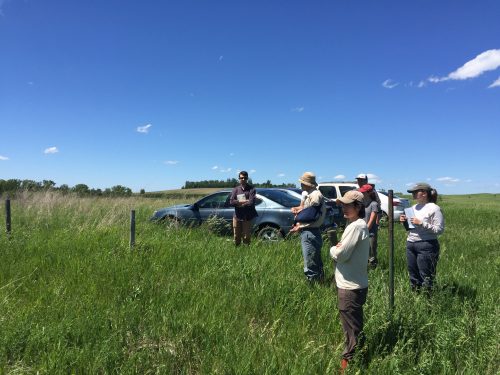
Team echinacea learns.
|
|