|
|
This project investigates the role of three fundamental constraints on mate availability – temporal asynchrony, spatial isolation, and reproductive incompatibility – in remnant Echinacea angustifolia populations. During the summer of 2014, we conducted two studies related to The Mating Scene project. In the first study, we mapped 991 Echinacea plants and monitored the phenology of 1360 flowering heads across 31 remnants to quantify spatial isolation and flowering asynchrony. At the end of the season, we harvested 193 flowering heads from 25 remnants to assess seed set. In the second study, we performed 364 pollen crosses to characterize patterns of reproductive incompatibility within 10 remnants. With the data collected in 2014 and subsequent years, we aim to elucidate how the interactions between temporal asynchrony, spatial isolation, and reproductive incompatibility influence reproductive fitness in fragmented prairie remnants.
|
site |
# of flowering plants |
# of flowering heads |
# of crosses |
# of heads harvested |
| 1 |
aa |
60 |
83 |
36 |
5 |
| 2 |
alf |
63 |
78 |
|
6 |
| 3 |
btg |
3 |
3 |
|
2 |
| 4 |
dog |
1 |
2 |
|
|
| 5 |
eelr |
33 |
17 |
28 |
5 |
| 6 |
eri |
38 |
54 |
|
5 |
| 7 |
eth |
9 |
46 |
|
5 |
| 8 |
gc |
6 |
6 |
|
3 |
| 9 |
kj |
7 |
8 |
|
5 |
| 10 |
lce |
90 |
70 |
24 |
5 |
| 11 |
lcw |
51 |
95 |
24 |
5 |
| 12 |
lfe |
64 |
103 |
24 |
5 |
| 13 |
lfw |
89 |
57 |
24 |
6 |
| 14 |
ngc |
8 |
5 |
|
|
| 15 |
nnwlf |
2 |
13 |
|
5 |
| 16 |
nrrx |
20 |
25 |
|
5 |
| 17 |
nwlf |
13 |
16 |
|
5 |
| 18 |
on27 |
92 |
96 |
42 |
5 |
| 19 |
ri |
82 |
112 |
44 |
5 |
| 20 |
rrx |
43 |
47 |
33 |
5 |
| 21 |
rrxdc |
3 |
3 |
|
2 |
| 22 |
sap |
29 |
13 |
|
5 |
| 23 |
sgc |
8 |
243 |
|
5 |
| 24 |
SppE |
92 |
81 |
41 |
42 |
| 25 |
SppW |
51 |
38 |
44 |
42 |
| 26 |
th |
8 |
9 |
|
5 |
| 27 |
tower |
7 |
11 |
|
5 |
| 28 |
waa |
4 |
8 |
|
|
| 29 |
wood |
4 |
4 |
|
|
| 30 |
yohE |
4 |
5 |
|
|
| 31 |
yohW |
7 |
9 |
|
|
Start year: 2014
Location: Phenology in 31 total remnants, compatibility in 10 remnants
Products: The phenology and compatibility datasets need to be made readyR. The harvested flowering heads are being processed at the Chicago Botanic Garden.
Overlaps with: phenology in six remnants, fire and flowering at SPP

Description: The Echinacea Project’s recruitment experiment examines the germination and survival of Echinacea angustifolia seedlings in oldfields and restored grasslands under different fire regimes. In 2014, Team Echinacea searched for and measured Echinacea plants in 60 study plots spread across 10 experimental blocks. After data collection was complete, we mapped all newly flowering plants. The goal of this study is to identify the environmental factors that influence the recruitment of seedlings and the long-term fitness of Echinacea plants.
Start year: 2001
Location: 10 experimental blocks located in oldfields and restored grasslands
Products: Raw data taken on paper were entered into database and verified. Flowering plants with new tags were mapped and the spatial data is located in the 2014 SURV files. Flowering plants with old tags were not mapped in 2014.
Description: During the summer of 2014, Will Reed designed and executed an experiment to measure the efficacy of various pollen storage methods including storing pollen at room temperature, in refrigeration, and freeze-drying pollen. Between July 14 and August 8, he collected pollen from 15 different plants and performed a total of 186 hand pollinations on 50 plants. These results will improve pollen storage practices and expand the capability to cross plants that flower asynchronously or potentially in different years.
Start year: 2014
Location: P1
Products: A dataset and detailed methods are located in Will Reed’s Dropbox folder. Dataset needs to be made readyR.
We harvested the heads Will used as pollen recipients. He could remove the achenes to see if his crosses produced viable seeds.

Experimental plot 1 (P1) encompasses 11 different experiments originally planted with a total of 10673 Echinacea individuals. These experiments include long-term studies designed to compare the fitness of Echinacea from different remnant populations (“EA from remnants in P1”), examine the effects of inbreeding on plant fitness (“INB” and “INB2”), and explore other genetic properties of Echinacea such as trait heritability (“qGen”). In 2014, Team Echinacea measured plant traits for the 5409 Echinacea plants that remain alive and followed the daily phenology of 567 flowering heads. Echinacea began producing florets on July 1 and continued flowering in P1 until August 24. The data collected in 2014 will allow us to estimate the heritability of various traits and assess the lifetime fitness of plants from the numerous experiments.
|
Experiment |
Year planted |
# alive |
# flowering |
# planted |
| 1 |
1996 |
1996 |
314 |
115 |
650 |
| 2 |
1997 |
1997 |
270 |
57 |
600 |
| 3 |
1998 |
1998 |
32 |
3 |
375 |
| 4 |
1999 |
1999 |
542 |
106 |
888 |
| 5 |
1999S |
1999 |
297 |
37 |
418 |
| 6 |
SPP |
2001 |
318 |
14 |
797 |
| 7 |
Inbreeding |
2001 |
221 |
15 |
557 |
| 8 |
2001 |
2001 |
170 |
11 |
350 |
| 9 |
Monica 2003 |
2003 |
28 |
3 |
100 |
| 10 |
qGen |
2003 |
2501 |
122 |
4468 |
| 11 |
INB2 |
2006 |
716 |
41 |
1470 |
Start year: 1996
Location: experimental plot 1
Products:
Overlaps with: aphid addition exclusion, Pamela’s functional traits, pollen longevity, pollen addition exclusion
Davis Blasini was awarded the best undergraduate student poster in 2014 by the Ecology Section of the Botanical Society of America: “Introduction of Echinacea pallida in the Prairies of Western Minnesota and its Possible Effects on Native Echinacea angustifolia” Co-author: Stuart Wagenius.
Congratulations, Davis!
Steph wrote a field guide years ago to help us identify insects that visit Echinacea heads during the summer in Minnesota. It still serves us remarkably well, but hasn’t been posted until now. Here it is!
As August draws to a close, we have been busy wrapping up phenology, making progress on demography, and harvesting Echinacea heads. While Claire, Elizabeth, and Stuart harvested heads at Hegg Lake, I mapped a patch of Echinacea angustifolia located a couple hundred meters west of P2. The patch centers around a small knoll ringed by poison ivy. I shot GPS points for 7 plants on the periphery of this Echinacea patch. Within the patch, I found 30 Echinacea flowering plants with a total of 37 heads. Most plants were located on the southwest slope of the knoll. Although I did not find any individuals on the north or east slopes, these hillsides should offer good Echinacea habitat.
In preparation for the fall burn at Hegg Lake, we set up a small project to monitor a patch of Hill’s Thistle (Cirsium hilli). We identified, shot GPS points, and measured the basal rosette diameter for 28 individuals. After mapping and measuring the thistles, we split the patch into two plots and mowed burn breaks around our plots. The north plot will not be burned in the fall. Like Echinacea, C. hillii inhabits dry prairies but Hill’s thistle is somewhat rare and is listed as a Species of Special Concern in Minnesota. Fire is thought to be necessary for maintaining the native plant communities of dry prairies but little is known about C. hillii responds to fire.
I’ve attached some goodies for everyone today, which are strategically placed at the end of this post. I am heading back to California on Tuesday and this will be my last flog post. I am go grateful to have been given this opportunity and I will miss lovely meals, Gretel’s chocolate cake, and all of the wonderful people I’ve met. I could list many other things that I will miss, but I suspect everyone is anxious to get to the sweeter section of this post.
AKA: EVERYTHING ANYONE COULD EVER WANT/NEED TO REPEAT THE POLLINATOR EFFICIENCY EXPERIMENT
My original proposal (with preliminary protocol):
Pollinator Efficiency Proposal 2014 .doc
Revised Procedure:
Pollinator Efficiency Procedure.doc
The observation datasheet we used in the field:
PolObDatasheet_2014.xls
Observation Data for P1:
PolObData_P1_2014_Final.xls
Observation Data for P2:
PolObData_P2_2014_Final.xls
Video ID Data for 2014 in P1:
P1_videoIDdatasheet_2014.xls
Video ID Data for 2014 in P2:
P2_videoIDdatasheet_2014.xls
Video ID Data for 2010, 2012, and 2013:
VideoIDdatasheet_2010-2013.xlsx
Metadata for Datasheets:
Metadata for videoIDdatasheet_2010-2013.doc
Metadata for PolObData_P2_2014_Final.doc
Metadata for PolObData_P1_2014_Final.doc
Metadata for P2_videoIDdatasheet_2014.doc
Metadata for P1_videoIDdatasheet_2014.doc
Dataset used for Analysis:
Taxon_Styles_Years.csv
R-File for Statistical Analysis (thanks in large part to Jennifer/Jared):
MLP_Pol_Eff_Analysis.R
My CBG Presentation:
Pol_Eff_Presentation_MLP_2014 (1).pdf
An Abstract (which could be sent to funders):
Maureen Page Pollinator Efficiency Abstract.doc
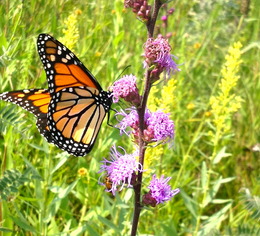
PLUS HERE IS A PICTURE OF A MONARCH!!!

I hope everyone enjoys their summer and I’m excited to see what happens in the months and years to come!
Cheers!
Maureen Page.
This afternoon the whole team ventured out to Staffanson prairie and collected demographic information on Echinacea plants. In addition to the 140 plants already flagged for phenology, we staked and collected data on roughly 200 additional plants!
While we put a substantial dent in the demography we need to do at Staffanson this afternoon, we still have a ways to go. Between 2010 and 2014 Team Echinacea mapped 1074 points, including 649 unique tag numbers. We will revisit all of these plants this summer in order to continue building a longitudinal demographic database.
I attached a graph to illustrate the temporal distribution of Echinacea tags at Staffanson. Note that all tags in the 19000s were placed in 2014, tags in the 18000s were placed in 2013, and tags in the 17000s were placed in 2012, etc. We have 410 unique tag numbers placed between 1996 and 2009 on our list of plants to stake!
sppDemoSummary.pdf
Today was a great day for Team Echinacea! After a quick morning of remnant phenology, we finished measuring Lydia’s Experimental Plot 09!!! On the Northwest Phenology Route, all flowering Echinacea at East Elk Lake Road and North West of Landfill have finished flowering. It is pretty cool to think of how long we have been returning to these sites for phenology, and now many of them are wrapping up (and quickly!). In the afternoon Elizabeth, Gretel, Jared and I were busy working on demography at East Riley, Riley, Railroad Crossing, and North of Railroad Crossing. Other team members went to KJ’s to look for seedlings that teams have been following in years past.
On the pollinator note comes a follow up from Steve Ellis’s talk with us last Friday. I recently came to learn that the city of Shorewood, MN has passed a law banning the use of neonicotinoids!!!! Shorewood now joins the all too small list of cities banning neonics, including Eugene, Oregon and Spokane, Washington. Although this is a small step towards protecting the bees, Shorewood has made a very important statement. Check out the Star Tribune article about the recent ban, along with a post on the Beyond Pesticides Daily News Blog!
http://www.startribune.com/local/west/269627281.html
|
|