|
|
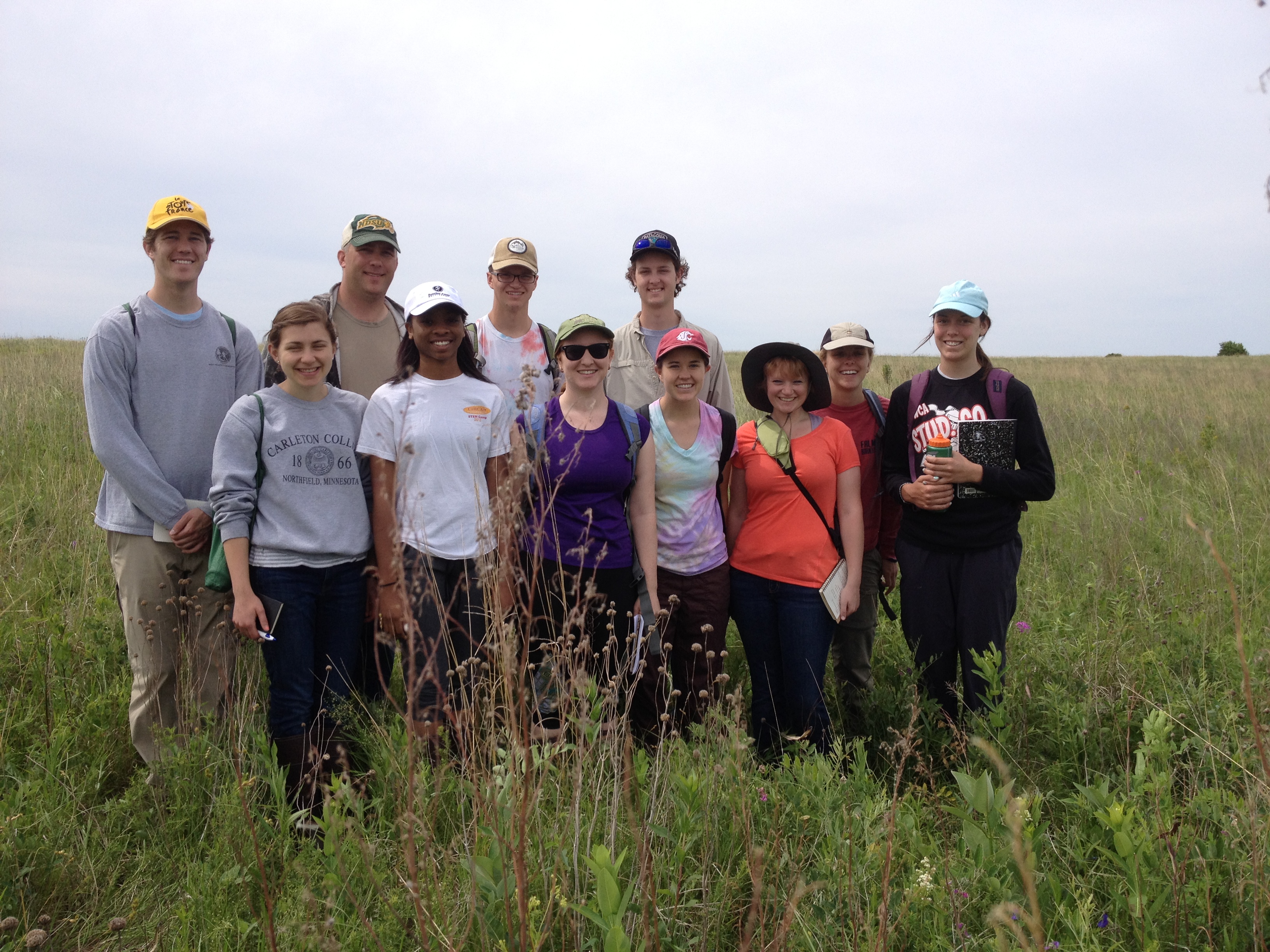
The summer field season is off to a great start! We have assembled an excellent team to investigate ecology and evolution in fragmented prairie habitat focusing on the narrow-leaved purple coneflower as a model organism. Meet members of the team.
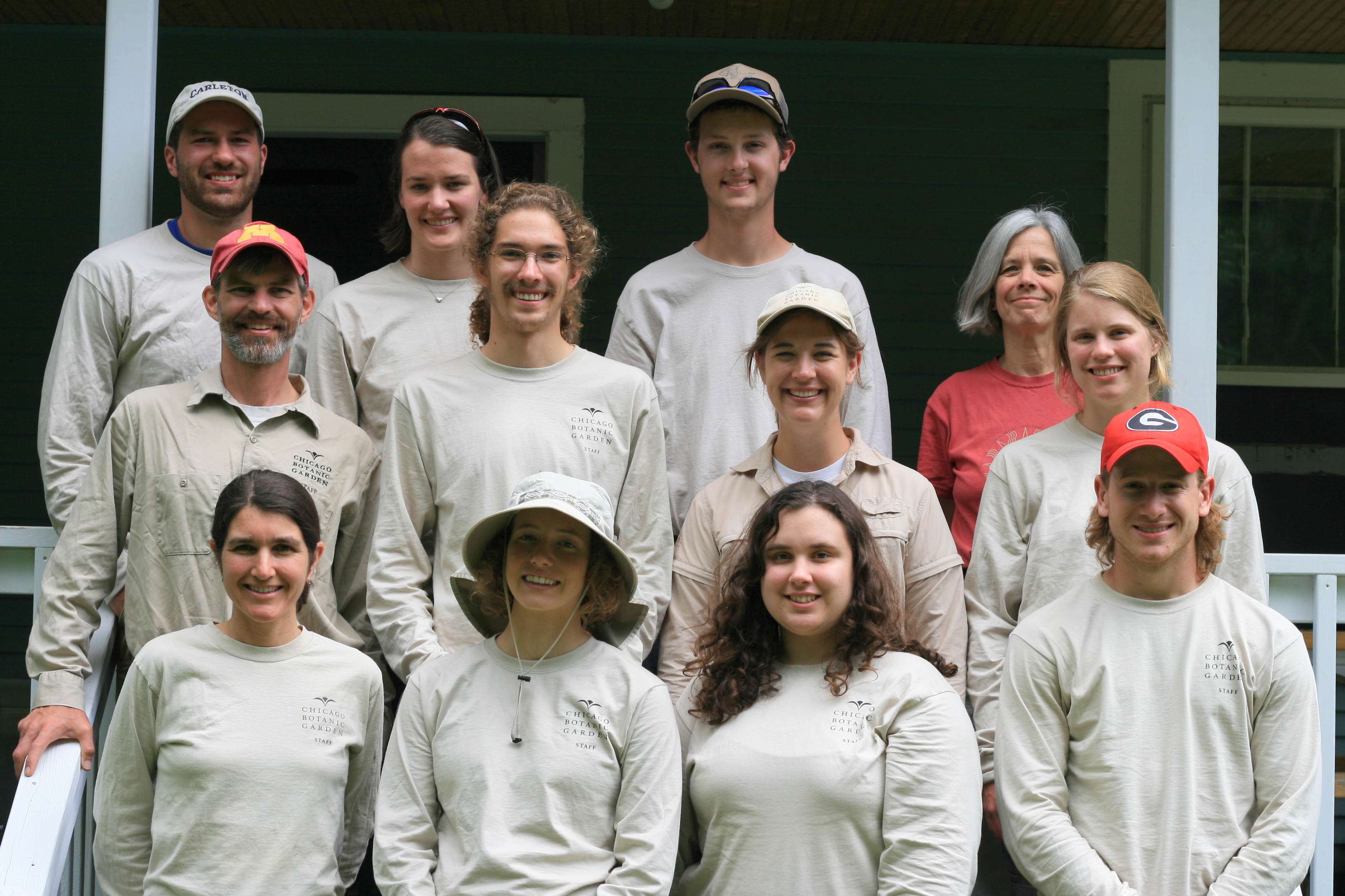
 Team Echinacea 2015: Danny, Matt, Ben, Will, Gina, Taylor, Lea, Amy, Katherine, Alison, Abby
We started the season with tours of local prairies large and small, including Staffanson Prairie Preserve, Hegg Lake WMA, which are large and protected. Stay tuned for team-members’ first impressions of some of the nearby remnant Echinacea populations.
Team-members hail from near & far: Barrett, Elbow Lake, and Alexandria, Minnesota & California, Alabama, New York, and Rhode Island. They are excited to develop summer projects and they will post their proposals here next week. Our team includes four college students, four who just graduated college, two high school teachers, and one high school student. And there are the old-timers.
To get ready for field work, we took the Hjelm House out of winter storage and cleaned out our storage facilities (g3). We inventoried supplies and made signs and tags for fieldwork. Everyone got a pouch with tools and supplies and Gretel has assigned us all a data collector. This may be (should be) the last year for our trusty handspring visor data collectors. The visors are trustworthy, but the computers and software that run them are showing their age.
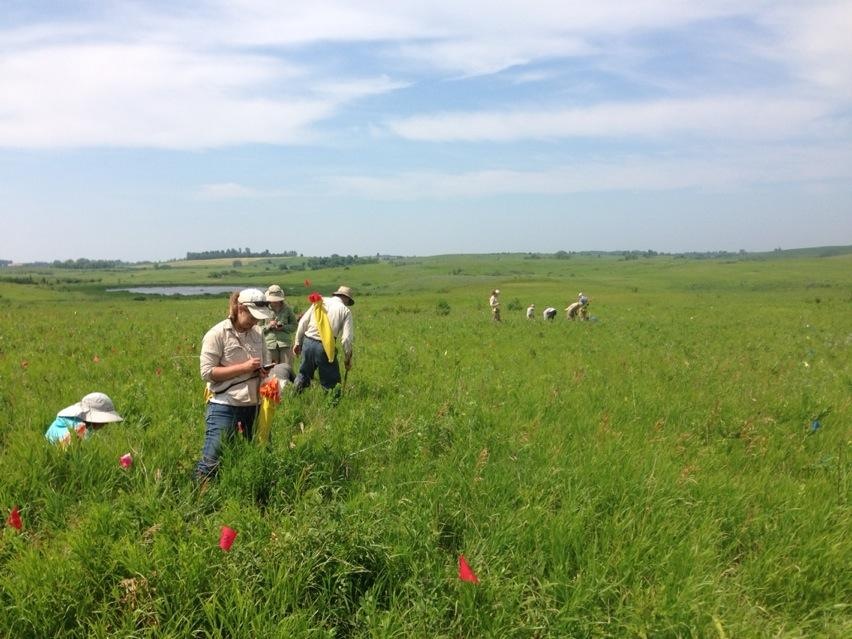
The first main activity of the season was assessing survival and growth of 2526 plants in the Q2 experiment, which is designed to quantify the additive genetic variation in two Echinacea populations. The amount of additive genetic variation determines a population’s capacity for adaptation by natural selection. Genetic variation is very important for the persistence of populations in prairie habitat. We’ll find out how much variation Echinacea has, which will give us some ideas about future prospects for these populations in the rough-and-tumble and rapidly changing world out here.
We got rained out several times this week, but managed to measure all 2526 plants. We found a few plants that escaped detection last summer and we even found one seedling. Welcome to the experiment, fellas! We’ve got our eyes on you.
Overwinter survival appears to be quite good and most of the toothpicks we used to identify individual plants made it through the winter too. The tallest plants were just over 20 cm and some plants had 3 or more leaves. This is great news for plants that were sown as seed in fall 2013. Growth conditions are challenging: a cold winter with little snow, a dry spring, shading out by established plants, chewing by herbivores, … it’s a tough life for a prairie plant.
All in all, it promises to be a great summer. We’ll keep you posted.
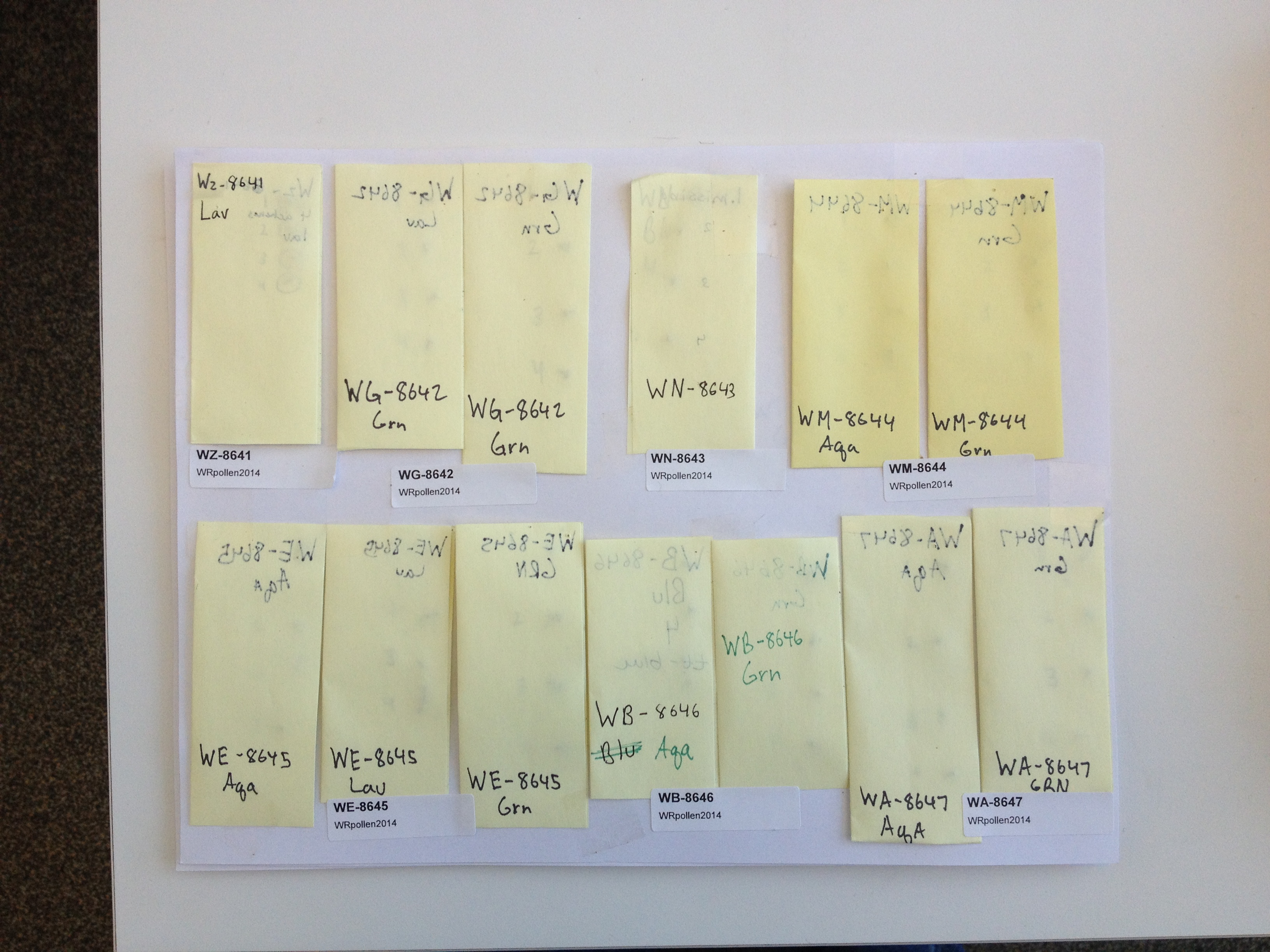
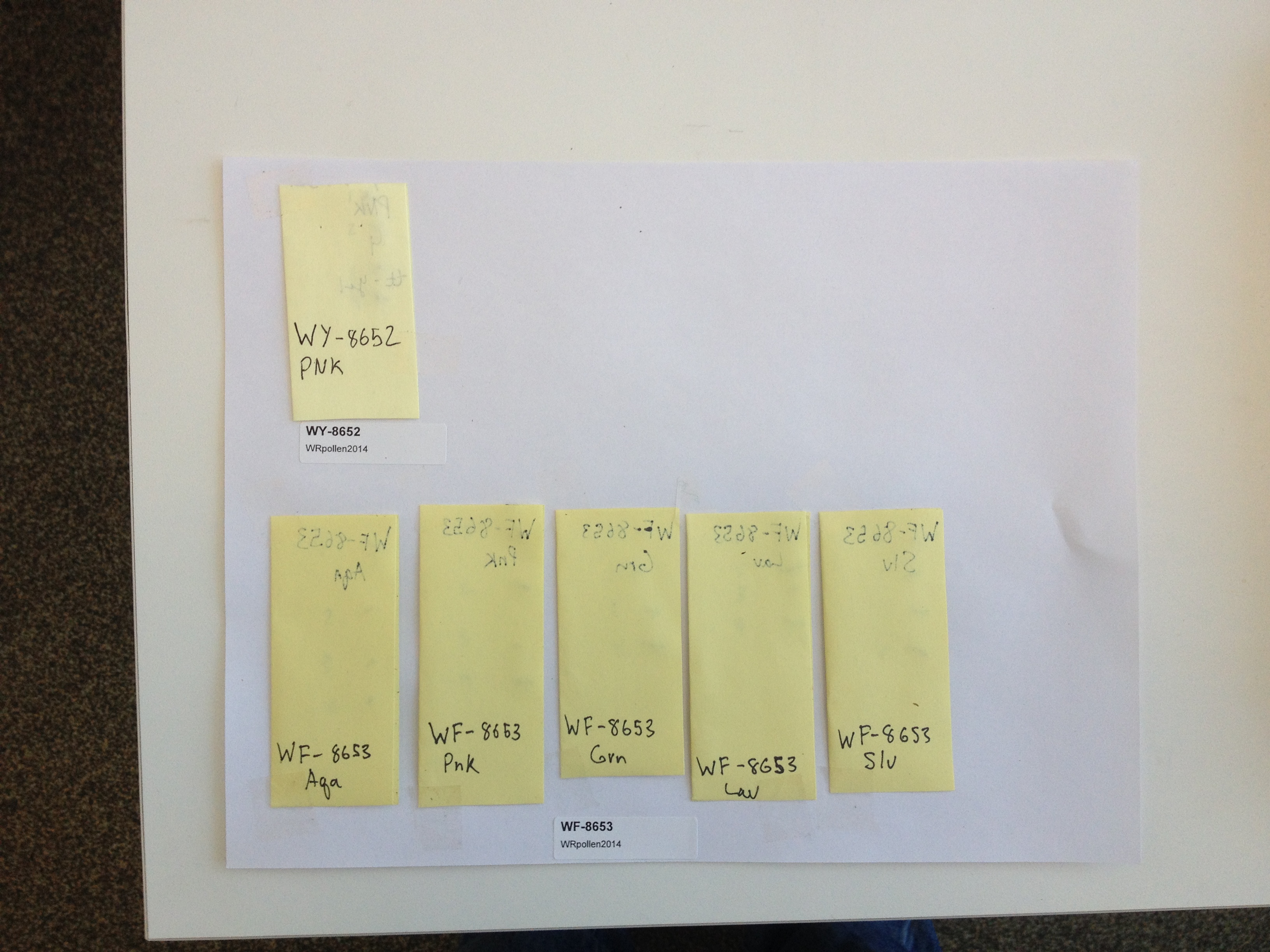
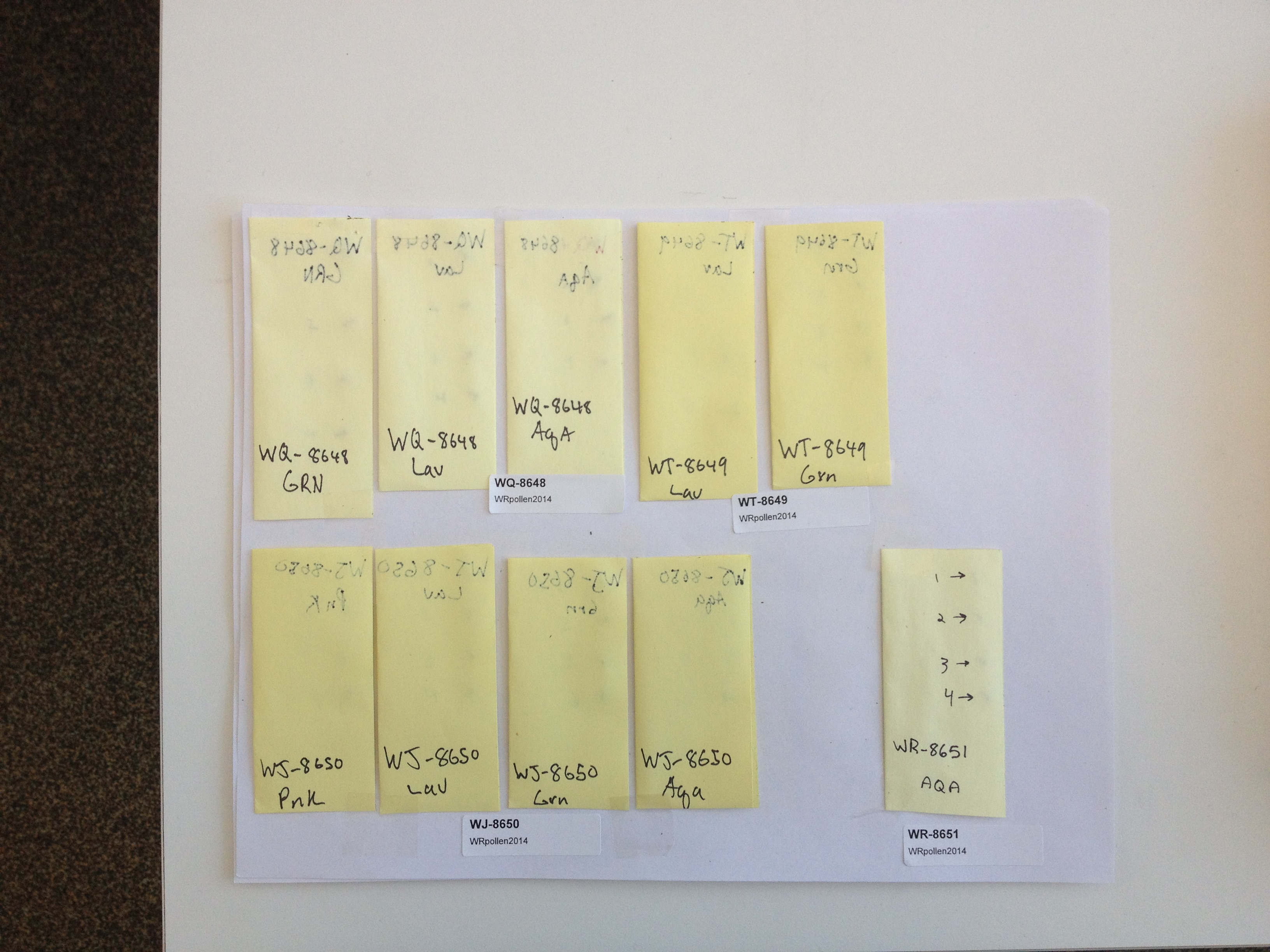
Photos of the sheets of sticky notes containing achenes (Echinacea fruits) that Will dissected at the U of Minnesota and that Jared will x-ray at the Chicago Botanic Garden this afternoon.
Will used freeze-dried pollen to pollinate the flowers that produced these fruits. During the summer styles of those flowers shriveled shortly after Will deposited pollen, providing evidence that the pollen was still alive. More backstory.
Do these these achenes contain embryos? We’ll find out this afternoon.
Live Science in real time!

This project builds on the Echinacea Project’s longitudinal demographic dataset from remnant prairies to explore the role fire plays in the reproduction of Echinacea angustifolia. In 2014, Claire Ellwanger and Jared Beck monitored the daily phenology of 324 flowering heads belonging to 143 plants that flowered in 2014 and gathered demographic information on 523 individuals within burned and unburned portions of Staffanson Prairie Preserve. Additionally, we collected 84 flower heads to assess seed set in 2014. Using this data and the data collected in previous years, we will integrate spatial, phenological, and demographic information from individuals at Staffanson Prairie to build a longitudinal database and evaluate the effects of prescribed fire on Echinacea survival and reproduction.
Our methods for collecting demographic and phenological data were identical to the procedures used in the projects “EA demo”, “phen in six remnants,” and “phen for Aii” except that we mapped nearest flowering neighbors. We mapped out to the 7th nearest flowering neighbor for focal plants on the SPP transect. Jared wrote an R function (looky) to streamline searching for nearest neighbors in the field. This function specifies a search radius and creates a map of all mapped flowering plants for a given site within that search radius. In addition to using looky, we targeted our searches near the edges of Echinacea clusters and where there were known Echinacea plants near the transect to increase the efficiency of our searches.
Read previous posts about this experiment.
Start year: 2007
Location: Staffanson Prairie Preserve
Products: Survey, demography, phenology, and style persistence datasets need to be made readyR. The Echinacea heads collected in 2014 are being processed at the Chicago Botanic Garden.
Overlaps with: EA demo, phen in six remnants, and phen for Aii
Description: In 2014, Alli Grecco developed and implemented a project to characterize the composition and abundance of plants that flower in 5 remnant prairie Echinacea populations. During her community surveys, Grecco identified 32 co-flowering species. This dataset will be used to describe variation in flowering communities both between and within sites over time.
Start year: 2014
Location: SPP, NWLF, EELR, ALF, NNWLF
Products: Preliminary dataset is located in Alli Grecco’s Dropbox folder. Dataset needs to be made readyR.
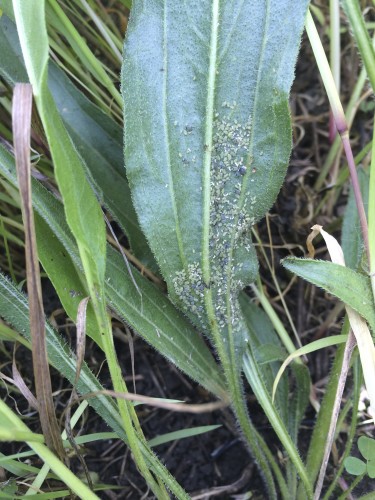
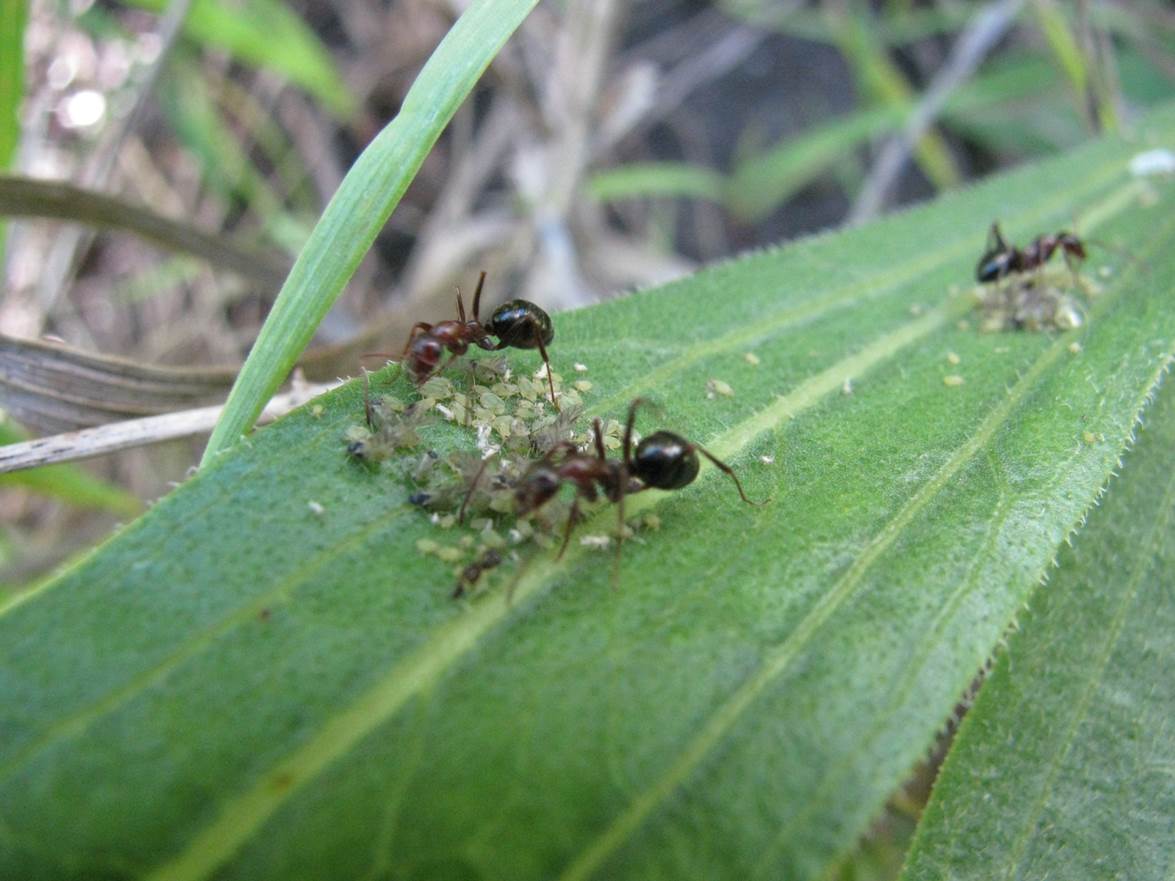
 This collection plant had some of the most aphids we’ve seen yet in one place!
Aphis echinaceae is a recently-discovered aphid species believed to specialize on Echinacea angustifolia. In 2014, Cam Shorb designed and implemented an experiment to test whether aphids could survive on the closely related Echinacea pallida or hybrids of the two Echinacea species. He added a total of 1600 aphids to 88 Echinacea plants at Hegg Lake WMA. Although the aphid survival rate was only 9 percent, Aphis echinaceae survived on all Echinacea variants suggesting the aphid may be more flexible than previously believed.
Start year: 2014
Location: Hegg Lake WMA
Products: A preliminary dataset is located in Cam Shorb’s Dropbox folder. This dataset needs to be made readyR.
With over 15 years of data, the study of Echinacea demography is among the Echinacea Project’s longest running research projects. During demography, Team Echinacea maps and collects basic demographic information about plants within 30 prairie remnants. In 2014 we collected demographic information for over 500 individual plants including 179 flowering plants at our largest site, Staffanson Prairie Preserve, alone. Across the other 29 sites, we found 897 flowering plants and visited a total of 1226 plants. For each plant visited, we recorded whether the plant was alive, whether the plant was flowering, and how many flowering heads it produced. With this extensive dataset, we hope to explore inter-annual flowering patterns, assess longitudinal plant fitness, and monitor numerical population dynamics in remnant populations of Echinacea.
Read previous posts about this experiment.
Start year: 1995
Location: 30 remnants prairies
Products: Stuart, Jared, and Gretel are working to clean, organize, and integrate demography, survey, and phenology data (project “demap”). Also see the demography protocol.
Overlaps with: fire and flowering at SPP
To examine the role flowering phenology plays in the reproduction of Echinacea angustifolia, Jennifer Ison planted experimental plot 2 (P2) in 2006 with 3961 individuals selected for extreme (early or late) flowering phenology. In 2014, we measured traits for all 2123 living plants and monitored the daily phenology of 247 flowering heads. Echinacea flowering began on July 2 in P2 and continued through August 24. Using the phenological and trait data collected this summer, we will explore how flowering phenology influences reproductive fitness and estimate the heritability of flowering time in Echinacea angustifolia.
Read previous posts about this experiment.
Start year: 2006
Location: experimental plot 2 (Hegg Lake WMA)
Overlaps with: pollinator efficiency

In 2014, Cam Shorb continued an experiment designed to assess the effects of aphid herbivory on Echinacea angustifolia survival and fitness. The plants are located in experimental plot P1. Cam removed aphids from the 44 plants in the exclusion treatment and added over 220 aphids to the 43 plants in the addition treatment.
Read previous posts about this experiment.
Start year: 2011
Location: P1
Products: Fitness measurements were collected during our annual assessment of fitness in P1. A list of focal plants and addition/exclusion datasheets are located in Cam Shorb’s Dropbox folder.
Overlaps with: Overlaps with: Phenology and fitness in P1

Greetings from Chicago Botanic Garden! A new year is upon us and it is time to recap a busy 2014 summer. Over the next several weeks, we will be posting flog updates describing research projects from the summer and the status of the Echinacea Project’s long-term experiments. Stay tuned!
Click here to Browse all of the updates!
Dwight and Stuart broadcast native prairie seed in experimental plots p1 & p8 on Friday. At 34 °F (1°C) it was the warmest day in a month. It was also very windy –great for spreading seed! We broadcast Bouteloua curtipedula, Schizachyrium scoparium, Galium boreale, and Phlox pilosa directly on the snow. There wasn’t much snow and it was melting. We broadcast Lathyrus venosus in p1. We stored about half of each species, except L. venosus, in the Hjelm house to broadcast in the spring. (Hedging our bets.)
|
|