|
|
Hi everyone,
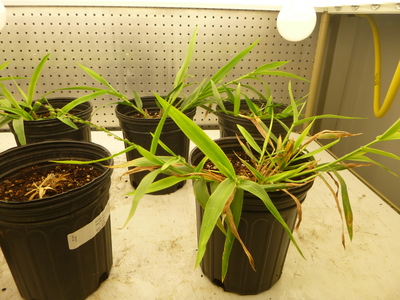
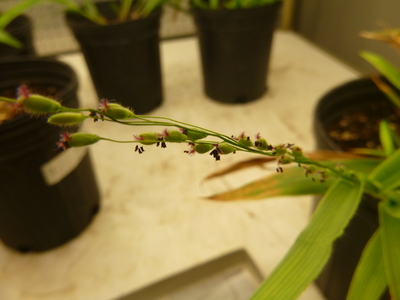
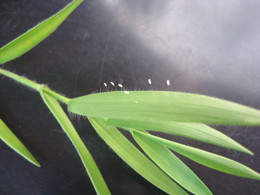
Maria here at CBG. On Tuesday, I came back from Thanksgiving break to find that one of the Dichanthelium plants in the growth chamber was flowering like crazy!

So many flowers! It was also interesting that the plant that flowered looked more stressed (yellow leaves) than some of the other plants.
Today, I collected some pollen (shook the spikelets) on glass slides, stained them with 0.1% toluidine blue, and looked at them under the microscope. It was amazing to see the stained pollen, and how different the viable and inviable pollen looked! I wish I had pictures. I will be learning how to take digital microscopic images (hopefully tomorrow?). So hopefully I’ll be able to stain pollen from all flowers tomorrow, take pictures of the stains, and count pollen to get a sense of levels of viability in Dichanthelium pollen.
Maria here.
Woke up this morning to some rumbling thunder in the distance.
The skies looked grey, but nothing too bad. We discussed how to do all the things we had to do at Staffanson: demo rechecks, harvesting Kelly’s Echinacea heads, removing twist-ties and flags from heads/plants that Kelly won’t harvest, figuring out 6 nearest neighboring Echinacea plants to each of Kelly’s plants that was going to be harvested, and pulling up ant traps. Whew!
We did some individual project stuff from 9 to 11am. Jill finished up sorting ants. Katherine and Kelly went to NWLF and NNWLF to pull ant traps and remove twist-ties from heads. I was in CG 99 South, measuring Dichanthelium from my maternal lines experiment, and got 4 rows done before 11am.
We set off for Staffanson, all 5 of us cozy in the truck. The corn and perennial weeds greeted us happily on the dirt road leading into Staffanson. Jill went to pull up her ant traps and then helped Kelly to remove twist-ties and flags. Stuart, Katherine and I brought out Sulu (the GPS), R2D2 (the netbook), and paper datasheets, and tried to figure out how to determine the 6 nearest neighbors to Kelly’s harvest heads. We concluded that the most efficient way was to use R to determine the 6 mapped nearest neighbors, obtain the distance to the 6th neighbor, then use a reel tape to measure out the distance and search to see if there are any other nearest neighbors closer than the mapped one. We would have to do it another day.
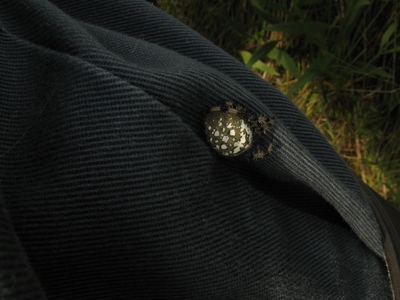
Here’s a fancy spider Stuart found on his knee today. Photo courtesy of Katherine.
On the way back for lunch, Stuart and Kelly belabored the pros and cons of color coding the top and bottom GPS poles.
After lunch we set out for Staffanson again. Kelly worked solo to harvest heads, while the four of us split into 2 teams (1 GPS + 1 clipboard) to do demo rechecks. After a little while, it started sprinkling and we heard some distant portentous thunder, so we turned back and left Staffanson.
Back at Hjelm House, Jill and Katherine cleaned up the ant traps and went to pull ant traps at Nessman. Stuart demonstrated dissecting achenes from Echinacea heads for Kelly, so she can dissect the heads she harvested when she’s at Carleton.
Lastly, as requested by Stuart, the “Sync Your Visor” song I came up with as an alternative to “Sync, Sync, Visor Sync”:
(To the tune of “Oh My Darling Clementine”)
Sync your visor, sync your visor,
Sync your visor everytime;
Data lost and gone forever
Don’t be sorry – sync it now!
Any suggestions for improvement are much welcome.
The last flowering plant in CG1 put out its last anthers today (August 27, 2012). It had been flowering over a week longer than any of the other plants we monitor! This marks the end of the flowering season for Team Echinacea, but we’ve still got lots of work left to do!
Happy Friday! Today was our fourth day “going solo” while Stuart is away in Chicago. In the morning, we finished up seedling searches at East Elk Lake Road. That’s two sites down! In the afternoon, we continued working on demography re-checks at some of the smaller sites. Basically, demography re-checks consist of fixing any errors that we might have made during the initial round of demography (i.e. one person said a plant had two heads while another said it had four), but it also allows us to go back and find basal plants that have flowered previously. By checking on these plants (or a random subset of these plants) each year, we can get a better idea of how often a plant flowers and the survival rate of flowering plants. Today we finished demography re-checks at Loeffler’s Corner (East and West) and Yellow Orchid Hill.
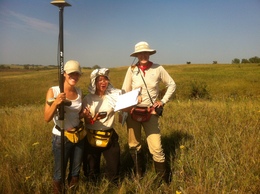
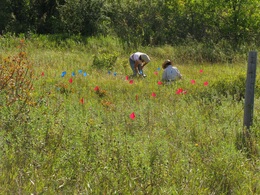
Here’s a picture of the crew at Yellow Orchid Hill after a hard day’s work:

The past couple of days have been lovely for outdoor work–sunny, cool, a little breezy. On Monday we said bon voyage to the Wagenius family as they prepared for their trip back to Chicagoland. Stuart will be back next week, but Gretel and the kids are done for the summer. Now there are five of us and no shortage of work to do.
Monday morning we went to the site off of hwy 27 to take demography data on plants that flowered last year and reconcile errors from this year’s demography census. With two teams working with the GRS-1 GPS units, the task went quickly and smoothly.
We spent Monday afternoon re-finding seedlings at KJ’s. This is a particularly challenging site because there is a high density of plants in a small area. We continued the endeavor this morning, and I’m happy to say are nearly finished. We should be able to defeat the beast tomorrow morning.
Here are Jill and Maria looking for seedlings at KJ’s. Red flags mark completed focal plants.

This afternoon we performed some routine maintenance of the main experimental plot, pulling out flags that marked plant we could not find. Then we spent the rest of the afternoon on individual projects.
Karen Taira, who came up last week, has been spending her days working on her pollination experiment involving several species of Helianthus. Her field story of the day was that she found a pile of entrails next to one of her experimental plants. Apparently they were bigger than a prairie dog’s and smaller than a human’s. Perhaps it’s a new form of sacrificial sun worship–Praise Helianthus!
Like their hosts, Echinacea aphids exhibit a strong seasonality. There’s a sharp rise in the frequency and abundance of aphid infestation followed by a rapid decline in early fall. That decline has occurred much earlier this year than last year. Fortunately, that has given me a chance to make some observations about what happens to aphids at the end of the summer. Here are a few things I’ve noticed:
1. Throughout my surveys in CG1 and several prairie remnants, I’ve noticed that the frequency of winged morphs has declined since July. Last week, I did not see any winged aphids, with the exception of a couple at East Elk Lake Road. This implies that dispersal declines as aphid numbers drop.
2. I and several others have noticed that aphids are starting to congregate at the base of the plant both at the petioles and at the base of the stem. I’ve also seen aphids crawling down beneath the soil surface and a few latched onto the tops of roots. One possibility is that as plants withdraw resources from their leaves, aphids move down the plant to follow their food source. I’ve also seen ants moving aphids at the base of the plant and placing them in dirt structures. These observations support the notion that aphids overwinter on Echinacea roots.
Many aphid species in temperate regions spend the winter and summer on different plants. Their winter host is where they lay eggs and their summer host is where they feed and reproduce asexually. My guess is that Aphis echinaceae does not have a separate winter host.
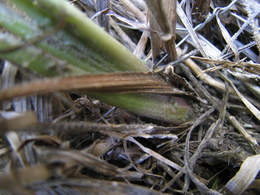
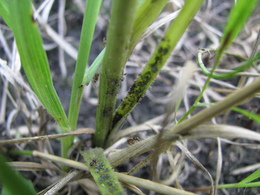
This plant at Nessman’s had a bunch of aphids congregated at the base. Notice the little green guys on the stem:
This is one of the plants from my aphid addition/exclusion experiment in CG1. There are still aphids on the leaves, but most of them have moved to the petioles:
Here’s all of my data from my crossing experiment and the R script that I used to analyze it! I’ll put up a metadata sheet soon.
angustifolia_pallidaCrossData.csv
final crossing script.txt
Hallo once again from K-town! It was yet another wonderfully nice day out in the prairie of Minnesota. This morning, Maria and Katherine headed out to the Landfill site to GPS all of the flowering plants we found earlier (about 80 of them this year). Kelly, Jill, and I headed over to Around Landfill to do demography on the plants Kelly used for her phenology project. And Shona and Andrew won (at long last) a battle with our second GPS unit (which arrived yesterday), Chekov. Chekov has come to join Sulu in our endeavors to gain coordinates. But it’s best if both work properly. Oh, and Kelly’s last plant at all her remnants finished flowering today! It’s bittersweet.
We came back to the Hjelm House later in the morning and had time to work on getting things ready and wrapped up for our poster presentations on Thursday. Yoiks! It’s coming up quick! Ruth came up with Lisa, and undergrad, and Dave, a potential post-doc for the Echinacea Project. After lunch, Dave gave us his presentation on his work with Solidago velutina (goldenrod). We then headed over to Aanenson to do demography. There were not very many flowering plants there this year, though Jill and I found a monster of one on the side of the road. We had both GPS units out with us, but we had a ton of trouble with them and were only able to GPS a few plants. We’ll just blame it on solar flares again. Once finished, we reconvened at the Hjelm House for some nummy watermelon fresh from the garden! Maria also found something interesting while we were out. We’re thinking these might be egg sacs of some sort, but we’re not quite sure.
Title: Examining Pollen Limitation in a native prairie panic grass, Dichanthelium leibergii
MW-UMN-30×40.pdf
It has lots of cool pictures and Dichanthelium as the background! 🙂
See you at the symposium!
Here’s the poster I will be presenting at the University of Minnesota on Thursday.
Shona Sanford-Long_compatibility poster_small.pdf
|
|