|
|
Hi Flog,
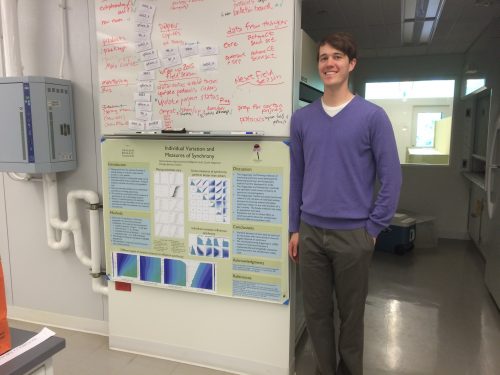
It’s great to be back in Minnesota after a muggy and fun week at ESA in Ft. Lauderdale. On Thursday, I presented my poster, “Two temporal scales of reproduction affect mating opportunity in long-lived perennials.” The poster was displaying work that I did this past year looking at the 11-year phenology dataset we have from the individuals in p1. The question I tried to answer, basically, was whether it flowering on a high-flowering day or in a a high-flowering year was more important for an individual’s number of opportunities to mate. For example, this year is a low-flowering year in p1, whereas last year was a high-flowering year. Would it be better to flower on the population’s peak date of flowering this year or to have flowered off peak last year? It turns out that in this system, the year is more important relative to the day. I think this is because all flowering within a season is synchronous enough that most individuals don’t totally miss out on opportunities to mate, even if they are early or late flowering. I still have some work left to do on my analysis, but it was super helpful to hear what questions people had and get some useful insights as well!
 Here’s me with my poster
Here’s a link to my poster if you want to take a closer look!
Hi Flog!
I’m sitting in Greater Fort Lauderdale/Broward County Convention Center, taking a break from hearing about all the great work people from all over the place have been doing. I thought that this was a good time to update you on how my poster presentation went (Mostly because the convention center has free wifi and our hotel doesn’t. What?! how can it be 2016 and there not be free wifi…)!
I arrived in lovely* Fort Lauderdale Sunday afternoon, this is the first conference I have been to and It is a little overwhelming but also super exciting! I presented my poster on “The heritability of flowering time and duration in Echinacea angustifolia” last night (Monday). Lots of people stopped by and it was really fun getting to explain all of the work I had done over the past year to them. The poster session lasted for 2 hours but it felt like 15 minutes.
Amy is here with me and she is going to be presenting her poster on Thursday night!
*Lovely – 90 percent humidity and 90 degrees
Below is a link to a PDF of my poster for closer inspection!
esaposter_willreedvf-1-1-1
Read Rachael’s final paper, in which she investigates the extent to which flowering schedules differ between plants with only one head and plants with multiple heads.
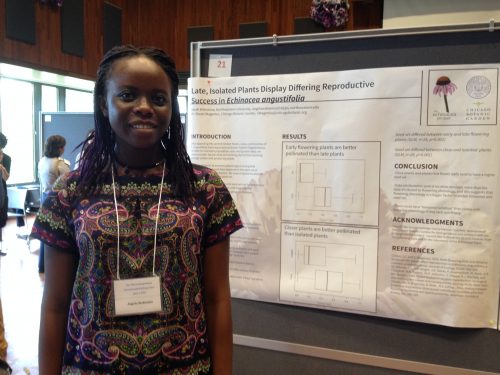
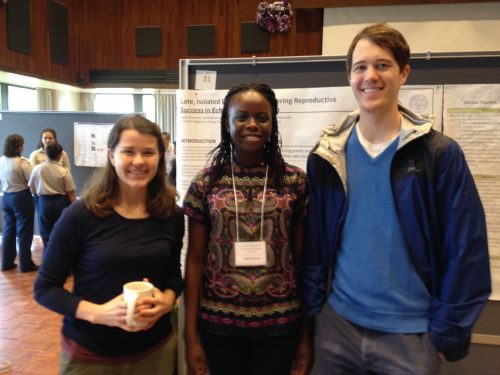
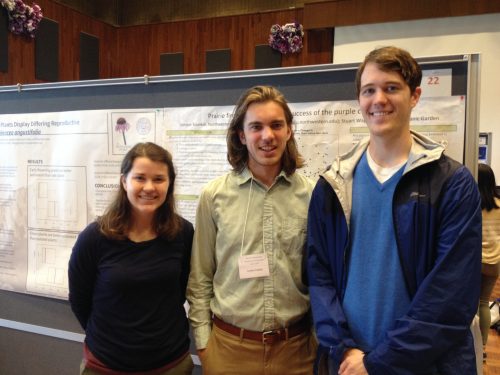
Sarah presented her poster, “Late, Isolated Plants Display Differing Reproductive Success in Echinacea angustifolia” at the Northwestern Undergraduate Research and Arts Exposition. Here are some pictures from the event and her poster, which you can find here.

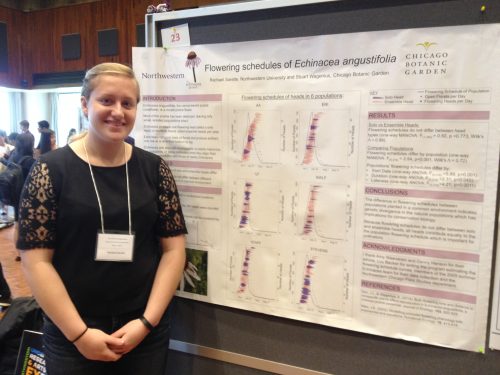
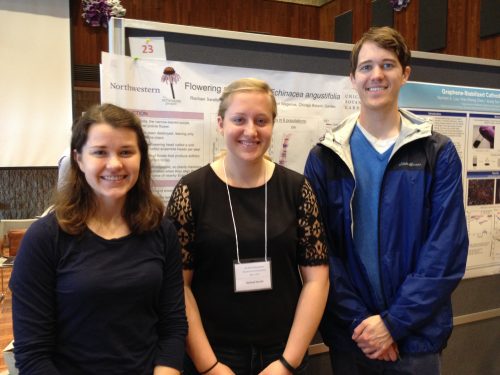
Rachael presented her poster, “Flowering schedules of Echinacea angustifolia” at the Northwestern Undergraduate Research and Arts Exposition. Here are some pictures from the event and her poster, which you can find here.
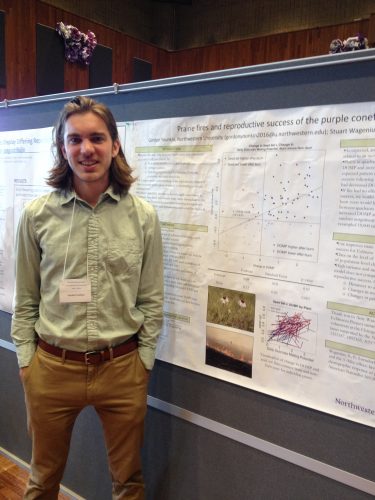
Gordon presented his poster, “Prairie fires and reproductive success of the purple coneflower” at the Northwestern Undergraduate Research and Arts Exposition. Here are some pictures from the event and his poster, which you can find here.

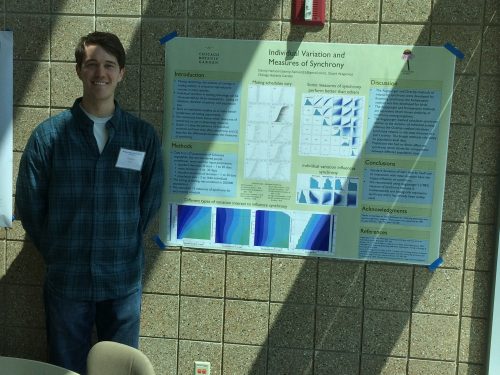
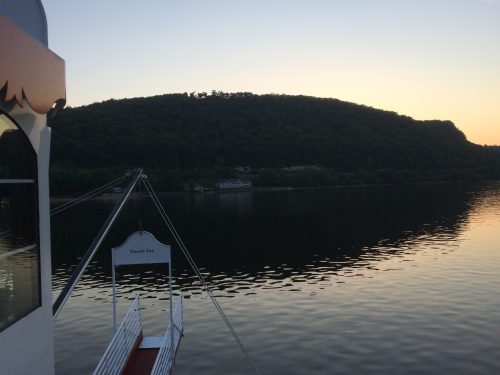
This past weekend, I attended the second, biannual Midwest Mathematical Biology Conference (MMBC) hosted at the University of Wisconsin La Crosse. There were a lot of great talks throughout the weekend including plenary speakers Dr. Louis Gross, Dr. Carina Curto, and Dr. Mark Craven. I learned a lot about mathematical biology, including a multitude of uses for differential equations and some great techniques in evolutionary computing. At the end of Saturday, there was a poster session that included 6 posters. After the poster session, most of the people at the conference went on a wonderful Mississippi River paddlewheel river boat replica and ate pizza.
The next day we had more great talks, then a long drive back to Chicago. You can find my poster in its new home in the lab, or you can see it here.
Standing with my poster in the atrium at UW Lacrosse A beautiful view of the Mississippi River at sunset My poster in its new lab location.
Nina presented her poster “Competitive Exclusion Between Echinacea angustifolia and Echinacea purpurea” at the Illinois Math and Science Academy student research symposium (aka the 28th Annual IMSAloquium) on April 28th.
You can read all of the abstracts. She gave a great presentation. It was a pleasure to have Nina on the team.
Taylor presented a poster of her summer research on fitness of native, non-native, and hybrid Echinacea plants at the Tennessee Louis Stokes Alliance for Minority Participation Conference. The meeting was held February 25-26, 2016 at the University of Tennessee-Knoxville. Taylor was awarded 3rd place in Science Poster Presentation category. Yay, Taylor!
Read Ben’s Lee’s report and look at his map about pollinator habitat in Echinacea land.
|
|