
LFC students Marissa Ruiz and Courtney King created this fabulous poster using samples from my 2012 Helianthus experiment for my thesis. Indeed, we have significant support for the self-incompatibility of the genus.
|
||||
|
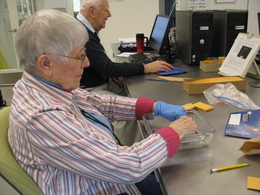
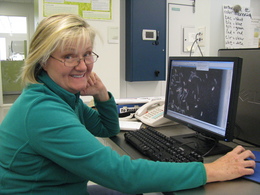
We are making progress on the 2012 harvest. Today, volunteers Lois and Susan are extracting achenes from Echinaea heads and placing them in envelopes. For this batch of heads, we are trying out a protocol of saving any leftover plant dust in separate envelopes.
We also have a lot to finish from the 2011 harvest. On Friday we started counting achenes from an experiment that examines the effects of burning on offspring fitness. Each plant came from a mother that was either burned or unburned the year before germination. In other news, we have a new member of the lab. Marie is a sophomore from Carleton College and is taking advantage of her winter break to gain some research experience. This month she will be processing some of the heads from Kelly’s Kapsar’s project on flowering phenology. Today, Stuart taught her how to extract achenes.
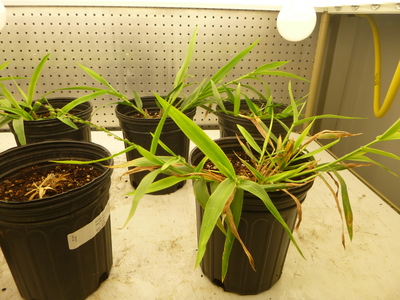
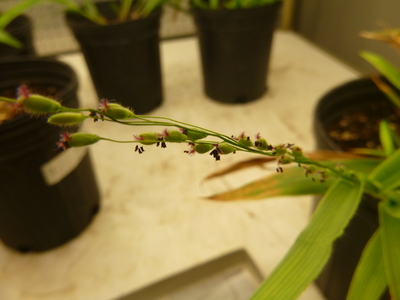
Hi everyone, Maria here at CBG. On Tuesday, I came back from Thanksgiving break to find that one of the Dichanthelium plants in the growth chamber was flowering like crazy!
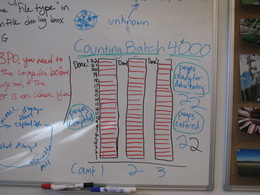
So many flowers! It was also interesting that the plant that flowered looked more stressed (yellow leaves) than some of the other plants. Today, I collected some pollen (shook the spikelets) on glass slides, stained them with 0.1% toluidine blue, and looked at them under the microscope. It was amazing to see the stained pollen, and how different the viable and inviable pollen looked! I wish I had pictures. I will be learning how to take digital microscopic images (hopefully tomorrow?). So hopefully I’ll be able to stain pollen from all flowers tomorrow, take pictures of the stains, and count pollen to get a sense of levels of viability in Dichanthelium pollen. As you can see in this lovely motivational diagram, we finally finished counting last year’s achenes from the 1999 experimental plot.
The next step for this batch will be to collect a random sample of achenes from each flower head to estimate pollination rates. We can tell whether an achene is “full” (contains an embryo) or “empty” (does not contain an embryo) based on its weight. We can estimate pollination rates based on the ratio of full and empty achenes. However, there are some achenes whose weight does not give us any information about pollination. Some are so small they never produce an embryo, some are damaged by insects, some are damaged during removal from the flower head, etc. If we weighed these, they would show up as “empty”, even though they may have been pollinated. Therefore. when we select a random achenes for weighing, we have to differentiate between those that are informative about the pollination environment (full or empty) and those that are not informative (small, sterile, damaged, etc.). For this batch, we are starting a new randomization protocol that assigns achenes to categories of “informative” (possibly full or definitely empty) and “uninformative” (sterile, undersized, damaged). Both are part of the random sample, but only the informative achenes are weighed. It’s a subtle distinction from what we were doing before, but it will be important for our results. Now that we have reached our goal in counting, we have started processing the heads we harvested in 2012. Today volunteers Katharine and Sam are trying out a new protocol for removing the achenes from Echinacea heads. Previously, we through away any dust left over from removing achenes. This time, we are saving the dust in separate envelopes. That way, we will be able to figure out whether the dust we throw away contains fragments of achenes. Also, we will be able to compare scans with and without the extra dust to see whether removing dust makes a difference in the accuracy of our count data.
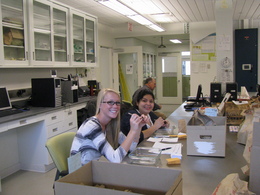
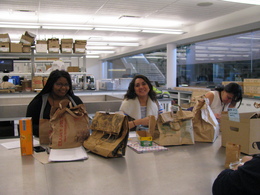
We had a lot of people in the lab last week. On Wednesday, we had volunteers Kathryn Eber and Sam Goldman along with a group of interns from Lakeforest College:
The Lakeforest students will return for two more afternoons–or longer if they so choose. In other news, we are nearly finished counting the seeds from the 4000s batch in the 2011 harvest. For this batch, we are trying out a new protocol for selecting a random sample of seeds to weigh. Volunteers Suzie and Susanne were the first to implement the protocol and have given us some good feedback. This week has brought us further along on our goal of counting and randomizing all of the achenes from 2011. Here is volunteer Kathryn Eber, looking pleased to have her picture taken. Thanks to her and the other volunteers, we are nearly finished counting the 4000 batch of the 2011 harvest.
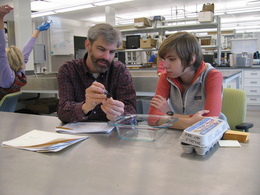
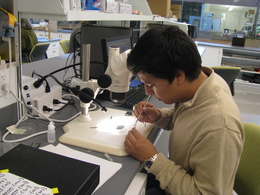
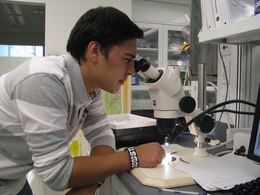
On Wednesday October 31st, we welcomed several students from Lakeforest College for the first session of a four week internship. Meet Randen, who is working with me to learn how to identify ants:
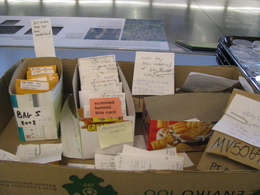
When he came in, he had no experience identifying insects or using taxonomic keys. By the time he left, he was able to identify ants to genus and–for some genera–to species. His project is to compare ant species collected from burned and unburned units of the Staffenson prairie preserve. Ants are a crucial component to terrestrial ecosystems: they move dirt, they prey on many critters, and they protect other critters like aphids. If fire influences the community of ant species in a prairie remnant, there may be cascading effects throughout the ecosystem. Naturally, I’m excited to see what Randen finds out during his project. Every year the Echinacea Project collects all of the flowering heads from the experimental plots and processes them in the lab. Considering this process managed and completed by different people every year, it is challenging to keep everything organized from year to year. One of our goals this year is to wrap up data collection on Echinacea seed heads from 2009 to 2011. Last year, Northwestern students Karen Taira and Ricky Rivera spent many hours organizing data from 2009 and 2010. They solved a lot of mysteries, including mislabeled heads, mislabeled files, and files saved in weird places. Last week I picked up where they left off. We are down to one box of mysteries–seeds that still need to be scanned, counted, and weighed. Once we finish with this box, we will have all our data from 2009.
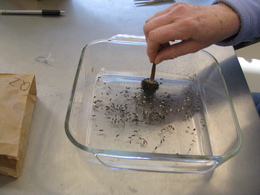
In other news, a class from Lakeforest College is coming to the Chicago Botanic Garden for a mini-internship program. Karen, Stuart, and I will all be mentoring students for the next few weeks in projects related to our research. We will introduce the students and update their progress on the flog. Lastly, this week we said goodbye to volunteer Art Abt as he prepared for his winter migration to warmer climes. We will miss him and his expertise in seed weighing. Photo of scanned achenes. The dot indicates that the achene has been counted. The pencil shaped item in the center of the image is the counting tool. Place the point on a achene and hit the enter key and the “dot” is placed as well the count increased.
|
||||
|
© 2026 The Echinacea Project - All Rights Reserved - Log in Powered by WordPress & Atahualpa |
||||


-thumb-260x202-136589.jpg)
-thumb-260x195-136585.jpg)