Suzanne Turner foing inventory on 2012 Echinacea harvest.
-thumb-260x202-136579.jpg)
|
||||
|
Suzanne Turner foing inventory on 2012 Echinacea harvest.
Bill Wallin Counting
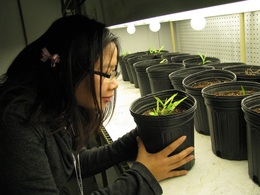
Based on the flog, it may seem that the lab activity has been consumed with counting seeds and identifying ants. However, I should point out that there are some real live plants in the lab as well. Maria has been lovingly tending her Dicanthelium plants that she germinated last fall. One of the perks of working at the Chicago Botanic Garden is the high-tech growth chamber that allows you to control light, temperature, and humidity on a programmed schedule. Maria has programmed the chamber to approximate fall in Minnesota.
Any one at CBG can use the growth chamber for their research. Anna Braum, a grad student at Northwestern, is growing host plants for her experiment on the parasitic plant Castilleja coccinea–also known as the indian paintbrush. Here she is watering her plants (with help from Maria).
Bill Wallin counting Echinacea achenes (2011).
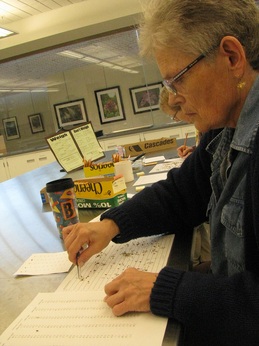
Charlynn Schweingruber making a random sample of achenes (2011) for weighing.
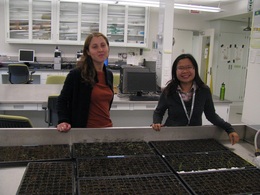
We made a lot of progress this week. First, the volunteers finished the first round of counting for one of the larger experimental plots. There are still two more rounds of counting to finish, but we’re mostly there. Suzanne started taking inventory of the heads we harvested this year. It didn’t take her long to get through everything, considering flowering was so low this year. Out of about 500 heads, there was only one that was mislabeled. There were a few missing, but they are on their way back from Minnesota.
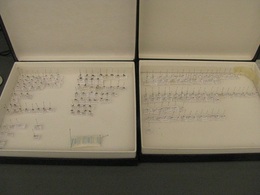
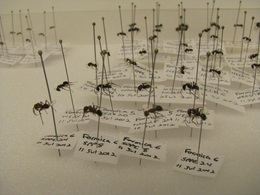
I’ve been busy trying to identify all the ant specimens we have pinned. Right now it looks like we have two species of Lasius, five species of Formica, and one species each in several other genera. There are also multiple species within the genus Myrmica, but I haven’t identified them yet. Apparently that genus is particularly difficult to identify. This summer, REU student Jill Gall put together a large collection of ants from prairie remnants in Minnesota. Yesterday, Stuart and I headed over to Lakeforest College to seek the advice of resident ant ecologist Sean Menke. Jill left us with two boxes of ants, which she pinned and identified to genus and separated into morphotypes:
Sean was impressed with her identification skills: she was correct in nearly every identification to genus and many of her morphotypes were consistent. He gave us some tips on what traits to look for when identifying ants. Now we have a plan for going through the rest of the collection. This will allow us to compare the species diversity of ants among prairie remnants, and hopefully pave the way for future ant research in the lab.
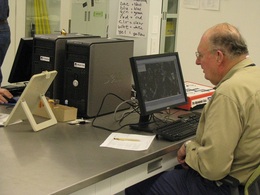
Now that the summer field season has come to an end, it is time to focus on what’s going on in the lab at the Chicago Botanic Gardens. I am taking over for Josh as lab manager and have spent most of the week learning my way around the lab. Since I arrived, the two major tasks for the volunteers have been counting, randomizing, and weighing achenes from heads collected in 2011. Here is Aldo, using the computer to count achenes from a scanned image:
Once we have a count of achenes for each head, we select a random sample for weighing. Here is Char, randomizing achenes based on a numbered grid:
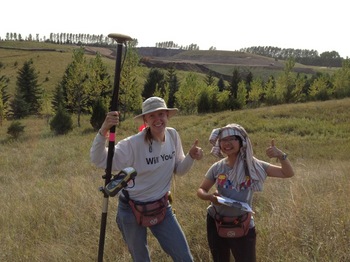
As for the 2012 harvest, we brought a little over 500 heads from the main experimental plot. This is much less than the 2890 heads collected last year. Our haul from this year also includes heads from Kelly’s phenology study, heads from Shona’s hybridization experiment, and a sizable collection of ants from prairie remnants. We have plenty of work in store for the coming months. Stuart is back! While Stuart worked on computer stuff – prepping for rechecks at Landfill and nearest neighbors at Staffanson – Katherine and I finished off demo rechecks at Aanenson. Apart from computer stuff, Stuart also finished seedling refinds at Randt (2 there), then set out for demo rechecks at Steven’s Approach. Katherine and I joined him after Aanenson. The three of us finished demo rechecks at a rate of ~1 plant per minute. After lunch, we set out for demo rechecks at Landfill. On the way out we had an interesting and informative chat with Steve, a beekeeper about bees and pesticides etc. At Landfill, we worked as a trio again. While Stuart staked with GPS, Katherine & I did demo, leapfrogging plants. We finished off 120 recheck points in about 2 hours, so again, rate of 1 plant per minute. We also flagged and demo-ed sling refind plants while at Landfill. Lastly, we “(took) a moment to revel in the prairie that hasn’t been turned into landfill”. And rewarded ourselves with rootbeer floats. Katherine and I had too much ice cream that we didn’t have much appetite for dinner.
|
||||
|
© 2026 The Echinacea Project - All Rights Reserved - Log in Powered by WordPress & Atahualpa |
||||
-thumb-260x202-136574.jpg)
-thumb-260x202-136086.jpg)