|
|
Broken up from the previous entry so as to not make things too messy in the Stipa category.

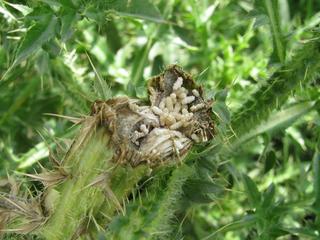
Carduus out at KJ’s
Some critter snipped the stalk and laid some eggs, looks like.
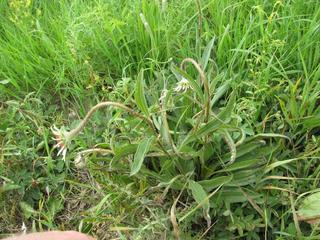
This sad-looking Echinacea was out at NW of Landfill, along with other bent over and crummy-looking Carduus and others. The grasses and legumes around it looked pretty OK, so I’m wondering if perhaps these were hit by some herbicide overspray earlier in the season before the grasses grew up around it.
Stipa collection is going pretty well, aside from the Topcon being flaky and not connecting to the data network for improved accuracy (it should be good enough for refinding tags along with the metal detector). We’ve collected from 85 out of the desired 300 so far, with different averages of seeds collected depending on the site. Landfill and Staffenson both had rather high averages, somewhere around 9 or 10 (no math here, just guessing based on what I was entering in the data fields) while some of the scattered remnants were closer to 5 or 6.
As for today, I’ll be out with someone to go search at other sites, hopefully, but the weather is looking a bit questionable today. We’ll see!
Here’s a list of plants that are available for Katie to use in inb1:
plantsForKatie.csv
I made this list with this script :plantsForKatieKoch.r
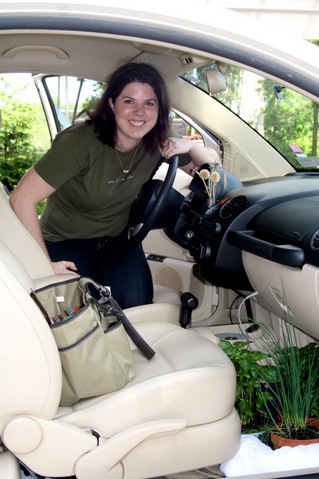
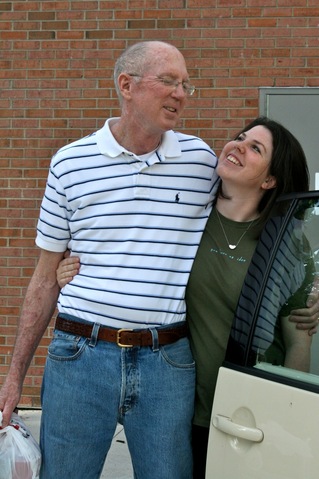
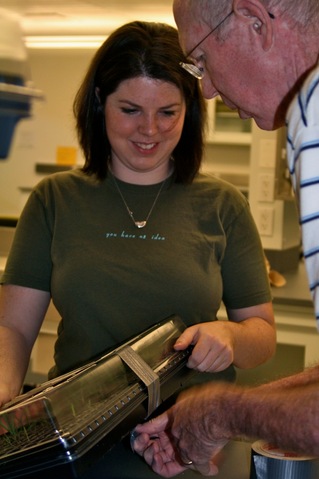
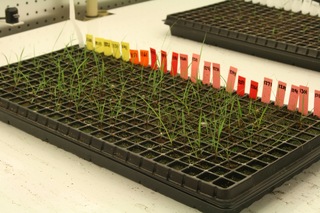
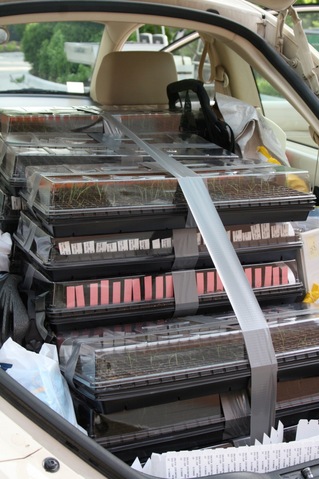
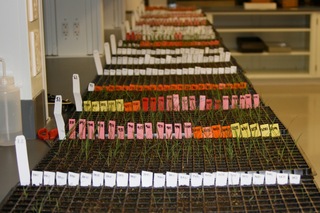
Well, I was the last to arrive this summer, same as last summer. With the help of my lovely parents I was able to pack all of my plug trays (18) into my 2007 New Beetle. I have attached pictures of this amazing feet.
After a 9hr drive, I arrived in Kensington and finally met the rest of the group. We have a great team this summer, so that makes everything better.
Unlike last summer, I got to enjoy Runestone days in Kensington this year, which was very fun. We watched the parade, and I think it was the longest parade I’ve ever witnessed, which is ironic because Kensington is the smallest town I’ve ever lived in for any period of time. I think other floggers will be posting parade pictures, but I would just like to note that the giant Norse ship with the mini-vikings inside (i.e. kids dressed as vikings, shiny swords and all) was my favorite part.
Anyway, today is Monday, so back to the grindstone. To do:
1) Seed sorting. (I know the many CBG volunteers are helping to sort seeds for me back in Chicago. I will be doing my share here in the evenings.)
2) Measuring plants. Hopefully I can find a partner or two to work on this with me.
3) Organize my planting locations and get them ready to go.
Other work:
4) FNC ordination (still working on this)
5) Work on style persistence data
6) Call Amanda and chat about the “little aster” issue…
Well that should keep me busy. Attached are some pictures and last years Cookbook.
Ech2009Cookbook.doc


-Kate
We had a pretty eventful weekend with the Runestone festival going on in K-town! We checked it out Friday night and saw fireworks, had a pancake breakfast Sat morning (all except Ian), talked to the locals, and had fun sniffing candles at the crafts fair. Then on Sunday we watched the parade and biked to the lake in Hoffman!
-Katie
This afternoon I spent some time with Terrasync, getting a data dictionary together for Hesperostipa seed collection. What does this mean?
This means I can take the GPS out, throw down a tag, collect some seed, then, while taking GPS points, put the various bits of information about the seed that I want directly into the Trimble. Geospatially referenced data with little effort!
Making sure that the GPS Pathfinder Office’s transfer utility is pointed at the right device (GPS Logger on Windows CE, in this case), you click “Send”, “Add” a data dictionary and browse to the file and Transfer All. You did create your data dictionary, right? No?
Well, take a step back and click on Data Dictionary Editor in the Utilities menu. From here, it’s pretty straightforward to create your very own data dictionary. Add the Features you want (features being the kinds of points you want. I added one for Stipa individual). From there, you add Attributes. These are the fields you want to take data on: whatever would be on your paper data sheet. Annoyingly, text fields are limited to a mere 100 characters, so keep that in mind for your comments fields (always have one; you never know!). Useful ones for me were Numeric (tip! if you want to widen the number entry field from the measly default of 2 characters wide, put some large number as your maximum value; you won’t be able to go above that, but that’s not a problem for my tag and envelope number fields. Certainly nothing will be above 1000000), Text, and Date. After getting your dictionary squared away, save it somewhere and transfer it to the Trimble.
At this point you should take the new data dictionary for a test run. Restart the Terrasync software on the Trimble and start anew. Create a new file and start taking a point. See if the dictionary suits your needs. If not, go back, fix your dictionary and retransfer, overwriting the old one. Now you’re collecting with style!
For the collection dictionary, I selected the following fields:
Tag Number (text)
Envelope Number (text)
# Seeds Collected (numeric)
Location (text)
Notes (text)
Notes2 (text; text is limited to 100 characters which may not be quite enough)
Current Date (date; autogenerated)
Collected By (text)
Hi!
Im Ian Holmen, a new REU student on the Echinacea project this year. I arrived in K-town not over a week ago after just finishing up my sophomore year at Carleton College. I recently declared myself as a biology major (a tough call between Spanish, economics, chemistry, anthropology and all those other thought invoking studies), and am hoping to absorb as much as possible from this summer experience. I have just finished up a preliminary proposal for some independent research that I hope to carry out throughout the summer. The proposal is in need of some tweaking so if anyone has some suggestions please let me know. Otherwise, stay tuned for a updated (hopefully improved) proposal in the future.
Project Proposal (rough draft).pdf
Hi I’m Lauren Hobbs. I am from a town in Wisconsin almost as small as K-town (aka Williams Bay). I attend UVA and am a psych major. Hence I am learning a lot already!! Fortunately, I found a friend here to work with!
Hi! My name is Hillary Lyons and I am from Olympia, WA. I am a biology major from Carleton College. I really like muskoxen.
proposal.pdf
I’m back! You may have noticed all my photo links are broken… well, that website is dead and I can’t edit my old posts. I’ll go back through and comment on my posts with pictures with updated links so you can have a clue as to what’s going on.
I now keep a (nearly) daily photo blog on Blipfoto and will do weekly posts linking all of the photos from that week, along with other photos and posts as necessary.
As for my project this season, I’m interested in looking at the effects of humidity on the awns of Hesperostipa spartea (aka Stipa spartea. thanks, plant geneticists). The current idea is to construct some sort of variable-humidity chamber with a humidity guage readable by time-lapse photography. I expect this will involve a sealed chamber and a humidifier, dehumidifier, and some way to control them powering on and off. The seeds will be in the chamber, digging through artificial duff or maybe just looking at how the awns curl.
Hi, I realized that not everyone will be able to open the file i saved my proposal in so here it in in a PDF format. phenology proposal.pdf
|
|


-thumb-320x240-45742.jpg)
-thumb-320x240-45745.jpg)