Hey everybody, I pleasantly stumbled upon this blog today and i’m glad to see this year’s Team Echinacea is up and running. Everything is looking good. The Flog is definitely proving to be a useful, as well as fun and interesting tool. I was a member of Team Echinacea last year as well as the Bee Team.
I recently got the chance to watch an experienced beekeeper mark a queen honey bee. The process was very quick and easy and I think could be tailored to use in the field in MN. There is a special container used for capturing and marking. A marking pen with special bee marking paint is used. There is no cooling involved. I’m going to try to find a website that explains this. The marking paint used by beekeepers is designed to last for the lifetime of the bees. Here is a video from youtube that demonstrates the marking of a queen bee.
I think that you guys should invest in some marking pens and look into getting other beekeeping equipment, at least just to see what is out there. Last year we didn’t really look into that stuff so we were just kind of reinventing the wheel.
-Jameson
|
||||
|
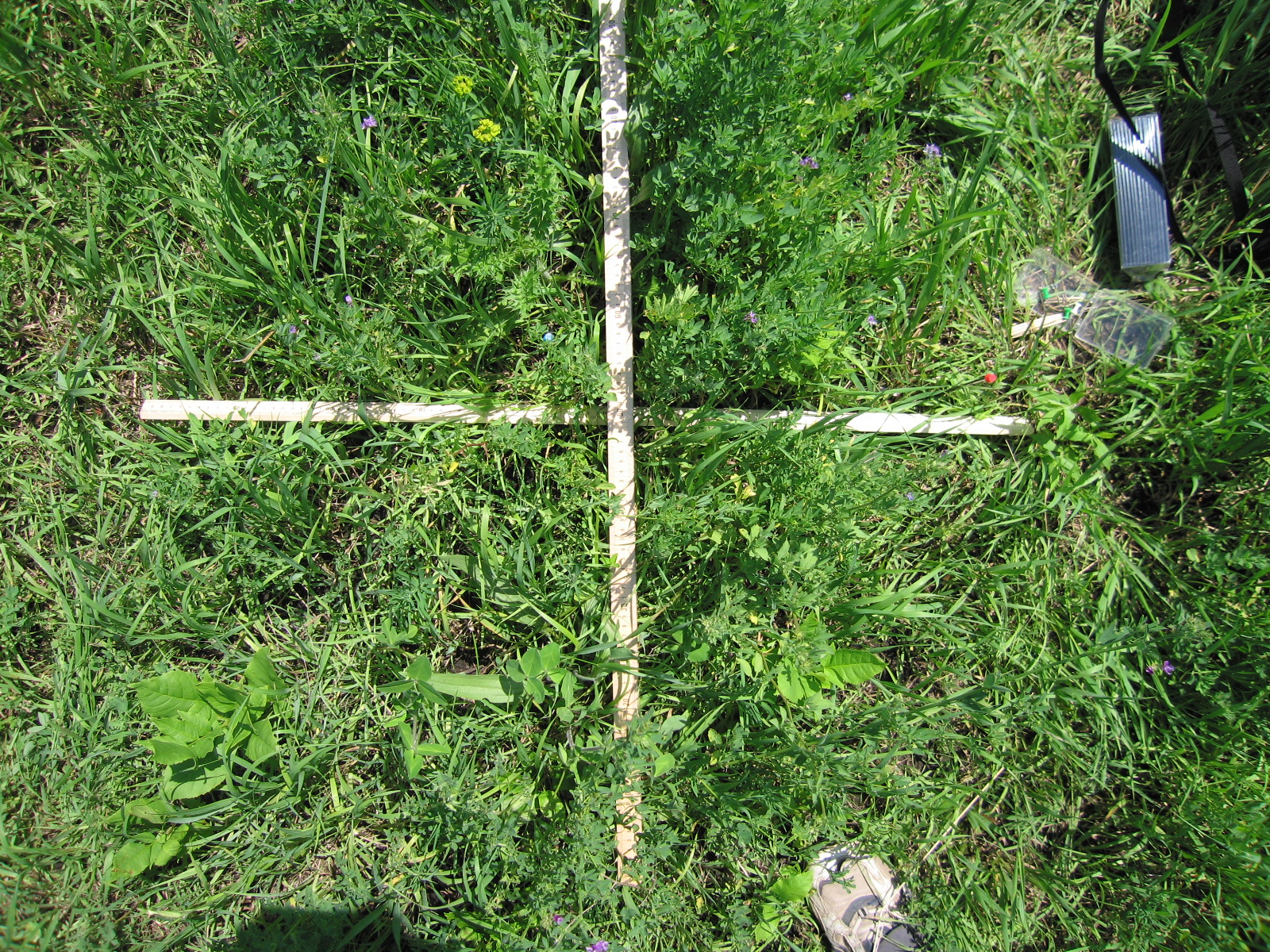
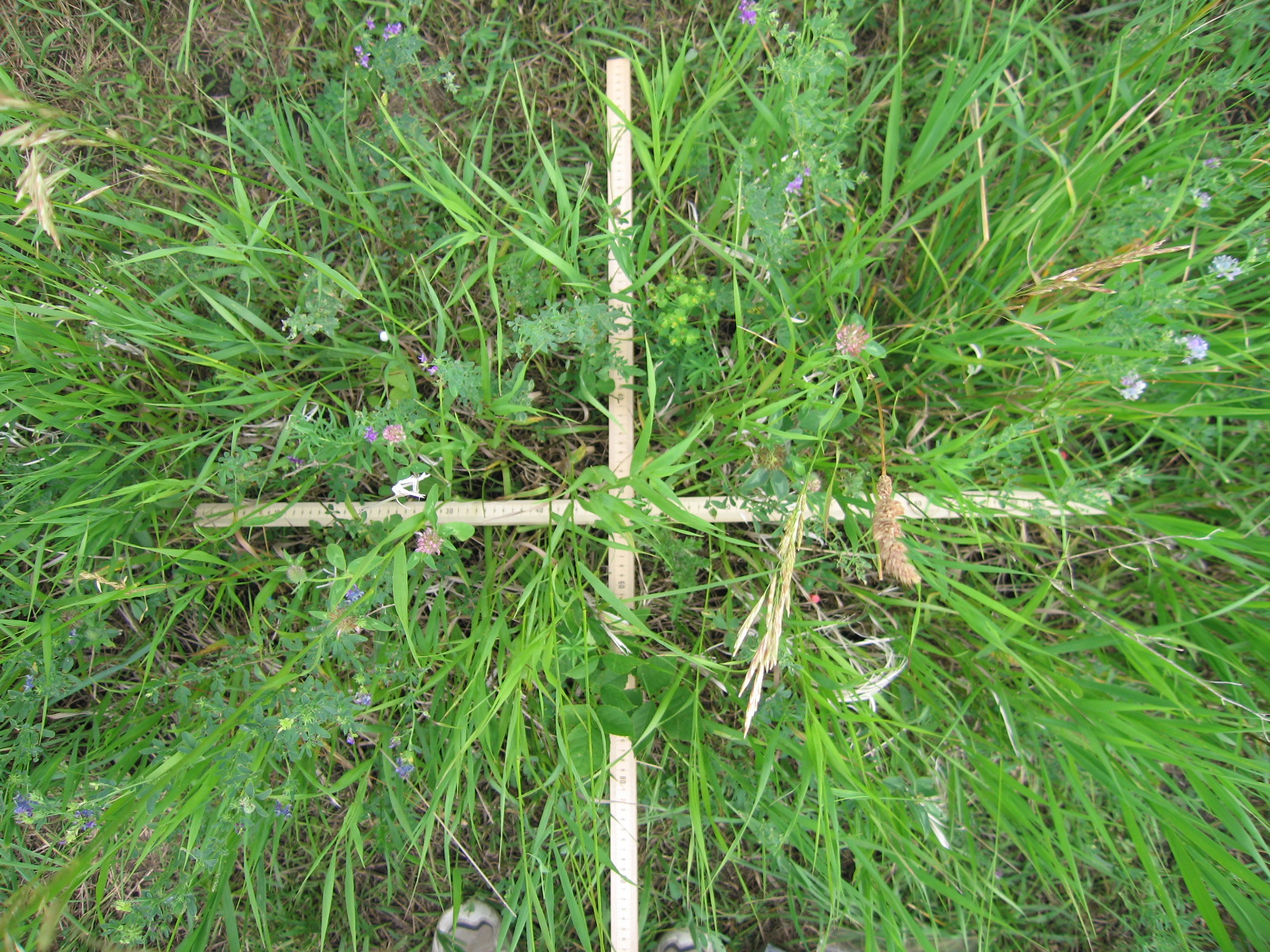
I’m working on improving our seedling search protocol, using perhaps photography, a physical grid, or some combination of things. Here’s a couple photos I took to test out a locating device: toothpick plus coffee stirrer plus thumbtack. The first photo is in easier short foliage conditions and has two red markers and a blue marker somewhere in the 1m diameter circle marked by the meter sticks. The second photo is in more difficult high foliage and has two red, a blue, and a white. All are visible in both pictures, but perhaps not immediately apparent. Happy hunting!
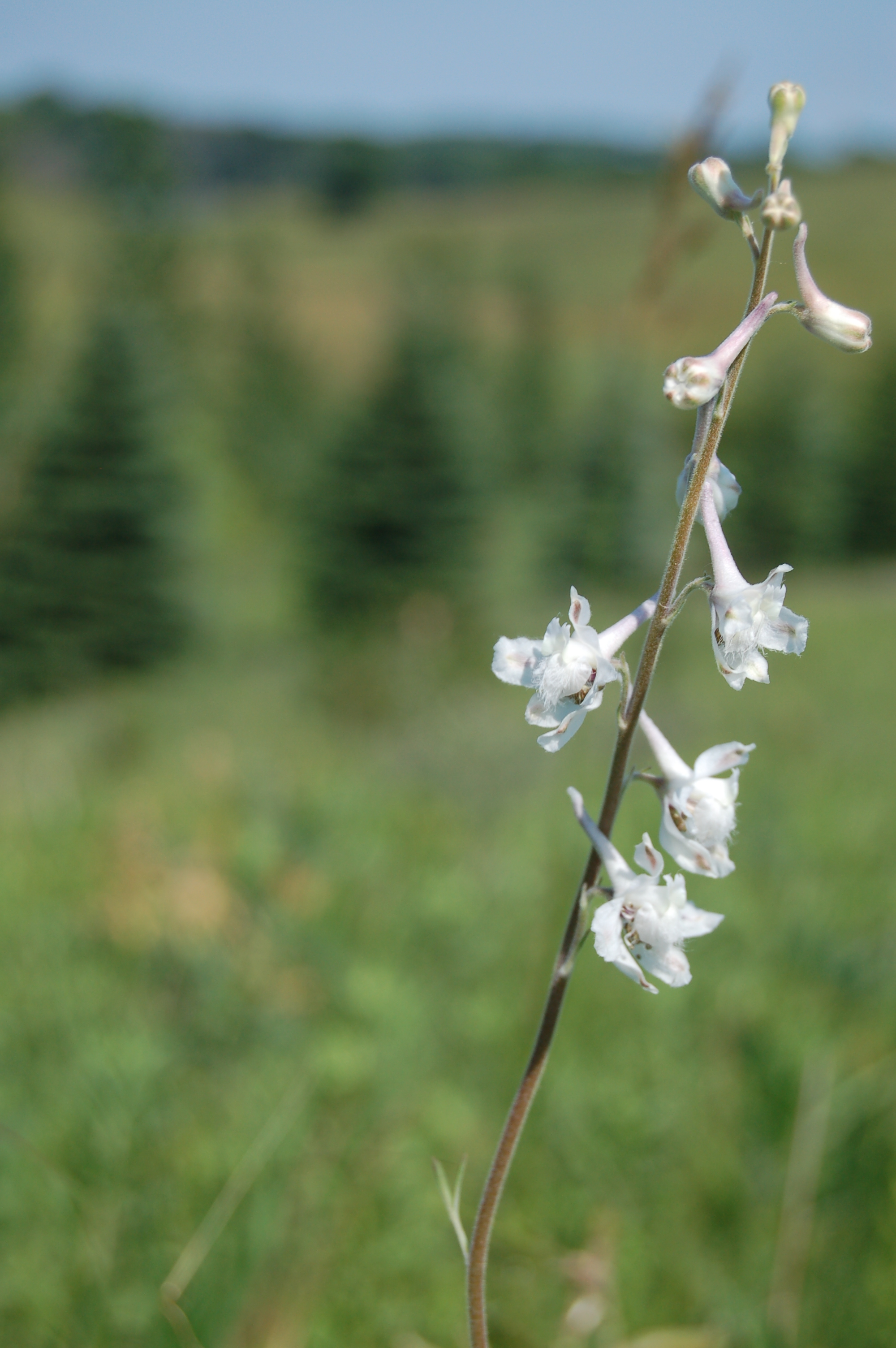
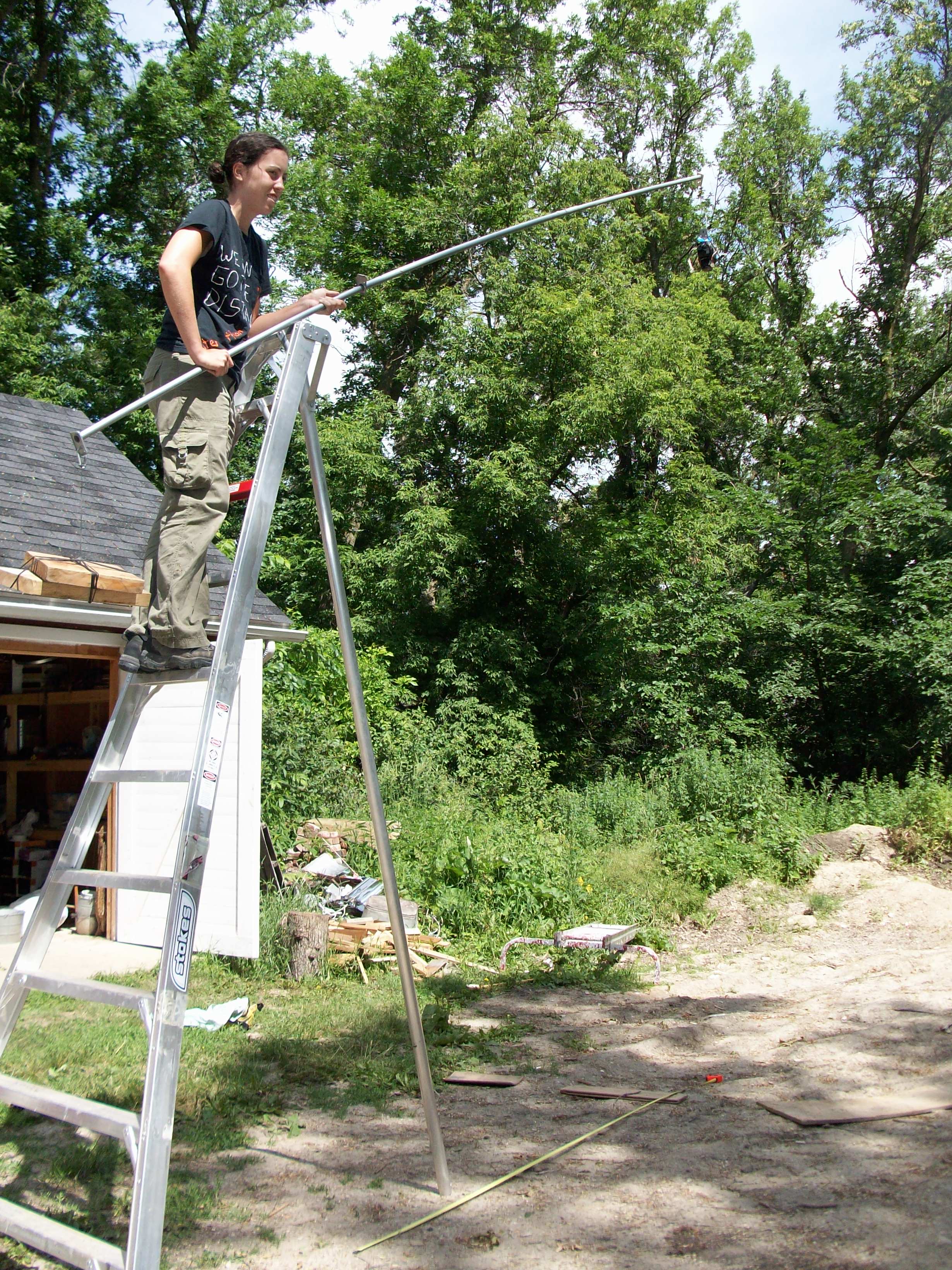
This is a picture of one of the plants at the landfill where Lecia and I are collecting plants. We didn’t collect this one (which I think is Delphinium carolinianum subsp. virescens (Nuttall) R. E. Brooks) because there were only three plants. Luckily Christine was with us to take some really good photos. So far we have 53 collections from landfill, and there is still more out there that isn’t flowering/fruiting yet. I think that’s a fair number of specimens considering we haven’t spent much time there. The hardest part is waiting for our collections to dry out in the press so that we can identify them. For my independent research project, I want to assess if plants in homogeneous Echinacea populations fare better with pollinators than plants in populations mixed with introduced sweet clover, introduced thistle, and native prairie rose. To accomplish this, I will apply several methods. First, I will randomly choose flowering Echinacea plants in several of the remnant populations to study. Then, I will record the number of introduced potential competitors as well as other native plants within a certain radius of the plant by using aerial photography. To get the camera high enough above the plant, I will stand on a ladder and hold a ~4m pole with the camera on one end and a counterweight (two wooden blocks nailed together) on the other. I will take two rounds of photos for each plant- once before peak flowering and once after. I will be able to determine distances from plant to plant by placing markers at one meter and calculating the number of pixels per meter when I review the photos.
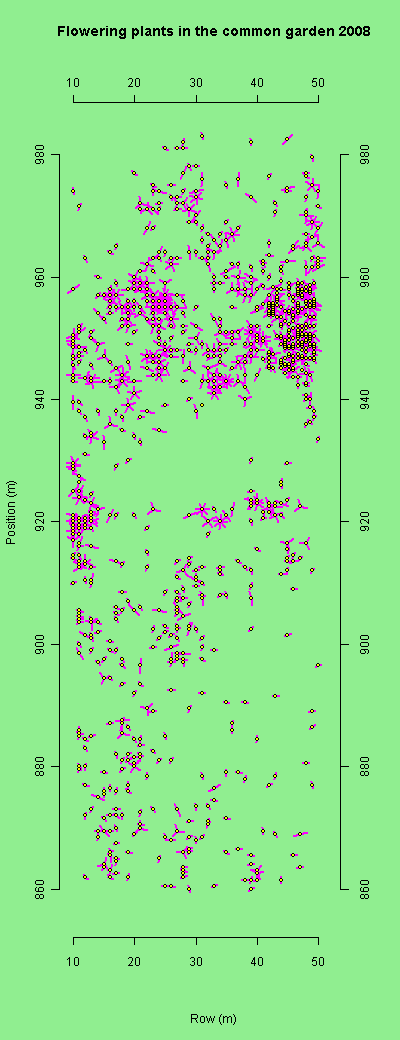
After classifying the surrounding populations to the flowering plant, I will determine the pollination success by observing the styles of the flower. When a flower receives compatible pollen, within 24 hours the style will shrivel, indicating successful pollination. I can count the number of shriveled style rows in each flower head to determine its success as a pollen receiver. I hypothesize that the flowers in closer proximity to other flowering plants will receive less successful pollen visits than Echinacea in more homogeneous populations. Hopefully, I will collect data from more than twenty plants. The plants are finally flowering, so this week I will be choosing my plants of study and start counting styles when they emerge. Here’s a practice time lapse series for plant (28, 943) from July 2nd-6th. I’ll be photographing 16 plants every morning or until people get tired of driving me around to the garden. I didn’t hit the ‘thumbnail’ option when I uploaded this, so if you want to see it in its full glory, right-click and go to “view image”.  Even though I’ve marked the position and height of the tripod with flags, it looks like it’s difficult to get the same photo every time. The changing background, I suspect, is a result of the head growing upwards a bit, causing me to change the camera angle. This shouldn’t be as much of an issue in the pictures taken from above. Bonus! After spending a good while talking about our independent project and looking over the work of last year’s Bee Team, Denise and I have come up with a preliminary plan for the next two weeks, sure to be revised once we actually get out there and figure out what works and what doesn’t. We considered how many different topics might affect bee behavior, including home ranges and the quantity of pollen on an echinacea head, but we ultimately decided that observing flight distances in relation to local daily densities of pollen-presenting echinacea would be the best complement for the lab work we’ve just finished. How will bee flight patterns change throughout the season–will they fly farther than usual between two echinacea before and after peak flowering, causing beneficial gene flow, or will the extra distance between the echinacea heads cause the bee to move to a neighboring non-echinacea, reducing the chances that the pollen will reach another echinacea plant? Due to the late flowering the year our observation time has shrunk to just two weeks, but hopefully it will be enough time to catch pre-peak and at least part of the peak flowering behavior. The key data we’ll want to gather during our observations are: Thanks to the time spent by last year’s Bee Team working out the kinks in their painting and observation protocol, we should be able to save a good deal of time by adopting their methods. So, following their lead, here’s the general plan: Last year’s team suggested that 7:30 AM would be the best time to begin catching bees. Because of our reliance on others for transportation to the garden, this may or may not happen, but we will try to get started as soon as possible each morning. Using a row number randomly generated by our visor as a starting point, Denise and I will search for bees in that row plus the row to the west and two more to the east. When we find a bee on an echinacea head we will catch it with a net, place it in a vial, and label the vial with the row, position, and twist tie color. The vial will be placed in a soft-sided cooler underneath an ice pack so the bee can calm down while we continue searching. Once we have a few bees in the cooler we will return to the original capture site, take the first bee out of its vial and place it on a plastic bag on top of the icepack. Using handy dandy paint holsters made out of eppendorf tubes and duct tape, we will place a small dot of paint on the bee’s back, being careful to avoid the wings and antennae. The previous bee team suggested applying the paint with a short piece of metal from a flag, bent, sanded, and taped to a stick, but we will probably have to make do with toothpicks for the first day or so. Once the bee is painted and has warmed up a bit, it will be returned to the echinacea head where it was collected and observations will begin. For observations, last year’s Bee Team suggested having teams of 3-5 people, with one person recording data and the others a few meters back from the bee, standing in a circle. When the bee lands on an echinacea head, the observers will call out the color of the twist tie and, if they can, the specific position of the plant. If the bee is moving from plant to plant too quickly for the observers to check the position, one of them will put a stake in by the plant before moving on and the data recorder will check the position. Due to the difficulties voiced by last year’s Bee Team over consistently recording accurate start and stop times for the bees on each head, and because we plan to use paper forms rather than the visor this year, we will not be recording these times. We will, however, make note of the collection and release times, as well as the time at which we lose track of the bee. According to this plan, it looks like the materials we will need are: Things that we probably will not want: Dear All, This is Andy McCall, I am studying pollination and herbivory with Stuart and Ruth and am based, this summer, at Denison University, where I teach. You may remember me through my witty or witless posts last year on this flog; it has been a long time since I have posted anything, but… Together with Colin Venner (on the crew last year) and Monique Brown, both of Denison, I have cobbled together a few small videos of pollinators we observed last year. We have over 800h of video to watch and we are more than halfway done! Anyway, I am going to try and post a few videos of known pollinators and a few unknowns — I would love it if anyone might be able to identify the unknown bee — we have several, but it is hard sometimes to see characteristics on the video. I hope the flowering commences soon! yours, Andy We are very interesting in observing (and participating in) the Echinacea mating season this summer. We are still waiting for the action to begin. Here is a map of the flowering plants in the main garden. Each dot represents a plant with 1 or more buds (immature capitula). The short purple bar indicates a plant with one bud, a long bar indicates two, and n short bars indicates n buds. In the main garden we found 869 plants with at least one bud and a total of 1572 buds. The most buds on a plant is 11. This is a modified “sunflower plot” that was generated with R.
We are waiting for the action to begin. At this time last year, like most years, Echinacea flowering was in full swing. We are prepared for the flowering to begin. We flagged all positions evenly divisible by 5. We mowed paths between rows so we can avoid stepping on plants. We have flagged every flowering plant. Note: don’t buy fluorescent colored pin flags. The flags tend to detach from the more frequently than non-fluorescent colors. What’s up, Forestry Suppliers? We weeded thistles and sweet clover, trapped gophers, found plants with Aster yellows, and are waiting for the action to begin. This flog entry from last year proved valuable. I just looked it up and followed the common garden maintenance protocol.
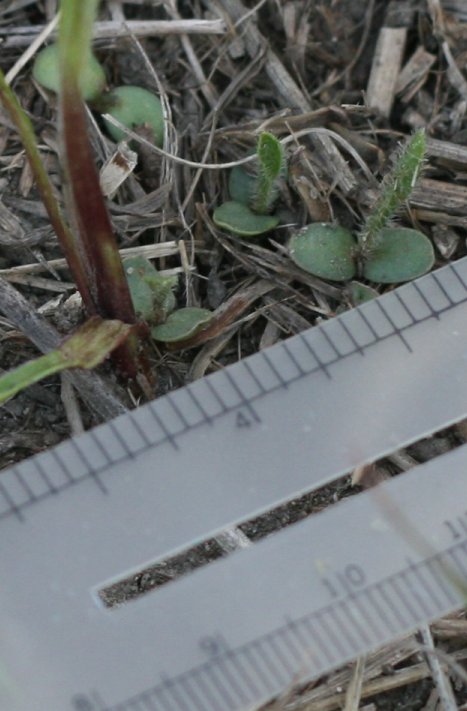
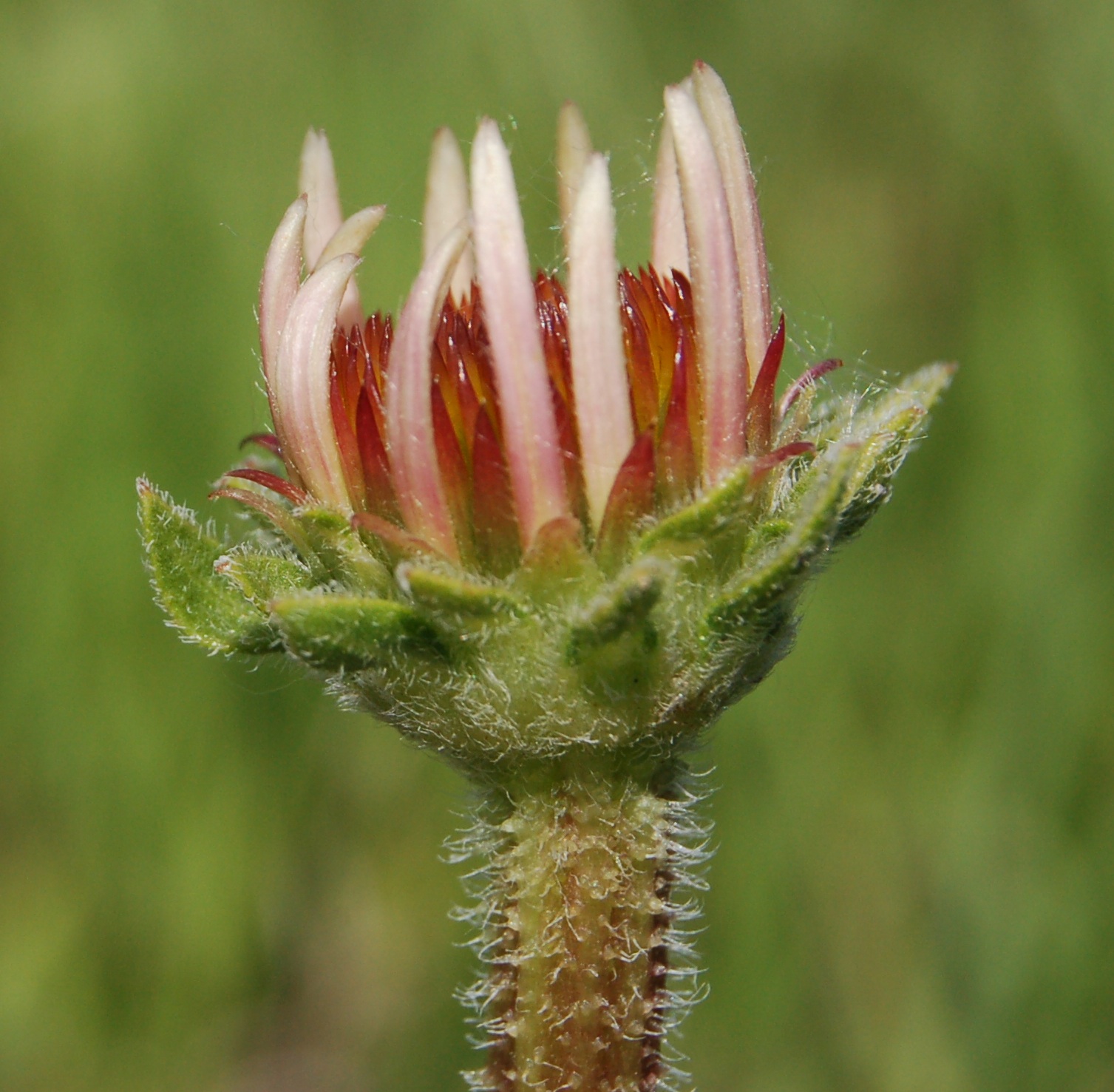
This photo by Christine shows fours seedlings near Echinacea plant 2044 at StApp on 17 June 2008. The seedlings are mapped & uniquely identified on pages 56 & 56 of “Seedling search 2008.” The ruler is marked with 16th of inches on the top and millimeters on the bottom. Today we finished searching for seedlings for the season. We searched near about 200 plants that flowered last year in 15 sites. We found about 239 seedlings. We made maps so that we can refind all the seedlings in August–at least those that survive. In August we will make sure we can find the seedlings again next year so we will be able to follow this cohort for several years to determine their survival, growth, and eventual reproduction. Searching for seedling is fun, but we are ready to move on to other exciting developments! As is probably apparent in this recent explosion of posting, we’ve now got the Internet on the inside of the condos. Neither rain nor mosquitoes nor legions of caterpillars can keep us from our e-mail. To demonstrate our unsurpassed powers of data transfer, I present to you…. a picture that is truly huge. This is the most developed Echinacea head in the common garden* which is remarkable because this time of year is usually the peak of flowering, or so they say. In any case, I’ll be taking pictures of it and some of its developmentally challenged comrades every day or so. The result ought to be a number of sequences that chronicle this awkward phase in their lives, followed by their blossoming and wild reproductive successes (or lack thereof). Yes, much like the reality TV stars that they are, these plants will have no secrets! * except maybe for the 99 garden, where I did not dare venture |
||||
|
© 2026 The Echinacea Project - All Rights Reserved - Log in Powered by WordPress & Atahualpa |
||||