|
|
Today, we started out the day in task forces and disperse throughout the common gardens and remnants. A number of us worked on p1 phenology and got absolutely soaked from the wet big bluestem. After that, many of us went inside while drying our stuff outside to work on R coding for our projects (I made a map of angustifolia and pallida ranges in the United States). The CoWBee team spent their whole morning at p2 working on their projects as well, and we were all able to convene for lunch, where some individuals gave us updates on the status of their projects.
After lunch, Kristen brought a team to move emergence tents around the prairie. The rest of us went out and did demography at the Loeffler’s corner, railroad crossing, and northwest of landfill remnants! The day ended and we all were happy to be home! I worked on writing a proposal for my project at night (and finished the map), and the rest of the roost team, along with Kristen and legendary Team Echinacea member Laura Leventhal, cooked a fried rice and tofu dinner for us all! The night ended with more intense games of Werewolf!
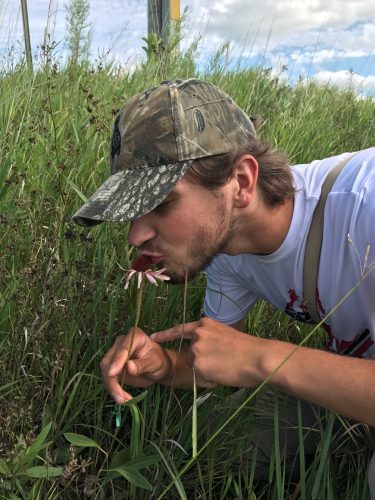
 I kiss an Echinacea at the Northwest of Landfill remnant
Today seemed like any other day. Zeke and I were recording visits, while Mia worked on her hand crosses. However, a rumbling in the distance distracted us from our work. It was a rare sighting of other members of Team Echinacea. Even though we (CoW Bee) were confused about these other people we were able to record visits and hand crosses. When we returned to Hjelm we met Lea, a PhD student who drove up from CBG. In the afternoon we measured in P1. For dinner Riley made tacos for Taco Tuesday (Not sure what else he would have made today). We ended the night with a few rounds of 10 person Werewolf. Tomorrow it looks like it’ll rain in the morning, but hopefully the team will be able to go out and work on our projects.
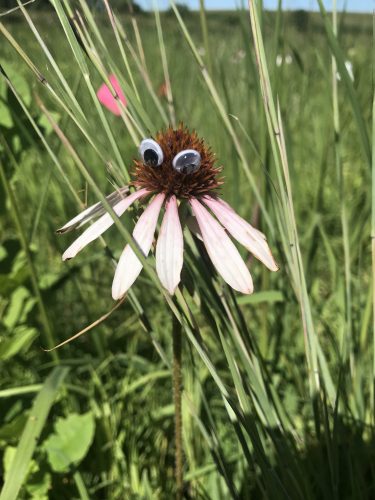
This Monday morning began with an unusual surprise. The team arrived at the Hjelm house to find numerous googly-eyes covering almost every conceivable surface. Upon recovering from this shock, the team assessed phenology in experimental plot 1. Many plants are finished flowering and we will likely only assess phenology a few more times this season. Following phenology, the team split up into task forces, with different members working on such diverse activities as staking bee tent trap locations, assessing the photosynthetic rate of Echinacea, excluding and adding aphids to plants in p1, and collecting more phenology data from from other Echinacea populations! The team reconvened for lunch, and in the afternoon went to a remnant Echinacea population for our first day of flowering plant demography. I had a chance to use Darwin, the team’s new GPS, for the first time!
A new variety of aphid? In the evening, the Roost held its fifth weekly Journal Discussion Club. For our discussion this week, I chose “The Problem with Wilderness” by environmental historian William Cronon. This essay focuses on the historical development of wilderness preservation and its place in the American environmental movement. Our resulting discussion was rich, and even became heated at times. We’re looking forward to the paper Riley chose for next week on the life-history traits of non-native fishes.
Warning: this post may contain traces of hyperbole and an overdose of alliteration.
To the untrained eye, activity at the Roost today may have seemed mundane, nothing out of the ordinary. But in reality, it was extremely eventful. We decided that laundry had languished in hampers for far too long so we launched into laundering. Meanwhile, in the living room, Mia knitted wildly, Andy ferociously consumed his book, Michael and Riley demolished their opponents in their respective video games. A select few (Zeke and Evan) participated in activities more conventionally accepted as exciting and productive: work. At P2, they spotted 18 bees while Kristen laid pan traps.
Later, Mia labored arduously over a pot, concocting a delectable dinner. The meal of spicy sauce on spaghetti squash with a side of salad was devoured by a ravenous Roost.
After dinner, Riley and Andy dueled via a game of tennis and three brave Roost-ers ventured into the dangerous outdoors to gather some groceries.
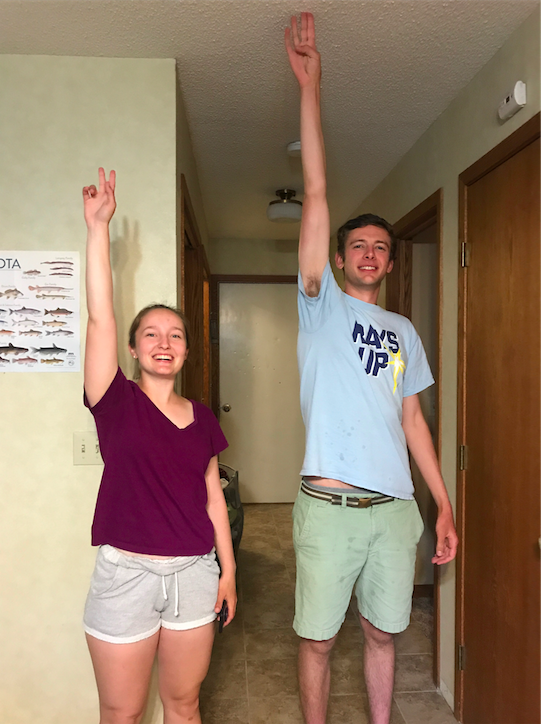
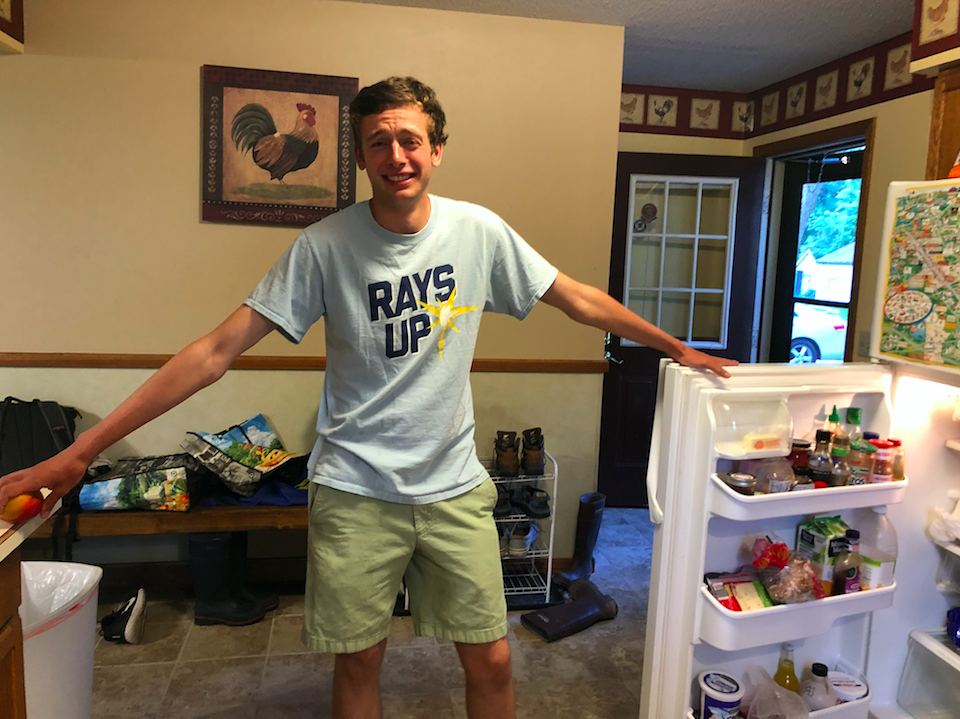
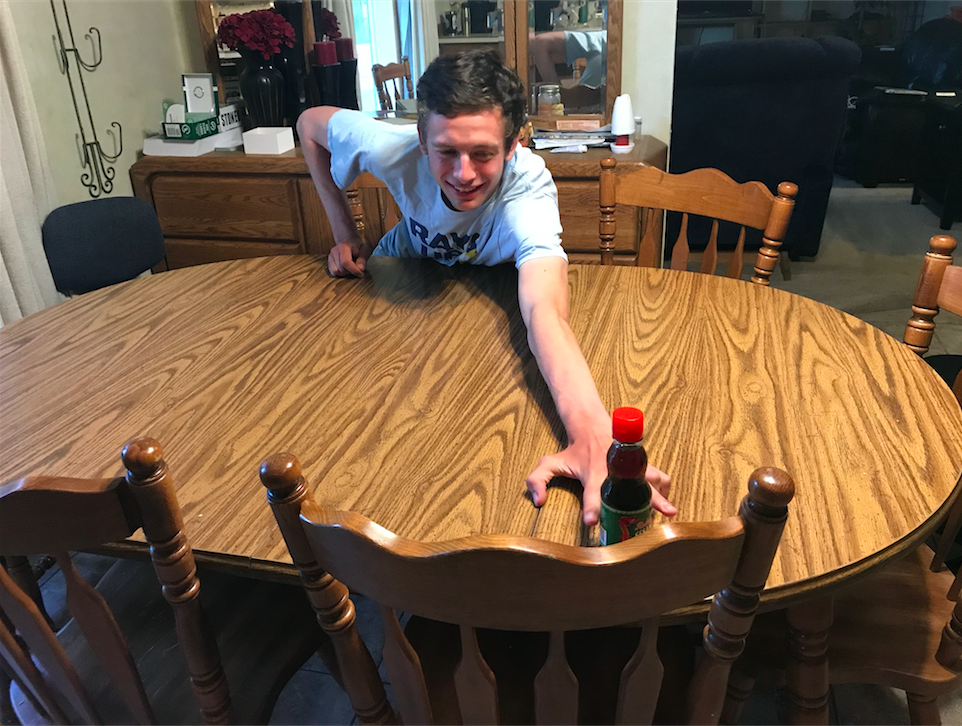
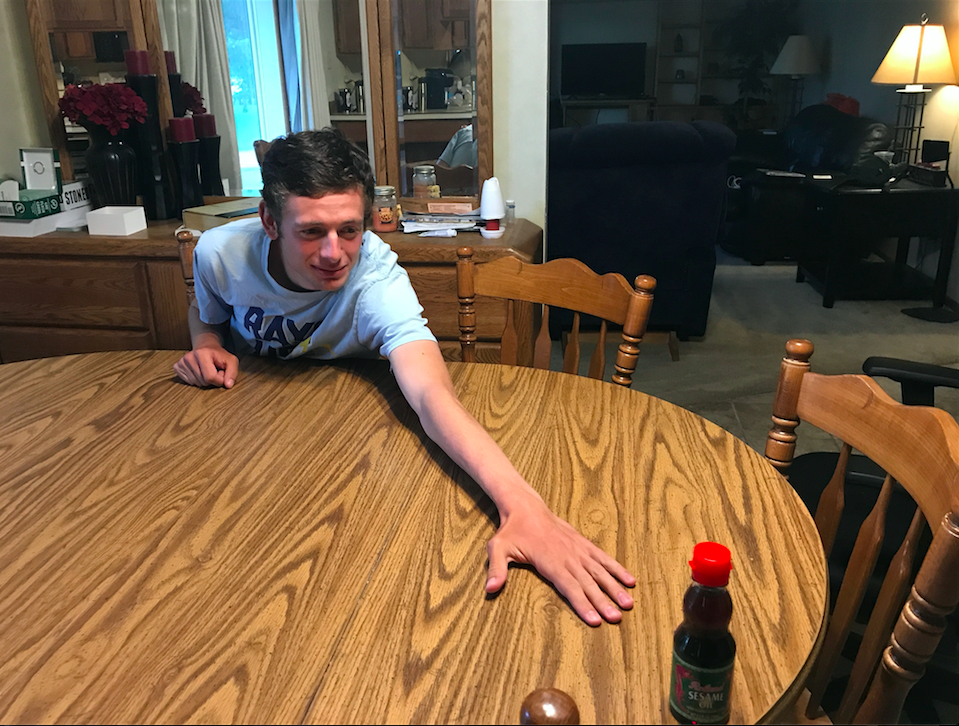
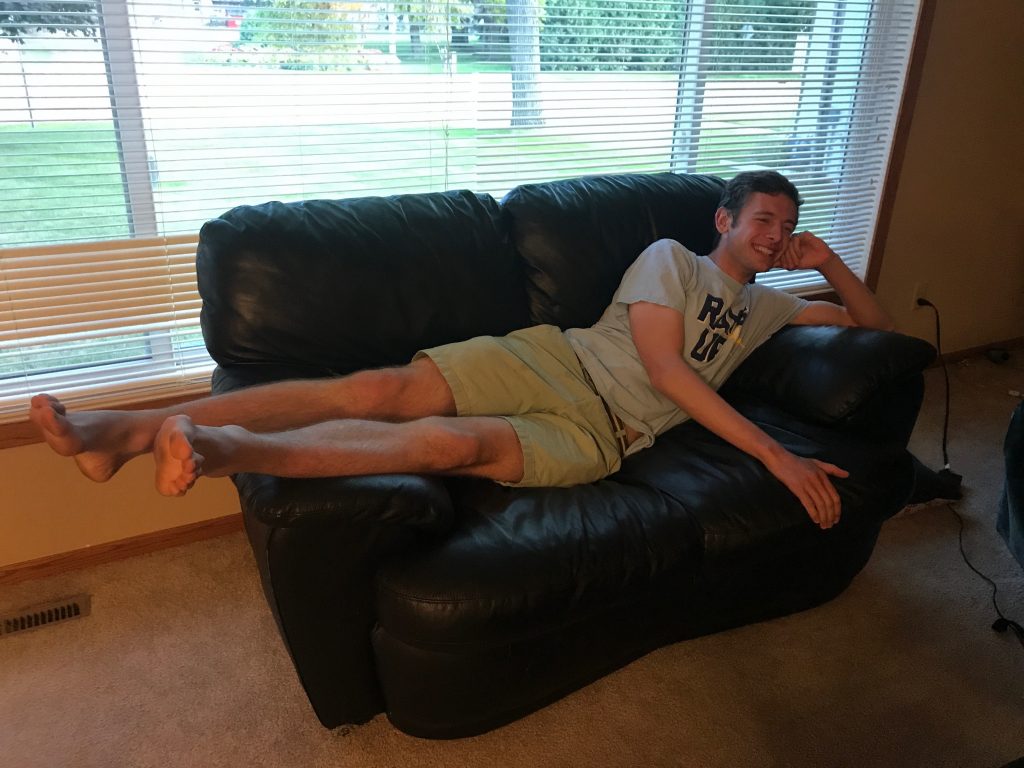
Upon return, we engaged in a rousing game called ‘What can Zeke reach?’. This game was a thrilling exploration of Zeke’s potential as the resident tall person.
Can Zeke reach the ceiling?
 Zeke touches the ceiling Can Zeke reach the tallest kitchen cabinet?
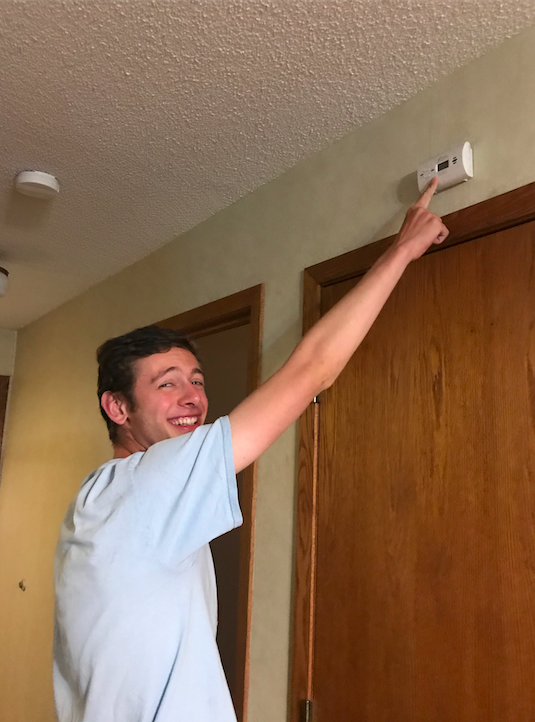
 Zeke reaches the tallest kitchen cabinet Can Zeke reach the carbon monoxide detector?
 Zeke reaches the carbon monoxide detector Can Zeke reach the fridge and counter?
 Zeke can reach from the fridge to the counter Can Zeke reach across the table?
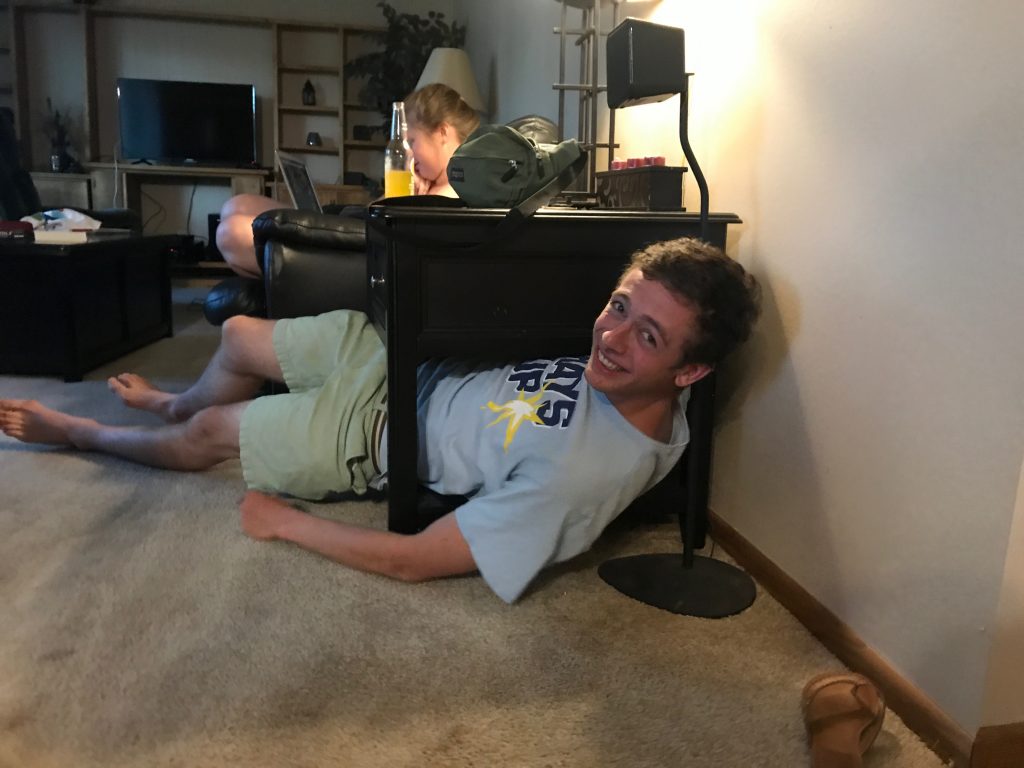
 Zeke can reach the soy sauce  Sad Zeke can’t reach the soy sauce However… being short has it’s advantages…
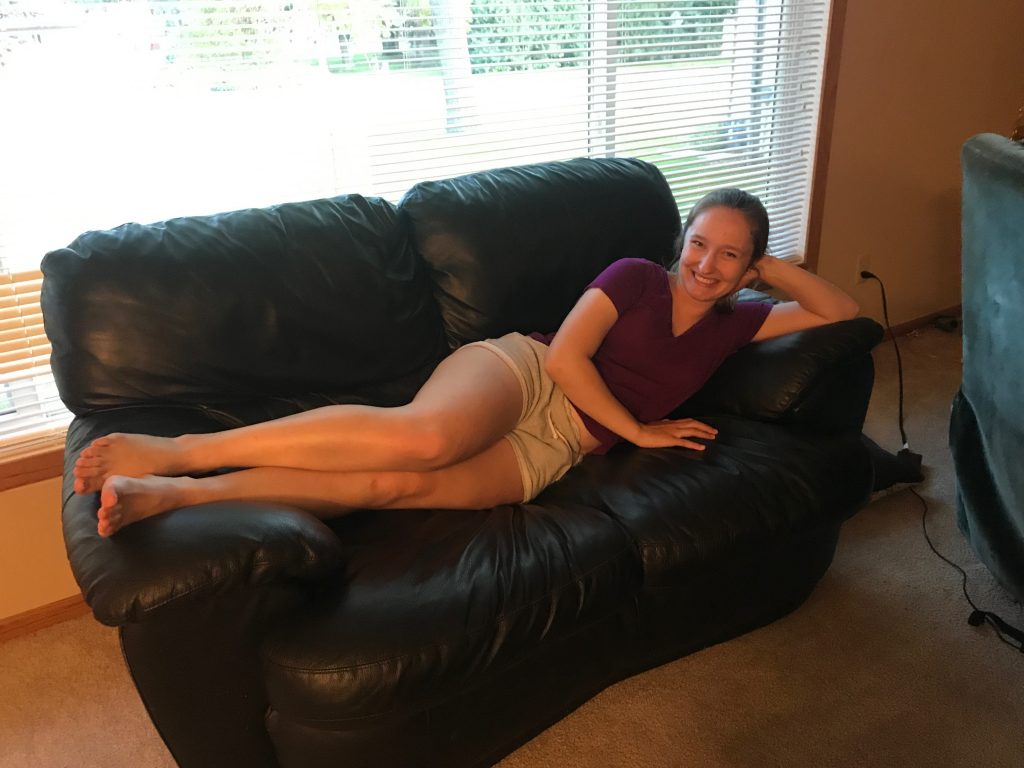
 Zeke can’t fit very well  Zeke can’t fit very well  I can fit People told me that communal living teaches you to live life with peace and balance and helps you achieve self actualization. Little did I know how accurate this would be. Alone, I would be unable to reach many things. But together with Zeke and all the Roost-ers, we can reach anything: ceilings, cabinets, and even our goals.
Hi flog,
Friday night we watched “The Truman Show” starring Jim Carrey. Since then the roost has been fighting the feeling that our existence is all part of a reality TV show….
Kristen bought an HDMI cord, so that the roost could watch movies such as, “The Truman Show”  Mia saw this beautiful bumblebee visiting a rose this morning. Cameras are everywhere. This morning me, Mia and Evan went out to Hegg Lake and observed bee visits as part of our study on pollinator efficiency, nicknamed “Pollen in the Bank,” (we call it pollen in the bank, since the bees make “withdrawals” and “deposits” from the pollen on the flower). This morning we observed five small black bees and removed anthers and styles before and after each visit. But where were the cameras? Were the bees actors?
Mia pulled styles from her hand crosses, which aim to see how many grains of pollen are needed to fertilize a single Echinacea floret. One of the styles from Mia’s hand-crosses was shriveled, which probably means that this style was fertilized. Or pretended to be?
While we were waiting for bees we found the cover to Andy’s visor (handheld electronic data recorder). An exciting plot twist?
Back at the roost, we ate corn instead of eggs. Andy, and Mia had friends visit from out of town. We visited Will’s puppy, Shadow. A friendly puppy going through teething? Or a trained actor meant to manipulate us for entertainment.
Andy and Anne made two toll-house pies (giant chocolate chip cookies; and product placement?)
Thanks
Post the Big Events you may think that the team’s trips to experimental plot two would be few and far between, well you would be mistaken. Zeke, Evan, Jennifer, and I (hereafter “Team CoWBee”) have been busy working there doing pollinator observations and a lot of painting. Today we went straight to Hegg Lake allowing us to get there while the bees were still sleeping. Zeke and Evan were busy watching the bees. Andy and Morgan joined us to work on phenology. While that was happening I was preoccupied with my independent project. What is my independent project you ask? Well, let me tell you!
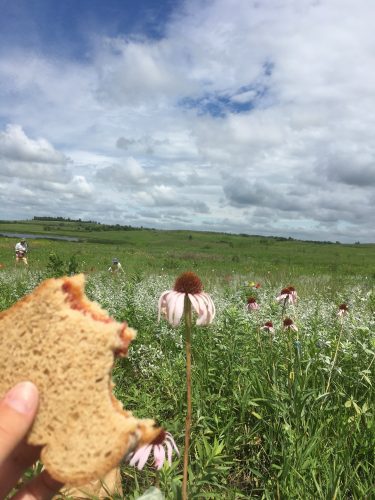
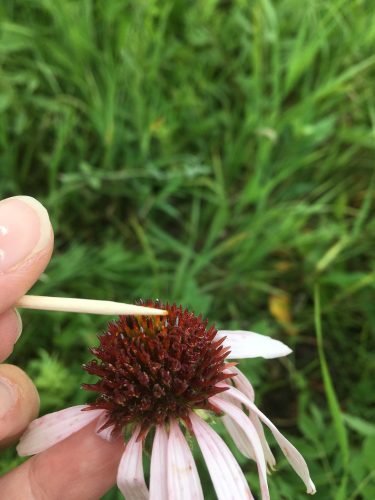
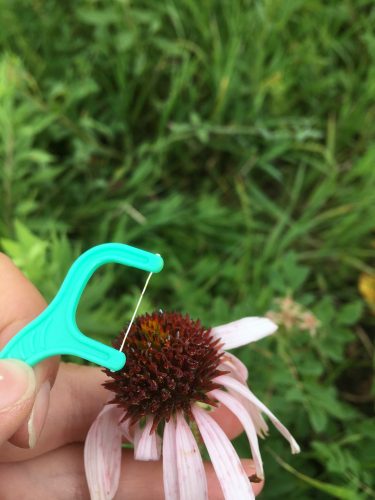
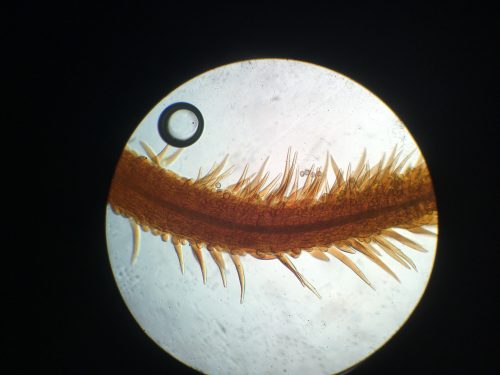
Lunch with a view In pollination biology, it is often thought that the more pollen grains a bee deposits the more efficient it is (the better it is for the plant). However, Echinacea technically only needs one pollen grain to make a seed. Once you consider that not all pollen grains are viable more than more may be necessary to ensure a seed is made. My question is how many pollen grains are necessary for there to be a 90% chance that the seed is made. How in the world am I doing this you may ask? Well, I must be the bee. Not literally but I need to deposit different amounts of pollen on styles and see if a seed is made. To deposit the pollen, I have been using toothpicks, a flosser picks, and a patience. Once I deposit the pollen I will come back remove the style allowing me to count the amount of pollen under a microscope. Today I spent the majority of the time being a bee, performing these hand crosses so that I can remove the styles tomorrow. My goal is to perform a total of 480 crosses (80 heads) (half of these are backups) today I did 54 crosses (nine heads).
Toothpicks aren’t only for hors d’oeuvres Who uses flossers for their teeth?  A style under a microscope Still, have a lot of work to do so until next time!
Mia
Today, the weather was not in favor of getting field work done. We spent the morning working on getting things ready for some of the Echinacea Project’s biggest tasks like Demography and Measuring. We also spent time working on our independent projects and learning to code in R.
At lunch, Jennifer gave a practice version of her upcoming talk at the Botany meeting in Rochester, MN. We learned about the maintenance of pollen color in Bellflowers.
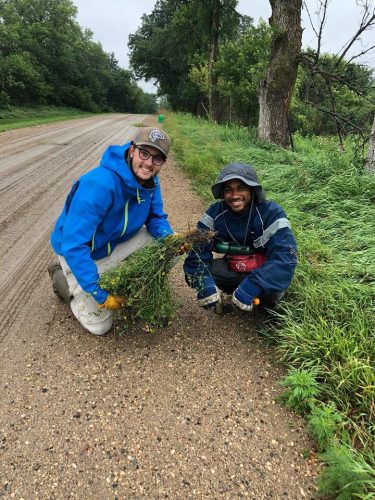
After lunch, there was a brief ‘break’ in the rain so we headed out to Tower Road to remove some bird’s foot trefoil. We have been removing this invasive for several years and I think that our progress is easily seen! Evan and I found one monster plant that took the two of us to remove (see picture). It was a bummer to miss a day of field work but it was nice to have some time to catch up on inside tasks.
Evan and I showing of our trophy
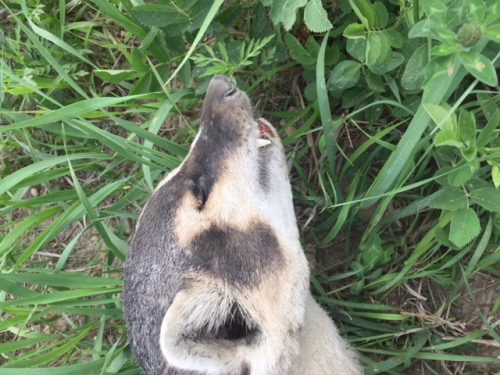
A rarely seen mammal in MN, dead or alive. This badger was along the roadside but didn’t appear to be hit by a vehicle. Today was a busy day with groups going different directions. Phenology on P1, Bee photography at P2, insect pan traps, moving insect tents and a lesson on demography with a practicum test. Ryley getting accustomed to running the lycor which measures the photosynthetic rates and has the label micromole CO2/meter squared per second. How cool is that? The Echin Project seems to be flowing like a well oiled machine and the plants too. Tomorrow looks like it may rain so plans were made for Thursday to begin looking at some of the data/specimens we’ve collected over the weeks. Personally, i’m looking forward to Big Event 6: Contact 3-2-1. (I’m thinking of a word beginning with the letter B)
Good evening floggers. Today was an exciting day for Team Echinacea. Big Event 4: Revenge of the Bees occurred this morning out at p2. I unfortunately was unable to attend because I had to stake and move emergence traps. The weather was nice today so I imagine it was a fun time!
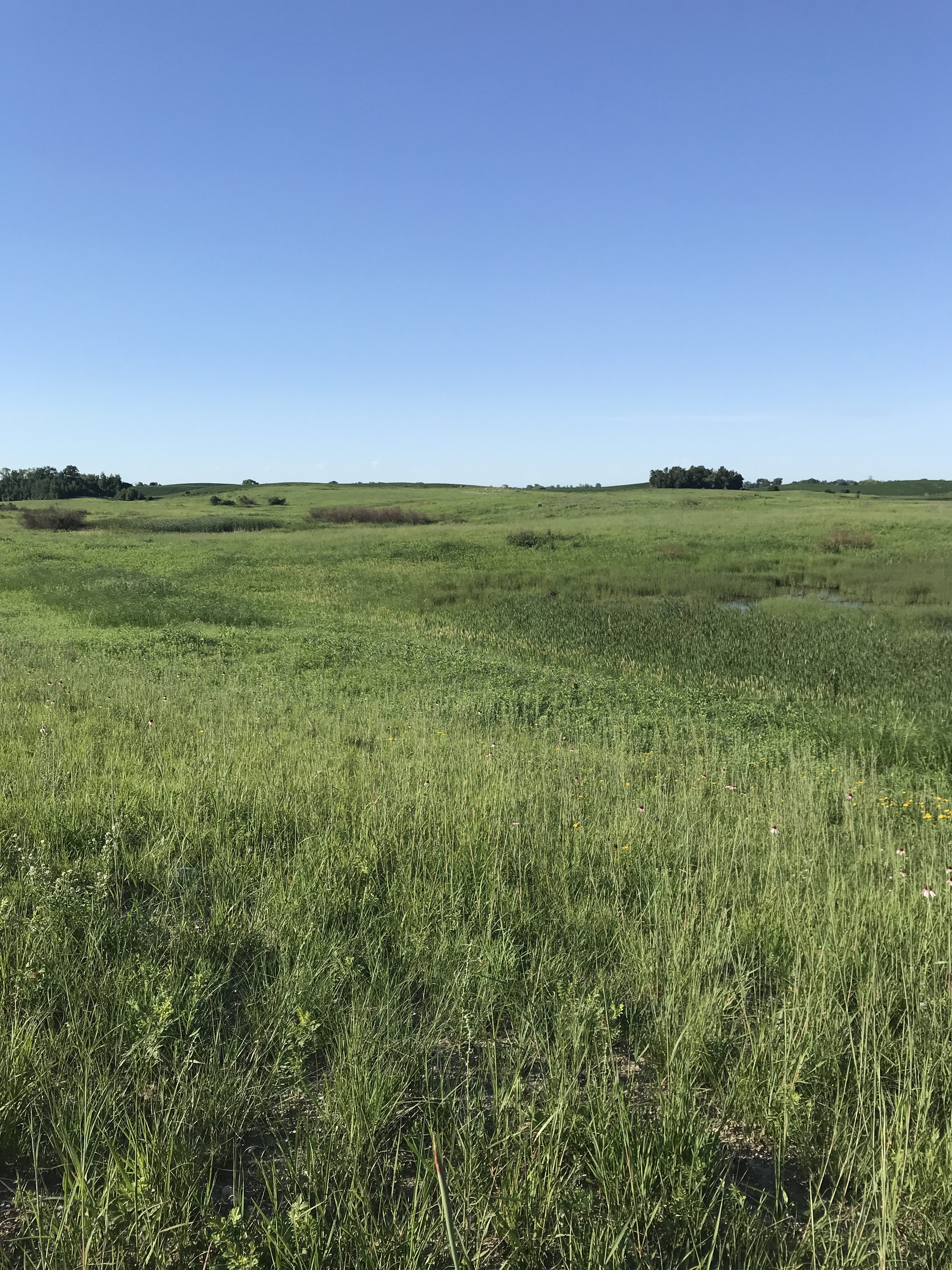
What p2 looked like from where I was this morning. Today was my first day at a new site for the bee emergence tents. Yesterday I collected traps at Hegg Far West. Sadly, there were no bees yesterday. Today I staked and moved tents to Hegg North East with hopes of catching a bee in the traps tomorrow.
Tonight we had our weekly Journal Club. Mia picked an interesting paper titled “Experience teaches plants to learn faster and forget slower in environments where it matters” by Gagliano et al. 2014. Using the sensitive plant they showed that plants are able to show an elementary form of learning. We had a tantalizing discussion about the sentience and value of plants along with a discussion of the methods.
See you tomorrow flog!
Today the residents of the Roost awoke to a rainy morning in Alexandria. We started off the day with a trip to the grocery store to stock up for the week, followed by several hours of rest and relaxation at the house. Later we got in touch with our inner artists. With Kristen’s help we attempted to recreate some of our favorite paintings (see below). In the evening we enjoyed a delicious dinner of mac and cheese with a jalapeño cheddar cheeto crumble, courtesy of Mia.
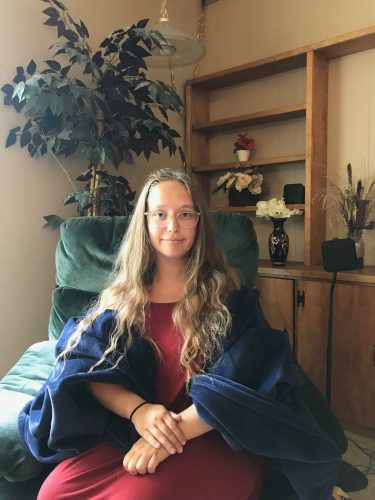
Mona Lisa – Leonardo da Vinci
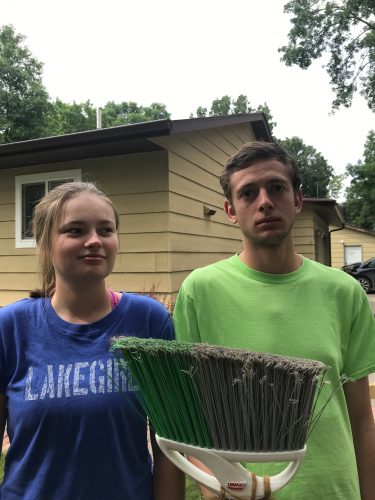
American Gothic – Grant Wood
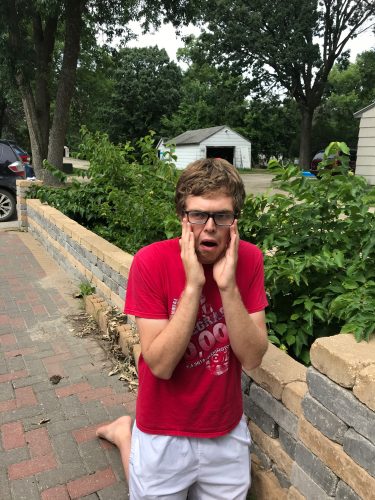
The Scream – Edvard Munch
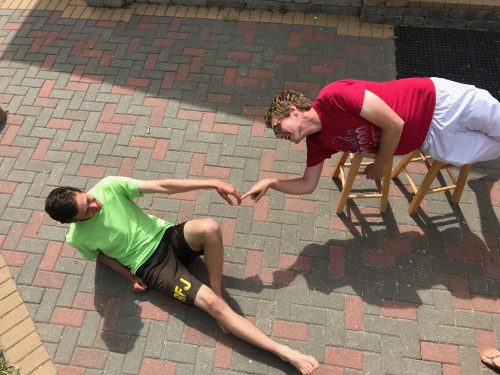
The Creation of Adam – Michelangelo
|
|