|
|
Today, Team Echinacea took a significant detour from our normal routine. Not only did we leave Solem Township on an adventure to Glacial Ridge National Wildlife Refuge, but we didn’t even study Echinacea while we were there. No, instead we studied a member of the orchid family, the endangered western prairie fringed orchid.
Our trip north started early in the morning, with us leaving the comforts of Alexandria at 6:00 AM, in order to arrive at the site by 9:00 AM. Of course, a much-needed donut stop was had along the way. Once we arrived in the first of the two experimental sites, we got to work finding the prairie orchids.

Gretel teaching the team how to count flowers on an orchid
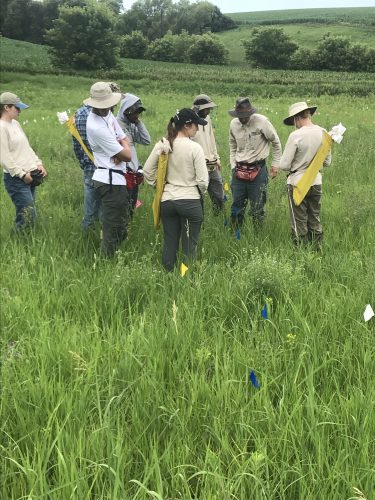
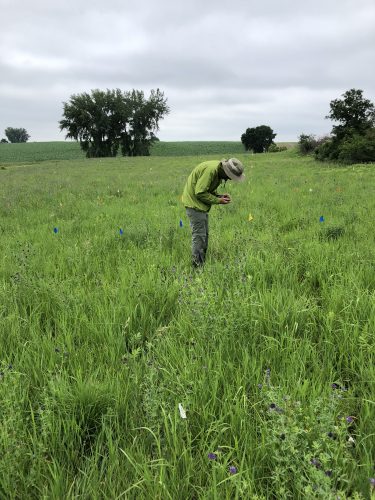
We do a full census of the prairie orchids that are on the experimental plots, which means we need to find every orchid that is within the boundaries of the study. And therein lies the challenge. The plants themselves aren’t necessarily too hard to find: big ostentations flowers, often with 5+ flowers on a plant. No, what is challenging is figuring out where one is within the experimental plots. The corner of every 10 meter by 10-meter plot is marked with a short wooden post, which, in tall grass and ankle height waters, at times, can be quite difficult to find. Of course, we learned to use our extreme geometry skills to locate the locations of where posts should be (as some posts simply weren’t there).
Little can one tell there are many plot marking posts within this picture
The ankle-deep water was much nicer that the occasion knee-deep water that criss-crossed the plots
All things considered, Team Echinacea had a very successful day as Team Orchid (or Team Platanthera, if you prefer). we found 584 plants within the experimental plots and got to see many new plants and birds that are not present in our Echinacea plots, like the showy milkweed and the upland sandpiper.
Get ready for tomorrow to hear all about the Big Event!
Michael
The day began with 2 rain delays before work began. Kristin moved her insect tents and Jennifer, Zeke, Mia, Evan and John finished the phenology at P2 and cut randomly selected Echin heads. It was a very short work day followed by the annual Independence Day picnic moved from Elk Lake to the farmhouse with members of Stuart’s family and Team Echinacea. Since the workday was short, here’s a little diddy:
A Day in the Life of Team Echin
(disclaimer – some words and names may have been spelled incorrectly but intentionally)
I’m leaving for work wife says “wow you smell purdy”
I say “thank you dear its sunscreen, SPF 30”
The Hjelm House, P8 and P2 and P1,
The Farmhouse, G3 and G2 and G1
Ticks, Chiggers, and mosquitoes
and Jalapeno Cheddar Cheetos
Evan, Anna, Brigid, Kristin and Morgan,
Citrus lanatus we love Stuart’s watermelon
Hydrate with water, put on your sunscreen and boots
What’s for supper tonight and who’s cooking at the roost
Visors, toothpicks, Twist Ties and Flags,
Proposals, projects, task forces and flogs
Wagenius, Reed, Dykstra and Shaw
Angustifolia, Purpea and Pallidaw
College of Wooster in Ohio with Zeke
Groupme, Dropbox, Twitter and Tweeks
Hegg Lake, Staffanson, Stevens and Landfill
PB and mustard sandwiches at lunch with Michaill
Team norms, teamwork, go team and efficiency,
Before you go please sync the visors Ryley
Jennifer, Amy, Evan, Andy, John VK and Mia
You see now Stuart “its not about Echina Cia”
Hi Flog
This morning we split up to do task forces. I worked with some people to finish phenology (what was flowering and when) in plot one. Afterward, we planned to start more work out at Hegg Lake but no sooner had we arrived, then we were driven back to the farm by thunder, lightning, and rain.
On our way back we picked up Michael who had prudently protected himself from the storm by crouching in a ditch in “lightning position.” For those who may not know; lightning position is a special crouch that makes you completely immune to any danger associated with lightning or any other electrical Armageddon. To attain the lightning position, take a deep breath, tap your heels together three times, cover your ears and crouch down with your knees facing outwards and your butt not touching your heels. Next, remain in this position for the duration of the storm, which if it lasts for more than a few minutes, will give you a killer lower body workout.
The theory behind Lightning position is that, because you are low to the ground you won’t be struck by lightning directly; and if lightning strikes near you the electricity will travel through the ground and delicately remove your pants; without stopping your heart. However, if you were in a normal crouch a nearby lightning strike could travel through the ground and then straight up your body; stopping your heart, without bothering about your pants at all.
After safely returning to the farm, we had a productive morning learning how to identify small solitary bees. Around 11 AM Amy Waananen’s advisors visited, and promptly identified all the bees in the house, down to species from across the room.
 Andy, prepared for both rain and mosquitos After lunch, the sun broke through the clouds and we were able to go out to an experimental plot at Hegg Lake. This plot was planted by the Echinacea project in 2006 and has provided the project with valuable research opportunities ever since, especially since it started flowering in recent years. Because it is an experimental plot researcher cut off all the flowering heads at the end of the season. This summer Dr. Jennifer Ison is conducting a study on how different types of native bees contribute to the male fitness (seeds sired) of Echinacea. This study requires only about 400 flowering plants, however, the plot did especially well this year and had over 800 flowering plants. Since conducting the study on all 800 plants (over 1800 flower heads; one plant had 15 heads) is not feasible, we were forced to cut the heads off of 300 randomly chosen plants sooner rather than later.
Video Jul 03, 4 24 21 PM
After we cut as many heads as we could for the day, we returned to the farm and planned to finish cutting flowers tomorrow.
While uploading data, Riley asked a provocative question:
If you have an Agapostemon in your hand, what is in your eye?
Upon request, I decided to tweak the lyrics to the popular song “Boys” by Charli XCX so that it is about bees. Here it is: (I encourage you to listen to the original song, both for comparison, and enjoyment).
I was busy thinking about beesX3
I was busy dreaming ‘bout beesX3
Head is spinning looking at beesX3
I need that Agapostemon to visit me on a Friday
And I need those small black bees to wake me up on a Monday
That Augochlorella can come over on Tuesday day
I want Andrena, I want ‘em all
But if they don’t visit I’m all alone yeah, I’m looking out at views of the prairie
Those rolling grasslands, and ponds.
Didn’t take a picture
I’m sorry that I missed that Stipa search (also called porcupine grass), I wish I had a better excuse like I had to fix a visor (a handheld electronic data collector) problem;
But I was busy thinking ‘bout beesX3
Head is spinning watching them beesX3
Don’t be mad, don’t be mad at me,
Darling, I can’t stop it
Even if I wanted
Don’t be mad, don’t be mad at me
Missed that Stipa searching I was miles away
Don’t be mad not like I had a choice
I was busy thinking ‘bout beesX3
I was busy dreaming ‘bout bees bees bee’ees
Head is spinning looking for bees.
Hi Flog!
I just wanted to give you all a quick update on the heritability of flowering time project I have been working on (for a long time)! We collected data on the phenology of the plants at experimental plot 2 during the summers of 2015 and 2016 and the phenotypes of those individuals to the phenotypes of their parents in 2005. Jennifer Ison began this project as a part of her dissertation in 2006 and I was lucky enough to pick it up when the individuals in experimental plot 2 really began to flower.
Since we collected data in ’15/’16 we have been working on analyses to determine the amount of variation in flowering time that is heritable. We found that there is substantial heritability for both onset of flowering and duration of flowering. Both of these traits are critical in describing the synchrony of an individual compared to the population and for determining the number of mating opportunities an individual will have in a season.
Today we submitted the manuscript that describes these results to Evolution. Drafting this manuscript has been an excellent learning opportunity for me and I have been lucky to work with some amazing scientists and writers. Thank you to my co-authors: Jennifer Ison, Stuart Wagenius, Frank Shaw, and Ruth Shaw.
Hello Flog! Today was a great day out on the prairie. We got a lot of important things done, but more importantly, we had fun getting them done! Weather-wise it was a nice day, we were slightly concerned at lunch after a brief spurt of rain, but things cleared off and the beautiful weather held through the afternoon. While temperatures in western MN have gone down a bit, the mosquito population still seems enormous.
In the morning some folks worked on independent projects, a select few worked on planning a top secret project ‘The Big Event’ (flog post coming soon to an Echinacea project flog near you). I worked in experimental plot one with Kristen, Andy, Anna, and Michael to find and record all flowering heads, Its a big job but luckily not as big as experimental plot 2!
 Kristen and Andy next to their prized flowering Echinacea I took a break at about 10:30 to learn more about our brand new GPS unit named Darwin. This is an excellent investment for the project and will help us get a lot more field work done. It has many more useful functions than our GRS-1 units which seem to be terminally ill.
At lunch, we discussed the finer points of the 40-hour work week.
Post lunch many of us went back out to experimental plot 1 to find and record information on the Hesperostipa spartea that are planted near the Echinacea in that plot. Since it is a grass it can be difficult to spot, I was lucky enough to work with Zeke who seems to have been blessed with the ‘Stipa Sense’ or the ability to spot these plants from at least 2 miles away on a foggy morning.
The team learning how to find Stipa
Have a great night!
Will
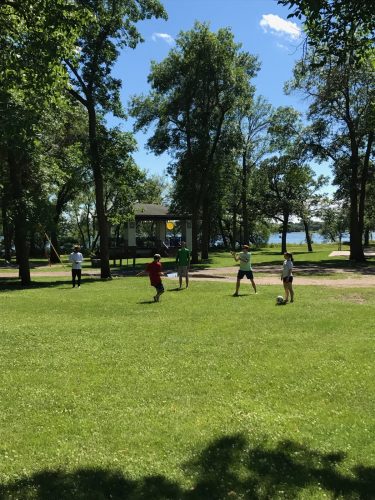
On this great Sunday to start off the month of July, the Roost woke up to rainy skies and an expectation of a rather laid-back day indoors. Fortunately, the weather cleared for sunlight and team CoW Bee was able to set up P2 for our Jennifer’s experiment by painting, bagging, and crowning flowering Echinacea heads. Thereafter, the Roost squad (and Kristen) reconvened at the Roost and decided it was time to turn away from the prairie ecosystem to relax at the limnetic Lake Agnes in Alexandria. At the lake, we engaged in common leisure activities some may call sport: kanjam, swimming, frisbee, and soccer. This small excursion was a morale boost for the team; we found that our fellow roostmates have skills other than searching for melted toothpicks.
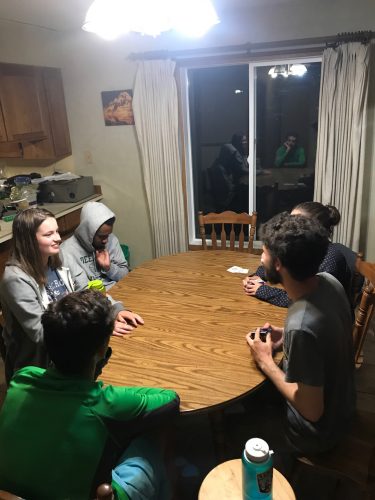
Evan, Zeke, Michael, Brigid, and Andy simultaneously pass the soccer ball and the frisbee. After sports ‘n stuff at the lake, the team decided to plant our taproots and relax for the afternoon before dinner. Mia cooked dinner tonight with the help of Kristen. It was a lovely combination of sautéed onions and peppers in a noodle matrix, with a fresh salad prepared from veggies we got from the house’s CSA. Once dinner ended, the squadron decided to disperse to get some work done or just relax. Into this wonderful time of relaxation, someone (this individual will remain unnamed) decided we should play a “super fun card game” called Mao (named after the late Chinese leader Mao Zedong). This game makes no logical sense, as it consists of an Uno-like base game in combination with rules generated by players, except nobody knows what the rules are… As one can imagine, this game is not fun, and I quickly left to engage in more productive activities – like writing this flog post and reading a paper for our journal club. As the Roost begins to settle down for the night, I ask myself, “what joy is found in playing an effectively rule-less card game in which people are actively raging?” I personally do not know the answer, but I will perform a thorough investigation at the Hjelm house during lunch tomorrow. Until then, remember to never listen when someone says, “hey let’s play this fun card game but I get to make up all the rules and not tell you.” Happy July!
Evan, Mia, Zeke, Michael, and Brigid play the “game” Mao.
This flog will be written in verse;
I hope you won’t think it’s the worst.
Rather than prose
In limericks I compose,
The daily events from the Roost.
On Friday the 29th of June,
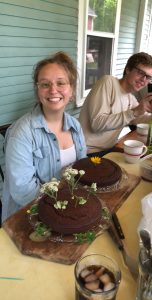
We celebrated Kristen’s birthday at noon,
By eating some cake,
And later, listening to Drake,
After eating some Mexican food.
 Kristen & Cake
On Saturday day we relaxed;
But adventure our night didn’t lack.
To a concert we went;
It was quite an event;
The custodian from my school played the sax.
 Evan, Zeke, and Mia making hats for Echinacea flowers
^Mike Kreitzer: custodian at Saint John’s University by day, rockstar by night.
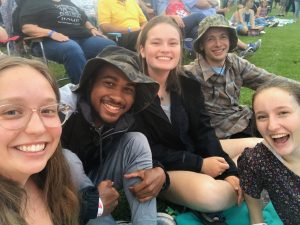
Kristen, Evan, Mia, Zeke, Brigid (looks way too excited) at the Melrose Riverfest Concert
After a week of skeeters and ticks and horse flies,
Being outside seemed unwise.
But after a day,
Of bugs being away,
Now we miss those we all once despised.
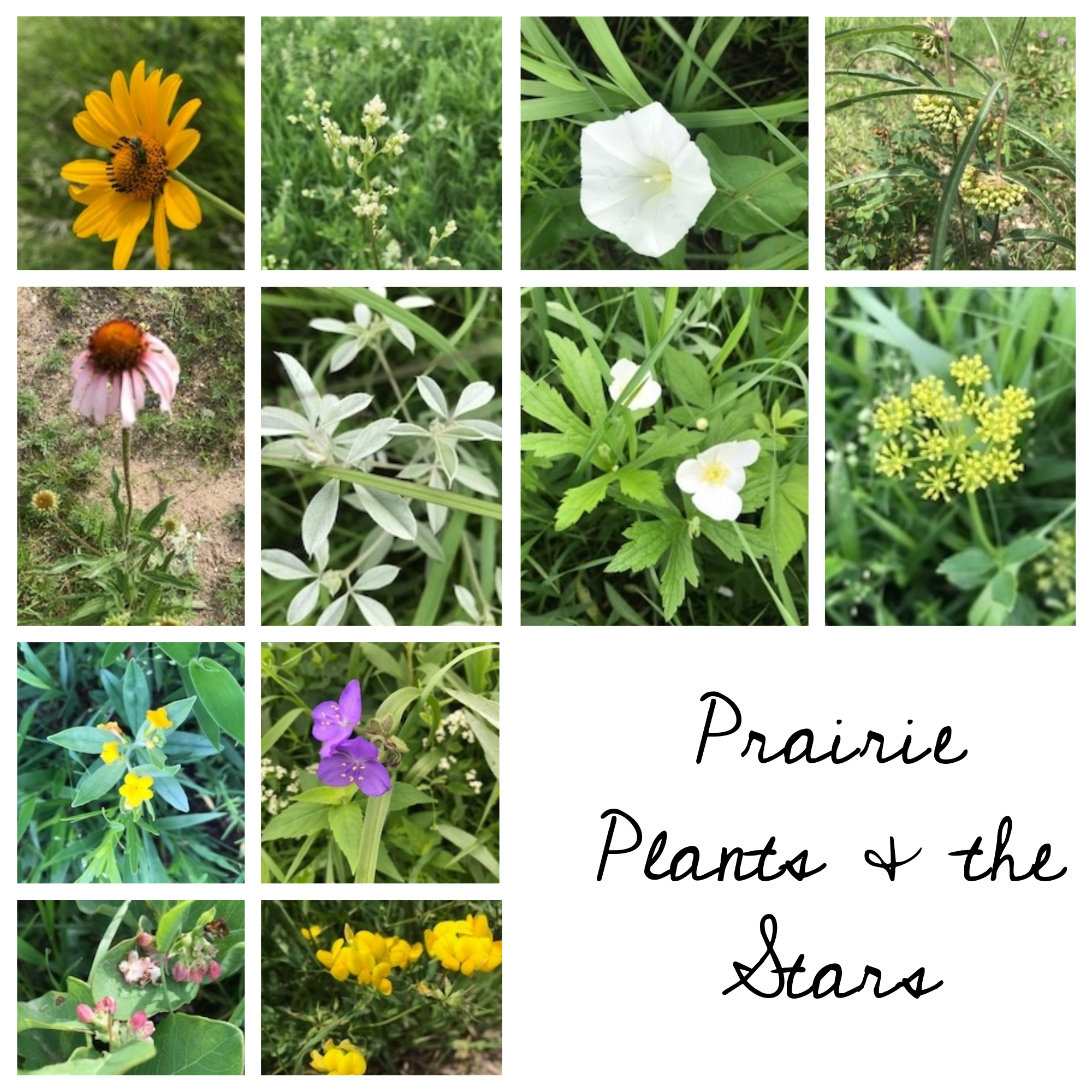
Hi floggers! It’s me, Kristen, your resident prairie plant astrologist. The alignment of the stars and planets has captivated humans for centuries. In times of confusion humans have looked to the sky for answers. Many think that how these celestial bodies move throughout the sky determine the course of our lives. Do you struggle with finding the thread of greater meaning among the events of your life? Do you suffer from a constant internal battle between the head and the heart? Astrology may have answers to some of these questions for you, human. But did you know that just like people, prairie plants ALSO have their own horoscopes?
In times of confusion, like loss of habitat, lack of essential nutrients, threats from pollution and other anthropogenic forces – our astrological bodies can provide plant communities with guidance towards higher survival and reproductive success. Many weeks ago on my Instagram story (@kristenmanion) I did a similar reading of the signs as prairie plants. This time I have used plants exclusively found in Echinacea Project field sites.Below I provide characteristics for the signs in the form of prairie plants based on my interpretation of their alignment with the stars. For simplicity, I have decided only to use Sun signs in this analysis.

Below from left to right:
Capricorn. Heliopsis helianthoides. – Wow False sunflower. You work hard to attract those pollinators. Remember that hard work can take you far, but it’s important to remember your roots and appreciate the pollen donors and stigma receptors who got you there.
Aquarius. Capsella pursa-pastoris. – Shephard’s purse you intellectual! Don’t forget that sometimes matters of the heart are important along with the head. Life’s emotions can be complex, consider your roots.
Pisces. Convolvulis arvensis. – Classic field bindweed producing a gorgeous and showy white flower. Your creative side is your strength but can also be your weakness. Consider that inspiration can come from unlikely places!
Taurus. Asclepias viridifloris. – Spider milkweed, you’re almost ready to attract those butterflies! As a Taurus you never seem to forget to relax and kick back. It’s okay to work hard sometimes – more milky latex the better!
Gemini. Echinacea angustifolia. – Oh, my dear Echinacea! Why of course you would be a Gemini. Your beauty illicits feelings of great joy, yet why do you also seem to provide us with our greatest challenges? Perhaps it is because there are two sides to you. We love to see you blooming, yet we don’t want to harvest 1800 heads in P2!
Cancer. Pediomelum argophyllum. – Just like you Cancer, silver leaf scurf pea is soft around the edges. Remember that just because you might be a little sensitive you are still important. Fixing nitrogen is so important to the prairie! You’re value is never underrated.
Leo. Anemone canadensis. – I know you Leos like to be proud, and boy are anemones a proud bunch. Don’t forget that just because you like to show off doesn’t mean you can’t step out of the limelight for a less popular floral neighbor. It’s okay to be okay with not always performing!
Virgo. Zizea aurea – The prim and proper golden alexander knows that order is key to a productive life. Sometimes though, you may find yourself overwhelmed by your blooms. Take a step back and reevaluate when things get tough.
Libra. Lithospermum canescens. – Just like you, hoary puccoon, is an interesting plant! We know that you like to be balanced Libra but that you also don’t like to move away from your comfort zone. Consider thinking outside the box. It may reward you!
Scorpio. Tradescantia occidentalis. – Spiderworts are very mysterious, just like sun sign Scorpio. We know you have a meaning behind the madness but don’t forget that transparency is okay too. The team wants to know what you’re thinking inside your head!
Aries. Symphoricarpos albus. – You can be tough sometimes (especially given your woody habit)! Consider other points of view. You thrive when other people help you out, don’t forget that you can be someone to lean on too.
Sagittarius. Lotus corniculatus. – The only non-native in this list, but you don’t care, Birdsfoot trefoil, because you love to travel. Sometimes it’s okay to not spread so much. When there’s too much of you, it can force others to feel like they can’t shine.
This has been the first edition of “The Signs as Prairie Plants.” Consider ways in which the stars can guide your life and remember sage advice from plants in the prairie: always remember your roots!
As we learn from our struggles of today (whether it be setting up emergence tents at EELR, checking twist ties at p2, or learning how to be an efficient team member there is always something to be learned about oneself. Sometimes the struggle is worth it! Consider this as we lean into this next few weeks.
Love Your Prairie Plant Astrologer,
Kristen
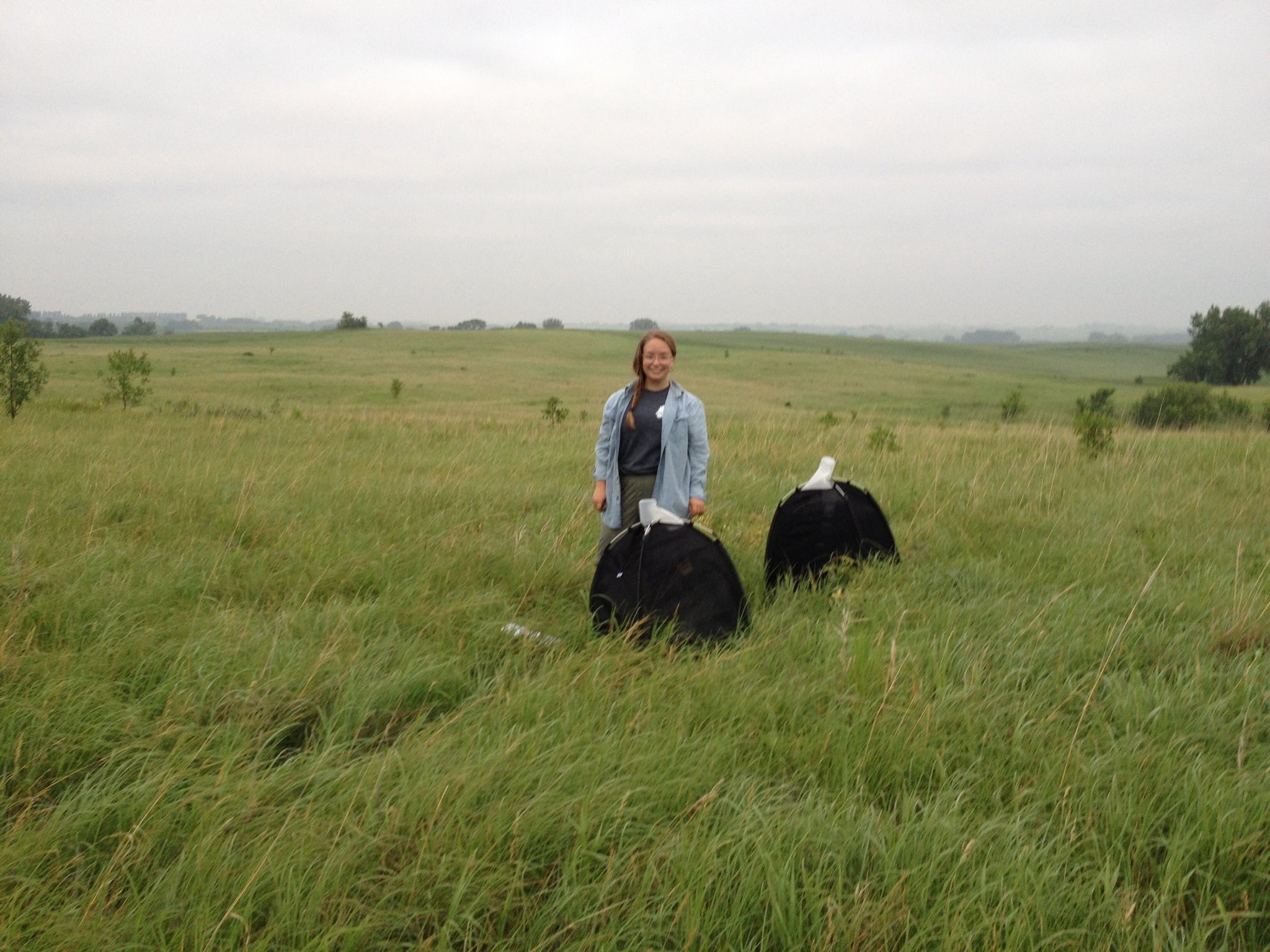
Kristen setting up emergence tents for the first time. The team after surviving the onslaught of mosquitoes at p2.
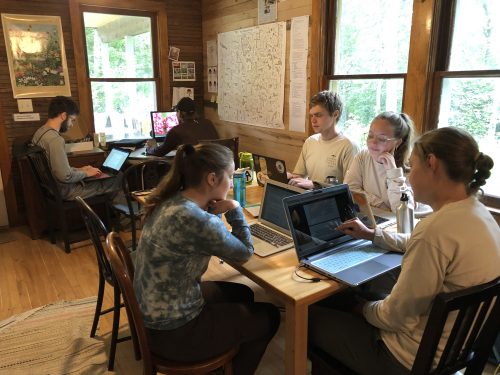
Hello Echinacea Project! Yesterday was a very productive day. It had rained the night before, so we all brought our laptops and started on our project proposals! We were very concentrated and hard workers 🙂
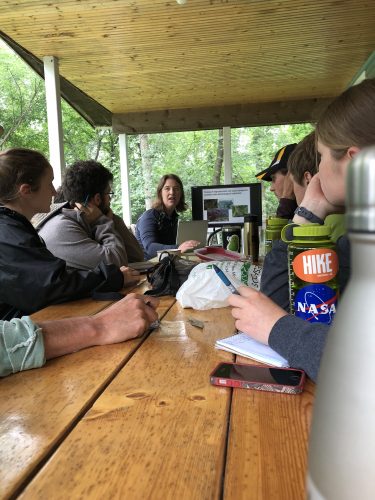
Team being very productive During lunch, Jennifer gave a very informative presentation about bees and plant flowering times.
After lunch, we split up into task forces. Some people worked with the bees, some people did plant data at the P2 experimental plot, and some people went out to P1 to start the aphids and spittlebug projects. The unfortunate part about the afternoon was there was no wind, therefore every member of Team Echinacea was very itchy that evening from all the mosquito bites we got.
Andy bundled up to avoid mosquitos while taking spittlebug data
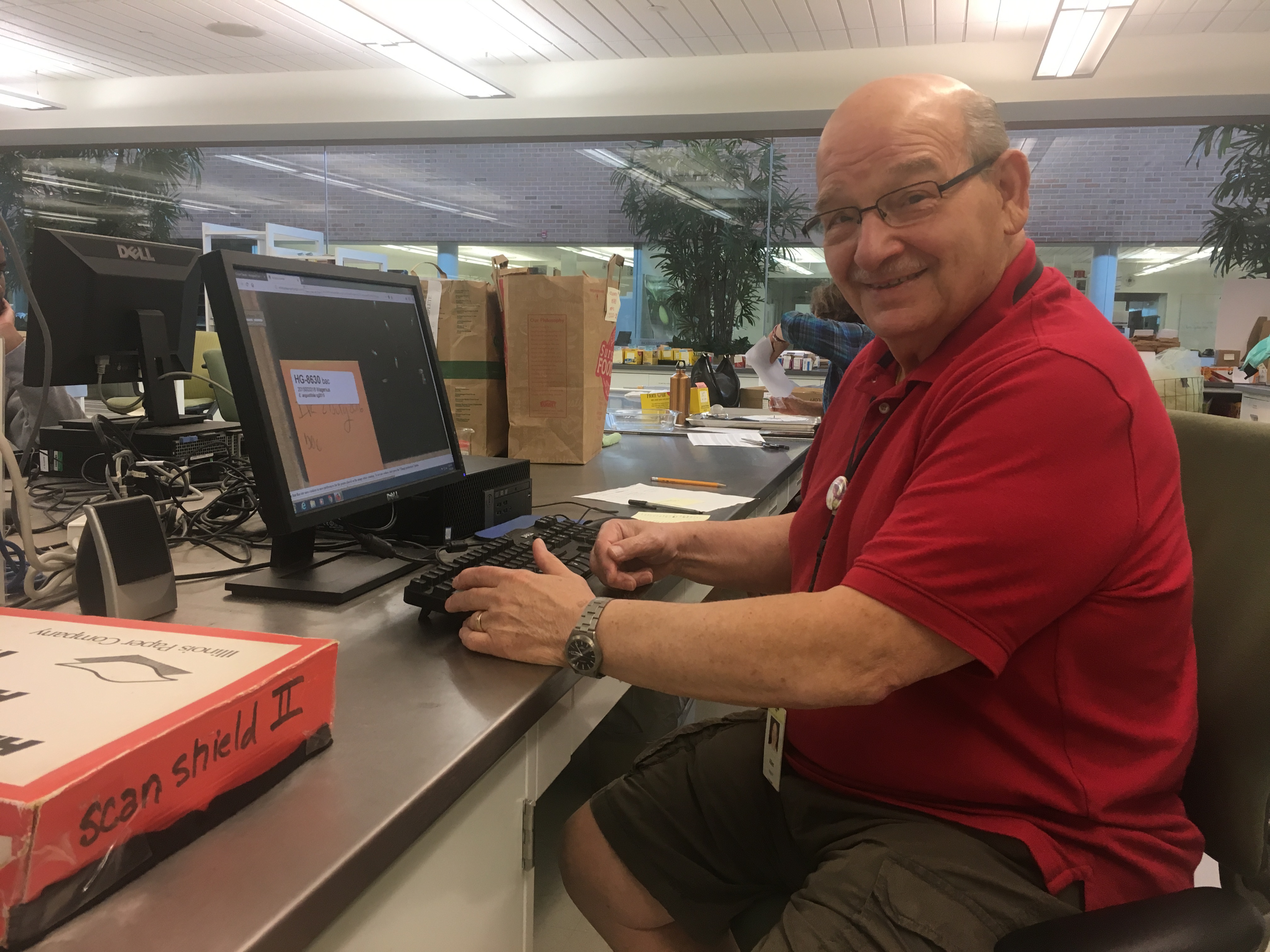
Last week, Allen and his wife Doris won an amazing award at the Volunteer Awards Reception! Congratulations Allen and Doris!
Allen and Doris were presented with the 2018 Kris S. Jarantoski Excellence In Horticulture Volunteer Service Award, an award that recognizes volunteers for “their dedication to nature, enthusiasm for education, and exemplary volunteer service in support of horticulture and plant collections at the Chicago Botanic Garden.”
We have been so happy to have Allen on our team. He is a long-term volunteer at the garden and has worked on a variety of different projects over the years. He comes in on Tuesday afternoons to work with Team Echinacea and is one of our critical achene counters! Thanks for all of your hard work, Allen- this award is well-deserved!
Allen counting achenes.
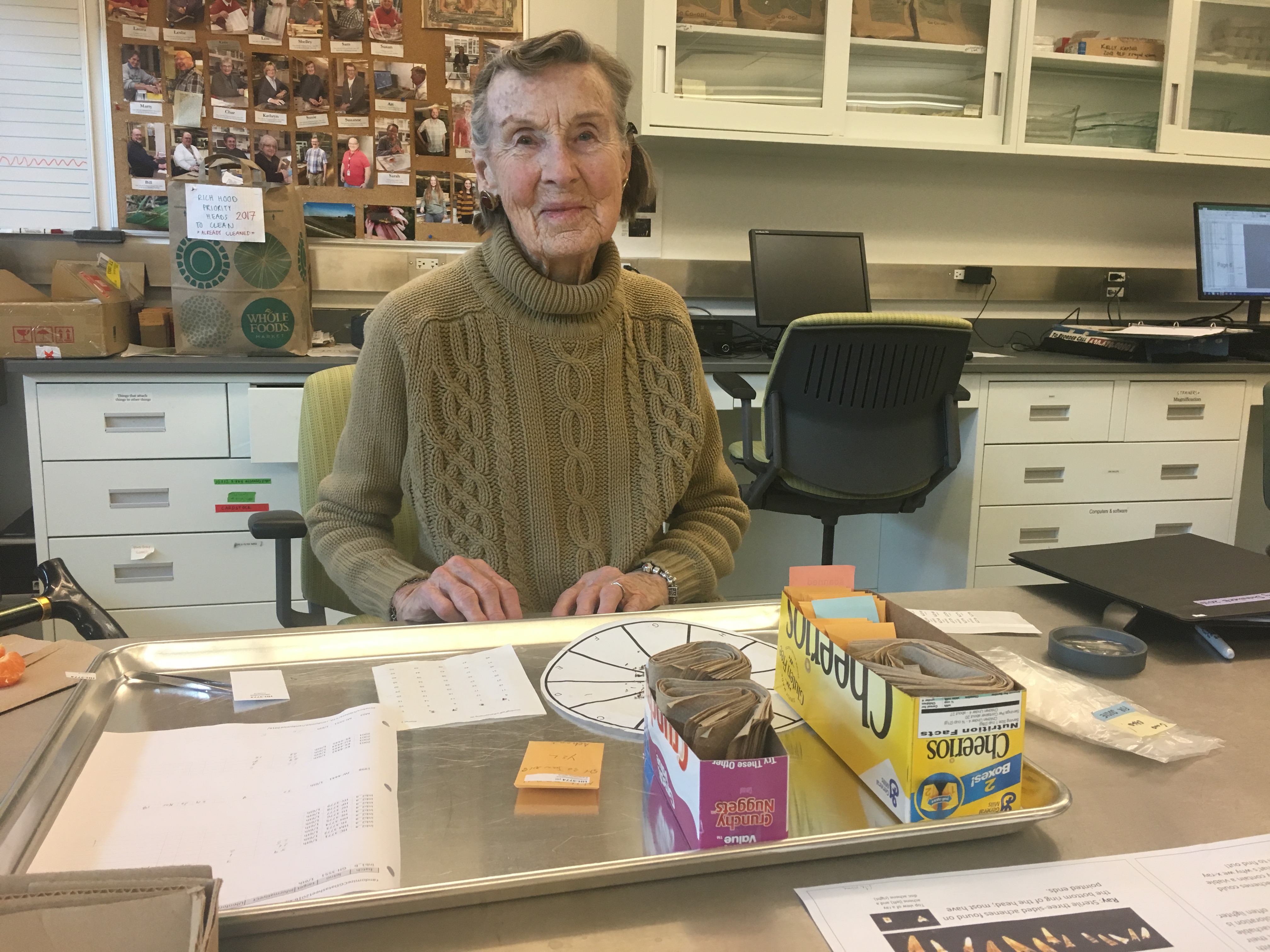
Susie, a member of Team Echinacea since 2011, was also recognized for volunteering over 600 hours this past year! That is quite an achievement. Susie would come in all day Tuesdays and Thursdays, starting out with randomizing or cleaning in the mornings and then working in the herbarium in the afternoon. Susie did so much great work for the Echinacea Project, always had a smile, and was always keen to learn about what the lab managers and grad students were working on.
Susie with all of her randomizing materials out.
|
|