|
|
As of late the Roost has been obsessed with pirates thanks to Riley’s love for chanties. Because of this I decided to write a flog post as if Team Echinacea were as a pirate crew. Enjoy!
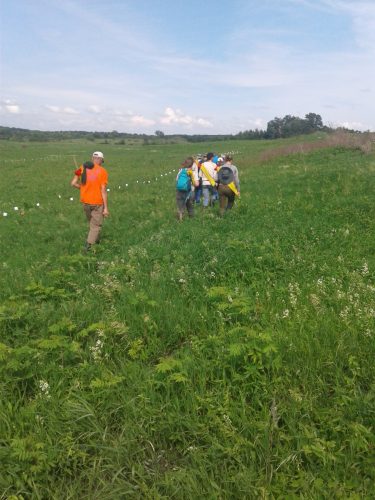
June 25th, 2018. A storm is brewing. As the crew traveled to the docks where the S.S. Hjelm was stationed we sang some of our favorite chanties like Boys by Charli XCX. Once we arrived at the docks we broke into smaller groups. A group of us, led by Captain Stuart, marked out where our precious purple coneflower treasure was in p1. (Not all of this can be paralleled into a pirate based theme, but I’m trying my best).
 Andy standing stoically as the storm approaches. Knowing that the worst is inevitable, but still hoping for the best The storm that was brewing passed over as we headed in for meal time. We were meet with a new crew member named Amy who quickly won us over with brownies (Not sure if pirates ate brownies, but couldn’t think of the equivalent of brownies for pirates). Once our meal was finished, Captain Jennifer took us out to p2 where we also marked where our precious purple coneflower treasure was buried. As the day came to an end, the crew members who lived in the Roost (and Kristen) returned home where we ate a meal prepared by Andy and talked about tales of native bees (Didn’t know how to incorporate our scientific reading club into the story smoothly, but I think that’ll work). Amy also joined us as we shared tales about native bees.
As dusk began to fall upon the sky, I recorded the events of the day in the captain’s log (The pirate version of the flog) before retiring to my quarters and resting for the tasks that tomorrow holds.
 After risking their lives to mark the precious purple conflower treasure, crew members began the long journey from p2 back to the docks where the S.S. Hjelm was stationed. The work for the day may be over, but more challenges lie ahead. However, with the camaraderie among the members, there is nothing the crew can’t overcome.
Following Zeke’s excellent dinner last night, we well-fed residents of the Roost, plus Kristen and Will, extensively discussed what movie we should watch. 30 minutes of heated debate resulted only in a suggestion to watch The Smurfs (2011). Given the failure of these deliberations, the crew decided to play frisbee instead. The Roost and its allies honed their frisbee skills with several rounds of “Michael in the Middle.” After this intensive exercise, the crew drove to Dairy Queen for some well-deserved ice cream and then watched fireworks from a hill in Lake Brophy County Park.
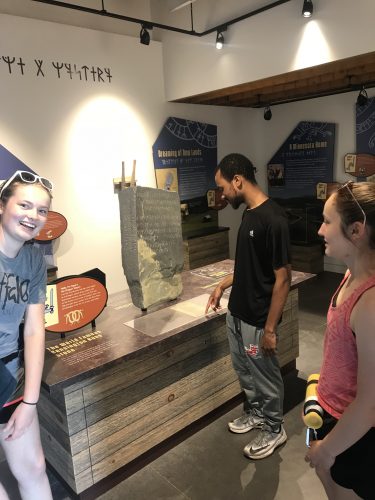
 Making friends with Alex locals at Dairy Queen The residents of the Roost enjoyed a relaxed Sunday morning, but by lunch time we were ready for more adventure. In an effort to engage in the cultural heritage of the area, we visited Runestone Park near Kensington. There we toured the new visitor center and went on a brief, mosquito-filled hike. We then returned to Alex for a lovely dinner prepared by Mia.
Evan attempts a new translation of the Kensington Runestone All in all, the Roost crew had a great weekend. We relaxed following our first week at the Echinacea Project, continued exploring Alexandria, and most importantly, enjoyed some quality bonding time.
Hello Flog!
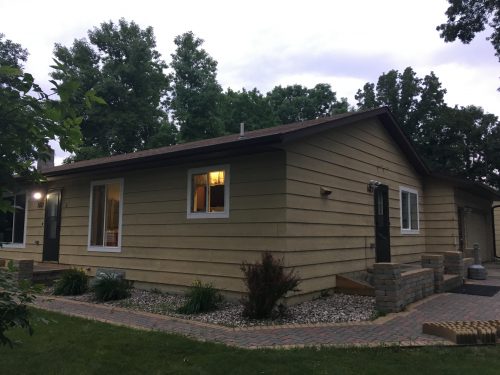
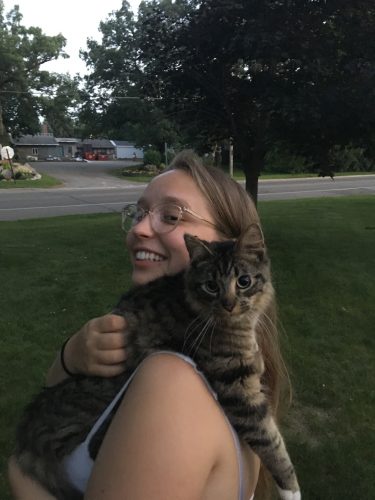
I am excited to be the first flogger of the season (other than team flogs)! Since we had such a busy first week in the field all of us at the Roost were looking forward to some well deserved rest. Speaking of the Roost this is where part of the team lives in Alex, the house got its name from all of its rooster themed decorations. Last night Kristen and Will came over to the Roost and we found a cat outside the house. The cat was so nice, she was very friendly!
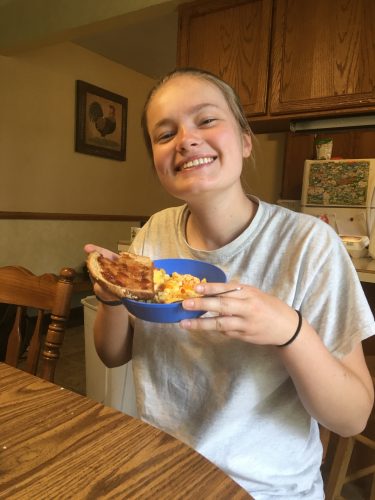
 The Roost Kristen and our new friend I made scrambled eggs for breakfast and for some of the house. They were quite tasty if I do say so myself.
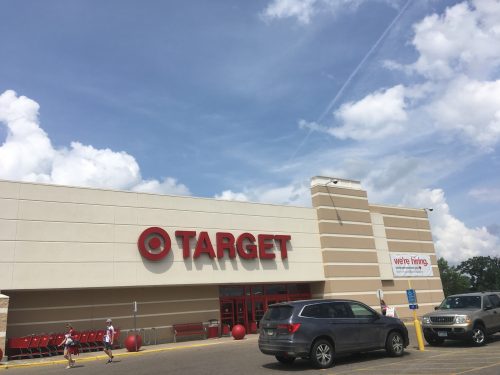
The Chef with the meal Happy Place Brigid, Evan and I went to Target to get some supplies for the Roost. As a College of Wooster student Target is a big deal, there is no Target in Wooster, Ohio. It lived up to and exceeded our expectations, everyone was so nice! After Target we headed to Goodwill. We were in search of a bowl for salad. We have been using a pitcher or a large pot to make salad for the last five days. The pitcher has been working well but we finally caved and bought a real sized bowl. At Goodwill we found some of the strangest clothes and wore them. Brigid found a fabulous snakeskin coat, shoes, the outfit was completed with a zebra striped scarf and a news boy cap. She will be deputing this outfit at Alex Fashion Week 2018 along with Riley in his “Adventure Wear” in his half unzipped zip off field pants.
Everyone is a critic Zeke is making stir fry for dinner tonight and we are all looking forward to eating it and using our new salad bowl!
See you soon flog!
Native long grass prairie is the most endangered ecosystem in North America. Humans are the obvious cause of the dramatic reduction of this system. The human impacts on prairie can be seen in nearly every remnant prairie that the team visits and the Nessman plot is no exception. The Nessman plot is a roadside prairie remnant, with corn on one side, soybeans on the other, and a small patch of remnant prairie in the middle, bisected by a gravel road. A little ways down the road there is a dairy farm once owned by the Nessman family. The prairie that remains consists mostly of invasive alfalfa and European cool-season grasses. These four things: agriculture, pastureland, invasives, and transportation, are the culmination of the main effects that humans can have on the tallgrass prairie.
On Monday June 18th, we went to this prairie remnant and got a glimpse of the impact that humans have had. Upon arrival, we quickly saw the prolific flowing of non-native alfalfa, and the buzz of pollinators all around. The agriculture crept in from both sides, squeezing the heavily invaded remnant prairie closer to the road. Even still, two massive Echinacea plants bud in this highly disturbed prairie site. It made us realize that, even in the most affected sites, native plants still survive and even thrive.
This raises an important concern for every person who interacts with the prairie: how can we have as little impact as possible? Every step we take in the prairie can have deleterious effects on important and rare plants. Here are a few ways that we reduce our impact when we enter the prairie remnants.
Steps and tips for low impact walking in prairie research:
-First you need to determine where you are trying to go
-Then you plan out a path that involves taking the least number of steps and disturbing the fewest plants.
-You need to take large steps and lift your feet up
-Once you get to where you are trying to go you should keep your feet planted, don’t shuffle or shimmy
– After observing or gathering the intended information, make your way back attempting to follow your original path. Remember to take large steps and lift your feet up.
– Finally, once you’ve successfully made it back, receive some well deserved congratulations from your fellow team members! Because as we here say at the Echinacea Project- “It’s not just about the Echinacea!”
Evan-
The first thing that comes to me when I think about East Riley is definitely the poison ivy. The notorious three leafed plant made me hesitant to get any closer to investigate the site. Fortunately, there were a few Echinacea plants present closer to the side of the road. Both sides of the field were bordered by agricultural fields. The agricultural field facing north was growing soybean while the field facing south was growing corn. When out at the site I didn’t notice any solitary bees flying around, but next time I’m at East Riley I would want to observe how frequently they fly to this specific site even with the large amount of poison ivy present.
Riley-
Nothing is more exciting than arriving to a site that shares one’s name. That being said, I had high expectations for a locale sharing my alias; I anticipated a diverse array of species as well as a slew of budding Echinacea heads. Unfortunately, my wish for high species richness did not come true, but I was lucky enough to spot 8 Echinacea heads. Although the exact land use history of the site was unknown to myself, I could only speculate (with the help of Ruth) that the land was previously used for agriculture due to low plant diversity and a lack of remnant prairie indicator species. My experience at East Riley as one of my first impressions of a non-remnant prairie will leave a lasting impact on me because the difference in plant community composition between it and remnant prairie is so immense. It is amazing to me how years of land use can be summarized by a plant layer on topsoil and how much we can learn from this green blanket.
Ruth –
As the member of our team who had been to East Riley quite a few times, I noted its usual great extent of bare ground from which numerous Echinacea with nicely developing flowering stems were emerging. Here, there is a rather wide (over a meter, I’d say) road edge that is level with the road surface. This edge is frequently scraped by snow plows and other road maintenance equipment. The mature Echinacea, with their deep taproots, tolerate this remarkably well, resprouting over many years. Other species typical of unbroken prairie, like leadplant, are not abundant here and may be less tolerant of the scraping. At this site, we have found many seedlings of Echinacea each year for a decade and have relocated them in subsequent years to monitor their survival and (eventual) flowering. Amy Dykstra led this seedling project and has been working on this dataset this year. I don’t remember such vigorous poison ivy in the past. Important to beware of that patch!!
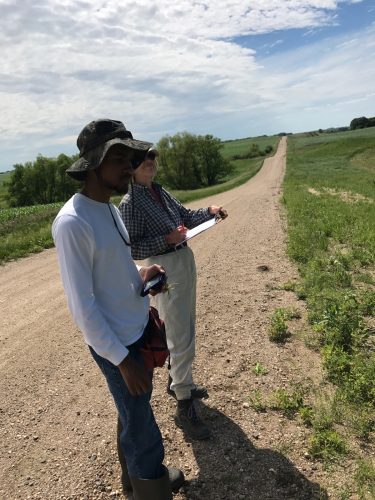
Ruth draws a map of East Riley while Evan enters site data onto his Visor.
The year is 1300 CE. Steven, a viking explorer, has just landed on the shores of the land that would one day become Kensington, Minnesota. Steven and his crew pull their longship ashore on the banks of the vast Southern Canadian Sea, weary from their long journey. Although Steven would never see how dairy, corn, and soybeans would feed the world of his progeny, Steven saw in this landscape the potential for a land of vast prosperity. In the first few months, Steven lost most of his crew to a frog-borne parasite, now known exclusively for its adverse health effects in dogs. Steven learned the lay of this new land but often struggled. He was drawn back to his homeland after many years of documenting the landscape. Steven took with him a new appreciation for the beauty of discovery, and respect for new lands. Though most traces of Steven’s visit are lost, the Kensington runestone documents Steven’s journey into the unknown.
In the years following Steven’s journey, this majestic Southern Canadian Sea receded further to the north, eventually becoming what we know today as the boundary waters. As the soil dried, the sea floor served as a mineral-rich substrate for the colonization of new seeds. This new community of plants (dominated by grasses, forbs, and legumes) became the tallgrass prairies we know and love. Many people and animals have come to appreciate the prosperity of this verdant land. The spot on which Steven first stepped foot on North American shores is known today as Steven’s Approach.
Today, Steven’s Approach provides scientists associated with the Echinacea Project an opportunity to study how small plant populations persist in fragmented habitats. The site is comprised of two small remnant prairie patches located along Wolly Lake Road near Kensington, Minnesota. Most of the site is dominated by non-native plants. Invasive plants like these often make it difficult for native plants to compete for resources and space. This ecological consequence of small habitat sizes may impact the native plants at this site. Steven’s Approach only had one flowering Echinacea individual. What are the chances for reproduction and survival when your population is 1? This single plant is dependent upon pollinators for spreading its genetic material. How close is the nearest Echinacea individual? Will this individual plant at Steven’s Approach be able to spread its genes onto the next generation? This plant may struggle to survive and reproduce in the coming years.
Perhaps Steven existed, perhaps he did not; regardless, we hope that you were able to see the value of Steven’s journey. Discovery, growth, and a willingness to live with an open mind were key to his success. Our own growth this summer will be a lot like Steven’s. Like Steven, we will approach this new experience with a willingness to grow. We will learn more about ecology and evolution in fragmented habitats. We will take the knowledge we gain from this summer back with us to our own institutions in the fall. While we seek knowledge about the world around us, we will really come to know ourselves.
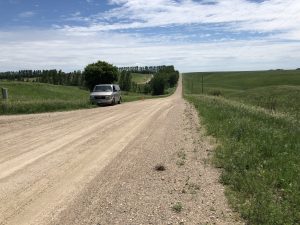
Why did the bee cross the road? In order to answer this question first consider the road. On the first day working with the Echinacea Project, we (Zeke, John, and Brigid) visited the Around Landfill site. The aforementioned road passes through this Around Landfill site, which coincidentally, is located around a landfill. On either side of the road, C4 warm season plants and legumes grow. Alfalfa and Yellow Sweet Clover pepper the roadside, breaking up the green with flashes of purple and yellow. Small Echinacea buds hint at flowers to come. Corn dominates the landscape farther from the road. Cattle once grazed on one side of this road, as evidenced by a barbed wire fence.
There wasn’t always a road to cross. Before the road, a sea of uninterrupted prairie swayed as far as the eye could see. At this time, before the road broke the continuity of the prairie, the bee had no need to cross the road. Now, grasses, flora and legumes must straddle the road. In order to bridge this divide and visit flowers, the bee must now cross the road.
But can bees cross the road? Consider this question from the perspective of a bee. A bee’s umwelt is quite different from that of humans; bees have a short field of vision as well as the ability to see the UV spectrum of light.
We all sat on the roadside at this site, wondering if bees were indeed able to cross the road. Then, just when we asked this question aloud, a butterfly serendipitously flew across the road, as if in answer. If a butterfly can cross, we supposed that a bee can as well.
But will the bees be able to cross the road in the future? Given rapid expansion of cities, it is likely that the road will wide, creating a world for cars and not bees. Getting to ‘the other side’ could prove a much more daunting task in the future. 
Echinacea Project 2018

Assistant Professor of Biology, The College of Wooster (Wooster, Ohio), 2015 -present
Research Interests
Reproduction in flowering plants is particularly vulnerable to fragmentation and the loss of insect pollinators. Typically plants with hermaphroditic flowers have mechanisms that reduce the likelihood of pollination within the same flower and require a vector (i.e., wind or pollinator) for successful sexual reproduction. Native solitary bees are common pollinators for many plants species. However, pollination research has mainly focused on large social bees—bumblebees and the non-native honeybee. In addition, most studies only quantify seed set (i.e., the female fitness of a plant), thus ignoring fitness contributions from siring seeds (i.e., the male fitness of a plant).
This summer we will quantify how four generalist solitary bee taxa contribute to total male fitness in a mate-limited prairie plant, Echinacea angustifolia. We will also compare how each pollinator taxon varies in its relative contribution to a plant’s male and female fitness. To quantify male and female fitness, we will use a combination of a novel manipulative field experiment and previously developed genetic tools. This summer’s research will build on previous pollination research by College of Wooster thesis students. In 2016, we found that Echinacea’s pollinator community changes over the course of the flowering season (see: Ison, JL, LJ. Prescott, SW Nordstrom, A Waananen, and S Wagenius. 2018. Pollinator-mediated mechanisms for increased reproductive success in early flowering plants. Oikos. doi:10.1111/oik.04882)
Statement
Hi floggers! I’ve collaborated with the Echinacea project for many years (before there was even a flog!). I started as a Team Member back in 2003 after graduating from St. Olaf College. After few years, I started my dissertation research on Echinacea. After completing my dissertation, I took a few years off the Echinacea Project to work on a plant that takes 30 days (instead of 7 years) to flower. However, I couldn’t stay away from Echinacea and have been examining Echinacea‘s pollinators since 2013. When I am not watching bees on Echinacea, I enjoy hiking and tennis. I also have a very active nearly-three-year-old who loves being outside.
Echinacea Project 2018
Plant Biology & Conservation, Northwestern University 2017-
Ecology & Evolutionary Biology, University if Kansas 2017
Research Interests
Broadly, I am interested in how landscape dynamics shape bee communities. Did you know that over 80% of bees in the prairie spend part of their life in the ground? We have lots of information about how bees forage and the kinds of pollen they forage for, but know very little about the kinds of conditions suitable for bees to build their nests. My thesis project explores how land use history and soil microhabitat indicators influence nesting densities. This summer I will explore how common land use treatments (remnant prairies, restorations, and old agricultural fields) influence where bees build their nests!
Statement
I am a Master’s student in Plant Biology & Conservation through Northwestern University and the Chicago Botanic Garden. I grew up moving all over the country but went to high school and college in the Kansas City area. I believe passionately in diversity and inclusion and try to do my part to make STEM a more equitable field for people of all backgrounds and identities. I am active on Twitter and Instagram and am learning how to use these platforms for science education and communication. I love to read in my spare time, but I also just enjoy learning/speaking Spanish, listening to good music, smelling candles, and cooking yummy food!
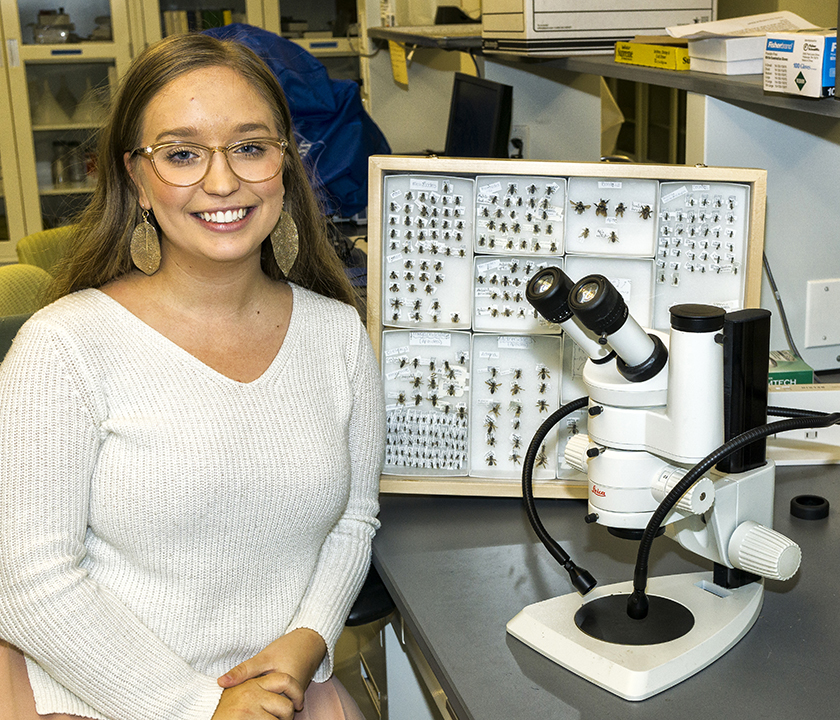
 Some bees posing with me and a microscope!
Echinacea Project 2018
Ecology and Evolutionary Biology, University of Colorado Boulder, 2018 –
Ecology, Evolution, and Behavior, University of Minnesota, 2018
Research Interests
I am broadly interested in the genetics of plant populations as well as investigating how phenotypes are expressed in different environments. I have estimated the heritability of flowering time in Echinacea angustifolia and I would like to evaluate selection on flowering time. I am also interested in learning about patterns of flowering across a fragmented landscape, like the one we study in western MN!
Statement
I am from Alexandria, MN, about 20 minutes east of our study site. This will be my fifth year working on the project! In my free time, I like to do outdoor things, I particularly enjoy fly fishing and hiking. I also enjoy finding and listening to new music. This summer I plan to spend lots of my free time playing with our new puppy!
|
|