|
|
Synchrony between plants is important as higher synchrony with other plants leads to more potential pollen sources and a greater likelihood of a seed being pollinated and becoming viable. At this point, synchrony is measured by counting the number of nearby flowering echinacea plants, but my malo curve data allows us to measure synchrony using the number of florets open on a given day for the entire population and comparing it to the number of florets for a given plant. As shown by the graph below, measuring synchrony by counting the number of flowering plants can overestimate synchrony later in the season when flowering plants have less open florets. Time to explore these graphs for different populations and look at the potential impacts.

Nina presented her poster “Competitive Exclusion Between Echinacea angustifolia and Echinacea purpurea” at the Illinois Math and Science Academy student research symposium (aka the 28th Annual IMSAloquium) on April 28th.
You can read all of the abstracts. She gave a great presentation. It was a pleasure to have Nina on the team.
After working on my analysis for a few days I have realized that whether or not the head is unique to an Echinacea plant does not affect the malo curve for the individual head, or in real world terms, it doesn’t affect the flowering schedule of the head. This conclusion brought up two more questions.
The first question I have is what, if anything, explains the variations in the malo curve for the head if its uniqueness to the plant doesn’t. To try to answer this question I will be investigating is including the population of origin for the plant and the year it was planted in the investigation. I hope that this information will shed some light on the variations in the malo curves.
The second questions I have is how do multiple heads on an Echinacea plant interact to form the malo curve of the plant as a whole. The first thing I did was graph all the heads on a common plant on the same graph, which produced a lot of variation.
 Two heads with no overlap.  Two heads with almost complete overlap.  A plant with 6 heads! Now that I’ve visualized the differences in the data, I’m excited by all the variation that I see. My next step is to produce malo curves for the plants as a whole and start an analysis. With two viable paths of investigation, I’m expecting a lot of work in the next few days.
 Keke hard at work counting the q3 offspring Keke is a senior Environmental Studies major at Lake Forest College who has been working in the lab for the past semester. For her project, she focused on the maternal plants of qGen_3. In that experiment, we crossed individuals in p1 with pollen collected from plants at Staffanson and Landfill during the summer and planted the seeds from those crosses in the fall. When dissecting the heads, we only selected achenes that we knew had been crossed properly.
This left ray achenes and achenes that may have been contaminated with other pollen, plus any achenes that we missed! Although we didn’t want to plant inviable or contaminated achenes, knowing the fecundity of the maternal plants is an important part of estimating fitness, so we wanted to have accurate achene counts for each mom. This is where Keke comes in. She removed all of the “extra” achenes and counted them, along with the rest of the maternal achenes which had been scanned in the fall.
Keke also analyzed the effect of a new pollen management procedure that we followed for q3. This procedure involved collecting pollen in multiple vials and taking care to only remove a vial from the refrigerator for crossing once. This was in an effort to reduce exposure of pollen to repeated warming and cooling cycles, which we thought might have reduced its viability in q2. Keke assessed the percent of successful crosses in q2 versus q3 and found that the percent of successful crosses increased 5% with the new procedure. Cool!
You can read more about what Keke did this winter and spring in her report, which can be found here:
Keke’s Q3 Report
Thanks Keke and best of luck in all of your future endeavors!
In 2015, we continued an experiment that investigates hybridization between the native Echinacea angustifolia and the unintentionally planted non-native E. pallida. This year, out the the 758 plants planted in spring 2014, 521 were still alive which is a survival rate of 68.7%.
In the late summer of 2013, members of Team Echinacea collected heads from Echinacea angustifolia and Echinacea pallida from two nearby populations at Hegg Lake Wildlife Management Area. Unlike previous experiments, we performed no artificial crosses. This allows us to determine if hybridization is occurring naturally. In the winter of 2014, Lydia English germinated seeds from these heads. In the spring, Lydia and Stuart planted 758 seedlings at Hegg Lake WMA near experimental plot 7. We took fitness measurements, such as number of rosettes and leaf lengths, this year.
In addition to the experimental plot, we collected heads and tissue samples from 28 E. angustifolia that were near the restoration with E. pallida. We have not yet done any analysis on these plants but we are hoping to determine if hybridization in continuing.
Read more posts about this experiment here.
 Echinacea Pallida at Hegg Lake Start year: 2014
Location: Hegg Lake Wildlife Management Area – Experimental plot 9
 A hybrid at Hegg Lake In 2015, we continued an experiment that quantifies fitness of Echinacea angustifolia x pallida hybrids and pure-strain plants. Out of the the original 522 plants, 323 were still alive in 2015, which is a survival rate of 62%. The mean leaf length of these plants was roughly 11.7 cm. Stuart planted the 522 seedlings at Hegg Lake WMA in spring 2013. The seedlings result from hand reciprocal crosses conducted by Shona Sanford-Long during the summer of 2012.
Read more posts about this experiment here.
Start year: 2013
Location: Hegg Lake Wildlife Management Area – Experimental plot 7
In 2015, we continued an experiment investigating fitness of Echinacea angustifolia x E. pallida hybrids. This year, out the the original 66 plants, 55 were still alive. That’s an impressive survival rate of 83% since they were planted in 2012. The mean leaf length of the plants was roughly 16 cm. In the summer of 2011, Nicholas Goldsmith and Gretel Kiefer performed reciprocal crosses between 5 plants of Echinacea pallida (non-native) found in a prairie restoration at the Hegg Lake Wildlife Management Area and 31 plants of the native Echinacea angustifolia from experimental plot 1 to determine the hybridization potential of these two species. In the summer of 2012, team members planted 66 seedlings.
Read more flog posts about this experiment here.
Echinacea Pallida on Hegg Lake Start year: 2012
Location: Experimental plot 6
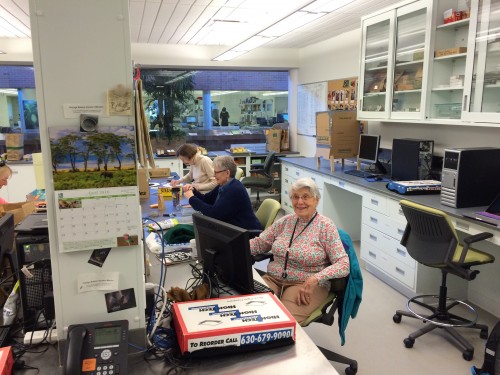
On this day inaugural National Citizen Scientists’ Day, we acknowledge the hard-work and dedication of our team of Citizen Scientists in the Echinacea Project’s lab the Chicago Botanic Garden. Some of the citizen scientist members of our Team have been working on the project almost 15 years!
Read profiles of our fabulous citizen scientist Team members:
Aldo — — Anne — — — Art — — — Bill
Bob — — Char — — — Kathryn — — Laura
Leslie — — Lois — — — Lou — — — Marty
Naomi — — Shelley — — Suzanne — — Susan
Two humble volunteers declined to have profiles posted. We respect their privacy.
Read about some of the ways in which they contribute.
Read about what some of the activities from this past week.
Read many flog posts about our volunteer citizen scientists as written by members of Team Echinacea.
This Saturday is National Citizen Science Day and in honor of our wonderful, hard-working citizen scientists (and interns), we’d like to show you all the fun science that occurred in the Echinacea Lab this past week. We also created an official page telling you more about our volunteers that can be found here.
Tuesday
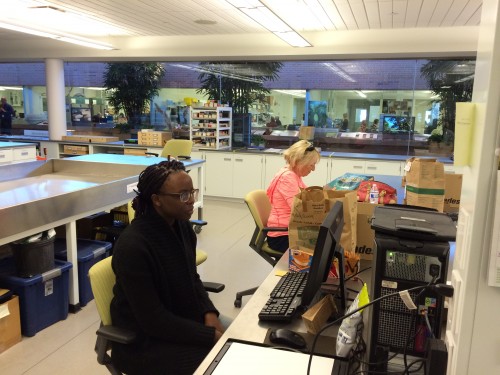
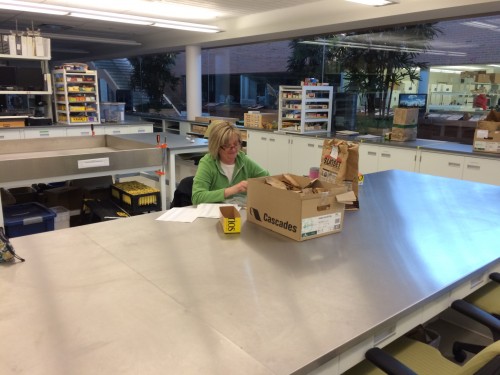
Tuesday is quite a busy day for us and we had many people in the lab throughout the day. In the morning we had Susie, Char, Lois, Susan, Sarah, and Rachael working on a variety of projects.
 Susie randomizing heads and Char cleaning heads from P1 – our main experimental plot. Lois “The Achene Queen” – our most decorated counter with more than half a million achenes counted to date! Sarah scanning heads from the remnant populations while Susan focuses on cleaning. In the afternoon we had a large crew that worked on cleaning, scanning, and randomizing. Unfortunately, we forgot to pull out our cameras and didn’t get any pictures of them in action! Expect a follow up post next week to see them doing vital work for the Echinacea Project. Our afternoon citizen scientists were Marty, Naomi, Laura, Anne (usually a Friday person), and Shelley and you can read more about them at our permanent volunteer page.
Wednesday
Wednesday morning we had two volunteers and two interns. One of them wishes to remain anonymous, but the other three were enthused by their prospective internet fame.
Katherine works on rechecking cleaned heads. We like efficiency here, but never at the sake of bad data so we have many checks throughout the process to ensure high quality data. Keke works on her report about the parents of our newly planted (as of last fall) quantitative genetics experiment. Contributions like Keke’s allow us to continue to expand the field of Evolutionary Ecology. Nina works on her final poster for her competition experiment. It was her last day as an intern with us and we’re sad to see her go but excited to play a part in the early career of an up and coming scientist. Thursday
We had a busy morning on Thursday followed by a quiet afternoon. Our fearless leader (Stuart) left to brave the intense heat of Minnesota (82 F) and spread some native prairie seed around our experimental plots.
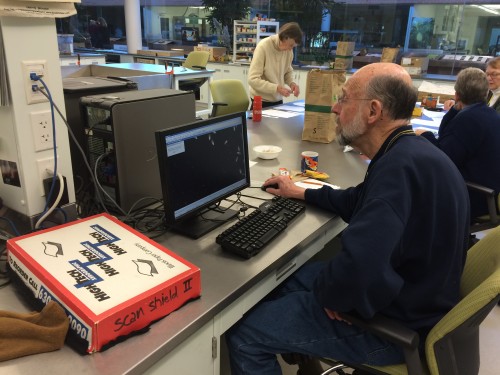
Suzanne works on randomizing achenes from the remnant populations for X-ray. Bill counting achenes. Bill is an expert counter who has been known to count as many as 31 heads in a single sitting! Char and Susie, back again! Suzanne was certainly focused on randomizing. Friday
Friday normally has two volunteers and two interns but because Anne came in on Tuesday we had two interns and only one volunteer in the afternoon.
Gordon ponders the meaning of many years of data at Staffanson Prairie Preserve. Mackenzie scans heads from our remnant populations. Leslie works on rechecking cleaned heads. Over the years, Leslie’s dedication to accuracy has led to her being our main rechecker.
As we wrap up the week, we want to make sure that our many citizen scientists, who help keep our lab running, are greatly appreciated. Though Saturday is National Citizen Science Day, in the Echinacea Project lab, every day is Citizen Science Day.
This week I started investigating the Malo curves and visualizing the data. In March of 2014, Lou, one of the citizen scientists that volunteers in the Echinacea Lab, wrote a program to take the daily flowering data collected in 2005 and output the 5 parameters that are needed to draw the Malo curves for individual heads. While these parameters are needed to draw the exponential sine functions, they also act as direct proxies for different phenological features like the start date of flowering, the maximum number of flowers open on a single day and more. So, I have 347 Malo curves drawn for me and lots of data to utilize in my analysis.
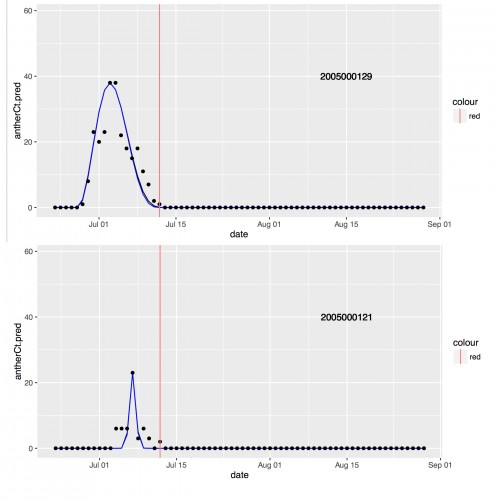
This photo shows 2 of the 347 curves that have been drawn. The black dots represent the actual number of flowers open on a given day, while the blue curve was drawn utilizing the parameter’s calculated by Lou’s program. The main focus of my analysis will be investigating how these curves vary, if at all, based on whether or not the head came from an Echinacea plant with other heads or if it was the only head on that plant. So, my first step was to create histograms for each of the 5 variables.
 This is the histogram for one of the parameters that represents the duration of flowering a single head experiences. The red line represents the mean flowering duration, while the blue line represents the median. After my preliminary investigation, it looks like none of the parameters, and therefore the Malo curves, vary based on the number of heads on the original plant. My next step is to utilize statistical tests like Nonmetric Multi-Dimensional Scaling (NMDS) and MANOVA, to determine if and how these parameters are related to each other. Stay tuned!
|
|