|
|
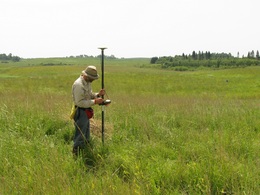
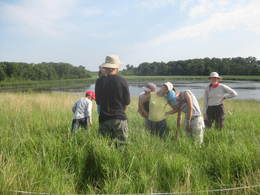
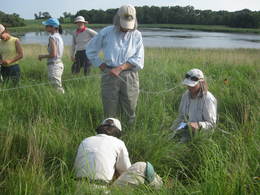
Monday was quite sultry, if I remember correctly. In the morning we divided forces to look at flowering phenology in C1 and to finish measuring the plants in Amy Dykstra’s experiment at Hegg Lake. She has two experimental plots there: one containing the offspring of inter-remnant crosses and the other containing seeds collected from source populations between Minnesota and South Dakota. She sowed seeds in 2008 and has been tracking their progress every year since. Once we finished finding and measuring plants, Stuart took GPS points for each experimental plot:

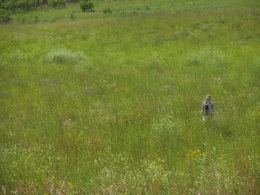
While he was doing that, Shona trekked off into the prairie to check on the plants in her hybridization experiment.
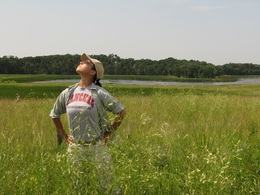
Meanwhile, Lydia and I waited by the truck and took advantage of the opportunity for an epic pose. I’d say it was successfully epic.
Friday the 13th of July! Sorry for the late posting.
Weather report:
According to my field notes, at 6.35am at Hegg Lake it was warm, no breeze, and a little dewy. The rest of the day, it was hot and humid, though not as bad as the past few days.
Fieldwork report (morning):
I was at Hegg Lake from 6.35am-10.30am, checking on my Dichanthelium plants for seeds that are ready to be harvested. The unfortunate news: 1 of my experimental culms dried out, and another culm was broken off 🙁 On the brighter side, the potted Dichanthelium from my pilot bulk experiment are doing quite well, and a second one started producing spikelets!
Kelly and Shona were out at Staffanson GPSing all the flowering Echinacea plants, including Kelly’s phenology plants.
Andrew and Lydia were in C1 observing and catching pollinators for Andrew’s project. Lydia caught one pollinator. There wasn’t much activity in the garden.
Jill was identifiying ants under the dissecting scope in the basement all morning. She found that many of them were Lasius and Formica.
Katherine was working with the data from the aphid survey and conducting preliminary analyses. She is planning on performing aster analysis with her data.
Ruth, Amy and Brad came over today. After lunch, we headed out to Hegg Lake to Amy’s plots where we measured seedlings that were sowed in 2008. We were out there until almost 6pm, impressive work!

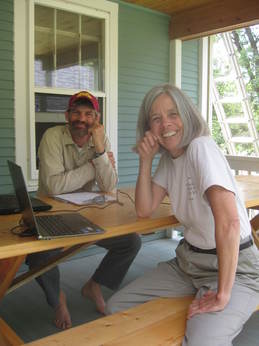
Stuart and Ruth 🙂
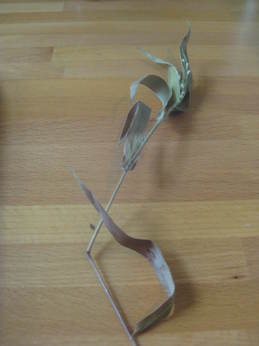
Poor broken culm of Dichanthelium. See how some spikelets were still open?
Tired Team Echinacea…
After last week’s sultry weather, we’ve been enjoying a “dry heat”, as Greg Diersen so artfully put it. This morning everyone went their separate ways to pursue their individual projects:
Shona, Maria, and Lydia went directly to Hegg Lake and combined forces to measure plants and take GPS points. Shona also photographed Echinacea pallida and E. angustifolia plants as part of her project to assess species traits.
Andrew searched the main experimental plot (C1) for plants where he can observe pollinators. Because peak flowering has passed, his selection of flowering heads is growing slimmer by the day. Fortunately, he has some good observations under his belt and will be able to collect more before plants stop flowering.
Jill and Greg joined forces in operation pit-fall trap. Greg’s traps are bowls full of soapy water that he sets on the ground and leaves out for a couple of days. Jill’s are tubes full of propylene glycol that she submerges in the soil and leaves out for a week. Today, they set out Greg’s traps and collected from Jill’s. I have to say: the smell of dead insects stewing in propylene glycol for a week is probably one of the worst smells I have experienced.
I spent the morning removing aphids from plants in my aphid addition/exclusion experiment. Even though it has been three days since my last exclusion, there were aphids on 11 out of 50 plants in my exclusion group. One plant had 67 aphids–all in three days! Those aphids are moving and breeding fast.
This afternoon we joined together in our common goal of measuring every plant in C1. My mother used to say that the only way to eat an elephant is one bite at a time. Well, today we bit a big chunk off of our elephant, finishing up the sections planted in 1997, 1998, and 1999. We have less than half an elephant to go!
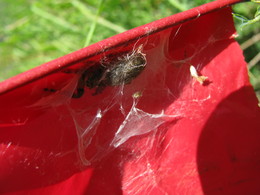
And now for a picture. In addition to helping us keep track of plants, pin flags make great habitat for spiders:
We were all having so much fun on the 4th of July that I forgot to write the events of the day.
Technically, the 4th of July is a day off for the Echinacea crew. Plants don’t celebrate national holidays, so we spent the morning assessing flowering phenology in the main experimental plot. After that, Andrew experienced a series of unfortunate events that kept him from observing pollinators. On the upside, he learned some valuable lessons and made a new friend.
Because aphids don’t take holidays either, I spent the latter part of the morning visiting plants in my aphid addition/exclusion experiment to remove aphids from the exclusion group. The goal of my experiment is to capture the effects of aphids in natural conditions–i.e. no cages or bags. That means that in order keep aphids off of the plants in the exclusion group, I need to visit them every few days to remove them by hand. For fifty plants (plus fifty more in the addition group) that’s a lot of footwork.
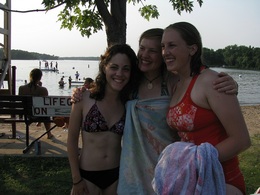
We celebrated America’s national holiday with a picnic at Elk Lake. We crammed in as many all-American activities as we could: potlucking, canoeing, sand-castle building, frying in the sun. If things weren’t American enough, Stuart brought a print-out of the Declaration of Independence, which we all took turns reading around the picnic blanket. Go America!
I didn’t get a good group picture, but here’s a cute shot of Jill, Shona, and Kelly:
(Aghh I just finished writing and then when i tried to publish the site told me that my session had expired and of course I lost the whole blog post T___T )
Anyways…
Today was a very hot and humid day. Temperatures into the 90s, feeling like 100. Sweaty sweaty sweaty.
Some of us accomplished field work.
Andrew was in C1 this morning painting bracts and bagging Ech flowers.
Katherine was also in C1 doing her aphid add/exclude experiment.
Shona was out at Hegg Lake for 4 hours painting bracts and observing crossed styles.
I (Maria) was also at Hegg Lake (for my own reference from around 10.30 – 4.40pm) surveying Dichanthelium inflorescences I’ve been tracking for the past week or so, and more importantly, finding plants for my pollen limitation experiment. I have 31 plants flagged and 62 inflorescences twist-tied. I’ll be initiating the experiment tomorrow, so I should be in bed now (hence, I’ll give more details in a later post).
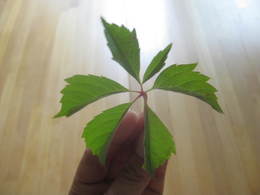
To end off the week, here’s a special 6-leaved Virginia Creeper (they are usually 5-leaved) I found in the 99 south garden. Hope it brings everyone good luck!
This summer I’m building off of Nicholas’ work with E. angustifolia and E. pallida hybridization. I uploaded my proposal last week, but I’ve already learned a lot since then.
First of all, after first thinking that I should be collecting pollen, painting bracts, observing styles and crossing all on the same day, Stuart pointed out that it would be better to do crosses one day and everything else the next. It makes things go faster, and it is also easier to tell which bracts were painted when. With that in mind I made a bare bones materials and protocol sheet to keep myself organized:
angustifolia_pallidaCrossingProtocol.doc
It worked wonderfully for a few days, when most of the heads were flowering and I didn’t have to keep track of which plant had been sufficiently crossed and which needed more, and then it started getting a little complicated, especially when Gretel found another pallida head to add in….
Talking to Stuart and Gretel a few days into my crossing I found out that I had been crossing in a less efficient manner than I could have been. I had been trying to fit all of my potential crosses onto each head, every time I crossed. This meant that I would have five or six different colors to paint, each with three or four bracts, and that I would have to do the same the next time to have enough styles. Then I had to look back and forth between data sheets to see whether style shriveling was consistent. What I’ve switched to now (for the most part) I think is closer to what Stuart had in mind. Now I try to paint six bracts for each cross, and just alternate crosses. For example, I’ll do three of the crosses one day and three the next time if there are 18 anthers on a head.
Today, Gretel came out to Hegg Lake to help paint bracts, and combined with less switching between colors, it took us about half as long as it has been for the painting and observing.
It also seems like most of my plants will be done flowering soon. A few have already finished, and a few of the plants with large or multiple heads have already been crossed with every possible cross.
This summer I’m going to continue with Amber Z’s phenology research from last year. I’ve added on two new sites: North Northwest of Landfill and Around Landfill. I started taking data on June 18th when there were only a couple of plants beginning to flower, but now, many more plants have started flowering and a couple are even close to finishing!
Kelly’s Flowering Phenology Project Proposal.doc
As a continuation of Katie Koch’s experiment in the summer of 2010, I am investigating the pollinator efficiency of bees that visit Echinacea.Project Proposal AK 2012.pdf
Here are the day’s events:
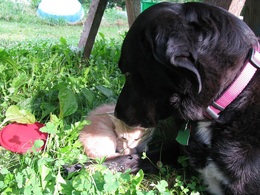
When we arrived at work this morning we came upon a poignant scene. The Wagenius’ family dog, Roxie, had was nurturing an abandoned kitten:
I’m happy to say the poor creature has found a home with Kelly and her parents. Thanks to her loving care (and Roxie’s), it is now purring and mewling with gusto.
Once the kitty situation was resolved, we moved on to more serious business. Shona, Maria, Kelly, and Lydia spent the morning working on their individual projects while the rest of us assessed flowering phenology in two experimental plots (C1 and C2).
A lot of work goes into maintaining an experimental plot. In order to keep C1 from being overgrown by woody plants, several of us spent the afternoon trimming ash trees and sumac. The rest of us made progress on our individual projects. Thanks to help from Kelly and Lydia, Jill and I succeeded in setting up ant traps for all but one of our field sites. I’ll post more about that later.
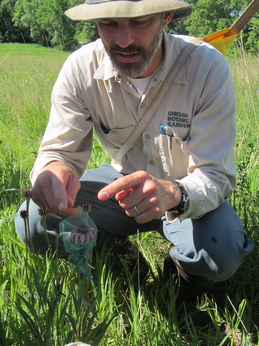
Last week was a busy and fun one for Team Echinacea 2012; no two days were the same. We wrapped up some of the first summer projects and started to transition into the second phase of the summer. We completed evaluating the recruitment plots, began to record their GPS locations, conducted demography and phenology observations in the common garden, and perhaps most notably, completed round one of seeding searches with the west (and recently burned) section of Staffanson prairie with help from Amy Dykstra, who came to visit on Friday. In addition to all the progress made on the long-term projects, we also spent multiple rainy mornings working on our individual research projects, the proposals for which have been recently, or will soon be posted here on the flog. Stuart Instructs us on the proper field techniques for cross-pollination, pollinator exclusion, and painting flowers so we can keep track of what we’ve just done.
After a short weekend, we started up working again this Monday with a morning dedicated to our independent projects, time which we all used to get out in the field and get our hands dirty. Ruth stopped by today and lent a hand and some very welcome advise, and joined the crew in the afternoon to do some weeding in the common garden. We clipped, pulled, and trimmed Buckthorn, Ash saplings, Birdsfoot Trefoil, Sweet Clover, and Sumac.
|
|