|
|
So, a while back when GPS-ing the recruitment plots, there were a number of places where no nail was found in our initial survey. Here’s the list of those point numbers in the GPS:
250
257
276
278
302
319
395
406
These were supposed to have nails, but we were unable to find them.
407
422
428
434
435
Here’s an improved version of my poster on my pilot study of Dichanthelium germination, which I presented at the Undergraduate Research & Arts Expo at Northwestern. It’s pretty much the same content, but less text and neater.
MWangURGExpo2012poster_44_x_36.ppt
Howdy folks,
Maria reporting from K-town.
Sunday we had a real day off =)
The weather was good and sunny, but not too hot.
Random tidbits from the town hall:
Shona made oatmeal pancakes for breakfast – they were really yummy – thanks Shona!
Kelly and Shona went swimming at Elk Lake and bumped into the Wagenius family
Katherine found a new trail in the forest at the Runestone Park on her biking adventure
Andrew had a great time at home and arrived at the town hall before 11pm
Lydia spent the day helping out in the kitchen at the camp in Alexandria
I made Irish Soda Bread to use up some sour milk, but still have ~1 cup sour milk (turned into buttermilk substitute, any ideas what to do with it? Pancakes would be easiest, but we just had them)
After the weekend break, it’s time for work again! Monday (today) we divided and conquered.
AM – Greg set out his yellow pan traps in his remnants. Stuart, Katherine, Jill, Lydia and I did demo in the remnants. Ruth and Greg came to join us. We found many Echinacea flowering at Loeffler’s Corner East, an okay number at Loeffler’s Corner West, 2 at Railroad Crossing (Douglas County), and ~6 at Yellow Orchid Hill.
The others (Shona, Kelly, Andrew) did CG1 rechecks and then worked on their independent projects.
Ruth bought some delicious fluffy spongy chocolate cake which we cleaned off the dish.
PM – The two teams switched jobs. Stuart led Shona, Kelly, Andrew, Ruth and Greg in demo at KJs and On 27. The rest of us did CG1 rechecks, and then worked on independent projects.
Here’s a file called “Crash Course in R”, which might be helpful to folks
crashR.2.pdf
Now for some photos!
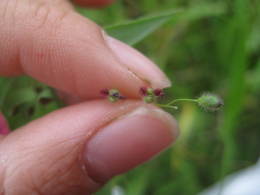
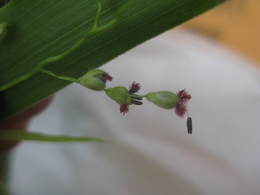
Flowering Dichanthelium!

I think this is a super cool picture as it shows 3 stages of Dichanthelium stigmas/anthers emergence. See how the bottom-most spikelet has the stigma just emerging, while the anthers are still inside; the middle spikelet is open and has both stigma and anthers well-exserted; and the top spikelet is closed and the anthers are drooping out from the spikelet.
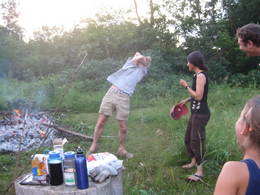
Last but not least here’s an epic picture from our bonfire last year 😀
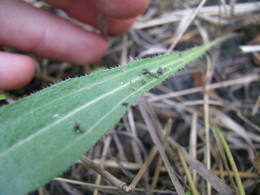
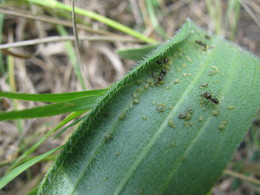
Saturday brought a resurgence of the “not-so-bad” weather we’ve been enjoying this week. Several rainstorms have brought some much needed moisture to the soil. The reason I mention this is that while I worked on my aphid addition/exclusion experiment, I noticed a lot of dirt mounds on plants where aphids were present. Presumably, ants build these structures to cultivate aphids. Some of these were small, consisting of only a few small pieces, and some were large, taking up a large portion of a leaf. Here’s one of the smaller examples. The opposite side of the leaf was covered in aphids.
Here’s a picture of one of the plants in my aphid addition group. As you can see, the ants are taking full advantage of the situation:
As for other field work, Kelly spent the morning checking the status of flowers for her phenology study. Most of the remnants have stopped flowering, with the exception of one plant at a small remnant and many at the Staffanson prairie preserve. Because the west half of Staffanson was burned in May, Echinacea began blooming later than in the unburned half.
In the evening, we all gathered at the Wagenius family home for potluck dinner and bonfire. I should say bonfires, since there were two right next to each other. Pyromanic desires were fulfilled by all.
Lydia mapped many Echinacea plants in two remnants: eelr and alf. Here is a list of distances in meters between all pairs of plants.
distancesForLydia.RData
This version of Lydia’s R script will read her dataset and edit it and then read the distances and merge them to her compatibility dataset.
mergeScriptForLydia.R
Now that the vast majority of Echinacea are finished flowering (except for the populations at Staffanson and one lonely plant at Northwest of Landfill), I’ve started piecing together a master datasheet with the first and last day of flowering for every Echinacea head that I have been studying. Please let me know if you have any comments or recommendations for statistical analysis, possible comparisons to other data sets, or better organizational methods!
phen_mastersheet_2012.csv
phen_mastersheet_2012_metadata.doc
Hi guys,
Saturday morning i woke up at 6am (body clock working on weekday schedule) and couldn’t go back to sleep, so i decided to watch the approaching storm, from the safety of the front door of the town hall. Saw some really interesting things that will sound like they were right from a children’s book but it was all true.
The sky was a strange yellow glow. i’m guessing it’s because of the sunrise before a storm. In the north and northwest direction, there were dark clouds and low rumbling thunder in the background. But in the opposite direction, birds were chirping incessantly. The sun was literally gleaming above the dilapidated barn house. I saw a rabbit prancing across the neighbor’s front yard. I watched as storm clouds in the west covered and uncovered a double rainbow. Gradually the storm clouds moved from north to south. Some pattering of rain, and cool lightning chases in the north/northwest, accompanied by louder thunder.
Around 6.50 i went back to bed. Jennifer was already up – she was going to meet Stuart at the Hjelm House at 8, and then go to Caribou Coffee in Alexandria to work on her manuscript for the whole day.
Later in the morning, Katherine went to the common garden to do her aphids experiment, which took all day.
Taking advantage of the cool temperature (high 70s with 10mph wind), Jill went out for a run at 10 and I went out for a slow jog at 11. Lydia, Andrew and Kelsey (Andrew’s special friend) went to Alexandria around noon – Andrew was showing Kelsey around. Kelly, Shona, and Jill went to the Starbuck beach in the afternoon and had lots of fun. Apparently there was lake itch at the first beach they went to but they found another beach on the same lake that didn’t have the itch.
In the evening, Kelly and Shona went out for a run before going to Alexandria to watch The Dark Knight Rises. Andrew and Kelsey joined them at the movies.
Oh, and the obligatory picture. My camera got really wet in the rain (i foolishly put it in my raincoat pocket), so it’s retired from service for now. But I still have tons of good pictures from this summer and the last, so no worries.

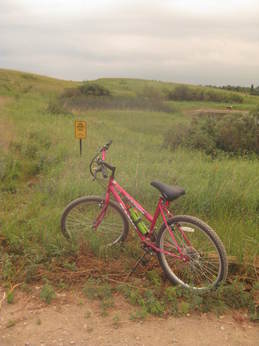
This was from the day of the storm. The yellow glow I was talking about. That’s my bike parked outside my field site at Hegg Lake.
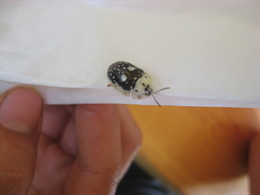
And this is a really cool bug I found on Dichanthelium. It can climb vertically and upside down very well, and it seems to have suction pads on its feet. Photo courtesy of Lydia.
Maria
RAIN!!! After weeks of very little in the way of precipitation, Team Echinacea was rained out on Wednesday morning. Instead of the usual field work and phenology, we worked on data entry and other analyses for our individual projects. Fortunately, it stopped raining around 10 AM and I was able to head out to Staffanson Prairie Preserve to collect data for my phenology project. West Staffanson was burned this past spring and a lot of the plants are flowering later than usual. This rain seemed to have jump started flowering and it seemed like all of West Staffanson went from young, green sprouts to beautiful flowering plants over night. Walking into West Staffanson, I felt like Dorothy entering the land of Oz! Below I’ve attached a few pictures of the flowering plants and pollinators that I saw. Because West Staffanson was burned pretty late in the spring, many of the flowers that have already finished blooming in other remnants were in their prime on Wednesday. In the afternoon, we started working on phenology in Jennifer’s Plot at Hegg Lake.

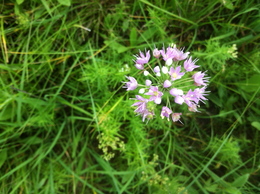
Allium

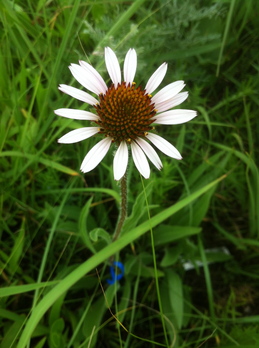
An Echinacea on its first day of flowering.
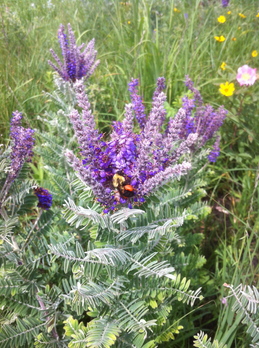
Flowering Amorpha canescens with a pollinator!
Pardon the belated appearance of my proposal on the flog, but here it is!
Proposal draft 2.pdf
This past weekend a group of us went over to Glacial Lakes State Park for some hiking and a change of scenery (i.e. trees). During our hike we passed a few sections of remnant prairie, evident by the presence of lead plant (Amorpha canescens). One of these had what appeared to be a flowering Echinacea angustifolia. Due to a combination of curiosity and habit, I walked over to check the plant for aphids. Sure enough, there they were:
They looked like Aphis echinaceae, though they were slightly bigger than the aphids I’ve seen around here. The reason I mention this is that the specimens for Aphis echinaceae were collected in our field sites throughout Douglas County. Glacial Lakes State Park is a little under 30 miles away. I didn’t collect any aphids, but I thought it was an observation worth sharing.
|
|