Last summer I conducted a biweekly survey of aphids and ants in the common garden, an experimental prairie restoration containing Echinacea from various remnant populations. I was interested in the spatial distribution of aphids and ants within and across years. This year I plan to scale down my survey to once a month, beginning next Friday. Here’s a detailed protocol:
|
||||
|
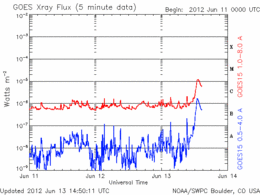
We just reorganized the bee collection into a cornell drawer, and need a cabinet to start storing drawers. Once we have better humidity control in the Hjelm house this is the cabinet we are considering. We delayed our fieldwork for a few minutes this morning because of scattered showers. Who knew we should have delayed for a few more minutes because of Solar X-Ray Flux? The National Weather Service’s weather radar indicated that the rain (aka atmospheric H2O flux) was mostly south of us, so we knew it would be a short delay. However, we should have checked NOAA’s space weather forecast… When we arrived at the site, the atmospheric weather was OK, but the space weather was poor and our gps machine, Sulu (a Topcon GRS1), had a difficult time getting oriented. It may have been groggy because of the burst of solar X-Ray Flux. Here is the graph of Solar x-ray Flux from NOAA:
Just our luck! Next time we’ll check our local weather forecast and the space weather forecast! Here is Sebastian Di Clemente’s final report on the main project of his internship: X-ray Radiation Effects on
Germination and Growth of Echinacea angustifolia Hello all! A lot has happened since my last post, so here is a brief update! After returning to school with my phenology data and experimental seed heads in the fall of 2011, I began work on my senior thesis using that data as a foundation. In April of this year I defended my thesis, “Flowering Phenology and Seed Set in Fragmented Populations of the Prairie Plant Echinacea angustifolia” and was awarded Distinction by my committee! Stuart and I continued to work on my data after my defense and are planning to continue the project and potentially incorporate data from this summer in the hopes of publishing it! Here are some of the very interesting results that we’ve gotten so far: > aggregate(ss ~ nndist + pdtime, data = mm, mean) We found that there’s a relationship between seed set (ss), peak flowering date (pdtime), AND distance to the 6th nearest neighbor (nndist). Seed set was higher in plants that had a combination of close 6th nearest neighbor (near) and early peak flowering date or far 6th nearest neighbor (far) and late flowering date. Very interesting! If anyone has any questions, is interested in continuing this exciting project this summer, or would like a copy of my thesis, feel free to contact me! (Amber Zahler at ambermzahler@gmail.com) If you are heading to ESA, visit Callin Switzer’s poster “Inspiring future ESA members in elementary or middle school, using place-based inquiry.” It has been scheduled for: Visit his poster, #35507! Yesterday, the Mettler Toledo BALNT software was throwing up an error when it was started, preventing weighing. Exact error message: BALNT.exe has generated errors and will be closed by Windows. You will need to restart the program. An error log is being created. This seems to be an error with the config file in the C:Windows or C:WINNT directory. To fix this, take the zip file in I:DepartmentsResearchEchinaceaVolunteersBalancebalancebackup-good2012.zip and extract it to the C: drive. This should overwrite the Balance-May2012 directory on the C: drive. Take the BALNT.ini file from that directory and copy it to C:Windows or C:WINNT, whichever exists. You should be able to start the balance software and begin collecting points. What’s this in plug 156? A young seedling with fused cotyledons and a true leaf just peeping up. in the nearby corner is a more typical seedling. Both plants come from florets of Echinacea angustifolia that were pollinated with pollen from Echinacea pallida.
Click image to embiggen! In a paper just published in Restoration Ecology, Echinacea Project researchers report that establishing Echinacea angustifolia in existing prairie restorations and abandoned agricultural fields requires more than 20 seeds for each plant that germinates and survives to flowering. Plants start flowering about 10 years after sowing. Also, burning the prairie before broadcasting seeds helps emergence and survival. Wagenius, S., A. B. Dykstra, C. E. Ridley, and R. G. Shaw. 2012. Seedling recruitment in the long-lived perennial, Echinacea angustifolia: a 10-year experiment. Restoration Ecology 20: 352-359. Available here: https://echinaceaproject.org/
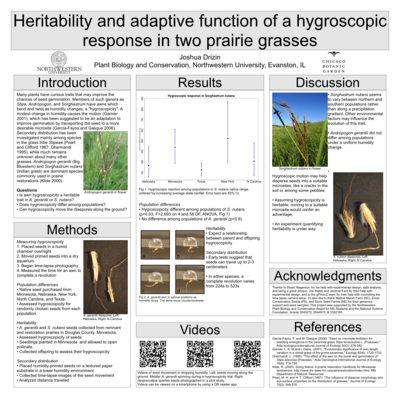
Click to embiggen the poster. This isn’t the full poster, but I’m not uploading a 30MB PDF. The videos can be read with a smartphone and a QR reader, or flip through my posts, as all the videos are on the flog somewhere. |
||||
|
© 2026 The Echinacea Project - All Rights Reserved - Log in Powered by WordPress & Atahualpa |
||||