|
|

With the early spring we’ve been having in Minnesota, I was curious about whether the Echinacea plants were sprouting. My husband and I made a day-trip out to Douglas County last Saturday (May 1). I did a quick check of my crossing experiment plot at Hegg Lake. I found some of the toothpicks we used to mark seedlings last summer, along with some of the plants–which are now a year old. I plan to do a complete census in another couple of weeks.
We also stopped by the common garden. Here’s one of the plants–already quite a bit of growth on the first of May.
Hey team,
Things have settled down a bit and I’ve started work again on the great pollen challenge! I have ten locations for each of ~150 slides, and for each location I have been recording the count of pollen grains, as well as the number of species as best I can tell (I have also taken notes with descriptions of pollen in each location). My goals at this stage are to get better at recognizing pollen grains of the same species in multiple photos and to get a feel for the diversity and amount of pollen on the pollinators we caught. I’d also like to see if there’s any pollen load size/diversity consistency within a pollinator species.
I have started looking at the male Melissodes sp. and so far it looks like about half of them carry no pollen at all, but some of them have multiple grains at each location.
My question for you is… What makes an insect a ‘pollinator’ in the context of this study? We are focusing on pollinators, and are not including insects that we caught but know are not effective pollinators (ex. syrphid flies), so there needs to be some way to distinguish between other effective and non-effective pollinators. I have thought about making a cutoff like, say, in order for an insect to be a ‘pollinator’ it must have one grain of pollen per location. That way insects that happen to be carrying one grain of pollen (total) but that aren’t really pollinators wouldn’t be counted as pollinators in this study. However, any cutoff seems very arbitrary. It almost seems better to include anything that we know carried pollen, even one grain.
But what about those male Melissodes sp.? If some individuals carry no pollen and others carry quite a bit, do they all count as pollinators, or just the ones that carried pollen?
If you have any ideas, please put them in the comments!
Here’s a poster I presented at the Evolution 2009 symposium at the University of Nebraska-Kearney, September 2-4, 2009. The poster describes my local adaptation experiment, and results of the early summer seedling searches at my three experimental sites.
DykstraPosterEvolution2009UNK.pptx
And while I’m back visiting the field blog, here are a handful of photos from the Stipa planting at the end of the summer.


As per a request from Daniel, here is a presentation I gave to Team Echinacea way back at the beginning of the summer. Enjoy reliving the magic!
Aphids and ants.ppt
I received the camera today so I had to test it out since the opportunity presented itself. The picture is taken through a stereomicroscope at 45x magnification of a live amphipod from the Big Sioux River. On a qualitative stream survey, we found our water to be very clean. So the camera isn’t just for live pollen anymore. School is going well. I find myself saying “protocol” instead of lab instructions sometimes. Must be a remnant from the prairie.
Hello,
I made it to the fourth day of school without taking my class outside to the nearest prairie remnant (the hill above the river in town)
It took very little time for them to learn to recognize ech. deadheads and rosa arkansana (rose hips). Some were even able to find basal ech. plants. (without offering 6-packs of pop as bait)
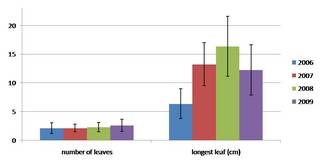
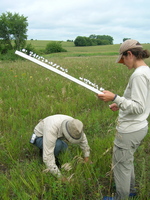
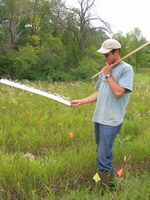
Thank you all for your hard work when we measured my Hegg Lake common garden a week back. It was by far the fastest the Hegg garden was ever measured and there were no rechecks besides can’t finds! Below is some information regarding the Hegg garden.
Total plants planted in May 2006: 3,945
Number alive in August 2006: 3,699 (94%)
Number alive in August 2007: 3,320 (84%)
Number alive in August 2008: 3,008 (76%)
Number alive in August 2009: 2,834 (72%)


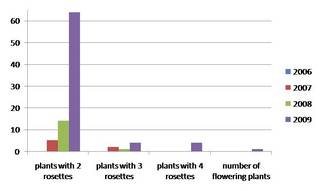
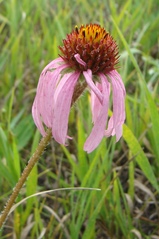
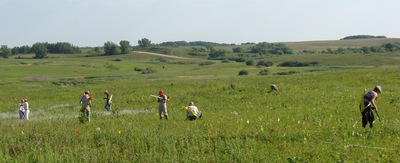
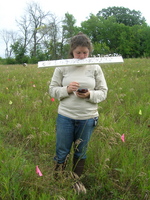
As you can see the length of the longest leaf actually decreases from 2008 to 2009. However, there were way more plants with multiple rosettes this year than in years past. I think the leaf length decreased because last year there was so much duff on the ground that the petioles of the leaves grew really long. The plants definitely looked healthy this year after the spring burn than they did last year. What was really exciting was I had my first flowering plant this year in row 7 position 44! Below is a picture of that flowering plant, and one of everyone measuring at Hegg.


Also, thank you to everyone in the town hall for being so hospitable to my dad, Oscar, and me. We had a great week and except my weird heat rash (it eventually went away) it was a lot of fun. Best of luck with the final push at the end of the season!
Regards,
Jennifer, Oscar, and John

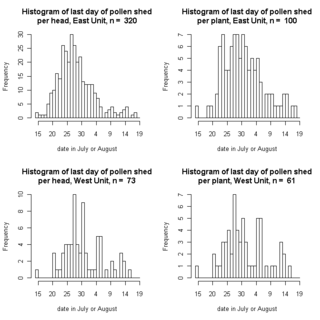
Echinacea plants on our transect at Staffanson Preserve are done shedding pollen for the year. A few still have persistent, receptive styles, but August 18th was the last day pollen was shed.
This graph show how many heads (left panels) or plants (right panels) finished on each day. The earliest heads finished on 15 July. I divided the preserve according to the burn unit: burned East (top panels) and unburned West (bottom panels):

Final date of flowering for 393 heads on 161 Echinacea plants
from a burned and unburned unit of a prairie preserve
This graph is based on preliminary, raw data, but I wanted to share. Click on the thumbnail to see a larger version of the graph.
DATA
Here is a copy of my excel file with all my data. The sheet labeled corrected data for analysis is the file with all the data for each treatment. The sheet labeled baggins has a list of all the heads I used that need to be harvested, this was also posted in a separate post called “Baggins.” The ones labeled “donor” do not need to be harvested but should not be expected to have high seed set as they were bagged for most of their flowering time.
Pollination interference data (data entry 2).xls
HARVESTING
I need all of the heads used in my project (the ones that are painted) to be harvested in egg cartons (located in the shelf above the sink in the Hjelm house). Please label the compartment of the egg carton with the row, pos and tt color of the head. The egg cartons should be packed so that they wont be disturbed during travel and please be careful with the heads so no seeds fall out! Gretel has a list of all the heads to be harvested and its posted on the flog in July (“Baggins”). Please mail the packaged heads to: 119 School Street, Keene, NH 03431
LANDFILL SPECIES
I have been collecting plants at Landfill this season and have started to compile a list of the plants I have either seen or collected there. If Megan and anyone else would like to add plants to that list that would be great! Or check my identification. This list is very rough at the moment but I will continue to update it as I get more plants identified.
Species list landfill 2009.xls
|
|


-thumb-320x240-10991.jpg)