|
|
We have made a few changes to the protocol for tomorrow’s FINAL outing for pollinator observation and collection:
1) DO NOT capture syrphid flies!
2) If you observe a small common syrphid fly (Family: Syrphidae, Sphaerophoria sp.) on your Echinacea head, make a note that one SCSF was observed. Here are some photos of syrphid flies:
http://echinacea.umn.edu/insects/images/poll2005vin1948side.jpg
http://echinacea.umn.edu/insects/images/poll2005vin1927top.jpg
http://echinacea.umn.edu/insects/images/poll2005vin1927front.jpg
Here’s a video that might help:
http://www.youtube.com/watch?v=UkjPfAMGmiw&NR=1
———————————————————————————————
As for pollinator collection and analysis…
We’ve gone out collecting three times now (tomorrow is the fourth and final day), and we have about 140 Echinacea insect visitors in vials in the freezer. Here is my protocol for making slides and labeling specimens:
1) Remove vial from the freezer and allow insect to thaw
2) Cut a very small (2mm cubed) piece of agar and situate it in the middle of a slide.
3) Remove the insect from the tube and dab and sweep every surface of the body across the agar cube. This is intended to simulate the amount of pollen that might be transferred to Echinacea styles during a visit.
4) Set the insect aside on Styrofoam.
5) Sweep the inside of the vial with the agar cube for any loose pollen.
6) Place a cover slip atop the agar cube and put the slide on the edge of a hotplate on LOW heat. Watch the slide carefully and remove it when the agar is soft but not melted (once melting starts, it will quickly boil and create bubbles in the slide).
7) Pin the insect (for identification if it is an unknown species, or quick-n-casual for a known species) and pin it with a new one letter, three number code.
8) Label the slide with the vial code and the specimen code.
Photos:
I photograph the slides on the same day as I make them so that the agar doesn’t dry out before the photo. To sample the slides, I have generated random pairs of numbers from 1 to 22 (inclusive). The cover slips are 22 x 22 mm and I use the ruler on the microscope to scroll to the randomly selected “plots” from one corner of the cover slip. From there, I take the photo at 40x. I take ten photos for each slide, and sometimes take more than one photo per plot if I capturing all of the pollen grains requires multiple focuses.
I will post some photos of this process soon, so hang in there!
As always, feel free to leave questions or comments.
Thanks!!
Amanda
So, there has been a serious lack of pictures lately (aside from those awesome Stipa scans), so I am posting a bunch of pictures taken a while ago, just so you can see what we are up to:
http://www.flickr.com/photos/danrath/3727546804/
Amanda in her little corner of the farmhouse, doing voodoo with bees.
http://www.flickr.com/photos/danrath/3726738091/
http://www.flickr.com/photos/danrath/3726739525/
http://www.flickr.com/photos/danrath/3726736903/
Greg and Kate locked away in the Basement of Oppression
http://www.flickr.com/photos/danrath/3727538558/
http://www.flickr.com/photos/danrath/3727532876/
http://www.flickr.com/photos/danrath/3726727059/
http://www.flickr.com/photos/danrath/3727301314/
Berry Picking, starting with Caroline’s Gollum face. We have picked at least 20 buckets of berries from these people.
http://www.flickr.com/photos/danrath/3727297280/
http://www.flickr.com/photos/danrath/3726488747/
http://www.flickr.com/photos/danrath/3726486389/ – Aphids, the enemy.
Insects in the Common Garden that I found while searching for plants
http://www.flickr.com/photos/danrath/3726483267/
Mimi broadcasting Stipa grass
We spent most of yesterday collecting pollinators and measuring plants in the Common Garden. (It has never taken me 3 hours to go 30 metres before, but all the plants I measured seemed to be in the middle of a grass clump). I have also figured out a procedure for refinding plants in the transects, and it should not take very long to refind all of them. This is good, as I might be working by myself to do that.
On July 20th I collected pollen,separated into three microfuge tubes, from plant 36, 958. Tube #1 has been left at room temperature, #2 is in the refrigerator, and #3 is in the freezer. There wasn’t much pollen available, so I hope it’s enough to try some pollinations and see how long the pollen stays viable under the three treatments.
Apparently there is some question about what I have been doing lately. Daniel was partly right–data entry has been on my list. Remember checking the recruitment zones earlier this summer? And being rewarded with all those six packs? Well, there were some ambiguities in the data. I compiled a list 2009 zones to check.xls of all the things we need to check in the recruitment zones. Some of these (checking burn status) can be taken care of with a visit to the plot; other ambiguities may be cleared up by taking some tissue samples and sending them to Chicago for microsatellite analysis.
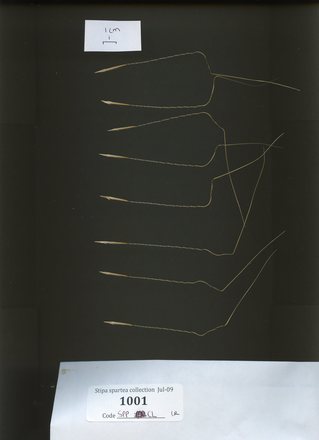
Below is one of the scans of Stipa seeds collected from Douglas County. This particular set of seeds was collected from a plant at Staffenson Prairie Preserve. The seeds themselves are pointed towards the left side of the image, and extending from them are the long awns that give Stipa it’s common name (porcupine grass). At this stage, they look less like quills, though, because they have dried and started to coil (click on the picture to see it full resolution and you can actually observe the coils and lots of other neat features of the seed, like hair and a dagger tip!). Out in nature, the coiling action would allow the seeds to attach to a disperser or to drill themselves into the ground in preparation for overwintering and germinating the next spring. We’ll be scanning all of the seeds we collected (an estimated 3,000+ seeds from 431 plants), making digital measurements of seed length and width, and planting around 2,500 of them interspersed with Echinacea in the common garden.

We are going to plant Stipa spartea seeds into the common garden. Here is a
file with target locations for ~2600 seeds. The seeds will be planting in ~269 batches. Here’s a list of the batches: allStipaStarts.csv Sometime before we plant, Caroline will share a photo of one of those Stipa seeds.
Here’s some of the work I’ve done with organizing my data. I still need to figure out how to organize it to be able to analyze it, so this is mostly just preliminary work. I have about 2 weeks to put this all together….any help/advice is appreciated because right now, the data I have is a little overwhelming. There are 3 sheets in this document.
Ech Guide to Co-Fl Sp.xls
For next week, it looks like the weather should hold up for Tues and Thurs to be able to do pollinator observations. So we will need to flag the sites on Monday and have everything ready to go for Tuesday. Remember, you ALWAYS record something for each observation you make, regardless of whether or not you observed/caught a pollinator. Select No for poll. observed and No for pollinator caught if this is the case. Some things I wanted to clear up for people helping with FNC:
>If you reach 100 when counting inflorescences, stop and record >100.
>When recording the species within 10m, you will no longer put this into a memo. Instead you will always select pl A, record 0 for infl ct, and in the field of quadrants, select the fifth option called “within 10m”.
>Review the guide to co-flowering sp for how to count infl or print one up and ask me if you have questions.
>If you come across a new species that isn’t in the list of species in the form, record in the notes not only the species but also a brief description of how you counted inflorescences.
Thanks!
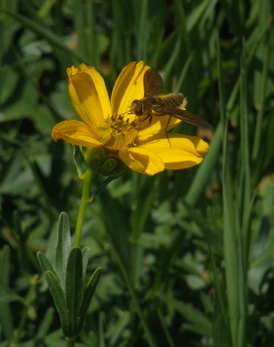
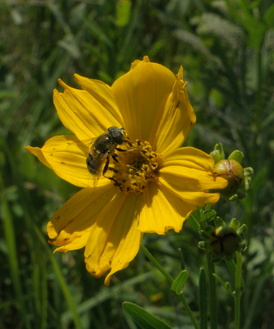
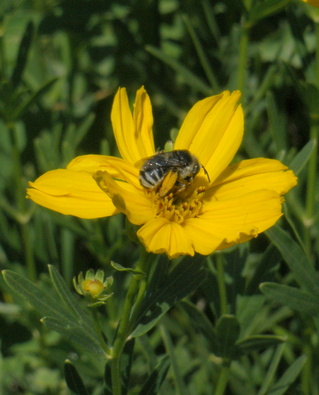
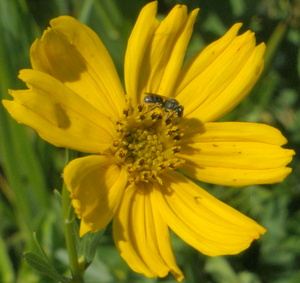
Here’s some of the pollinators I saw on Coreopsis near Hegg Lake. They seemed to only be pollinating Coreopsis although there were other species like Achillea, Amorpha, and Echinacea around.


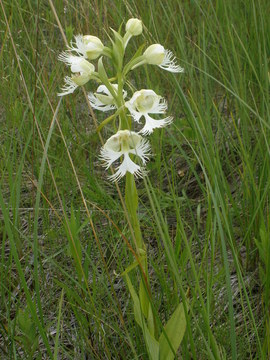
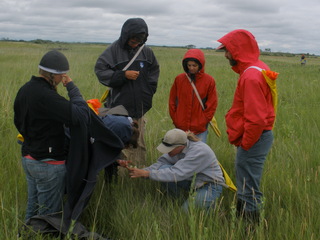
On Friday all of us except Greg went on a trip to a mesic prairie 3 hours away to help Gretel look for orchids. We split into 3 groups of 3 and flagged the flowering plants within the various treatment grids.

The Western Fringed Prairie Orchid, Pratanthera praeclara a threatened species. The first orchid I’ve seen in the wild!

Allegra, Amanda, Daniel, Caroline, Amy, Stuart–it was pretty cold for mid-July!

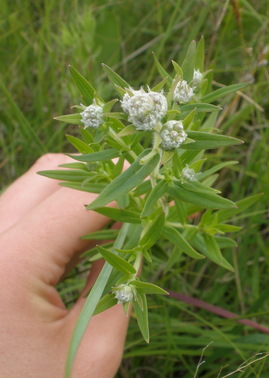
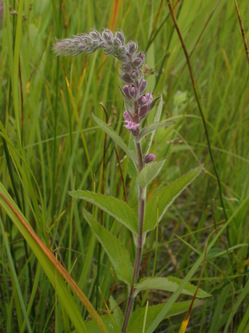
Mountain mint–Pycnanthemum sp. It was really neat to see some different species found in the mesic prairie, as well as some familiar ones. Some others plants we saw were Liatris, Rudbeckia hirta, Apocynum, Lilium philadelphicum,, Asclepias incarnata, A. speciosa, and Campanula. Below is another mint, whose name I can’t remember:

Thanks Gretel for letting us help!
Hello all!
This is Daniel with another update on what team Echinacea has been up to in the past week. Allegra, Stuart and I have become what I like to call the “Staffanson Crew”, and we are responsible for doing phenology at Staffanson every other day. Today we got the time down to about 2 hours and 20 minutes, from 3.5 hours originally. The process was made a lot more efficient by splitting up sections and giving everyone a separate checklist. Of course, the temperature was almost 40 below, so that was slightly unpleasant. Add the wind and the fact that I was only wearing 2 thin layers, and you have a recipe for hypothermia. However, I persevered, thinking of my avocado and sausage sandwiches waiting for me at the Hjelm house.
The pollinator project has been going along well, with Kate, Amanda and Mimi hard at working sorting out the oodles of data they have obtained. Greg and Kate are based in what I like to call the “Basement of Oppression”, working on making slides and taking pollen photos. Amanda is pinning bees and creating agar slides with the different pollen loads, then photographing them. Finally, Mimi is working on sorting out all the different types of flowering plants found at each sites. Meanwhile, who knows what Amy and Caroline are up to? Reviewing papers and entering data most likely, tasks far beyond the comprehension of we undergrads.
In my case, I have been searching for the different plants in the common garden that we identified as having spittle. I spent all afternoon in the common garden yesterday, and it was a ton of fun, especially since I saw so many interesting things. The most interesting thing of all though, was watching a bunch of ants pick up and move an aphid that was sitting on a leaf. The aphid may have been dead or alive (alive would be so cool!), but since I was silly enough to forget my camera, I guess I’ll never know.
Most of the plants I looked at have aphids on them, but I will need to wait until I finish looking at them all before I draw any conclusions. Meanwhile, our transect searches are done until next week. However, I have found aphids on many of the plants I saw during our Staffanson searches, so I remain hopeful!
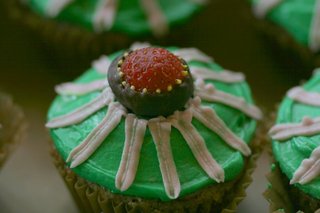
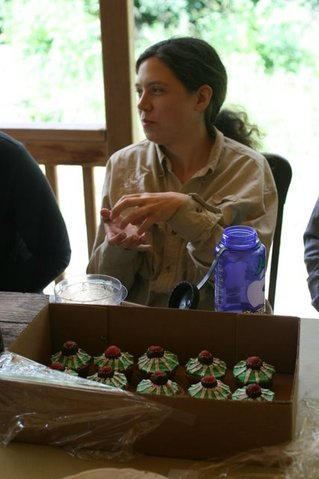
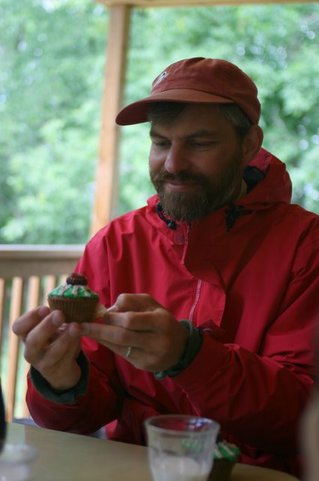
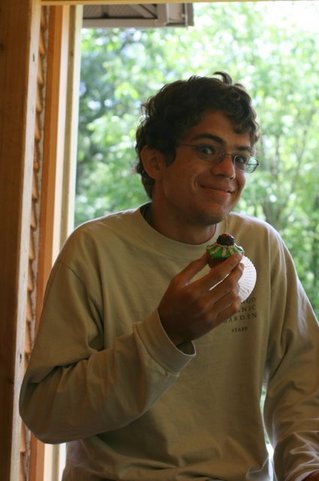
To celebrate peak flowering in the common garden, Megan made these awesome cupcakes. We all enjoyed them. Thanks, Megan!!


Megan with her breathtaking display of deliciousness.
Do you notice the stages of flowering presented here?
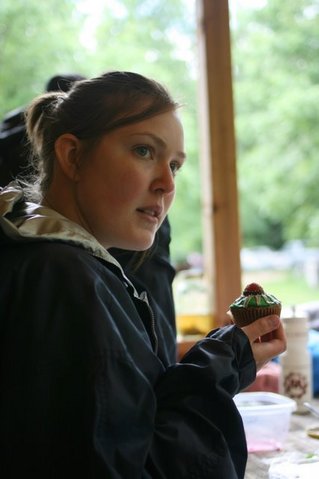
Mimi contemplates consuming something so beautiful.

Stuart basks in the celebration of his beloved study species.
Daniel enjoys with passion.
|
|