Another exciting field season kicks off with… demo? That’s right! We’re starting demo as soon as possible so that way Erin is an expert on it ASAP. So, logically, we started off at all environmentalists favorite hotspot – the golf course.
Now, the golf course, as you might know, is no longer operational. Additionally, there are some lovely prairie natives nearby including gallium, prairie rose, and, of course, echinacea.
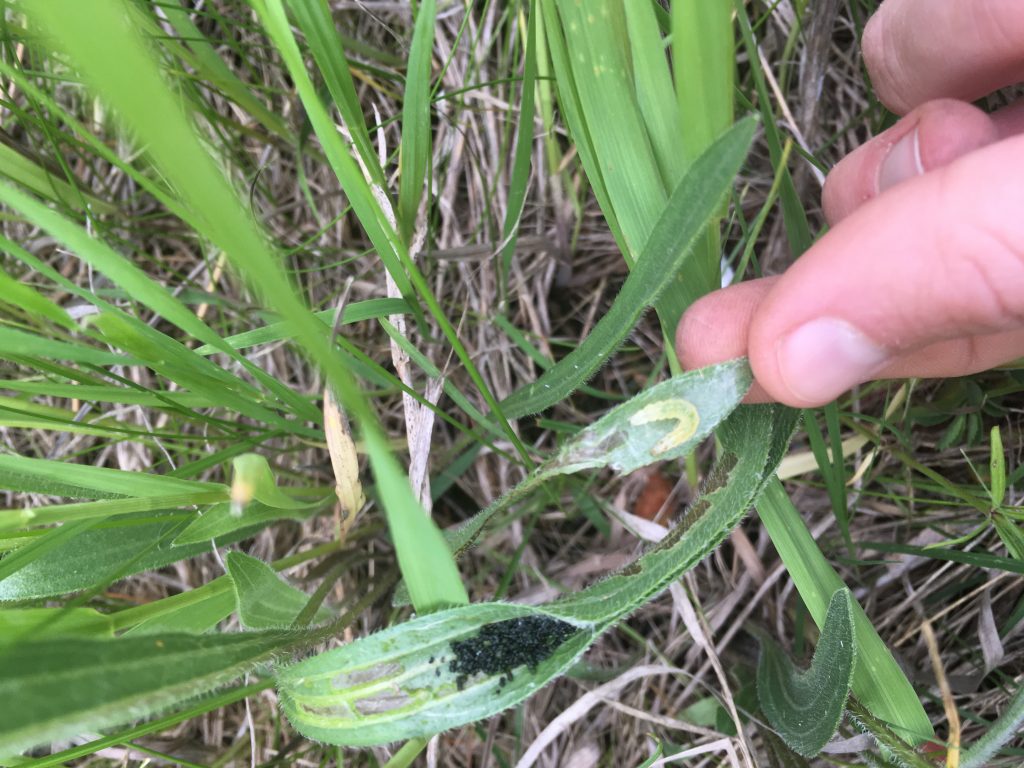
The day was full of new things and surprises. This was Drake and Erin’s first go at demo, and they both crushed it. Additionally, we found a caterpillar on an echinacea leaf chewing away in a way that we have never seen before (see picture below).
Ultimately, the day was completely successful, as almost all plants were still alive, and three of them were flowering! Hopefully with new demo masters Erin and Drake, we will find all the flowering echinacea in our plots. Until next time flog!
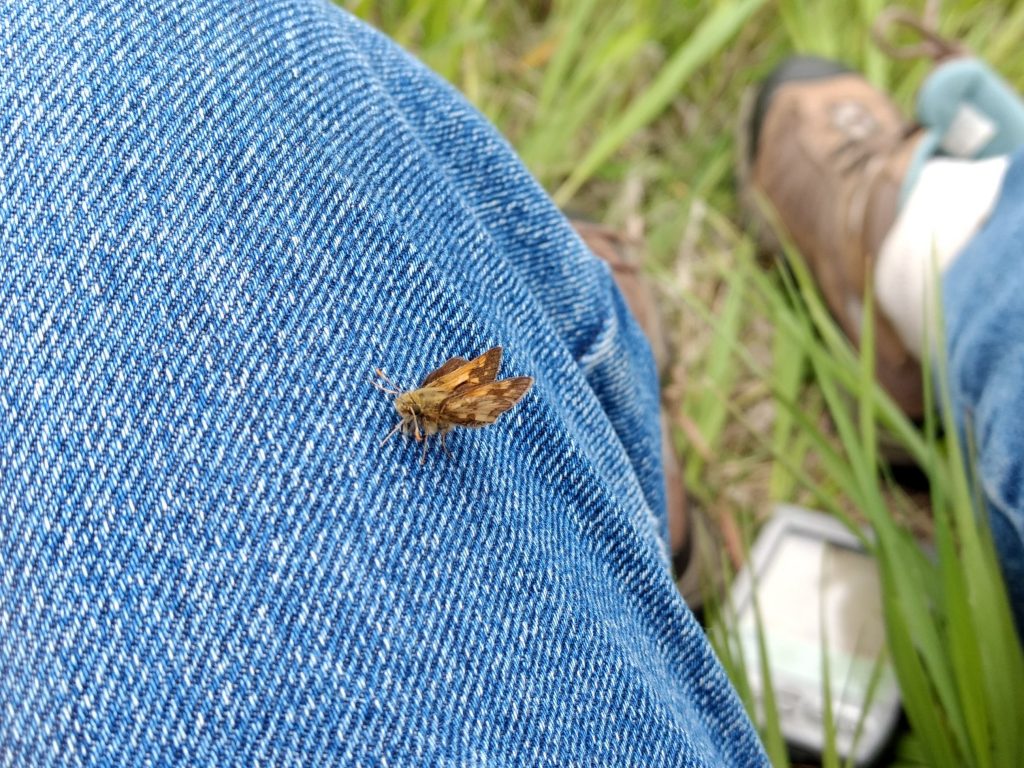
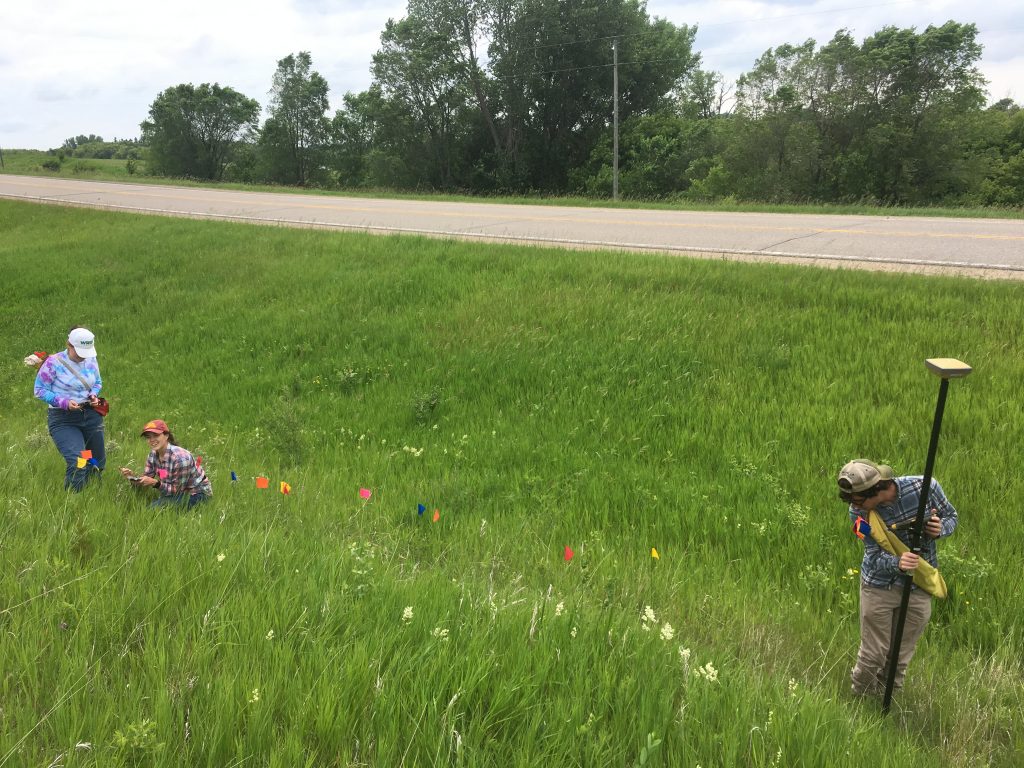
A butterfly on Erin’s leg. Is it a Dakota Skipper (maybe, reach out if you know)A caterpillar and his home. Look at all that frass! (that means, uhhh, scat)Erin, Amy, and Drake crushing some PBORY
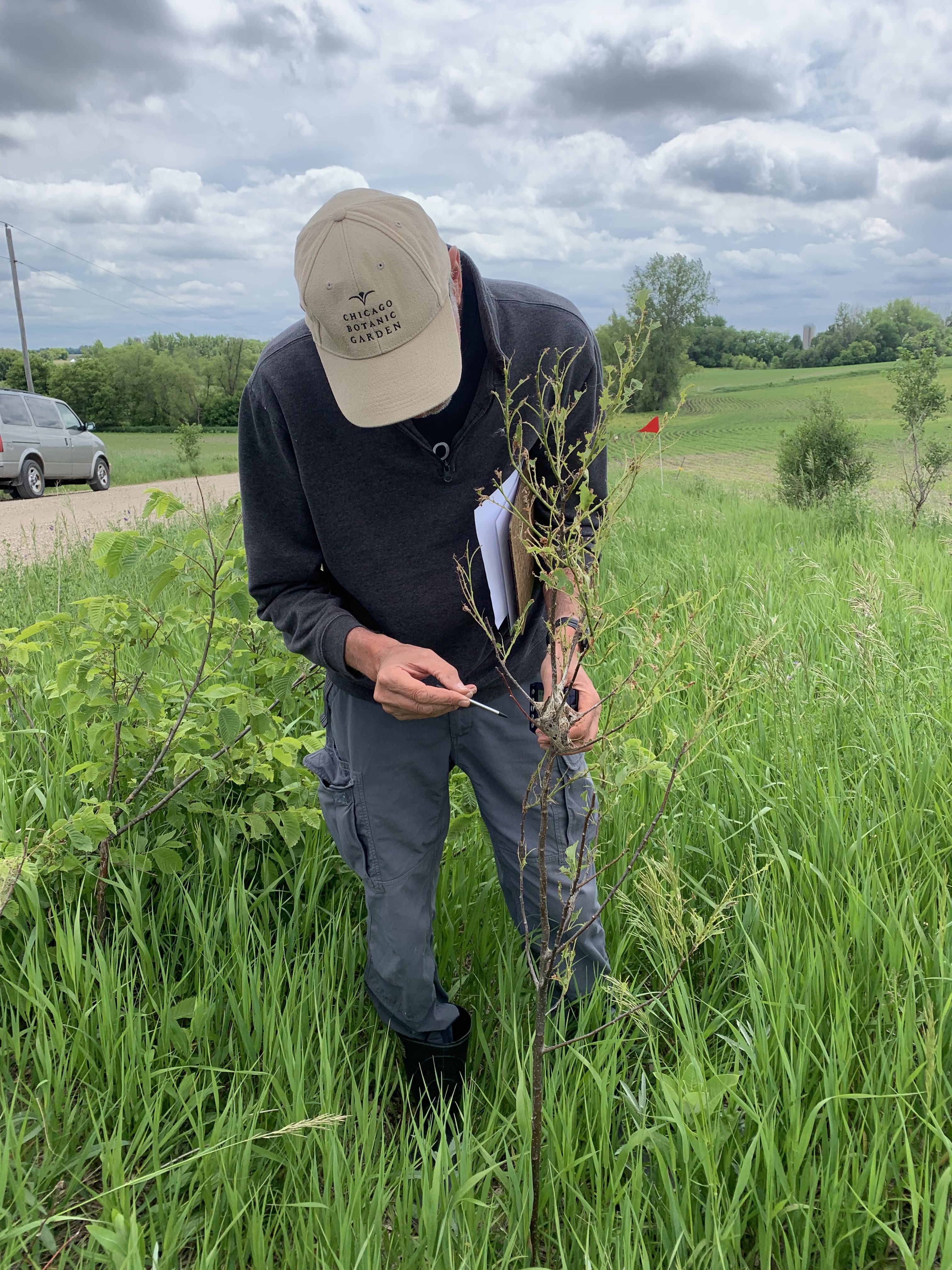
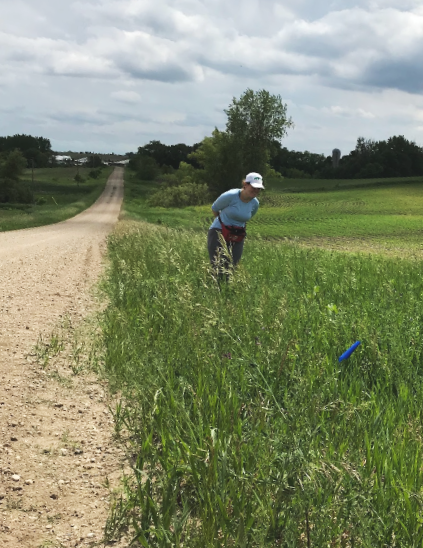
Echinacea angustifolia has an amazing will to survive, even on the edge of a fairly inhospitable habitat with relatively poor soil quality. The ground at our East Riley Site is pocked with ruts, packed by frequent mowing, and nearly scraped clean by this winter’s snow plowing. As an Echinacea Project veteran and a local familiar with this roadside plot, John told me on the drive to East Riley that he was nervous we might not see any plants sprouting out of the squished soil. But luckily, we were welcomed to the site by several healthy plants and rising flower buds poking out of the packed and duff-less ground. Surprisingly resilient, native Echinacea still sprout from their deep roots at the East Riley roadside season after season, striving to flower and pass on their genes to the next generation.
Life on the roadside at East Riley may be tough for the plants, but the tent caterpillars seem to be thriving. Here’s John examining one of their characteristic webby nests on a tree that must have been their most recent, hearty meal.
It had been a long 9 months in which nobody paid me any
attention. Then finally, on June 17th, The Echinacea Project field crew
that contained Jay, Shea, and Drake came to visit me. They were there to learn
how to use their visors and to hone their estimation skills. They counted my
flowering heads and searched around me for my nearest neighbors trying to gauge
how many of them would be flowering too. We had an unexpected visit from the
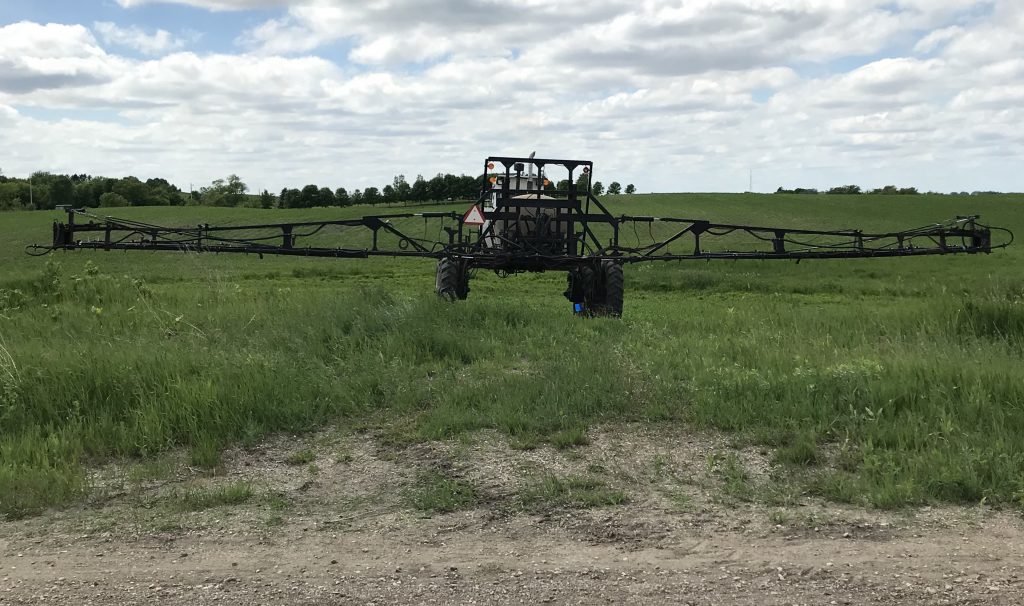
farmer next door who was riding in this sprayer. The Echinacea Project crew and
I were startled and wondered if he would just pass and pay us all no mind. Then
the unthinkable happened. I was nearly run over!
We all looked at each other in shock but started to calm down. The worst was over, or so we thought… the farmer’s sprayer began to extend its wings! The neighboring crops may be genetically modified to withstand his herbicides but I’m all natural. The field crew having finished what they came for and fearing being sprayed accidentally rudely returned to their car and left me for dead. I know they will be back later in the season to check up on me and my flowering heads though.
The following is our two accounts of first-day field experience, which comprised of orientation to the remnant prairie ecosystem and honing of field skills:
Riley’s Experience
When Erin and I rolled up to the Nessman prairie remnant for directed observations, I immediately felt threatened by the sheer amount of Bromus inermis present at the site. Although it is generally reported to be passive, I did not believe it necessary to disturb the rows of brome grasses that waited on the roadsides. Fortunately, the west ditch had a considerably lower amount of brome, and I felt considerably more comfortable stepping into its diverse collection of cold and warm season grasses, forbs, and legumes. Fortunately, I was not tasked with scouring this site for unknown plants so I was able to create a map of the site in the shelter of the middle of the road. Unfortunately, my partner Erin was not so lucky. Erin spent limited time on the east side of the road (the side with sea of brome), and she was fortunate enough to actually leave the brome sea unscathed. I was pretty impressed by the ninja skills Erin showed to avoid the constant onslaught of Bromus inermis in her personal space, it was cool. However, as Erin moved to the west ditch, there was a change… there was the emergence of an X factor, some may say. When I looked up from my mapmaking, I saw Erin under attack in the west ditch. Not by brome, but by caterpillars. Little known fact about caterpillars: caterpillar is Swahili for “guerilla warfare.” I unfortunately did not know this upon my site visit to Nessman, and I believed for a time that my partner suffered the consequences of many caterpillar attacks. At this point, however, I had known Erin for less that 24 hours and had failed to learn her most important skill: Erin serves as a trusty steed for a wide variety of grounded insects and she can communicate with them via hand signals to say, “Hi my name is Erin and I’ll be your Lyft driver today.” I was so happy to see that this seemingly menacing interaction between caterpillar and partner was actually a mutualistic one… One that I will not forget as I continue my year with the caterpillar whisperer.
Erin immediately before her interaction with a tent caterpillar
Erin’s Experience
Before visiting Nessman I had experienced remnant prairie only a handful of times, and all of those instances occurred earlier that morning. The landscape is gorgeous, diverse, and completely alien to me. I had never been in such a lush grassland before, and after our brief orientation in the morning, I could name maybe one in 100 plants I saw. Before arriving in Minnesota after the long drive from North Carolina, I had only ever seen Echinacea angustifolia on Google Images. Just picking it out from the surrounding prairie plants to estimate the number of flowering heads for our skill-building exercise was difficult. Riley knows his stuff and was an amazing help for any plants I had questions with, and could make a really educated guess even when he was unsure. I couldn’t distract Riley from his tasks forever, though, so I set out on my own to characterize the community for our record. As I carefully stepped over delicate plants and wracked my brain for plant identities and functional groups, I was desperate for something that looked familiar.
When I stumbled upon the first tent caterpillar my mind lit up with recognition before I could even process what I was seeing, or why it reminded me so much of home. I immediately recognized the little fuzzy caterpillar hanging out on a leaf as a friend; it took longer to remember that I spent many springs in my childhood catching the harmless and ubiquitous creatures in jars. Eventually tent caterpillars become far less charismatic tent moths that make unsightly silk nests in trees, but before then they make very good schoolyard pets. I scooped up the caterpillar and examined it for any significant differences from what I remembered in my youth, but it looked just the same as the ones we have back home. The familiar tickly feeling of the caterpillar in my hand was oddly comforting, and I carried it with me for the next few meters of my search before releasing it back to munch on foliage.
As I continued through the west ditch, I was surprised to find many more caterpillars, and not just of the tent variety.
Let us know if you recognize this friend!
Riley and I discussed the interesting difference in plant assemblage between the two sides of the road; while the east was dominated by invasive species, the west seemed to have greater native diversity of both plants and caterpillars. I look forward to visiting Nessman again in the future and hunting for more caterpillars, or maybe moths and butterflies!
Riley being extremely knowledgeable at one of our other sites
We had an excellent first day of the summer field season. We visited prairies, got gear, practiced some observation skills, and learned how to use our datacollectors . Here’s a photo of team-members at the end of the day…
top row: Riley, Julie, Michael, Drake, Jay bottom row: Shea, Amy, Erin, John
I am interested in community ecology, conservation genetics, and interspecific interaction, particularly in the context of pollination and reproduction. This winter, I had the wonderful opportunity to collect and analyze seed set data for Echinacea angustifolia, Solidago speciosa, and Liatris aspera with Team Echinacea. During that time, I came to wonder how the controlled burns used to maintain prairie fragments might influence plants’ interactions with their pollinators, potentially by altering the characteristics of plants’ floral displays in the year after the burn. This summer, I hope to explore other factors that could influence plant-pollinator interactions in prairie fragments.
Statement
I grew up in Menlo Park, California. In addition to studying biology as my major, I am a Cognitive Science minor with a focus on linguistics and neurobiology. I also enjoy learning languages, and while I’ve formally studied French, Spanish, and a little bit of Japanese, recently I’ve been trying my hand at teaching myself Korean. Outside of the classroom, I love to cook, knit, crochet, embroider, play clarinet, meditate with tai chi, and practice Muggle quidditch.
We had a really fun day at Echinacea East, full of new and exciting developments.
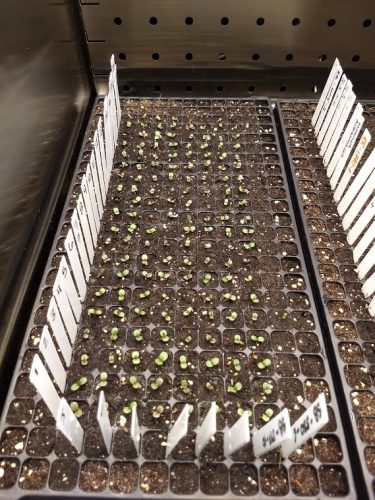
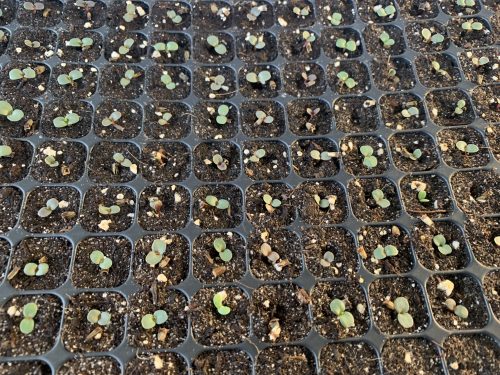
We’ve starting fertilizing our seedlings and they’re growing like crazy! They’re starting to develop their true leaves, which means we’ll be able to extract their DNA soon.
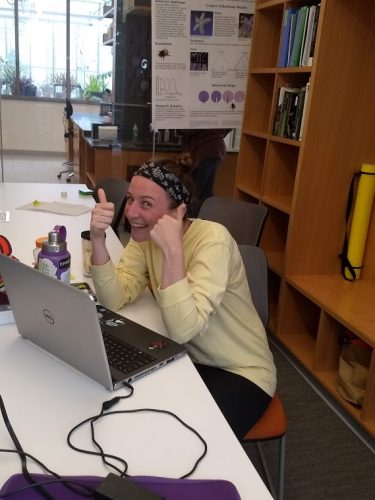
Avery has been working hard as our Scoring Extraordinaire. We’re super lucky to have her!
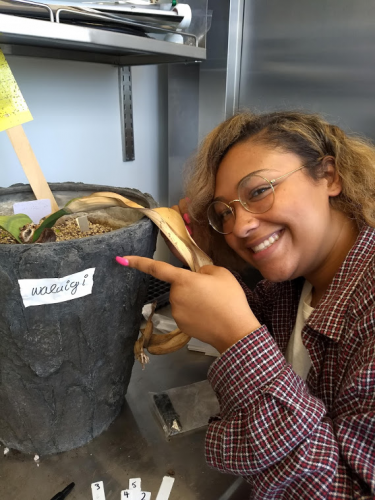
Miyauna is having fun chilling with her favorite plant: Waluigi the Welwitschia. She’s been working hard on PCRs while also interrogating the rest of us about our views on the “Self” (she was originally a psychology major).
It was a bittersweet day, though, when Mia left after lunch to drive all the way back home to Buffalo, New York for her sister’s graduation. On Saturday, she’s going to be flying to Arizona to complete her own research and we won’t be seeing her again for a few weeks. Have fun, Mia! We’ll miss you!
Overall, it was an exciting (and thought-provoking) day at Echinacea East!
It was another great Wednesday here in our Ohio lab! Mia and I dedicated most of our morning to PCRs, while Ren and Avery worked endlessly on the computers.
It was a special day as we got to run the student-led journal club for the other researchers in our building. It was a fun learning experience that Avery ran gracefully and smoothly.
Our little baby seeds are doing well and looking as cute as ever thanks to Seed Master Ren. We even are starting to see some true leaves come in!
Out here at the College of Wooster, we have continued to be busy as bees. Seed Master Ren’s seed children are growing up – we have now planted over 80 seeds! Though most of the seeds in this batch we expected to germinate have already, our next batch of seeds will switch over from winter to summer next week, so we should have a lot more soon!
Our plant babies are growing up!!
Mia and Miyauna tag-teamed it today, starting off by running a gel on DNA isolated on Monday and some of the PCRs that have been run so far. Things came out looking pretty good! They then ran some more PCRs (I was on temporary leave as president of PCR) and prepared what is called a mix plate which will be sent off to Yale for genotyping analysis.
I basically did not step into the lab the entire day. Instead, I was helping out and learning how to do data analysis on the results we get back from Yale. For samples of an older project, I was helping to “score” the results and essentially ensure that the data were organized properly so that they can be analyzed without issue in R. So I suppose while the president of PCR was on leave, the excel expert was in the office.
As we wrapped things up for the day, we had an unexpected surprise. We share our gorgeous new science building with many other people, including other lab groups, summer camps, and freshmen orientation sessions. This week, a science camp for middle school girls represents one of our neighbors in Williams Hall. On an end of the day stockroom run, we were accosted by a group of these campers, running down the hallway. Apparently, they were on a scavenger hunt, and they asked if they could ask us some questions. They were a mix of science-related questions and Wooster-related questions, ranging from the most bountiful class of organisms on this campus to the name of our football stadium. One question they were tripped up on was where to find dihydrogen monoxide, which I think all of us got a kick out of. By the end of the scavenger hunt, they probably knew more about our campus than we did. Regardless, it was cheering to see how excited these young girls were about STEM as the next generation of scientists!
I am interested in studying EVERYTHING! I am going into this summer with an open mind since this will be my first exposure to research outside of a high school classroom. Biology has always been my favorite subject in school and I am very excited to get to dive deeper into ecology and evolutionary plant biology. I’m hoping to gain a lot from this summer whether it be collection and analysis techniques, procedure planning, or just an overall better understanding of environmental science. I am eager to learn and can’t wait to get started!
Statement
I have lived in the Alexandria area for my whole life and Minnesota summers have always been my favorite part. I love to spend time out on the lake with my family and friends, fishing a lot and tubing as much as I can, but when I’m not on the lake, I’m playing soccer. Sadly, our summers do only last about three months around here so I also try to travel as much as I can with my family. And lastly, I am still undecided but I would love to pursue Biology at the University of Minnesota in the fall of 2020.