In 2022, Team Echinacea collected an additional summer of data for the Pollinators on Roadsides project after receiving funding through the Minnesota Environment and Natural Resources Trust Fund (ENRTF). Pollinator populations are declining worldwide, and pollinator habitat in western Minnesota has diminished over the years, but it is unclear whether the native bee community is changing as well. The Pollinators on Roadsides project, also known as the Yellow Pan Trap (YPT) study, is monitoring how native bee diversity and abundance have changed from 2004-2022 and investigating whether the amount of agricultural land and grassland correspond to the nearby bee community.
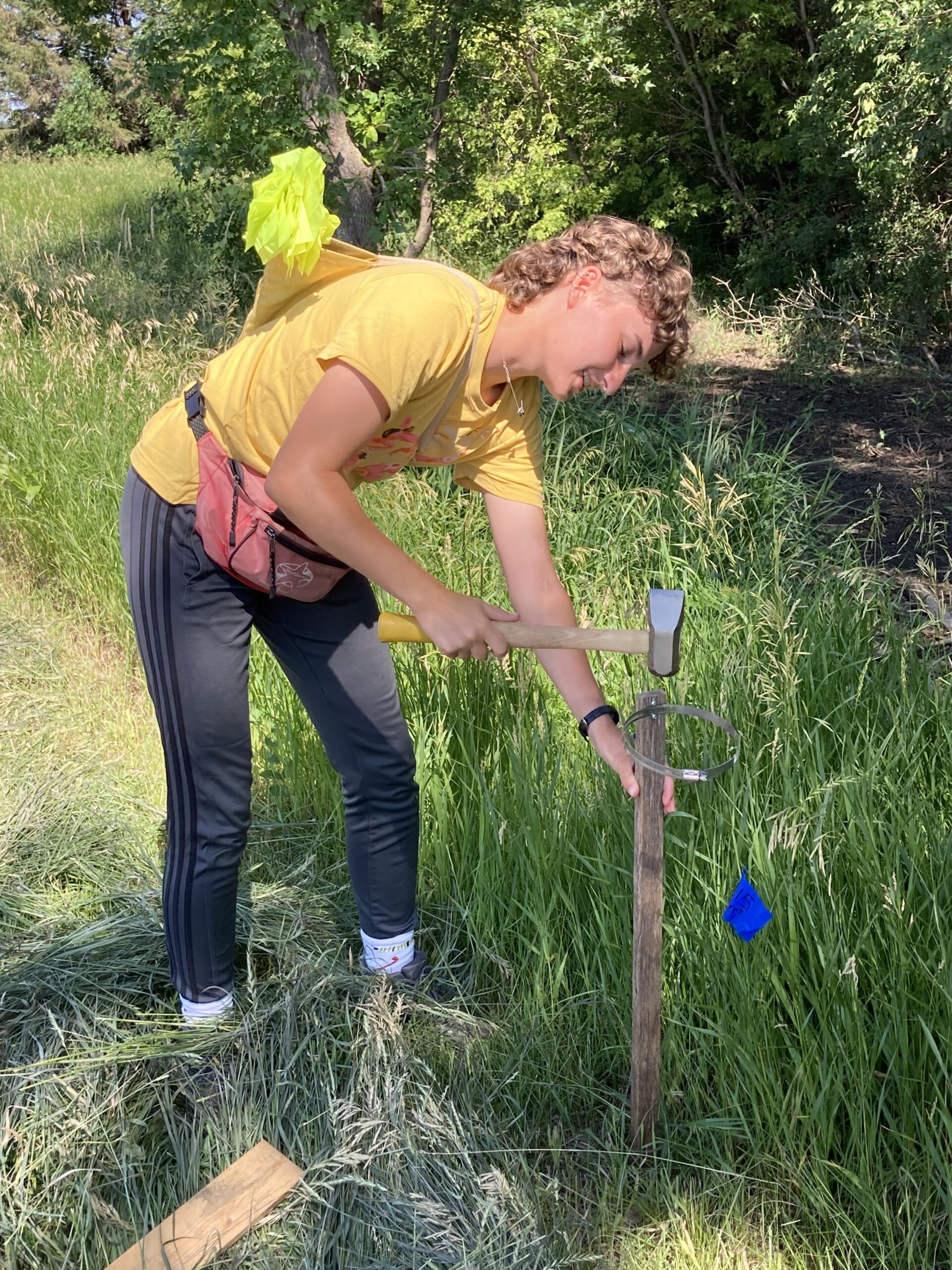
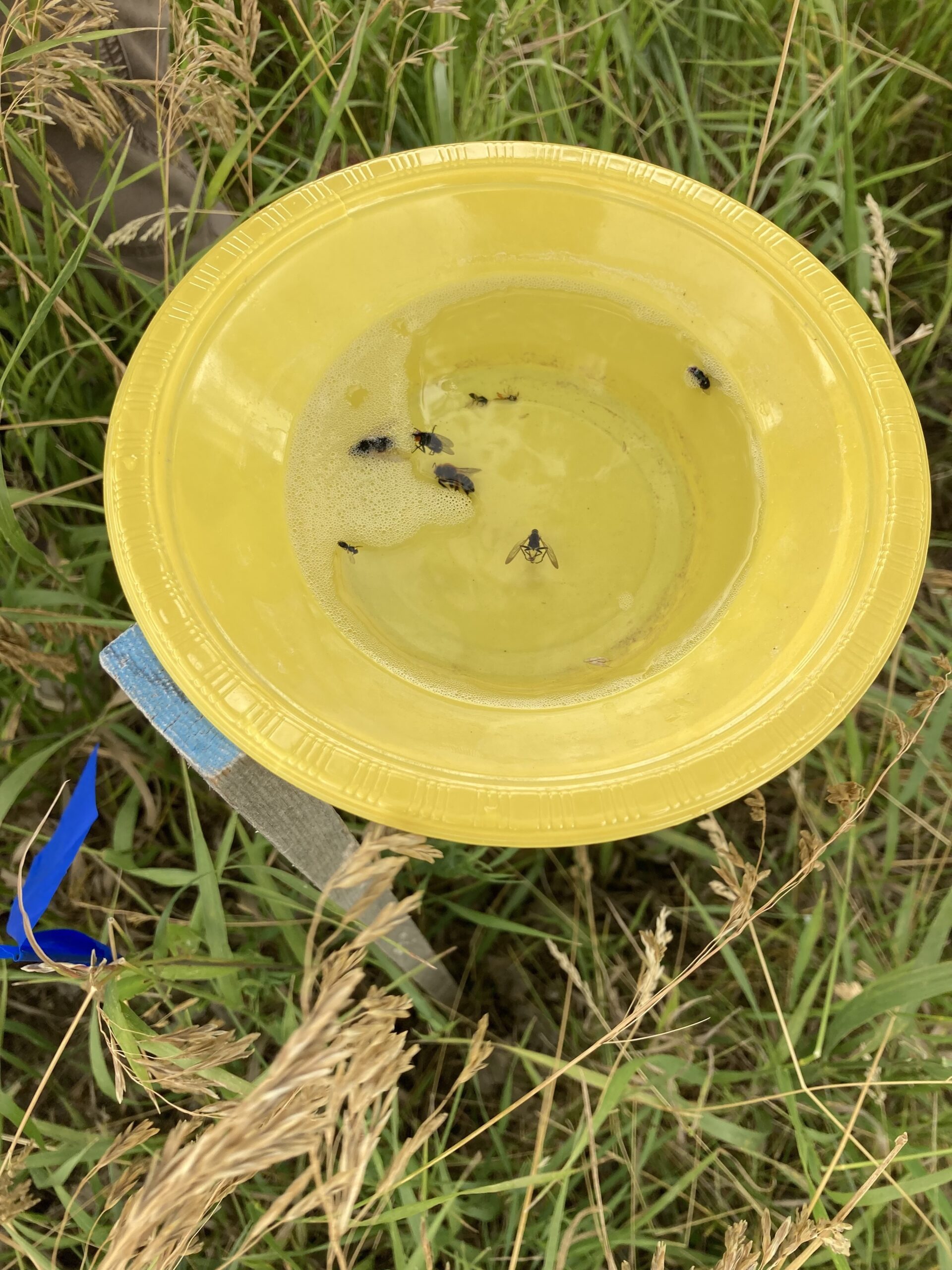
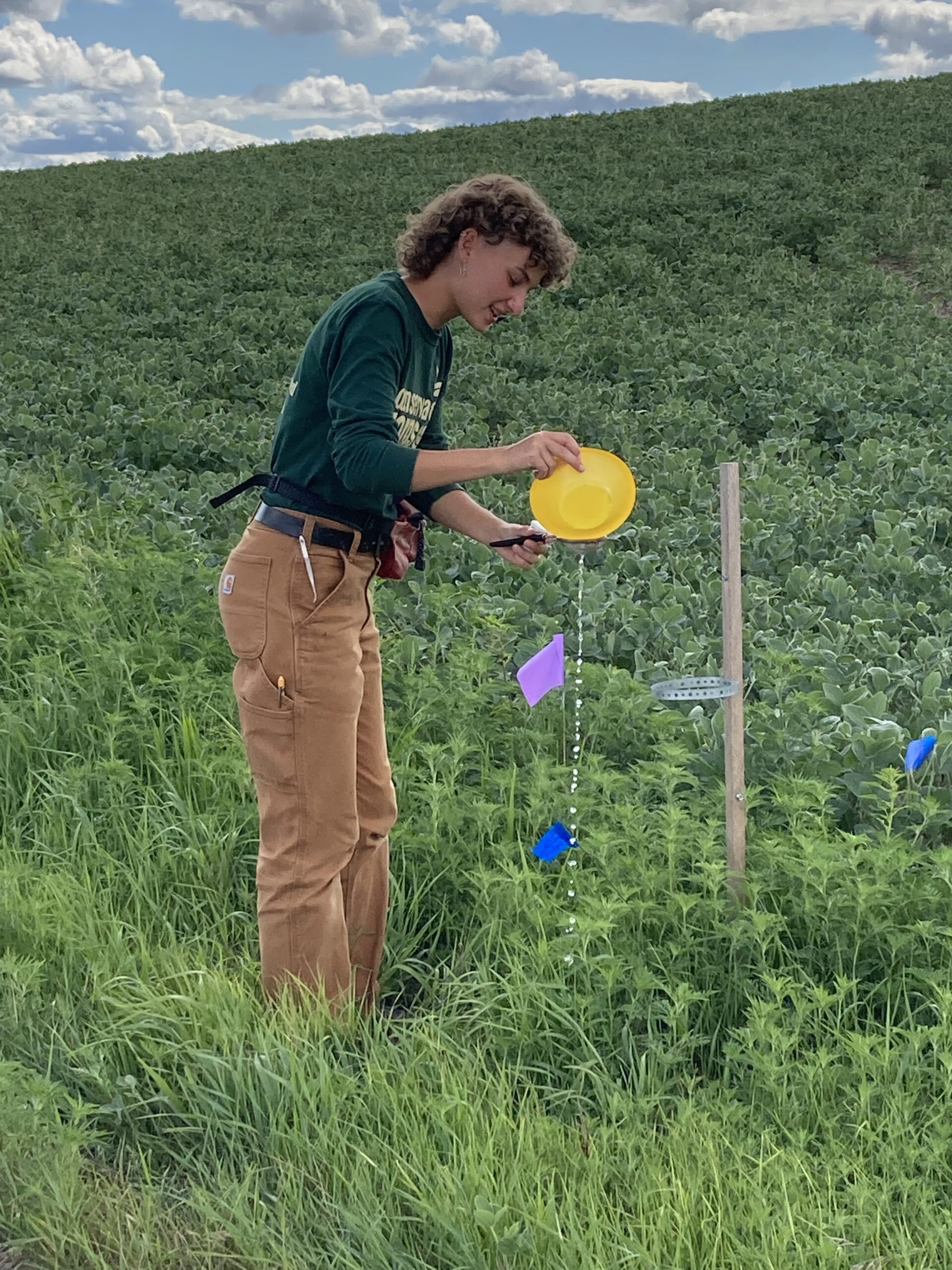
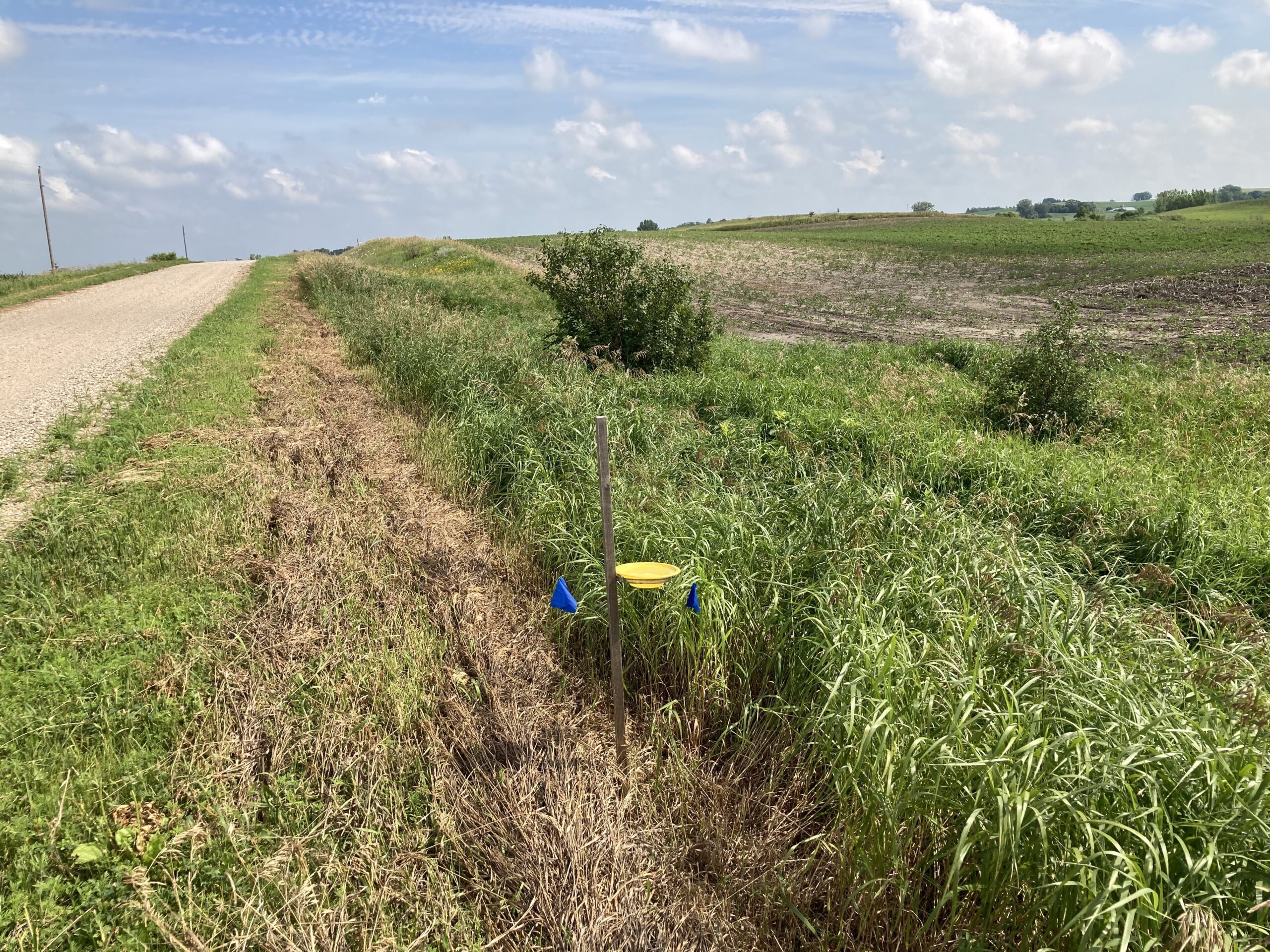
In summer 2022, Team Echinacea installed pan traps at 39 of the 40 locations that were used in previous years. The traps were placed along roadsides in Solem Township, and Geena Zebrasky also surveyed the plant diversity surrounding each trap. Geena and Alex set out the traps 7 times during the summer, once per week starting on July 7th and ending on August 17th. We filled the yellow bowls with soapy water each morning starting at ~8:00 am and collected bees from the traps in the afternoon starting at ~4:00 pm. We strained the bees through a sieve and stored them in vials filled with 70% ethanol. Over the summer, we collected seven coolers full of vials, which are now stored in the freezer in Illinois.
Geena installs a pan trapDelicious bee and fly soupGeena strains out the beesA pan trap awaits bee visitors
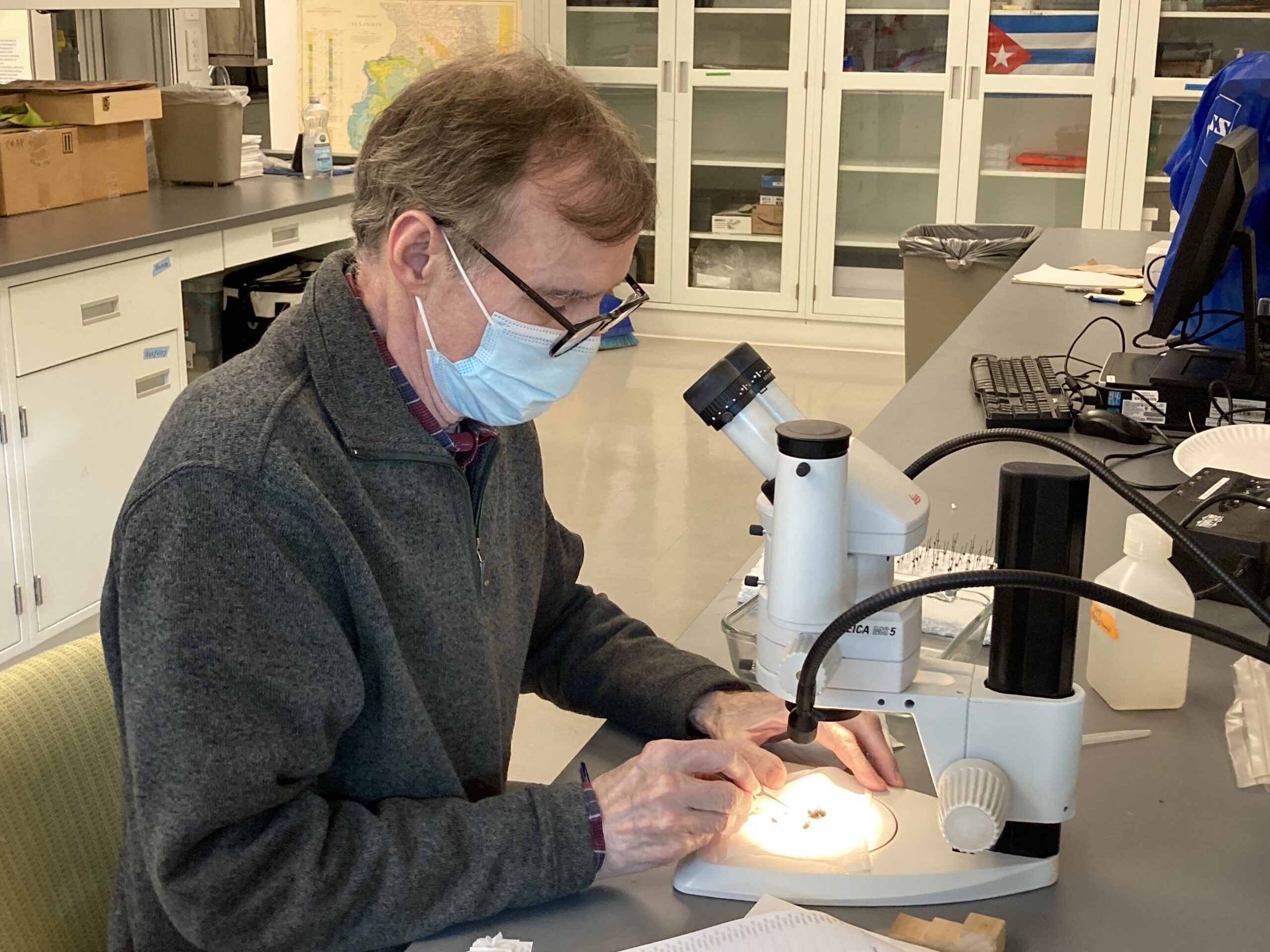
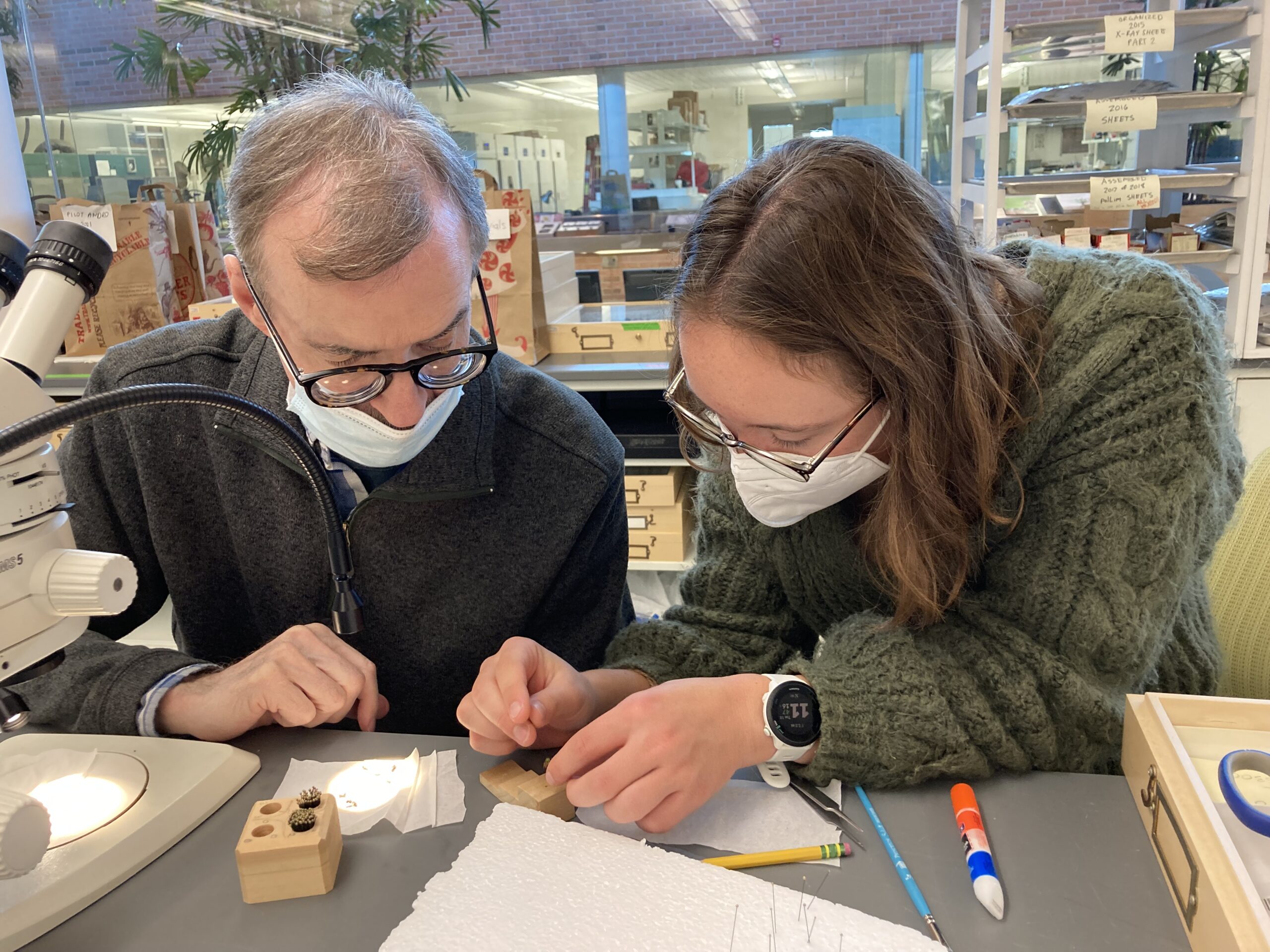
At the lab, volunteer Mike Humphrey has been pinning the bees that we collected during the summer. So far, Mike has emptied three of the seven coolers, and he has pinned 420 specimens from 90 vials. Each specimen is assigned a specimen id number (SPID), which started with SPID 20001 this year. In previous years, we glued tiny bees to point mounts, but this year we are gluing them directly to a #2 pin based on a recommendation by Zach Portman, the bee taxonomist at the University of Minnesota.
Last winter, we sent Zach the insects that had been collected in 2004, 2017, 2018, and 2019, and he identified the bees to species. Over the 4 years, we caught 1,901 bees from 76 different species!
The next steps are to finish pinning the bees from summer 2022, add descriptive specimen labels, and send the bees to Zach for identification. Mia and Alex are working on a bee community analysis and a landscape analysis.
Mike separates bees from flies under the microscopeMike and Lindsey pin bees
Start year: 2004, rebooted in 2017
Location: Roadsides and ditches around Solem Township, Minnesota. GPS coordinates for each trap are located here: ~Dropbox\teamEchinacea2022\YPTsummer2022\yptTrapLocations2022.csv
Data collected: All YPT data can be found in ~Dropbox\ypt2004in2017
Pinning datasheets are located here: ~Dropbox\ypt2004in2017\YPT2022
Zach’s species identifications are located here: ~Dropbox\ypt2004in2017\yptDataAnalysis2022\speciesIdDataEntryBySpidVerified.csv
Field datasheets from summer 2022 are located here: ~Dropbox\ypt2004in2017\YPTsummer2022
Specimens collected:
Bees collected in summer 2022 were stored 7 coolers of vials. Mike has pinned bees from coolers 1-3, and these specimens are labeled with SPIDs and stored in a case in the lab. Cooler 4 is in the freezer at CBG, and Stuart has coolers 5-7.
Zach Portman identified all specimens from 2004-2019, and the specimens are stored in eight cases at the CBG lab.
Team members involved with this project: Geena Zebrasky (2022), Mia Stevens (2020-2023), Alex Carroll (2021-2023), Erin Eichenberger (2019-2020), Anna Stehlik (2020), Shea Issendorf (2019), Mike Humphrey (2018-2021), John Van Kampen (2018-2019), Kristen Manion (2017-2018), Evan Jackson (2018), Alex Hajek (2017), and Steph Pimm Lyon (2004)
Funding for this project was provided by the Minnesota Environment and Natural Resources Trust Fund as recommended by the Legislative-Citizen Commission on Minnesota Resources (LCCMR). The Trust Fund is a permanent fund constitutionally established by the citizens of Minnesota to assist in the protection, conservation, preservation, and enhancement of the state’s air, water, land, fish, wildlife, and other natural resources. Currently 40% of net Minnesota State Lottery proceeds are dedicated to growing the Trust Fund and ensuring future benefits for Minnesota’s environment and natural resources.
You can read more information about the pollinators on roadsides project here.
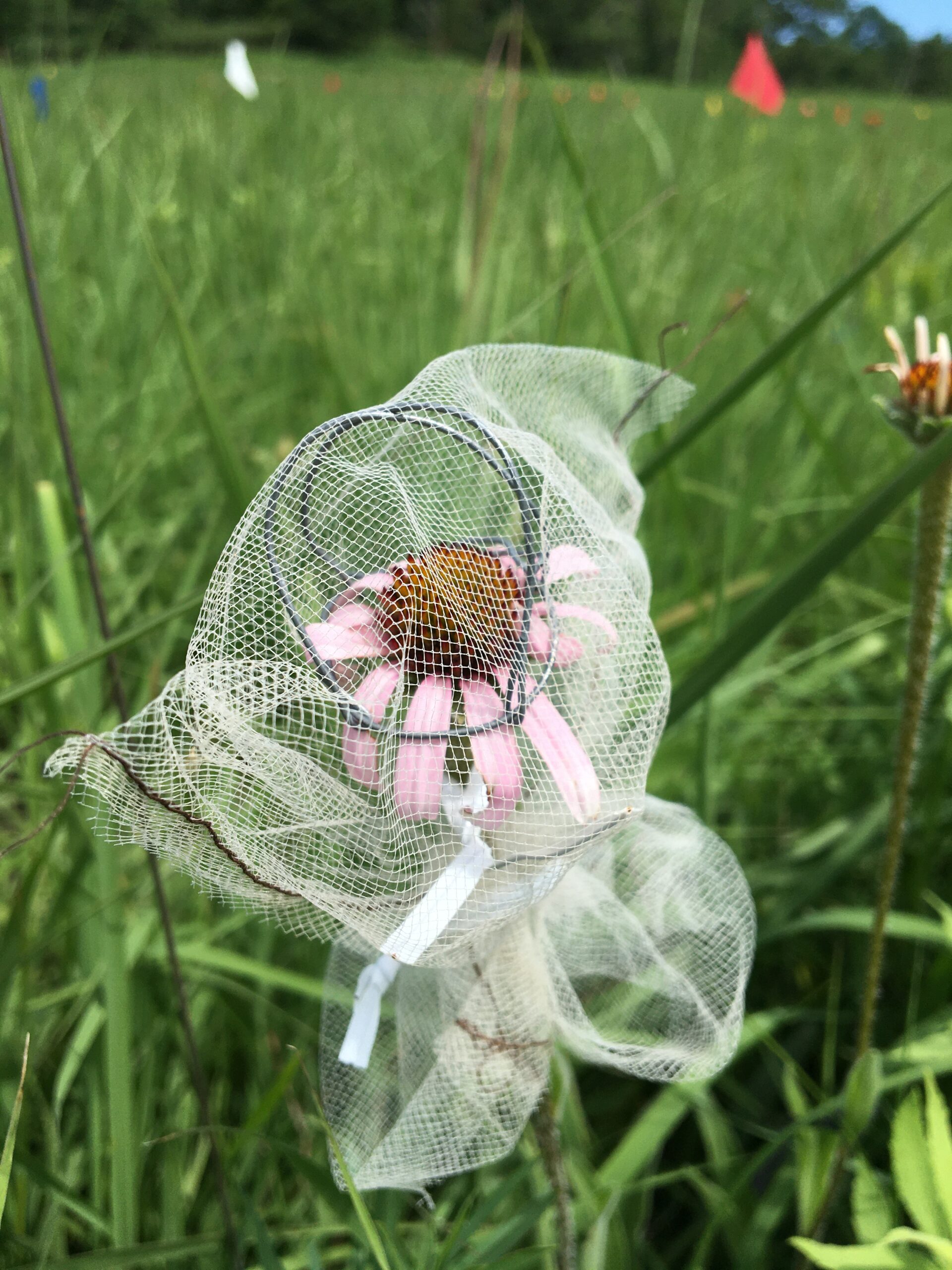
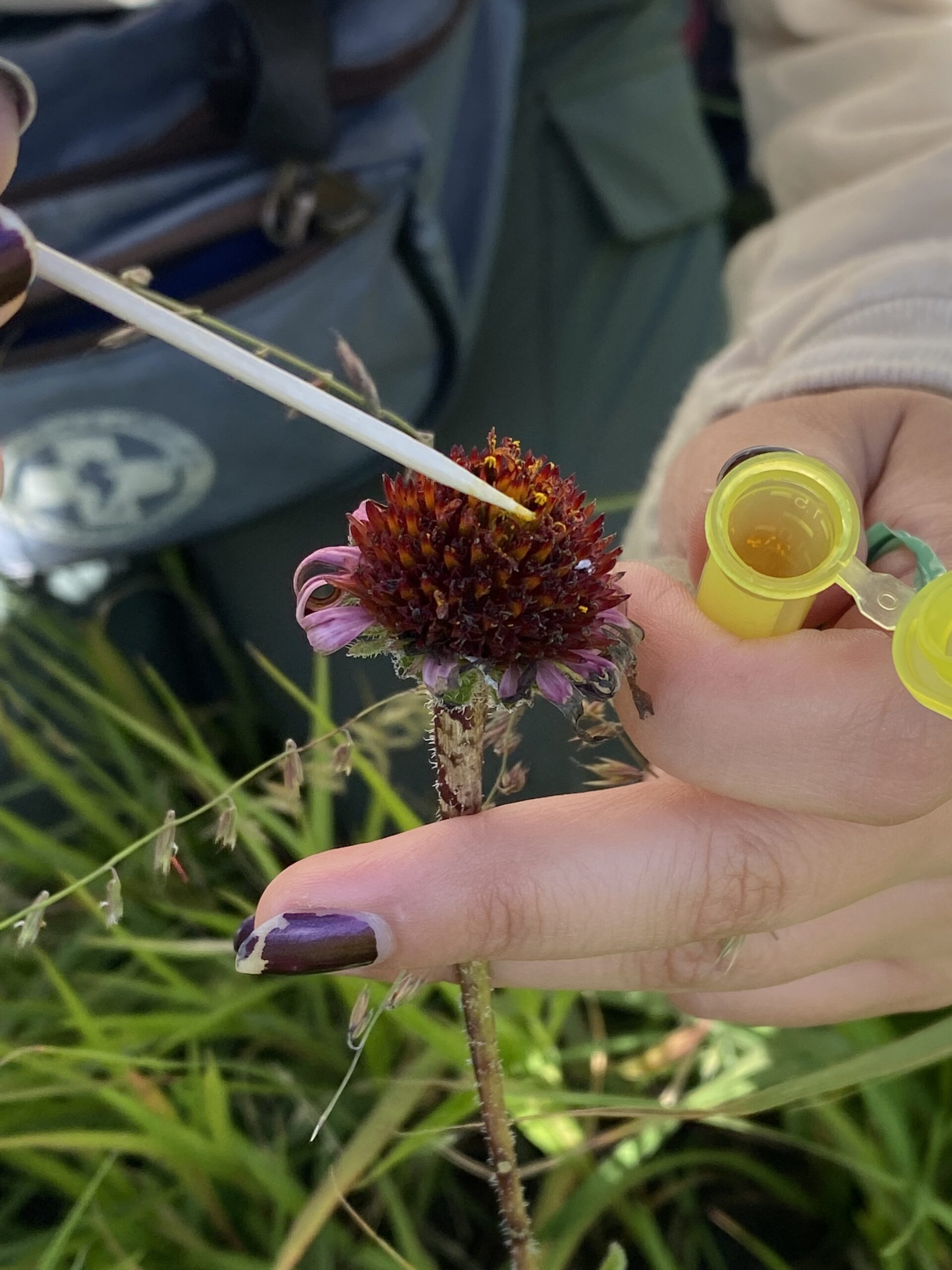
Reproduction in plants can be limited by access to pollen and resources. We previously found that Echinacea plants in the remnants are pollen limited, meaning that if they had access to more pollen, they would produce more seeds. However, the long-term effects of pollen limitation are unknown. Do plants that are super pollen saturated and have high amounts of pollen have a higher lifetime fitness than plants that are pollen limited? Also, we know that the plants in the remnants are pollen limited, but are the plants in the common garden environment also pollen limited? To answer these questions and more, 10 years ago Gretel randomly selected 38 plants from experimental plot 1; half of these plants were randomly assigned to the pollen addition group, and the others were assigned to pollen exclusion. Every year, plants in the pollen exclusion have their heads bagged and they are not pollinated, while we hand cross every style in the pollen addition group (See photos for reference).
In the summer of 2022, 24 of the original 38 plants were found to be living. 6 plants of the addition group were flowering with a total of 17 heads. They received hand pollination throughout their flowering time. 6 plants of the exclusion group were flowering and they received pollinator exclusion bags to remain un-pollinated during their flowering time.
Start year: 2012
Location: exPt 1
Specimens collected: 64 heads were harvested from the addition, exclusion and control group in the 2022 field season.
Data collected: Plant survival and measurements were recorded as part of our annual surveys in P1 and eventually will be found in the R package EchinaceaLab. Data sheets were scanned and entered and can be found here: “~/Dropbox/CGData/115_pollenLimitation/pollenLimitation2022”
You can find more information about the pollen addition and exclusion experiment and links to previous flog posts regarding this experiment at the background page for the experiment.
A pollen exclusion plant with a pollinator exclusion net from the pollen exclusion group. These plants wear crowns 👑Sophia conducting hand pollination on one of the plants in the addition group.
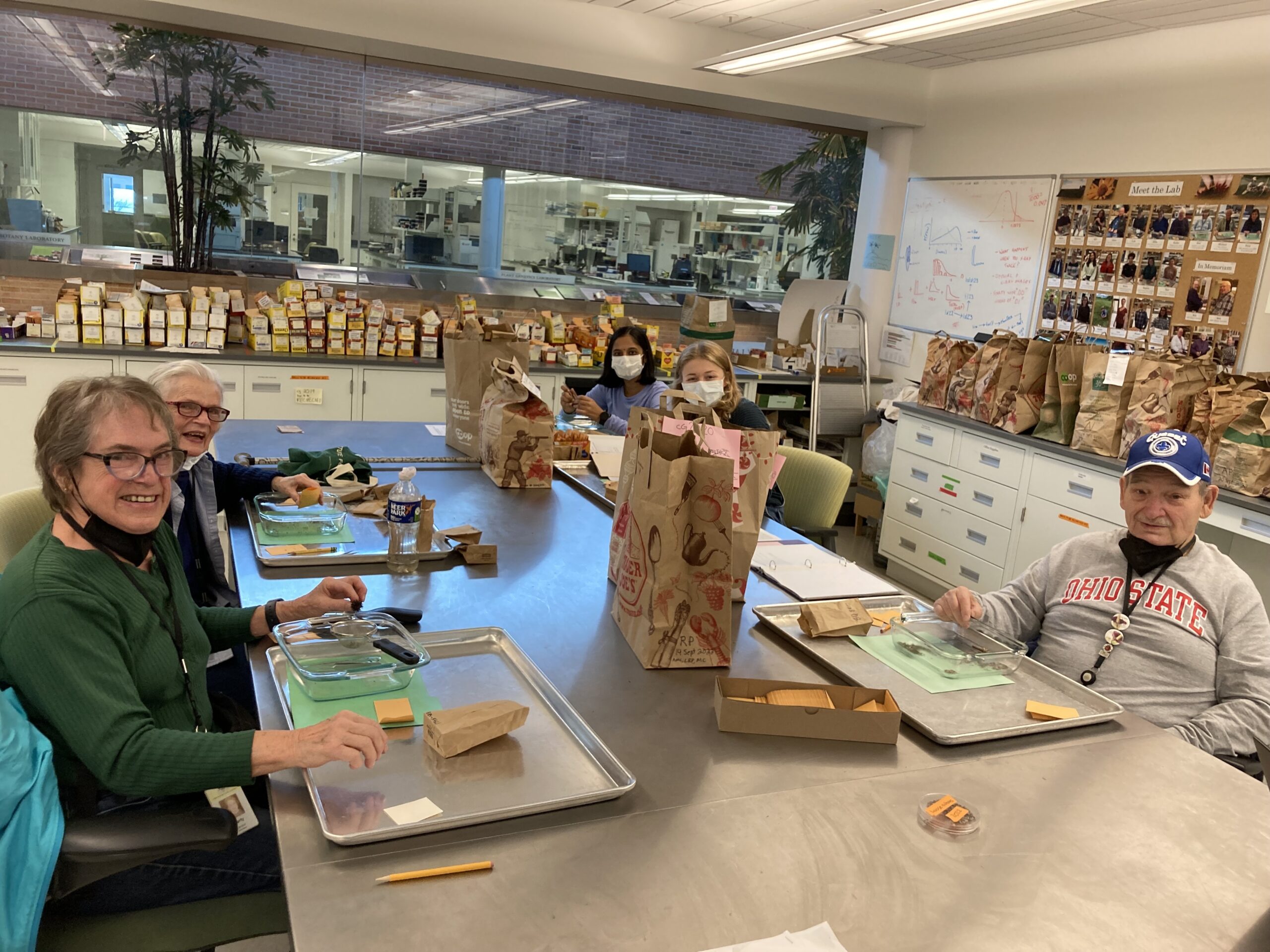
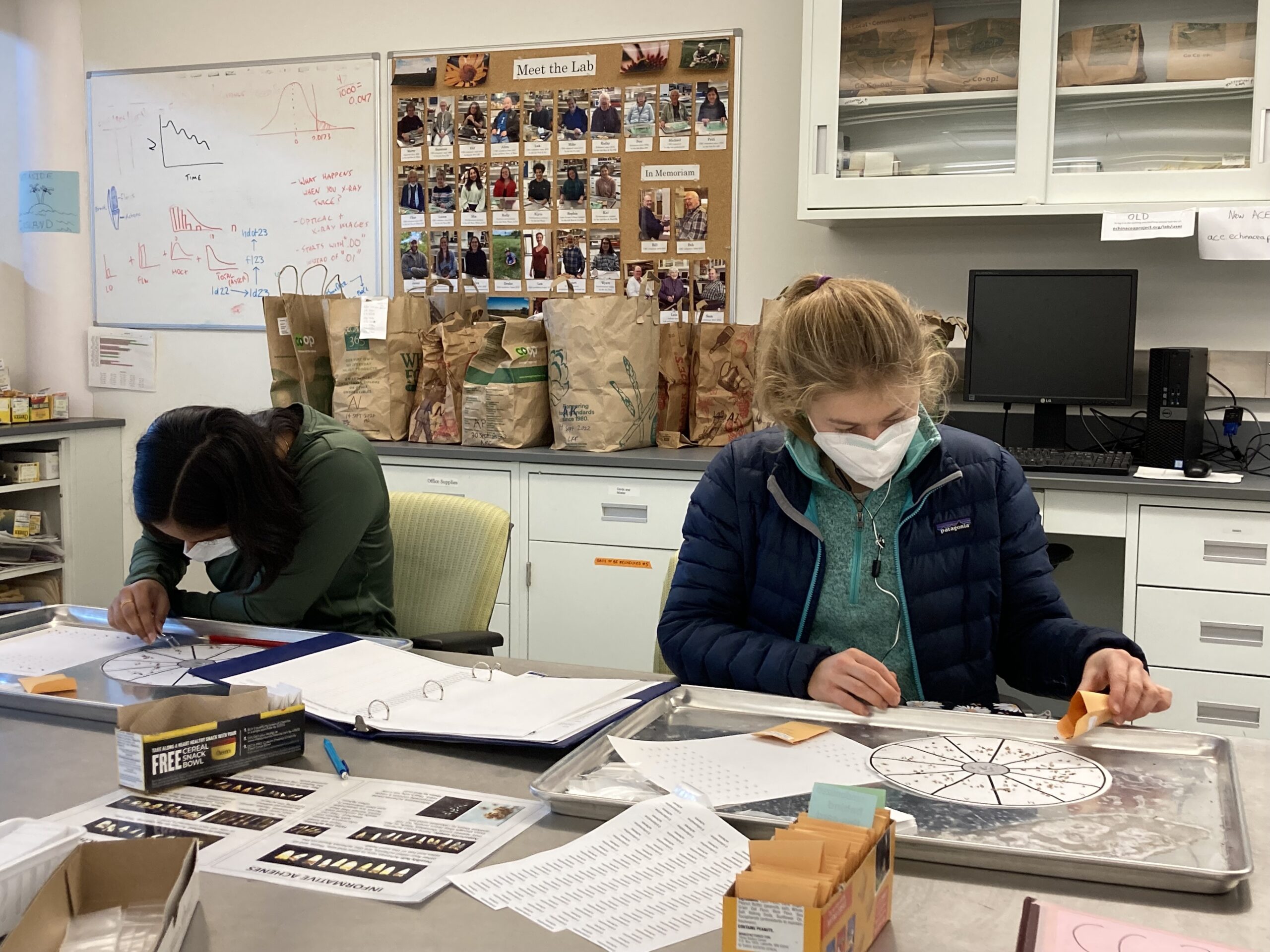
Today is the last day of our externship. As an extern, I learned about the entire process of data collection and analysis for the Echinacea project. I worked through the workflow of processing the heads that were collected in the summer and then separating achenes, counting them, creating a random sample, x-raying, and classifying to determine whether achenes had a seed inside (were pollinated).
Working on cleaning!Here are me and Caroline randomizing achenes
With all of the data that we helped collect, we got to pick and explore a question from 3 years of data of ~32 prarie remnants. I decided to work with paired samples (looking at the same plant over two years) rather than looking at the entire data set (or a population), which resulted in around 11 sites to analyze. Comparing paired samples is interesting, because they control for site, isolation, and other differences. With the pairs, I looked at whether burning influences reproduction.
Three aspects of reproduction- achene count, head count, and seed set interested me, because they all are extremely important to how many seeds are developed. Achene count did not change between burned and unburned years. Head count and seed set show some evidence (not statistically significant, but really close to it) that they potentially change between burned and unburned years. It is interesting that head count shows some differences, because I was a bit unsure whether it would change, as either genetic or environmental factors could play a role.
For more information and graphs related to my question and data analysis, here are my slides for the presentation that I gave today:
We also got to meet other people who work at Chicago Botanic Garden, walk around and enjoy the garden, get a tour of the production greenhouses, see the exhibition greenhouses, and watch presentations of other researchers at CBG. All of these experiences were helpful, and interesting to consider with doing research.
Overall, the externship has been a great experience. I learned a lot about using workflows, organizing work, writing and presenting work, the research process, asking and answering research questions, and more. In the future, I look forward to exploring more of science and research, whether with prairie organisms or elsewhere.
During the three weeks of my externship with the Echinacea Project, I am grateful to have learned about the steps used to process data in this lab and about the scientific process more broadly. I spent the majority of my time with the Echinacea Project practicing lab techniques that make it possible to answer critical ecological questions using Echinacea. While learning about data processing, I was supported in creating my own research question and hypothesis that I was able to analyze with data and the knowledge I gained about prairie ecosystems. Here is a photo of Padmini and I randomizing!
I learned how to analyze data with R and make graphs that helped me visualize the data and the relationships between remnant area size, isolation plants, and seed set. I used statistical tests to assess the strength of relationships between these factors in order to draw conclusions from the data pertaining to conservation of echinacea and other prairie species who use similar systems.
I wanted to investigate how pollination is impacted by the degree of isolation of plants and remnant size. My research questions were if isolation or remnant size impacts seed set, and which is a better indicator of seed set. My null hypothesis was that neither isolation nor remnant size impacts seed set. I predicted that a larger area would correlate with a higher seed set and that higher isolation would result in a lower seed set.
I found that the number of flowering heads correlates with a higher seed set, however neither the area size nor the degree of isolation had a significant effect on the seed set. These results suggest that the proximity of flowering heads is more important than how large the remnant is. Many of the remnants are close together, and pollinators likely travel between remnants and move pollen between flowers at different remnants. Therefore, measuring isolation only within remnants does not take the full context into account. Here are my slides:
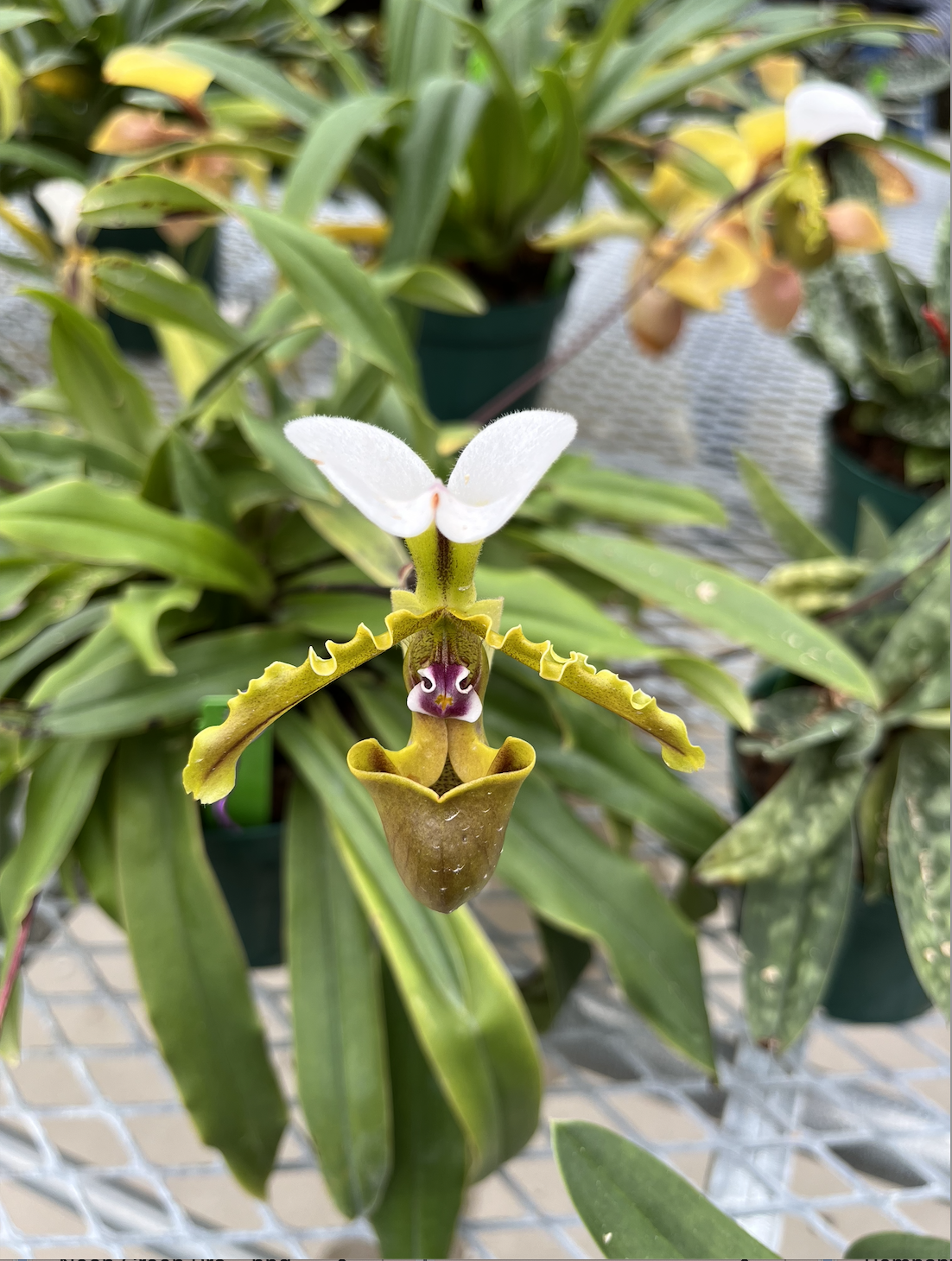
Other than my research project, some other highlights of my time at the Chicago Botanic Garden were meeting a variety of scientists and hearing about their projects and experiences. I particularly enjoyed seeing the production greenhouses and learning about the Plants of Concern Program. Here is one of my favorite orchids from the production greenhouse:
Location: Hegg Lake WMA. Start year: 2011. Echinacea pallida is a species of Echinacea that is not native to Minnesota. It was mistakenly introduced to our study area during a restoration of Hegg Lake WMA. Since 2011, Team Echinacea has visited the pallida restoration, taken flowering phenology, and collected demography on the non-native plant. We have decapitated all flowering E. pallida each year to avoid cross-pollination with the local Echinacea angustifolia. Each year, we record the number of heads on each plant and the number of rosettes, collect precise GPS points for each individual, and cut off all the heads before they produce fruits. This year, we cut E. pallida heads off on June 28th. Overall, we found and shot 224 flowering E. pallida plants, and 824 heads in total, averaging 3.7 heads per plant. These non-native plants were hearty with an average rosette count of 8 rosettes and an individual with a maximum of 65 rosettes! We did not take phenology data on E. pallida this year.
You can find more information about E. pallida flowering phenology and previous flog posts on the background page for the experiment.
Location: near exPt8. Start year: Crossing in 2011, planting in 2012Experimental plot 6 was the first E. angustifolia x E. pallida hybrid plot planted by Team Echinacea. A total of 66 Echinacea hybrids were originally planted. All individuals have E. angustifolia dams and E. pallida sires. In 2022, we visited exPt06 on June 27th visited 28 positions and found 18 living plants. No plants have flowered in this plot yet.
You can find more information about experimental plot 6 and previous flog posts about it on the background page for the experiment.
Location: Hegg Lake WMA. Start year: Crossing in 2012, planting in 2013. Experimental plot 7 is the second E. pallida x E. angustifolia plot. It contains conspecific crosses of each species as well as reciprocal hybrids, totaling 294 individuals. This summer, we visited 215 positions, and of these plants, only 119 plants were still alive. When measuring, we put pollen exclusion bags over every flowering head. There were 28 flowering plants this year, which is the most flowering plants in this plot to-date. From these 28 flowering plants, we harvested 28 heads. We have not yet used the pedigree data to see what number of these plants are hybrids or not.
You can find more information about experimental plot 7 and previous flog posts about it on the background page for the experiment.
Location: Hegg Lake WMA. Start year: 2014. Experimental plot 9 is a hybrid plot, but, unlike the other two hybrid plots, we do not have a perfect pedigree of the plants. That is because the E. angustifolia and E. pallida maternal plants used to generate seedlings for exPt9 were open-pollinated. We need to do paternity analysis to find the true hybrid nature of these crosses (assuming there are any hybrids). There were originally 745 seedlings planted in exPt9. We searched at 361 positions and found 247 living plants in 2022. When measuring, we placed pollen exclusion bags over every flowering head. Of these individuals, 49 were flowering. We harvested 109 heads from this plot!
You can find out more information about experimental plot 9 and flog posts mentioning the experiment on the background page for the experiment.
Data collected for exp679: For all three plots, we collected flowering status, rosette count, leaf length, head count and head height. All measuring data can be found in the cgdata repository (~/cgdata/summer2022/measureGood). Measuring data should be uploaded to SQL database eventually, but it is not currently there for 2022. For experimental plots 7 and 9, we also took phenology data periodically through the summer starting on June 24th and ending on August 5th, which can be found in the cgdata repository (~cgdata/summer2022/p79phenology).
Data collected for E. pallida demography: Demography data, head counts, rosette counts, GPS points shot for each E. pallida. Find demo and surv records aiisummer2022 repository. GPS coordinates can be found in demap.
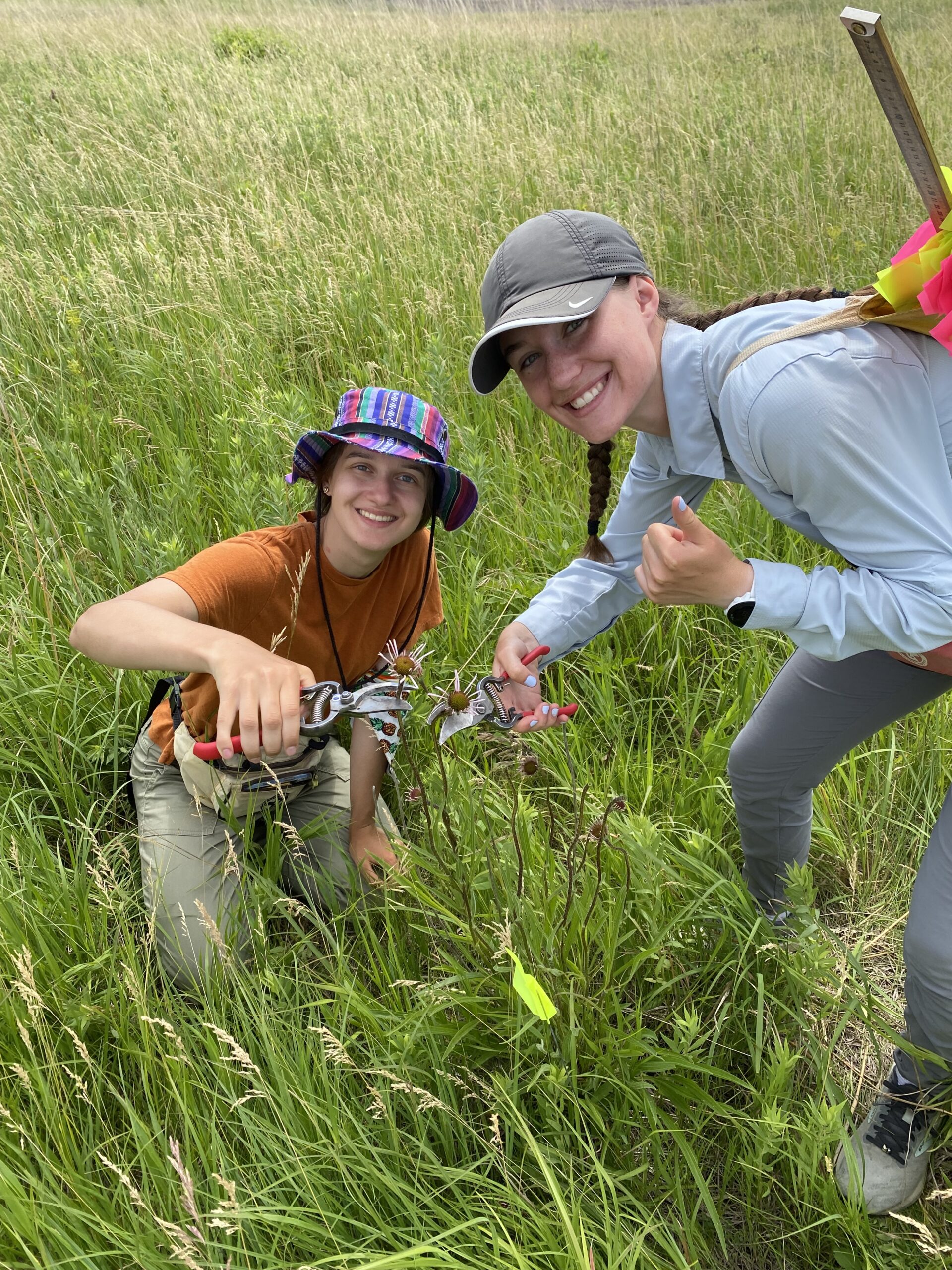
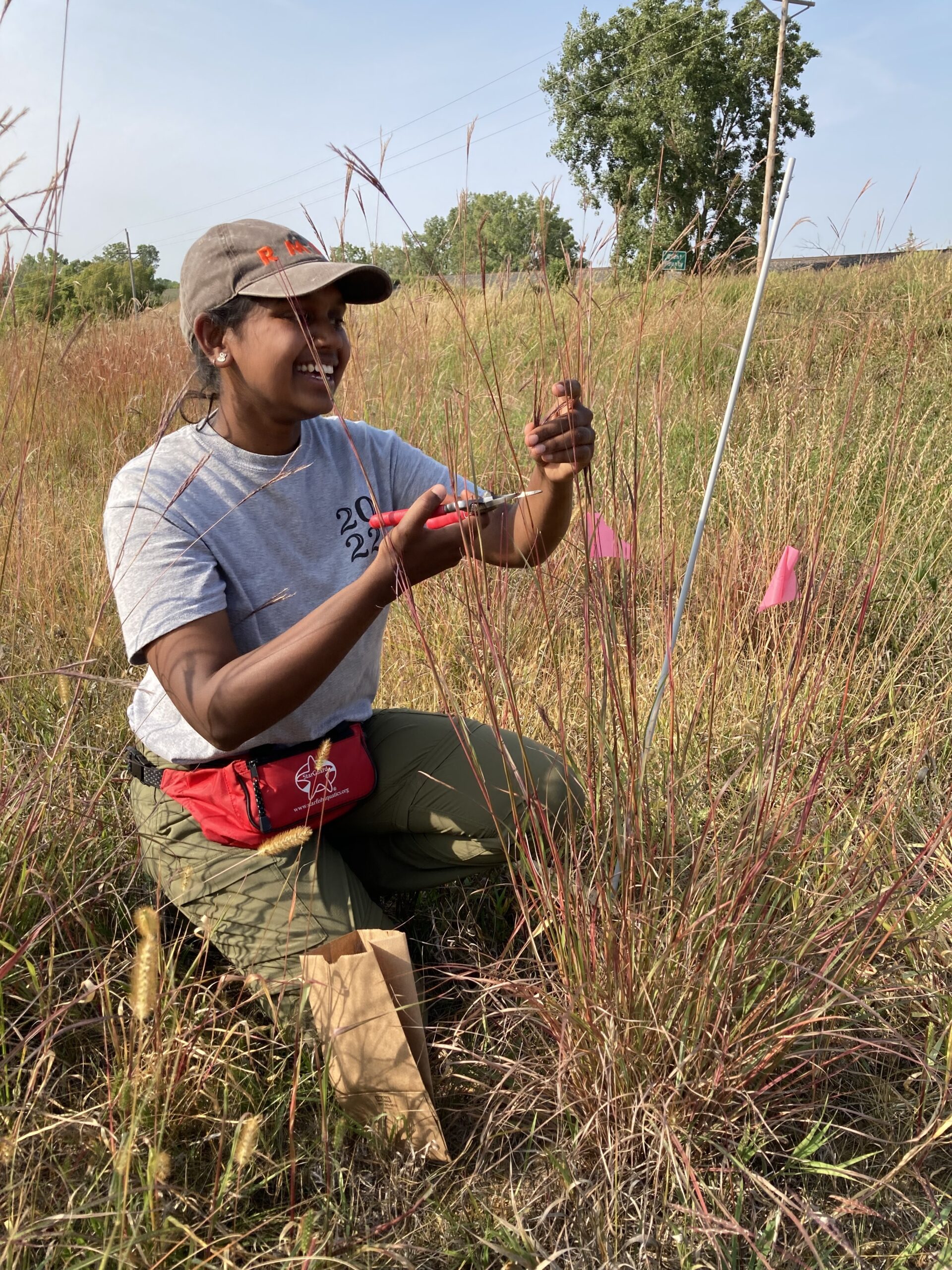
In late summer 2021, we began collecting data in remnant patches of prairie to quantify fire effects on the reproduction of Big Bluestem (Andropogon gerardii). In summer 2022, we revisited the same 378 random points across 27 remnant patches and counted the number of flowering Andropogon culms rooted within 1 m of the random point. Across the 378 plots, we counted 2442 culms. The highest density we observed was 197 culms in one plot at Loeffler Corner West, which beats our record from last year, 163 culms at KJs.
We also collected seed heads from all culms within 1 m of the random points to x-ray and quantify seed set. We initially visited random points on September 8, but some of the Andropogon was not ready to harvest, so we returned a few days later. We finished harvesting on September 19. In the lab, Elif has been developing a cleaning and x-ray protocol for Andropogon. Stay tuned for more details!
Manogya harvests Andropogon at Loeffler Corner West
Start year: 2021
Location: Patches of remnant prairie in and around Solem Township, MN
Data collected: Field datasheets are located in Dropbox: ~burnRems\remAndro\fieldData2022\remAndro2022DataSheet.scanned.pdf. We still need to do data entry.
Samples or specimens collected: Seed heads collected during summer 2022 are currently in the seed dryer but will reside in Jared’s office. These samples will be cleaned, processed, and x-rayed to quantify seed set.
Products: Stay tuned!
You can read more about the Andropogon fire and flowering in remnants experiment, as well as links to prior flog entries about this experiment, on the background page for this experiment.
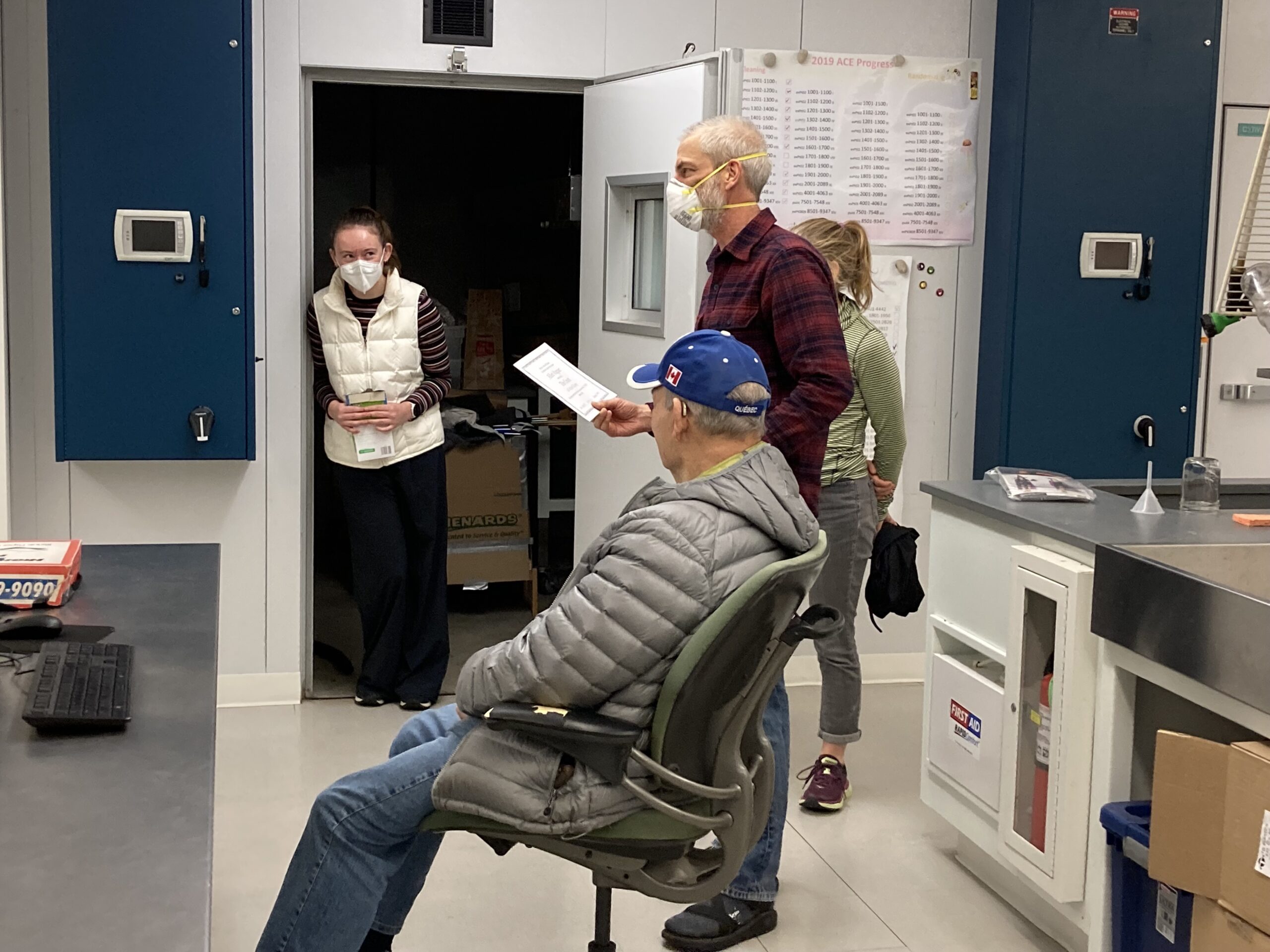
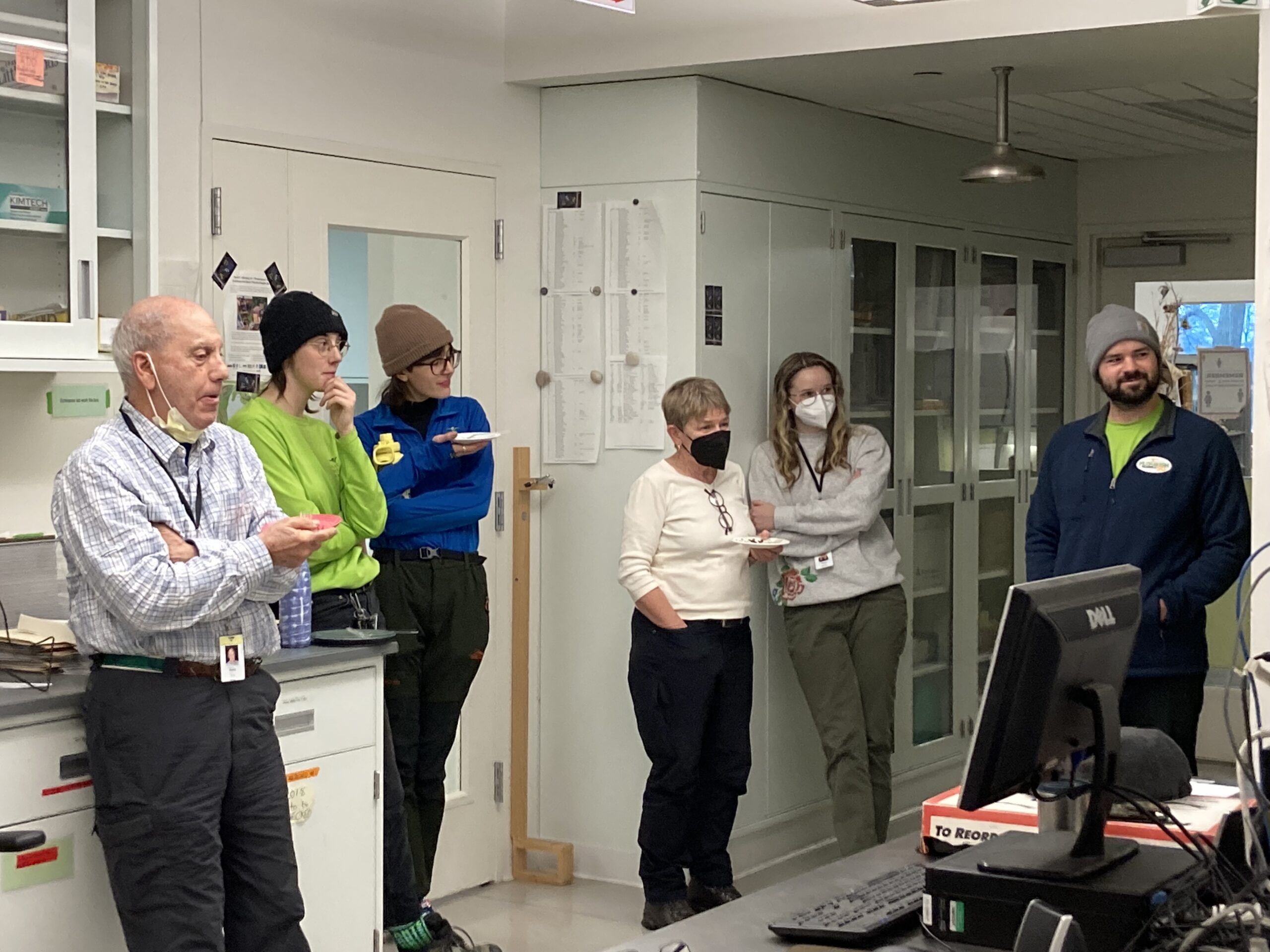
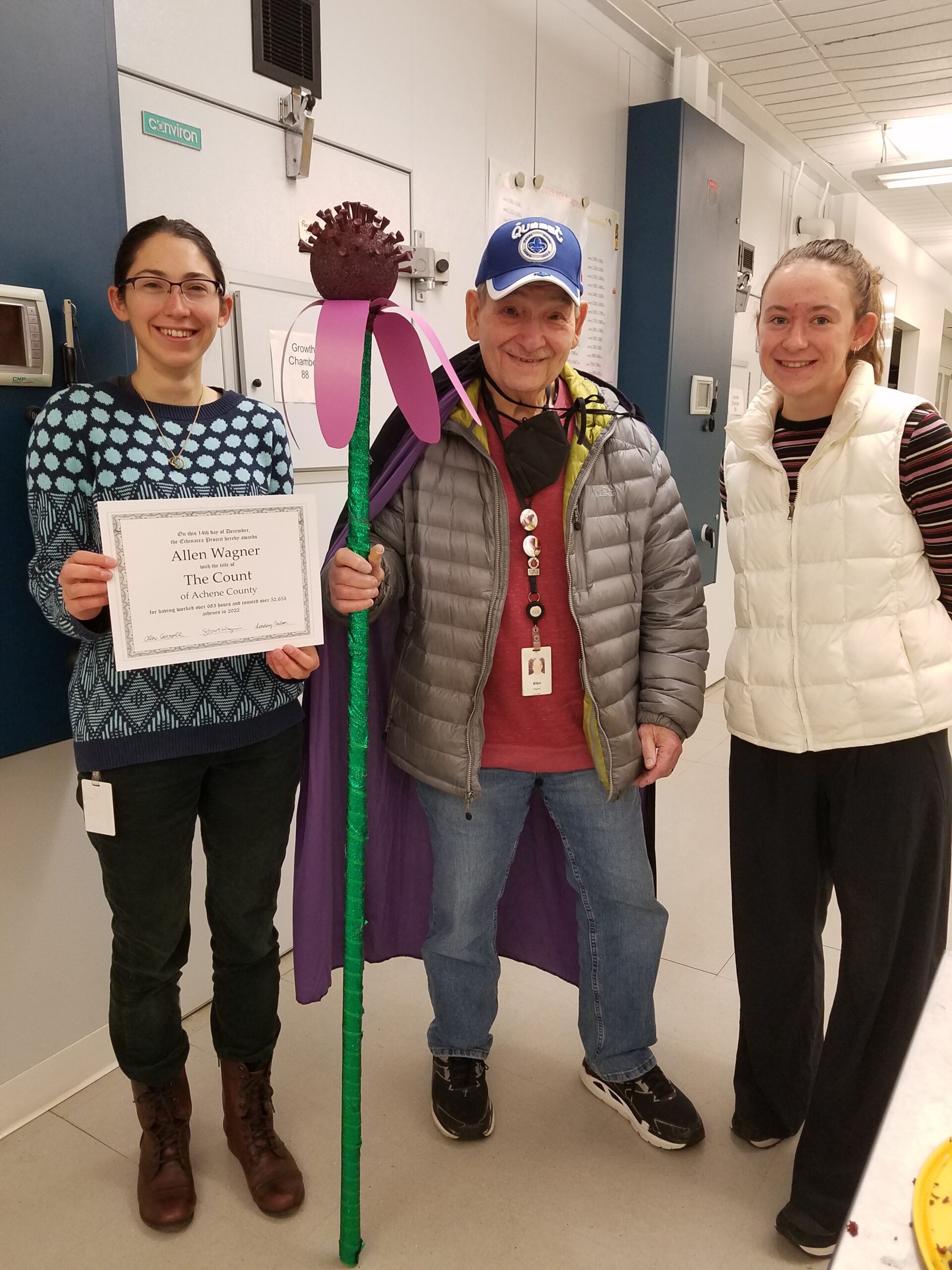
Hear ye, hear ye! On December 14th of 2022, members of Achene County celebrated volunteer Allen Wagner for his service. In 2022 alone, Allen has worked over 683 hours and counted over 52,653 achenes thus far. However, Allen has been an essential member of Team Echinacea for many years and has been a volunteer at the Chicago Botanic Gardens for 17 years! The celebration began with an official proclamation from Stuart, our town crier. Allen was given the honorific of “The Count of Achene County”.
Stuart, Achene County’s official town crier, alerting the town of the news.
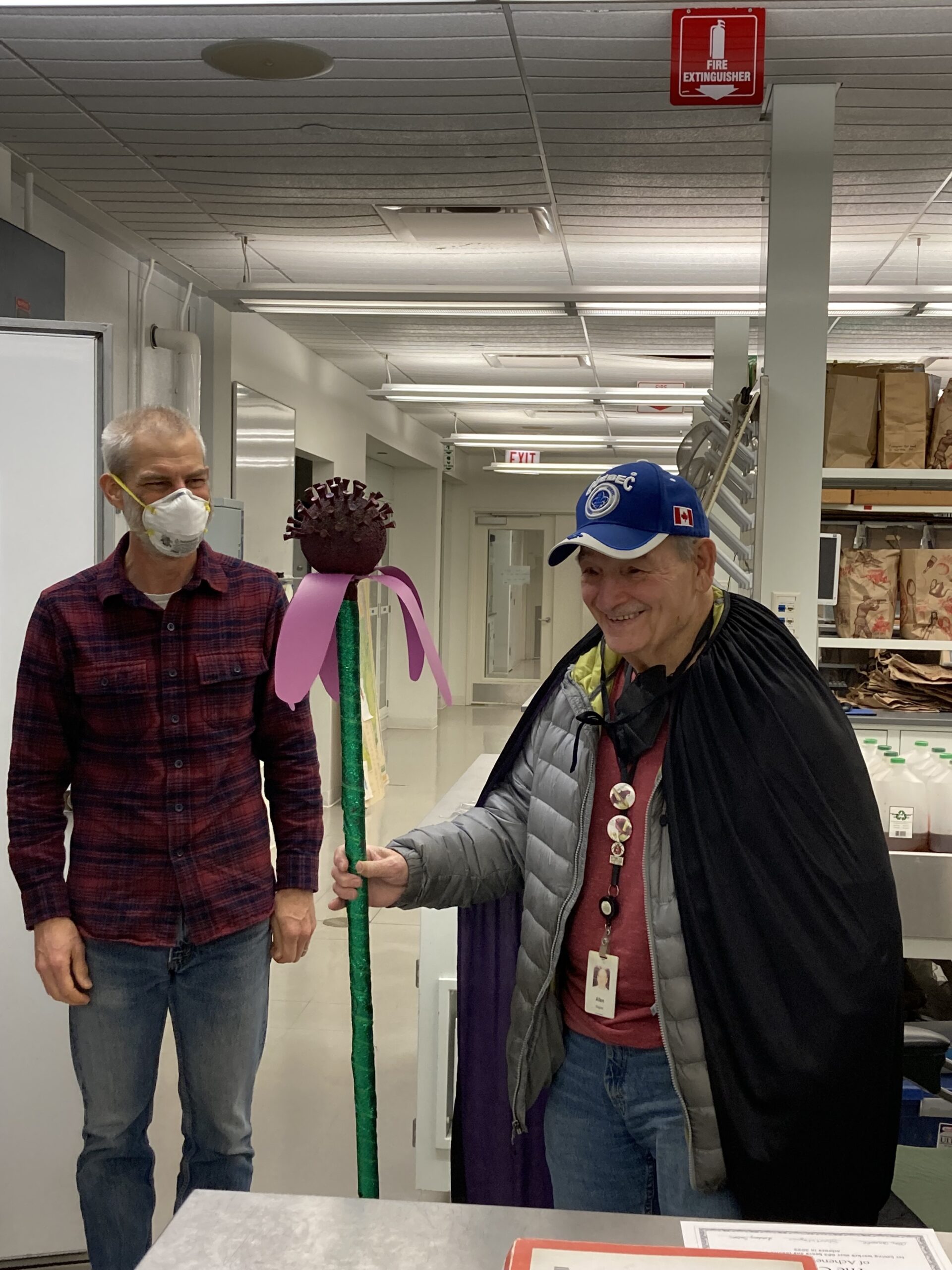
No noble is complete without their regal garb. Along with the title of “The Count”, Allen received his black and purple royal mantle and an all-powerful Echinacea scepter. Now everyone in the county will recognize our royal member.
Allen dressed for his new title.
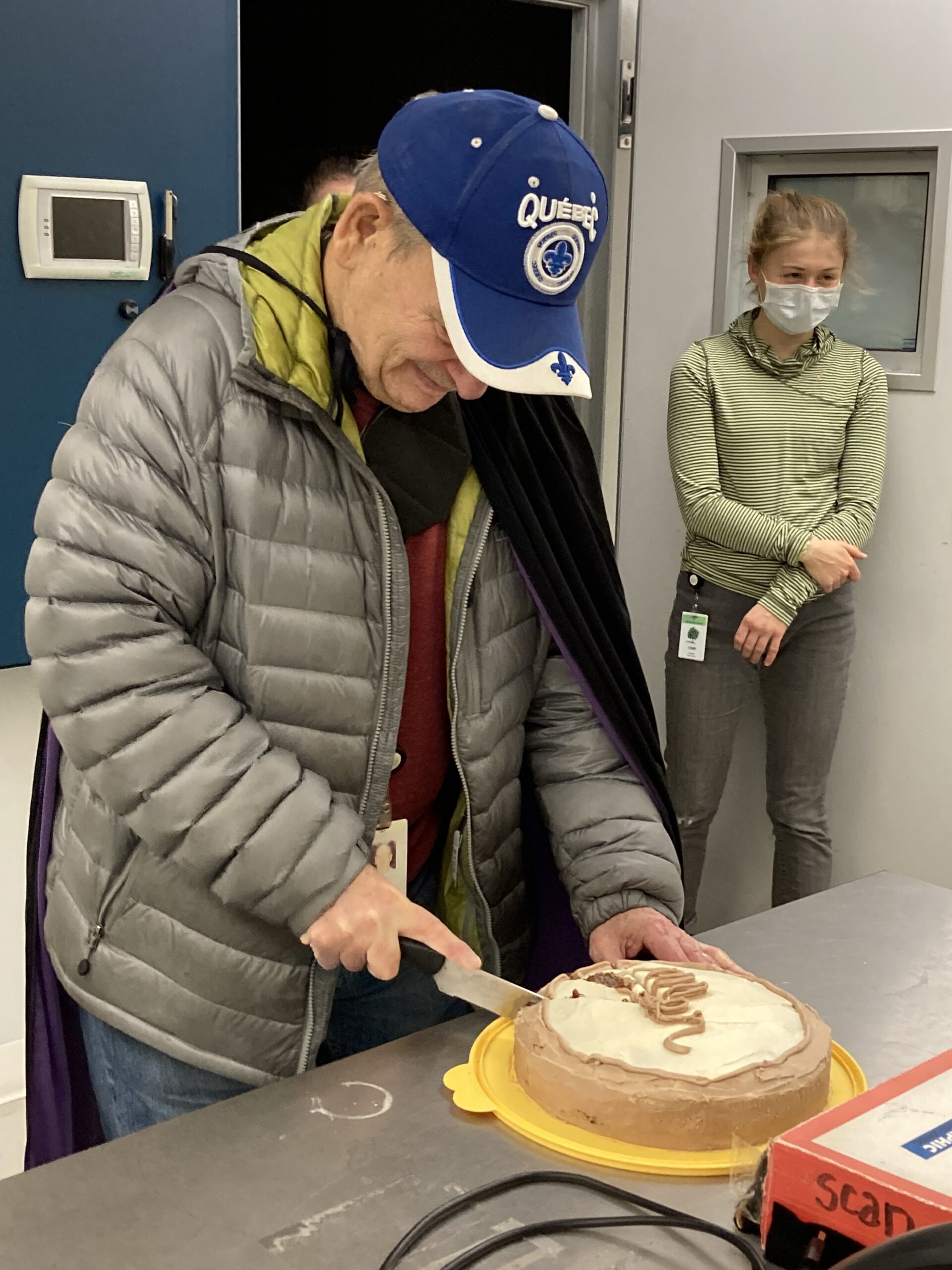
There was quite the crowd for this special coronation! All great celebrations involve some sweet treat, so Alex made a delicious chocolate cake for the occasion. The cake was frosted so when you cut it into slices, the slices looked like achenes!
The crowd gathers for the special day!Serving the Allen achene cake!
Allen is just one of the many volunteers who keep this village running. We are so thankful for all their hard work and dedication!
Alex, Allen and I (check out his official certificate!)
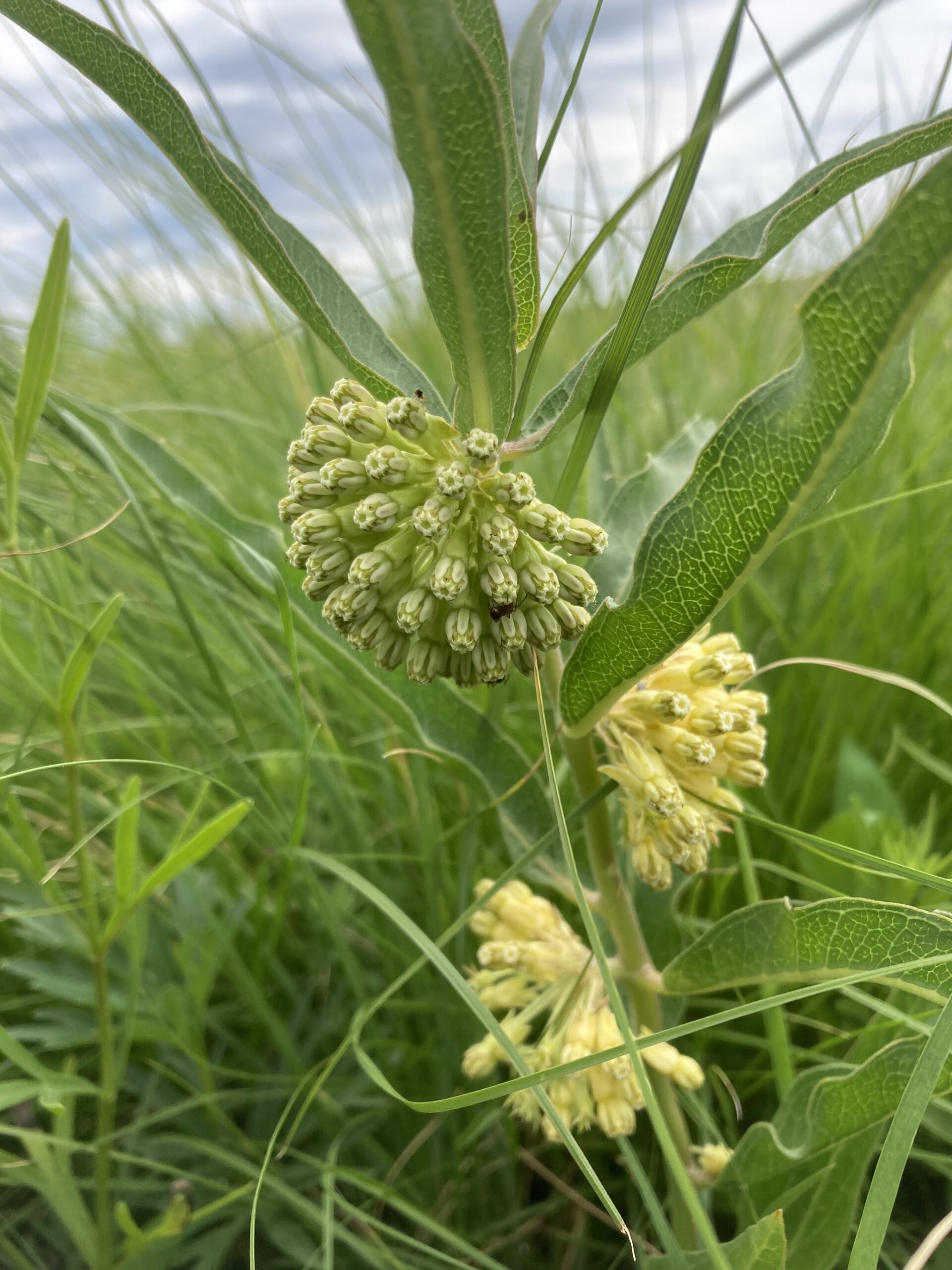
In summer 2021, Team Echinacea collected data on 70 Green Milkweed (Asclepias viridiflora) plants across 8 patches of remnant prairie in our study area in western MN. During summer 2022, we revisited these same individuals and found 58 additional plants. We collected demographic data on all 128 plants and harvested 52 seed pods. We will score ovules to quantify what proportion contain embryos, grow seedlings, and sow seed in western MN to propagate this species.
In addition to our reproductive and demographic work, we began collaborating with Mary Ashley and her group at the University of Illinois at Chicago to learn more about the genetic structure and mating patterns of green milkweed in fragmented prairie remnants. We collected tissue samples from 100 plants in the field. Mary’s research group is now extracting DNA and genotyping plants.
Start year: 2021
Location: Remnant patches of prairie in and around Solem Township, MN
Overlaps with:
Data collected: Spatial, demographic, and seed data are housed in the remav Bitbucket repository
Samples or specimens collected:
Seeds: 2022 harvest has been cleaned, counted, randomized, and X-rayed but still needs to be classified.
Tissue samples: tissue samples are at UIC
Products: Stay tuned!
You can read more about the Asclepias viridiflora demography, as well as links to prior flog entries about this experiment, on the background page for this experiment.
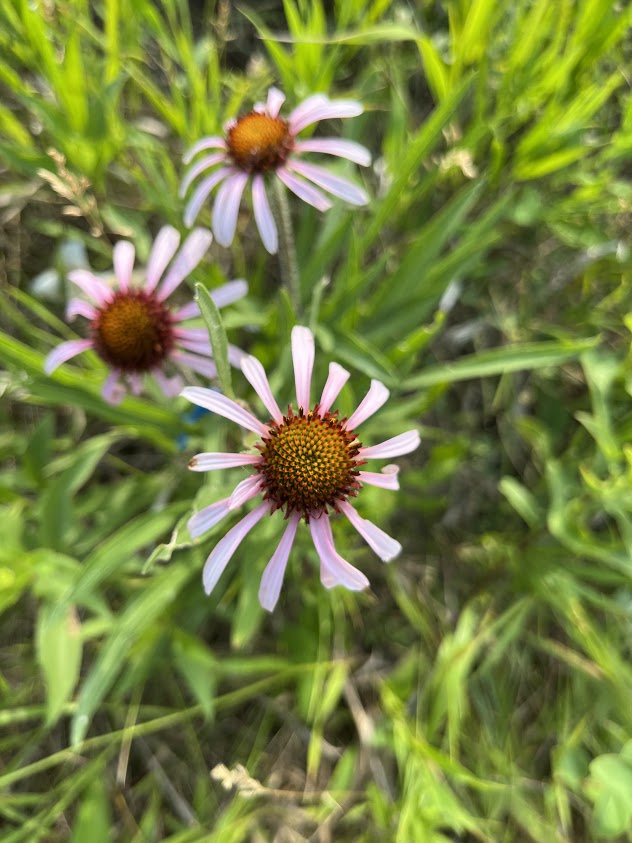
In summers 2018 and 2019, I mapped and collected leaf tissue from all individuals in the study areas and harvested seedheads from a subset of Echinacea individuals at populations in the NW corner of the study area (populations: ALF, EELR, KJ, NWLF, GC, SGC, NGC, KJ, NNWLF) to map pollen movement (see Reproductive Fitness in Remnants). To analyze patterns of gene flow, I will assess how individuals’ location and timing of flowering influence their reproductive success and distance of pollen movement. I am currently wrapping up genotyping the DNA from the leaf tissue samples and a subset of the seeds I collected. This summer, the team measured the 3-year-old seedlings from the gene flow study that are planted in exPt10. I did not do additional field work for this project this year.
A flowering Echinacea angustifolia
Start year: 2018
Location: Roadsides, railroad rights of way, and nature preserves in and around Solem Township, MN
Data collected: exPt10 measure data is in the cgdata repo.
Products: I presented a poster based on the locations and flowering phenology of individuals from summer 2018 at the International Pollinator Conference in Davis, CA this summer. The poster is linked here: https://echinaceaproject.org/international-pollinator-conference/.
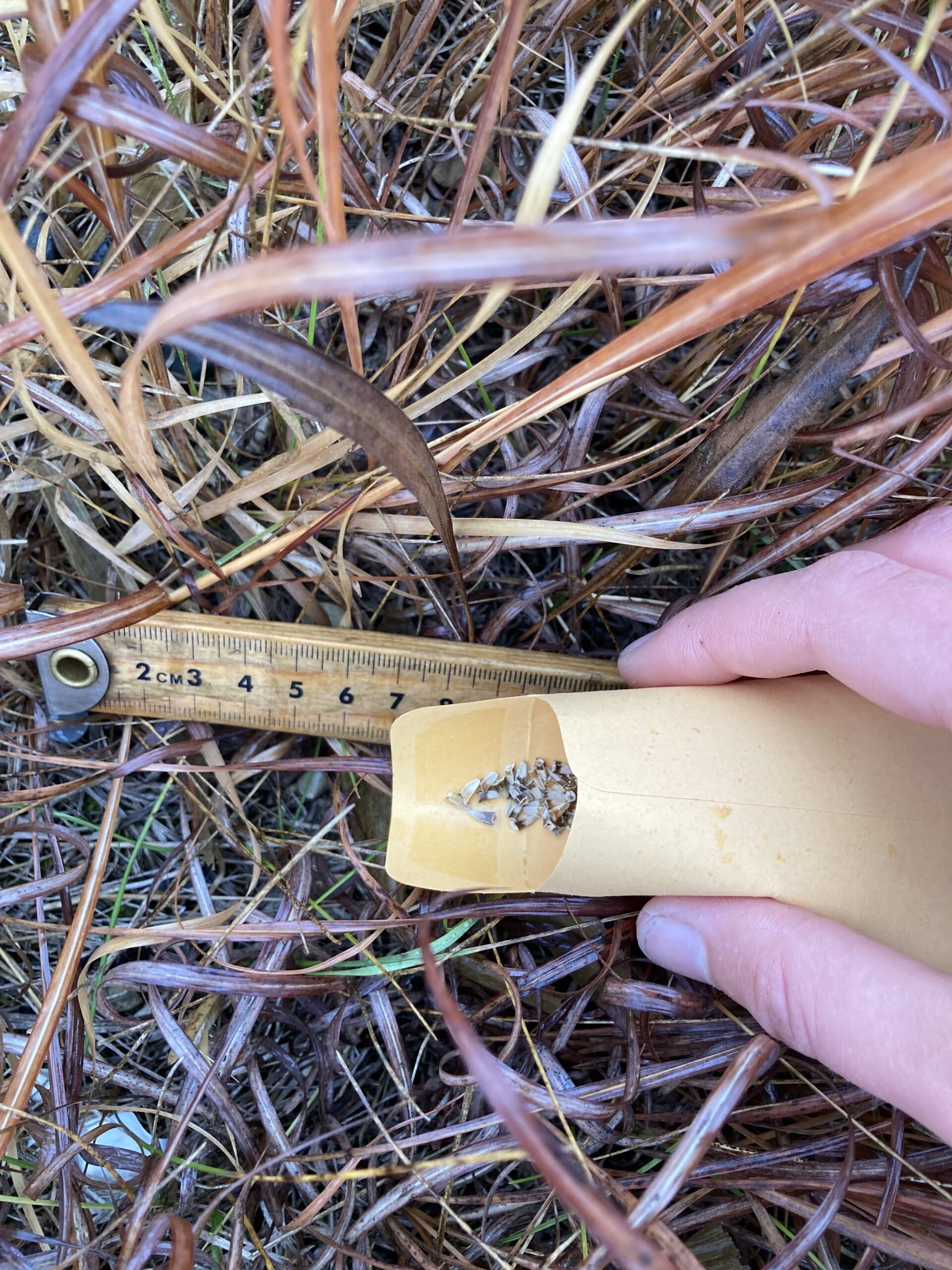
In 2021, Team Echinacea established 76 transects (each 4 m long) across 32 patches of remnant prairie in the study area. We planted seeds in one randomly selected segment per transect in fall 2021 but germination trials in the lab and seedling searches in the remnants during summer 2022 revealed that we had used a bad batch of seed 🙁 In fall 2022, we repeated seed addition experiment using seed harvested in summer 2022. Jared harvested Echinacea seed heads from Nice Island and Hutching’s hills. High seed predation from Hutchings left us with 155 heads from Nice Island. Stuart, Lindsey, and Alex sowed seed within randomly selected segments in November 2022. For fall 2022, we added 12 seedling transects (beng, fern, hutch, torge) and eliminated transects at two disturbed sites with the goal of maximizing variation in fire history across the study area. We sowed seed in 84 transects across 36 remnant prairie patches in 2022.
Start year: 2021
Location: 36 patches of remnant prairie in and around Solem Township, MN
You can read more about the Fire and seedling fitness in remnants experiment, as well as links to prior flog entries about this experiment, on the background page for this experiment.