Reproduction in plants can be limited by access to pollen and resources. We previously found that Echinacea plants in the remnants are pollen limited, meaning that if they had access to more pollen they would produce more seeds. However, the long-term effects of pollen limitation are unknown. Do plants that are super pollen saturated and have high amounts of pollen have a higher lifetime fitness than plants that are pollen limited? Also, we know that the plants in the remnants are pollen limited but are the plants in the common garden environment also pollen limited? To answer these questions and more 13 years ago Gretel randomly selected __ plants from p1 half of these plants were randomly assigned to the pollen addition group and the others were assigned to pollen exclusion. Every year, plants in the pollen exclusion have their heads bagged and they are not pollinate, where we hand cross every style in the pollen addition group.
In the summer of 2020, 27 of the original 39 plants were found to be alive 13 of the alive plants were in the pollen exclusion treatment and 14 were in the pollen addition treatment. There were nine plants that flowered, 5 were in the addition group with 12 heads, and 4 in the exclusion group with 6 heads.
Start year: 2012
Location: exPt1
Physical specimens: We harvested 18 heads, these heads are at CBG and have been inventoried and are waiting to be cleaned.
Data collected: Plants survival and measurements were recorded as part of our annual surveys in P1 and eventually will be found in the R package EchinaceaLab. Data sheets were scanned and entered and can be found here: “~/Dropbox/CGData/115_pollenLimitation/pollenLimitation2020”
You can find more information about the pollen addition and exclusion experiment and links to previous flog posts regarding this experiment at the background page for the experiment.
Since 1995, the Echinacea Project has been mapping and collecting demographic information on Echinacea angustifolia to generate detailed, long-term records of individual fitness in prairie remnants. In summer 2021, Team Echinacea visited 34 prairie remnants to search at 2899 locations where adult Echinacea plants had been previously mapped. At small sites, the team searched for all adult plants, and at large sites, they visited a subset of the adult plants.
At each Echinacea plant, the team used handheld data collectors (visors) to record the flowering status, number of flowering heads, number of rosettes, and near neighbors of the plant. They then mapped the location of every flowering plant within each prairie remnant using a high-precision GPS unit. This year, the Echinacea Project purchased a second GPS unit, named Collins, to facilitate faster mapping.
In summer 2021, Team Echinacea took 4768 demographic records (demo) and shot 1788 GPS points (surv). In total, they recorded data on 1662 flowering Echinacea angustifolia plants, after removing duplicate records. Landfill had the most flowering plants (327), followed by Loeffler’s Corner (272) and Aanenson (146). The demo and surv datasets are in the process of being combined with previous years’ records of flowering plants in “demap,” the spatial dataset of remnant reproductive fitness that the Echinacea Project maintains.
The following sites were burned in fall 2020 and spring 2021: Dog, East Riley, KJ’s, Landfill East, Loeffler’s Corner East, Steven’s Approach (east and west), and Yellow Orchid Hill (east and west). In 2021, Team Echinacea did not do total demo at Railroad Crossing Douglas County (rrxdc). To avoid confusion at Hegg Lake WPA, a site which also contains recruitment plots RHE, RHP, RHS, and RHX, site “hegg” (Hegg Lake) was renamed “nrpal” (Near Pallida) in the demo and surv datasets.
Over the course of the summer, Team Echinacea spent a total of 25,245 minutes (421 person-hours) on demo and surv. This includes flowering demo (131 person-hours), flowering surv (72 person-hours), total demo (161 person-hours), and demo/surv rechecks (57 person-hours).
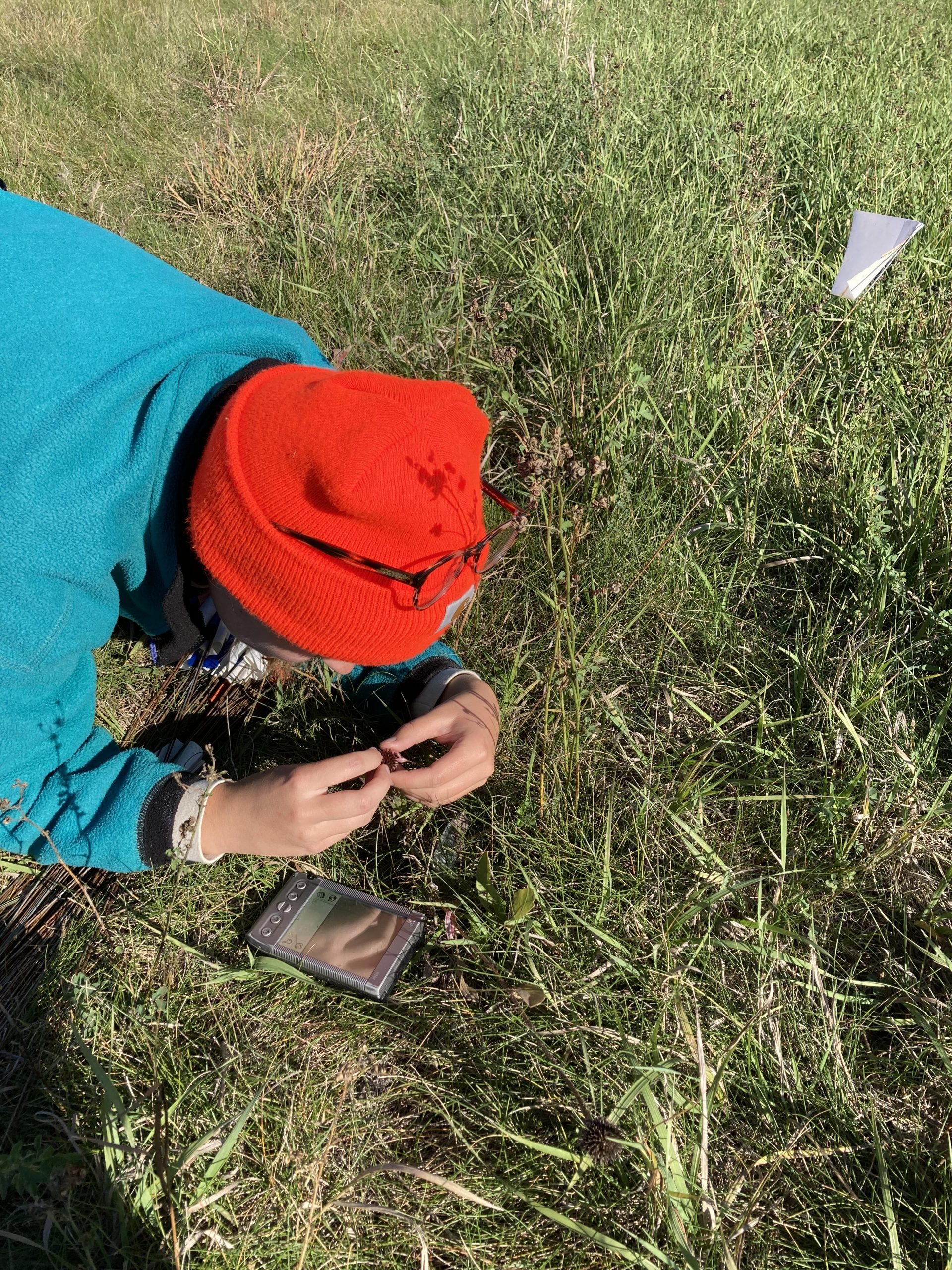
Mia scrutinizes a flowering Echinacea
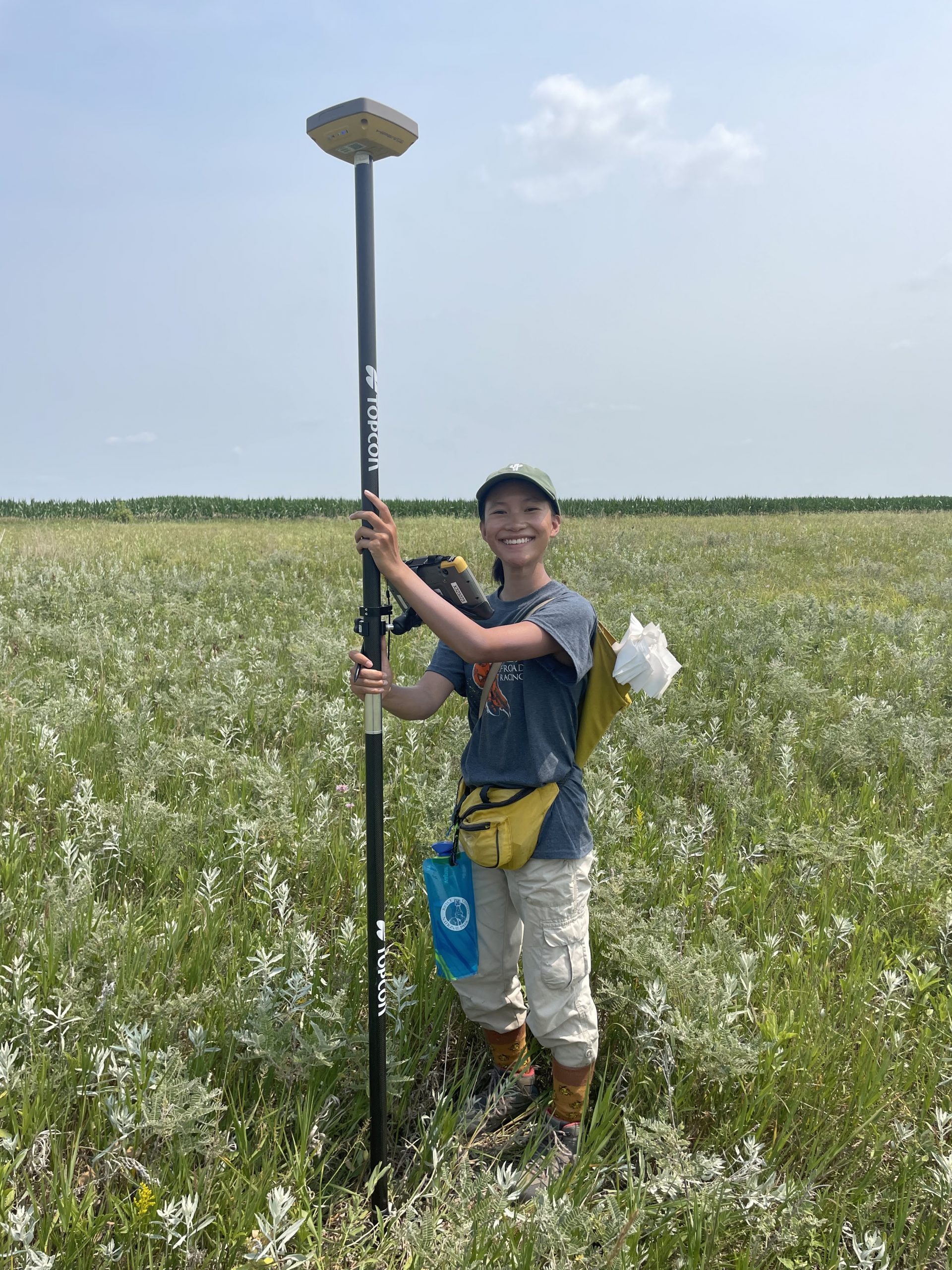
Allie shoots a GPS point
Start year: 1995
Location: Remnant prairie populations of the purple coneflower, Echinacea angustifolia, in Douglas County, MN. Sites are located between roadsides and fields, in railroad margins, on private land, and in protected natural areas.
Total demo: Bill Thom’s Gate, Common Garden, Dog, East of Town Hall, Golf Course, Martinson’s Approach, Near Pallida, Nessman, North of Golf Course, REL, RHE, RHP, RHS, RHX, RKE, RKW, Randt, South of Golf Course, Sign, Town Hall, Tower, Transplant Plot, West of Aanenson, Woody’s, Yellow Orchid Hill
Annual sample: Aanenson, Around Landfill, East Elk Lake Road, East Riley, KJ’s, Krusemarks, Loeffler’s Corner, Landfill, North of Railroad Crossing, Northwest of Landfill and North of Northwest of Landfill (lumped), On 27, Riley, Railroad Crossing, Steven’s Approach, Staffanson Prairie
Plant status (can’t find, basal, dead this year’s leaves, dead last year’s leaves, flowering), number of rosettes, nearest neighbors, and head count, if flowering
All GPS files are found here: Dropbox/geospatialDataBackup2021
All demo and surv records are stored in the aiisummer2021 repo
The most recent copies of allDemoDemo.RData and allSurv.RData can be accessed at Dropbox/demapSupplements/demapInputFiles
Samples or specimens collected: NA
Products:
Amy Dykstra’s dissertation included matrix projection modeling using demographic data
The “demap” project is a long-term dataset that combines phenological, spatial and demographic data for remnant plants
You can read more about the demographic census in the remnants, as well as links to prior flog entries about this experiment, on the background page for this experiment.
Since 1996, members of Team Echinacea have walked, crawled, and ~sometimes~ run next to rows of Echinacea angustifolia planted in common garden experiments. Although protocol varies depending on the experimental plot, every year team members record flowering phenology data, measuring data, and harvest the heads of the thousands of plants we have in common garden experiments.
Note that these experiments are not really gardens. “Common garden” refers to the experimental design. Most of our experimental plots are prairie restorations, a few are abandoned ag fields that are manged as grassland habitat. Some plots have multiple experiments within. The Echinacea Project currently has 10 established experimental plots:
exPts01-10. To avoid repetitiveness of reports on yearly phenology, measuring, and harvesting, this project status report will include updates on all experimental plots 1, 4, 5, and 8. Reports for the others will be elsewhere: Jennifer’s plot (exPt02) Amy Dykstra’s plot (exPt03), the hybrid plots (exPt06, exPt07, exPt09), and the West Central Area common garden (exPt10).
exPt01: Experimental plot 1 was first planted in 1996 (cleverly termed the 1996 cohort), and has been planted with nine other experiments in subsequent years, with the most recent planting being Amy Waananen’s inter-remnant crosses. It is the largest of the experimental plots, with over 10,000 planted positions; experiments in the plot include testing fitness differences between remnants (1996, 1997, 1999), quantifying effects of inbreeding (inb1, inb2), and assessing quantitative genetic variation (qgen1). There are also a number of smaller experiments in it, including fitness of Hesperostipa spartea, aphid addition and exclusion, and pollen addition and exclusion. In 2021, we visited 6,673 of the original 10,673 planted and found 3,085 alive. Only 79 plants were classified as “flowering” in exPt01 this year. This is a drastic decrease from the 484 plants that flowered in summer 2020– perhaps it is a testament to the benefits of controlled burning (we burned in spring 2020 but not in 2021). In summer 2021, we harvested 77 total Echinacea heads in exPt01 (we have not finished the inventory process). In the fall, we added 403 staples to positions where plants were gone for three straight years. We also converted the flaple>s (pin flags bent in half in spots where we ran out of staples) into regular old staples. There are no more flaples in p1!
exPt04: Experimental plot 4 was planted to gauge whether Echinacea from small remnant populations could be genetically rescued via an outcross to larger, more genetically diverse populations. Caroline Ridley and other members planted this plot in 2008. We did not measure exPt04 this year, but there were no flowering plants. Location: Hegg Lake WMA
exPt05: The only experimental plot planted at Staffanson Prairie Preserve (SPP), exPt05, was planted to compare progeny of maternal plants from burned and unburned sections of SPP. There were 2800 plants planted originally, but high mortality made it impractical to visit the plot row-by-row. Now, we and treat the plot like demography. We use our survey-grade GPS to find plants in exPt05 that have previously flowered and add more plants to the stake file if new plants in the plot flower. In 2021 we found 11 living plants, three of which were flowering! There was only twohead to collect, one head was toppled. Location: Staffanson Prairie Preserve
exPt08: Team Echinacea established quantitative genetics experiments to quantify additive genetic variance of fitness in Echinacea, with the idea that we can estimate evolutionary potential of study populations. The maternal parents of qGen2 and qGen3 are plants in the 1996, 1997, and 1999 cohorts. These plants were crossed with pollen from plants in remnants to produce seed for qGen2 and qGen3, which now inhabit exPt08. Originally, 12,813 seeds were sown in the common garden. Seeds from the same cross (shared maternal and paternal plants) were sown in meter-long segments between nails. A total of 3,253 seedlings were originally found, but only 443 plants were found alive in 2021. There were 28 flowering plants in 2021, and 32 heads. This is the most flowering heads in p8 we have ever seen, the first year plants flowered in p8 was 2019 and in 2020 five plants flowered. Note that there were an additional 14 heads collected from transplant plot.
Plot management: To ensure that the common garden environment is as similar as possible to the prairie environment we must actively manage it. This management includes removing foreign species and supplementing with natives. One of our main management methods is through fire. We were able to burn burn p8 this spring and hope to burn p1 this spring. We also collected seed to spread after burns including Schizachyrium scoparium, Bouteloua curtipendula, along with multiple species of Solidago and quite a few Asters.
Asclepias viridiflora in p1: In 2019, plugs of an uncommon prairie milkweed, Asclepias viridiflora, were planted in Experimental plot 1. The purpose of this experiment is to assess the survival and fitness of A. viridiflora. Assessing vitality will also provide a frame of reference for species conservation across modern prairies. We did not assess the A. viridiflora plants this year.
Hesperostipa demography: In 2009 and 2010, porcupine grass (Hesperostipa spartea, a.k.a. “stipa”) was planted in experimental plot 1. In total, 4417 seeds were planted, 1 m apart from each other and all 10 cm north of Echinacea plants. Between 2010 and 2013, each position was checked, and the plant status recorded. Since 2014, we have searched for flowering plants. The data from this summer can be found here cgdata/summer2021/stipaSearch & Dropbox/CGData/Stipa/225_measure/measure2021 in addition to data in these locations there may be paper data sheets that may or may not have been entered yet. These data have not been processed yet.
Inb1: The INB1 experiment investigates the relationship between inbreeding level and fitness in Echinacea angustifolia. Each plant in experiment INB1 originates from one of three cross types, depending on the relatedness of the parents: between maternal half siblings; between plants from the same remnant, but not sharing a maternal or paternal parent; and between individuals from different remnants. We continued to measure fitness and flowering phenology in these plants. In 2021, of the original 557 plants in INB1, 95were still alive. Of the plants that were alive this year, there was only one flowering plant. All individuals were planted in 2001.
qgen: The qGen1 (quantitative genetics) experiment in p1 was designed to quantify the heritability of traits in Echinacea angustifolia. We are especially interested in Darwinian fitness. Could fitness be heritable? During the summer of 2002 we crossed plants from the 1996 & 1997 cohorts of exPt01. We harvested heads, dissected achenes, and germinated seeds over the winter. In the Spring of 2003 we planted the resulting 4468 seedlings (this great number gave rise to this experiment’s nickname “big batch”). In 2021 we assessed survival and fitness measures of the qGen1 plants. 1,519 plants in qGen1 were alive in 2021. Of those, 2.4% flowered in 2021, this is down from 17% last year. All were planted in 2003.
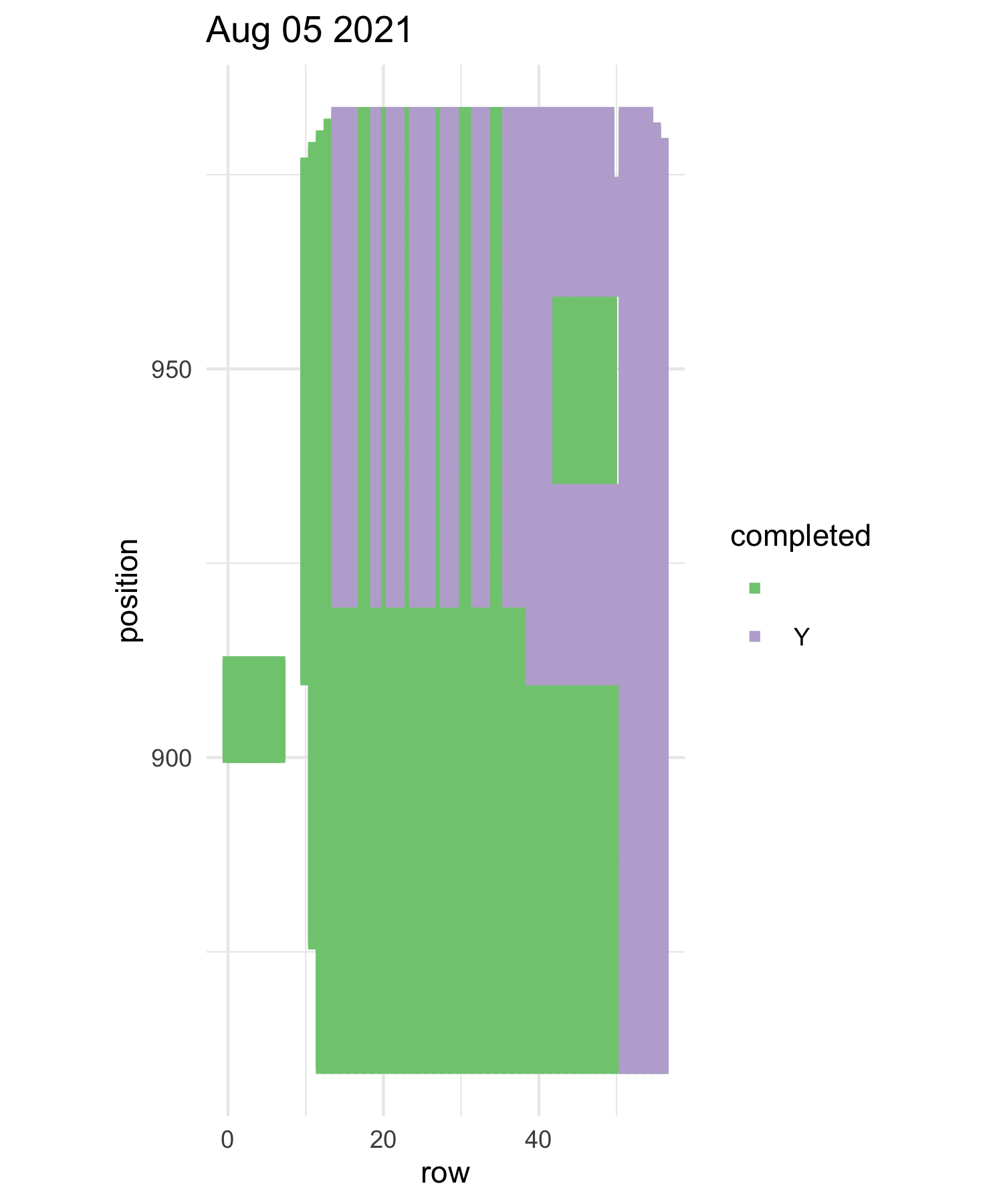
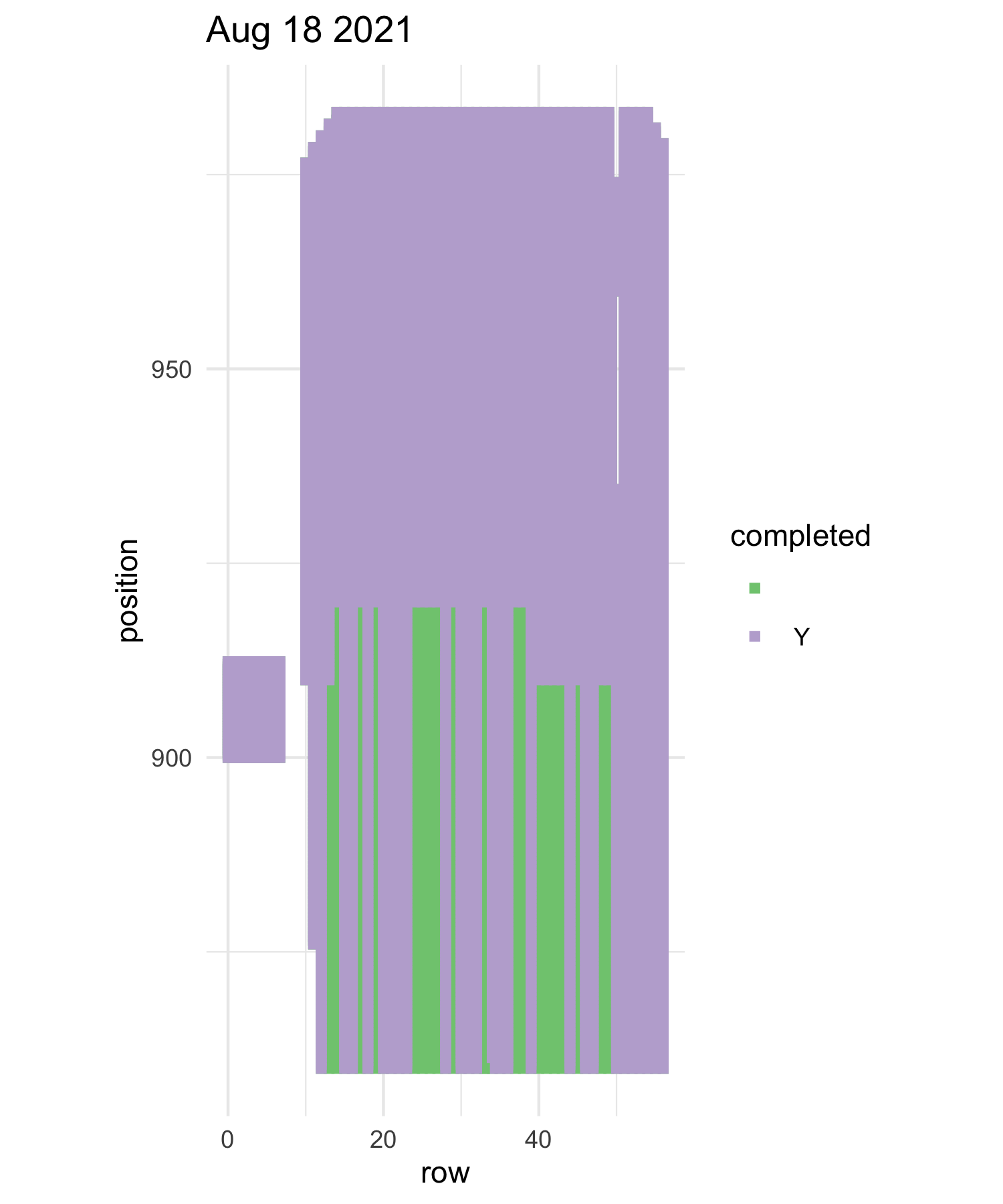
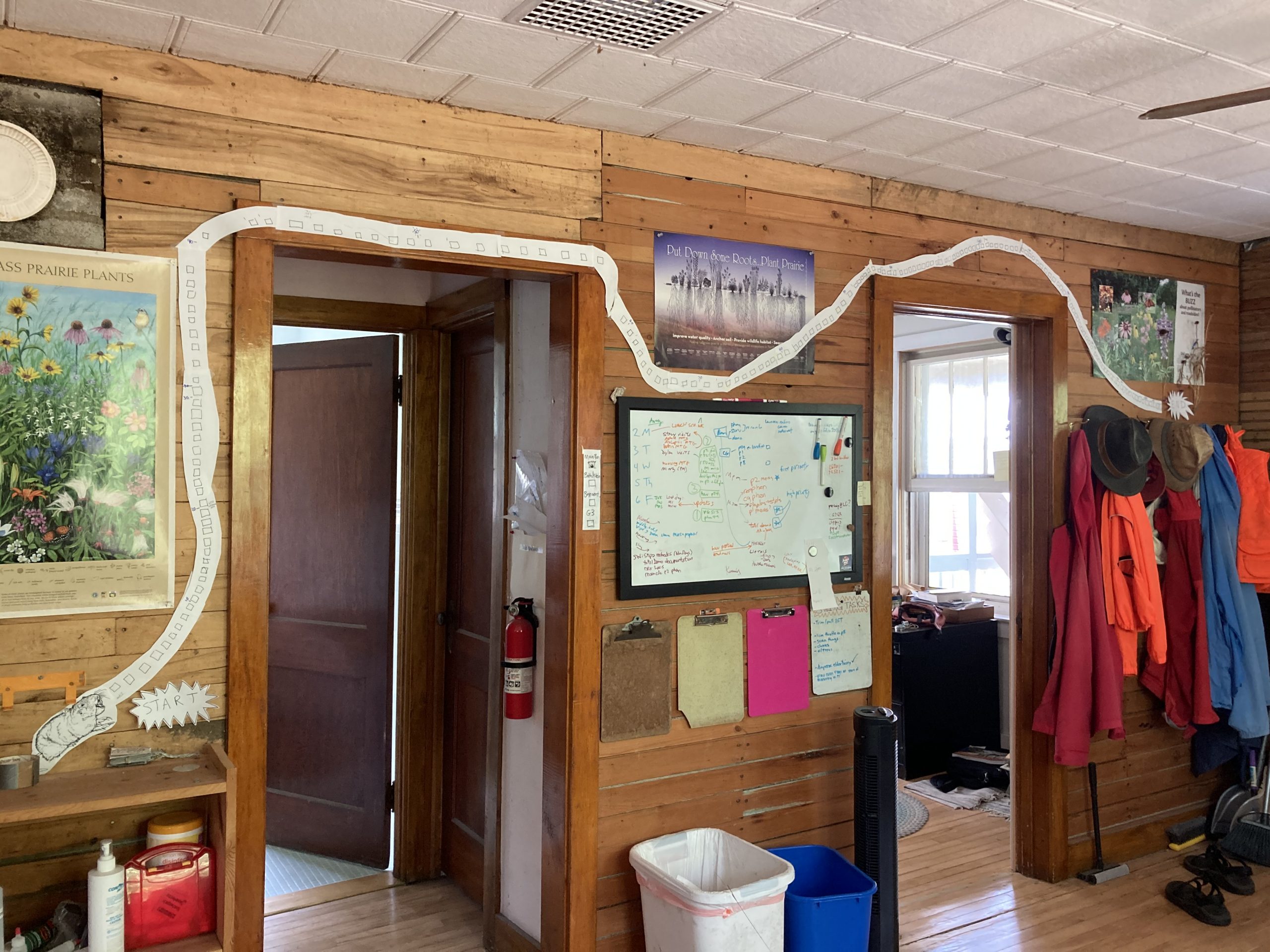
Team moral: Measuring experimental plot 1 is a large task for the team, it takes many days, usually hot days, with a project as large as this it is hard for the team to feel a sense of progress each day. So this year in hopes to keep the team more motivated I(Mia) took two strategies. First, we constructed a physical progress tracker, each square represented a segment in the plot A segment is a section of a row, rows are too big so we break them into sections for ease of measuring. After each day of measuring the team was able to count how many segments they completed and color in each square. The team had fun with their square decoration and got creative with it, there was various themes, fruits, names for peoples last days etc. I also made maps of the plot for each day of measuring that were color coded with what positions have been measured and which ones haven’t. Lastly, I do believe I may have bribed the team with cookies. Having multiple different forms of motivation, really kept the team motived and made the project less daunting. It was also added some excitement into measuring p1, a task that isn’t known for being too exciting.
one of the progress maps purple is done green is not done
one of the progress maps purple is done green is not done
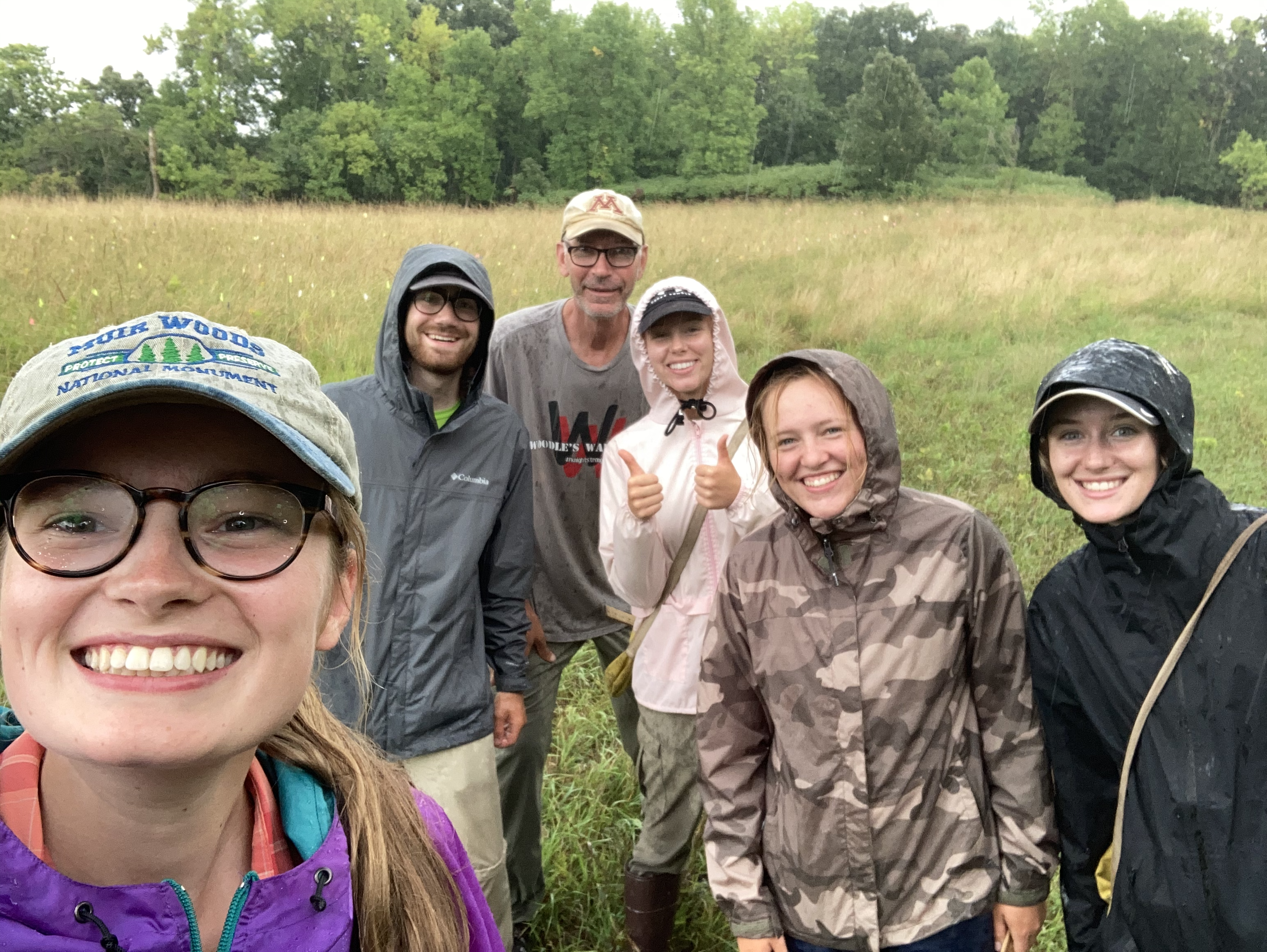
A hearty crew finishing measuring p1 during one of the only rainy days of the season
Progress tracker aka Gopher tunnel of love
For more information on survival in common garden experiments, see this flog post about survival in common gardens.
Start year: Various, see individual listings above. First ever planting was 1996.
Location: Various, see above
Overlaps with: Pretty much everything we do.
Data/ materials collected: Measure data for all plots. All raw measure data available in cgData repository. Processed data should eventually be available in SQL database; ask GK for status of SQL database.
new p79 stake file: Jared made a cleaned up stake file for p7 and p9 that can be found here
p2 stake file/points shot: Amy shot points in p2 this year the points can be found in these 3 jobs
This recruitment experiment was originally established in 2000 to quantify seedling emergence and juvenile survival of Echinacea angustifolia during its reintroduction to sites with varying land-use history and burn schedules. Before 2014, detailed data was collected on each plant in the plots. Since 2014, Team Echinacea has censused each plot yearly to collect demographic data for every flowering plant.
In 2021, Team Echinacea visited 7 recruitment plots and searched for 176 Echinacea angustifolia plants that had flowered previously. The team found 94 basal plants, 1 dead this year’s leaves, 2 dead last year’s leaves, and 49 flowering plants. In addition, the team discovered 12 plants that flowered for the first time in 2021, for a total of 70 flowering plants in the recruitment plots. For each flowering plant, the team took demographic data (number of rosettes and flowering heads) and shot a GPS point at the exact location of the plant. The team did not find the remaining 30 plants that had flowered previously, and there were 9 flowering plants with old tags that were not in the demo stakefile.
There was at least one flowering Echinacea plant at each of the 7 recruitment plots. The 4 plots at Hegg Lake WMA, a site managed by the Minnesota DNR, contained 51 flowering plants, and 13 plants bloomed in the plot at Eng Lake WMA. Four plants bloomed in the two recruitment plots at Kensington WMA.
On September 9, a crew from the DNR drove a Marsh Master through Hegg Lake WMA to spray invasive cattails. On their way from one patch of cattails to the next, they drove through one of the recruitment plots as well as experimental plots 7 and 9 and the Liatris transect, and they left distinct tire tracks through the prairie in those areas.
The Marsh Tracker tramples its way through Hegg Lake WMA
Start year: Plantings in 2000-2002
Location: Seven study plots on state land with different land use histories: old-field and restored grassland
Data collected: Plant status (basal, flowering, not present), rosette count, flowering head count, GPS point for each flowering plant in each recruitment plot
You can read more about the fire in recruitment experiment, as well as links to prior flog entries about this experiment, on the background page for this experiment.
During the summer of 2019, Team Echinacea planted over 1400 E. angustifolia seedlings into 12 plots in a prairie restoration at West Central Area High School in Barrett, MN. We planted seedlings from three sources: (1) offspring from exPt1, (2) plants from my gene flow experiment, and (3) offspring from the Big Event. In summer 2021, Drake also planted plugs of other species (pictured below).
This summer, the team measured the 2-year old seedlings from my gene flow study in exPt10, as well as a few seedlings from the other plantings within the plot. The seedlings from my gene flow experiment are the offspring of open-pollinated Echinacea in 9 populations in the study area. I am assessing the paternity of these seedlings to understand contemporary pollen movement patterns within and among the remnants. In summer 2018, I mapped and collected leaf tissue from all Echinacea individuals within 800m of the study areas and harvested seedheads from a sample of these individuals (see Reproductive Fitness in Remnants). In spring 2019, I germinated and grew up a sample of the seeds that I harvested to obtain leaf tissue for genotyping.
Then, with the team’s help, I planted these seedlings in exPt10 in June 2019. I also collected seeds and leaf tissue in summer 2019 to repeat this process, but I did not germinate the achenes in the following spring because I was not able to assess seed set due to the broken x-ray machine at the CBG and then COVID-related restrictions. I hope to germinate those this spring and plant in summer 2022. I am working on extracting the DNA from the leaf tissue samples I have, which I will use to match up the genotypes of the offspring (i.e., the seeds) with their most likely father (i.e., the pollen source).
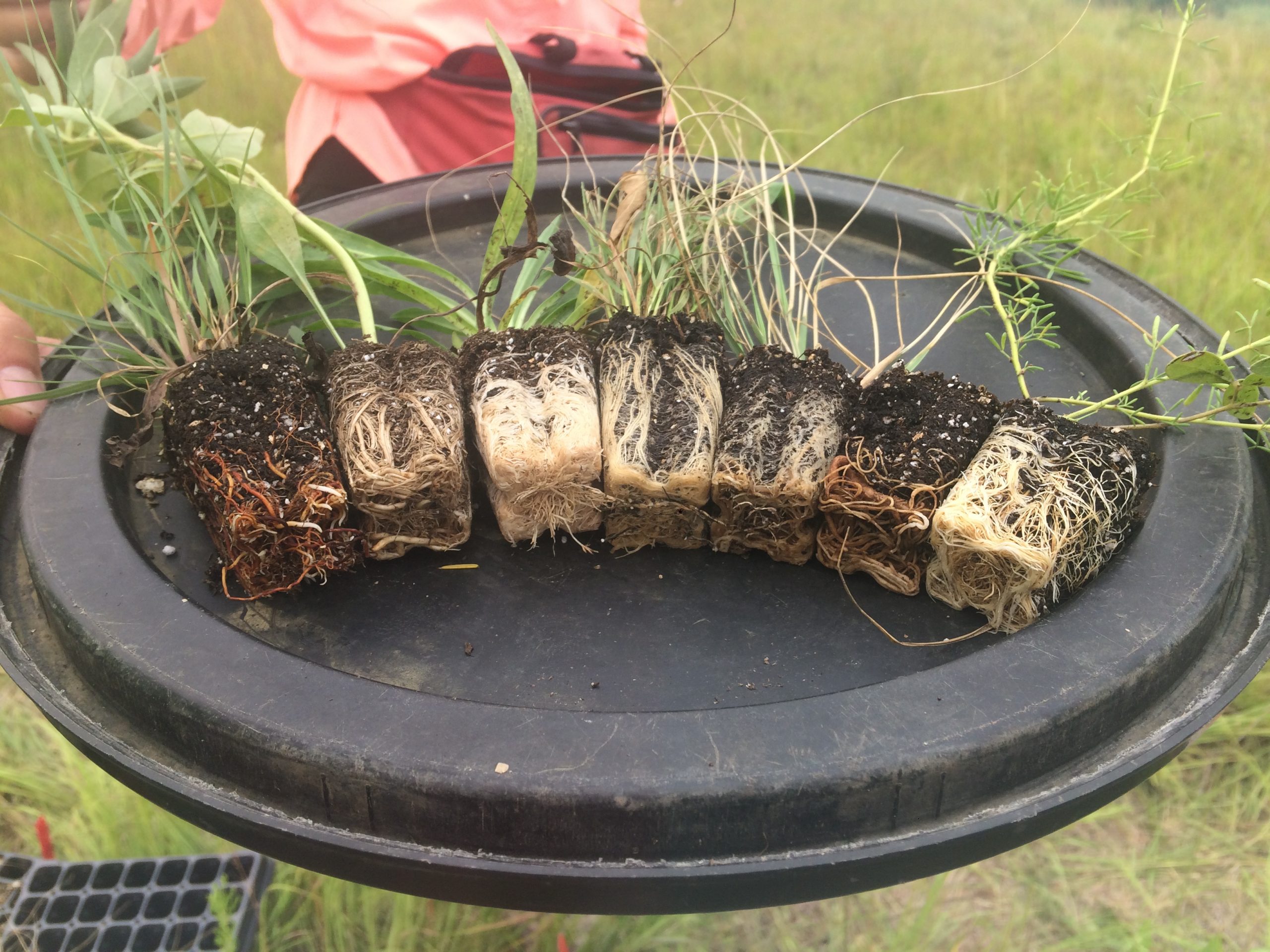
A sampler platter of seedlings, planted as part of Drake’s study of how prairie communities respond to parasitic plants.
Start year: 2018
Location: West Central Area High School’s Environmental Learning Center, Barrett, MN, Remnant prairies in Solem Township, Minnesota
In 2021, Lea Richardson conceived and initiated a 2-year study designed to test how fire affects community flowering phenology in remnant prairies in MN. We randomly sampled points in burned and unburned remnants for a total of 294 points. In a 1m radius around each random point, the number of flowering stems were counted for every plant species present in the circle twice a week from July 1-August 31. For some species, the radius extended past 1m. Random points used in this study were the same points used in the stipa project as well as other projects associated with Jared Beck’s postdoc studying fire in remnants. Lea also obtained estimates of total number of flowering plants of certain species for the whole site if the species in question was not in any of the random circles placed on the site (these additional observations should allow for more accurate flowering abundance curves to be obtained). Sites were divided into two driving routes with roughly half of the points visited on Monday and Thursday, and the other half visited Tuesday and Friday. This sampling protocol for the same sites will be repeated in 2022 to be able to compare points with and without fire across two years and among sites. Over 100 flowering species were identified within the circles. Data analysis will proceed on this first year of data in Spring 2022 and will be included as Chapter 4 of Lea’s dissertation.
Lea searches for flowering plants at a random point
Data collected: community phenology data, using visor form ptPhen (all data in aiiSummer2021 repo in ptPhen folder)
Samples or specimens collected: none
Products: [eventually] chapter 4 of Lea Richardson’s dissertation and hopefully a manuscript after 2022 data collection
You can read more about the community flowering phenology in remnants experiment, as well as links to prior flog entries about this experiment, on the background page for this experiment.
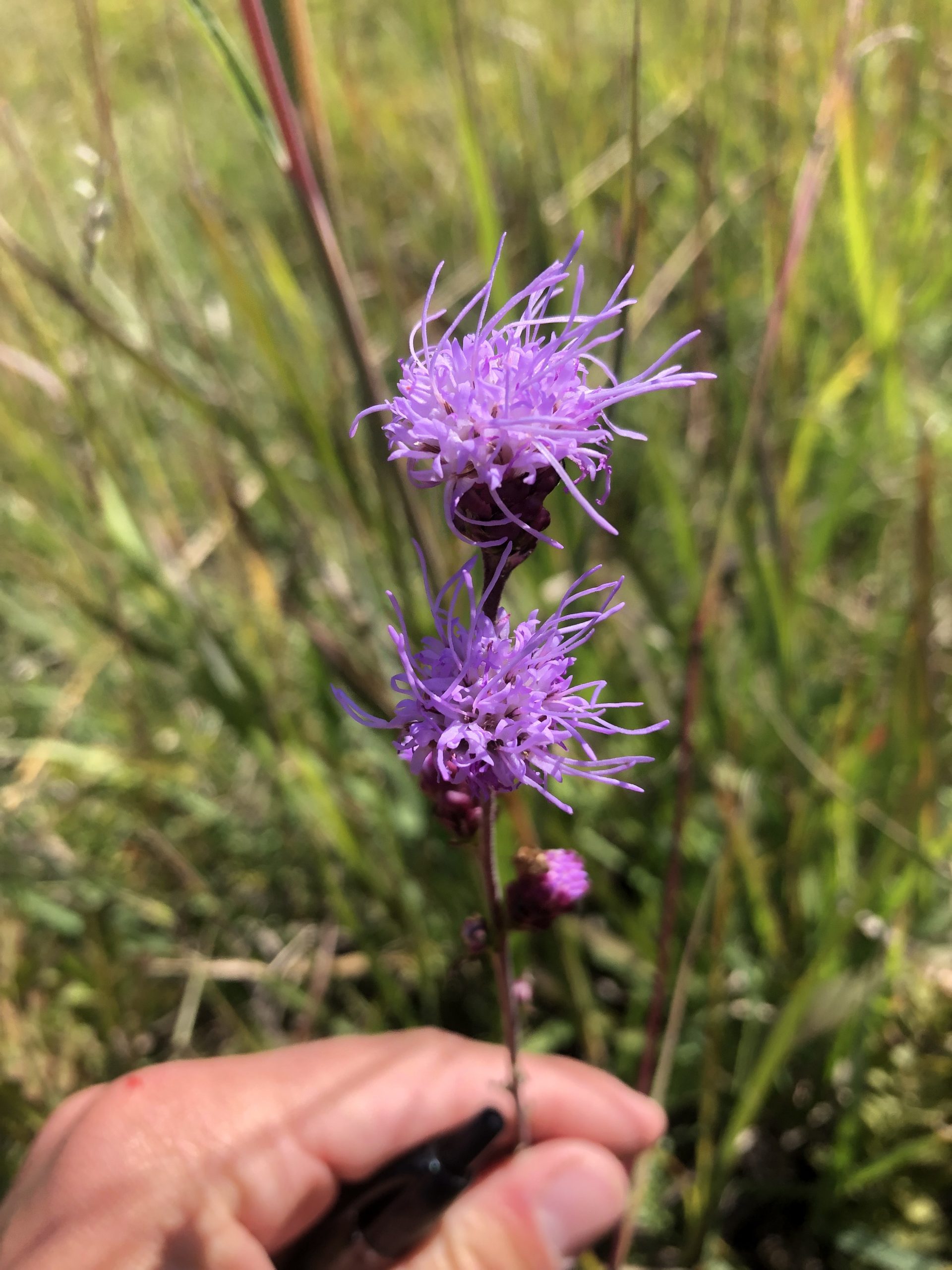
As a part of our research looking into the role fire plays on plant reproduction and population dynamics, we collected geospatial and flowering data on Liatris aspera at 22 prairie remnants in and near Solem Township, MN. Six of these remnants burned in spring of 2021. During the growing season, we collected data on the position, inflorescence count, and number of flowering heads for over 2400 individuals (exact number is unknown still because some individuals were shot twice with the GPS due to calibration errors).
We also randomly selected 234 Liatris as focal plants, which we harvested once they had gone to seed and brought back to the lab for cleaning. We hope to be able to use the inflorescences we collected to quantify seed set and compare density effects between burned and unburned remnants.
Over the summer, Team Echinacea spent 5955 minutes (99 person-hours) shooting Liatris GPS points and 2235 minutes (37 person-hours) harvesting the focal Liatris plants.
Collecting data on a small Liatris
Start year: 2021
Location: 22 prairie remnant sites in and around Solem Township, MN
For Wesley’s individual project, we made pollinator visitation observations and noted the presence or absence of other arthropods on Liatris aspera heads. Using the focal plants from the Liatris fire and flowering study, we were able to perform 95 5-minute observation periods on 84 individual plants. Most visitor identifications were made by eye in the field; however, we captured one bumblebee (released upon identification) and one fly (captured and frozen for future identification). We also recorded presence/absence data for Pennsylvania leatherwings, ants, ambush bugs, spiders, and other beetles.
All focal plants from the Liatris fire and flowering study were brought back to the lab, where the arthropod experiment is continuing via the quantification of seed predation. We have also encountered living larvae throughout the Liatris cleaning process which we hope to identify, possibly through rearing.
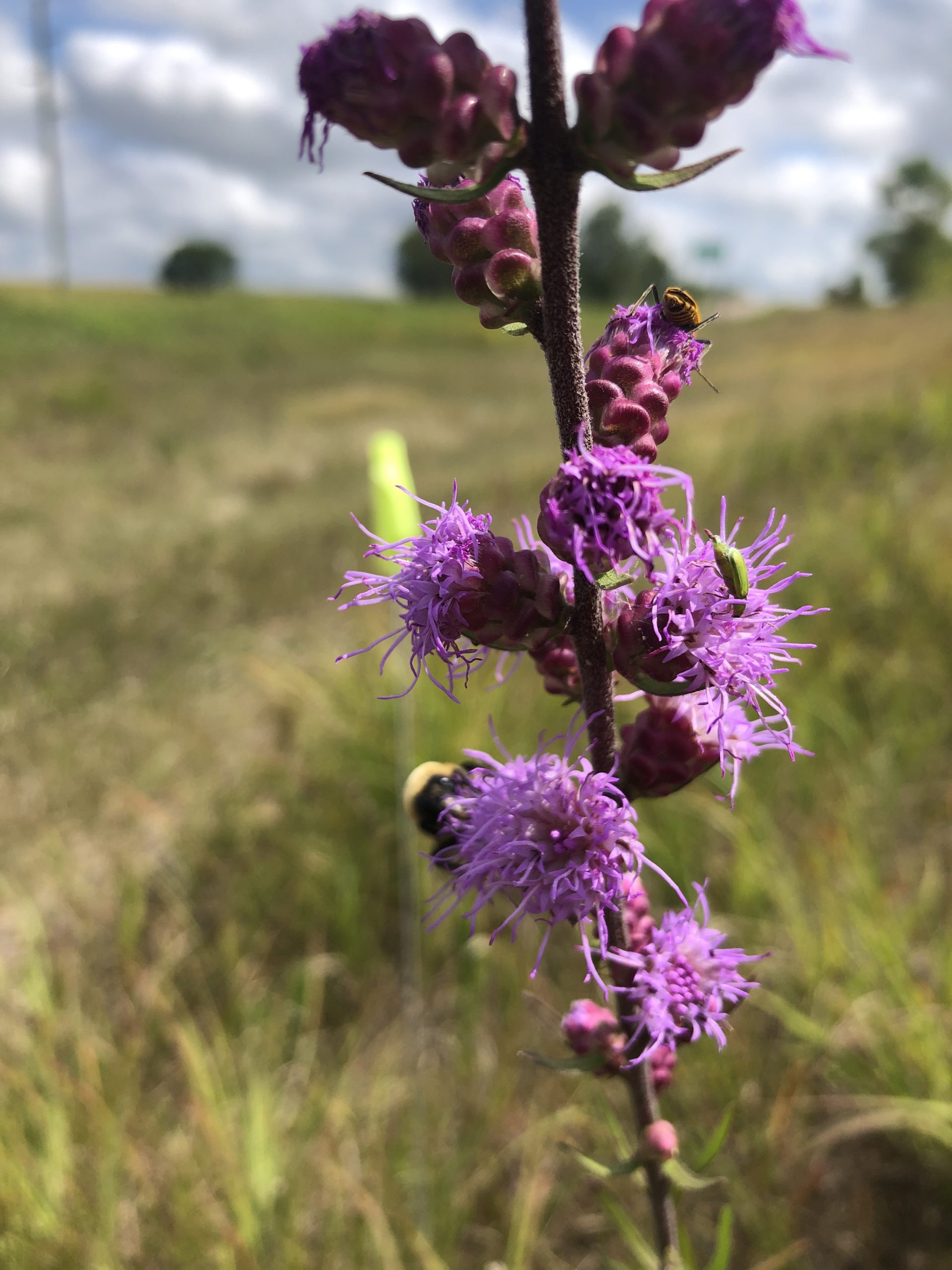
A Liatris with two beetles and a bumblebee on its heads
Start year: 2021
Location: 22 prairie remnant sites in and around Solem Township, MN
Data collected: Scanned datasheets and their typed versions can be found in ~Dropbox/remLiatris/liatrisObservations
Samples or specimens collected: 1 fly was captured for identification. Additionally, 234 focal plants were harvested. These plants are currently being cleaned and processed in the lab.
Products: Wesley’s REU was based on this project, which may at some point result in a paper or poster. Stay tuned!
This field season, the team continued the seedling recruitment experiment begun in 2007. The original goal of the project was to determine seedling establishment and growth rates in remnant populations of Echinacea angustifolia. Seedling recruitment rates are rarely studied in the field, and this is one of the few studies tracking recruitment in the tallgrass prairie. From 2007 to 2013 in spring, Team Echinacea visited plants which had flowered in the preceding year, and they searched near these maternal plants to find any emerging seedlings. Each fall since then, the team has searched for the seedlings, then juveniles, and measured them.
In 2021, Team Echinacea visited a subset of the sling plants at 12 prairie remnants from September 21st to September 29th. The team visited 62 focal maternal plants and searched for 117 sling plants of the original 955 seedlings. In total, the team found 49 basal plants, 2 dead this year’s leaves, 3 dead last year’s leaves, and 3 flowering plants! One of these heads, tag 18136 from East Elk Lake Road, was harvested and is currently being cleaned in the lab at the Chicago Botanic Garden. The team did not find the remaining 60 sling plants, and 17 of these plants have not been found for the past 3 years, so they will not be visited in 2022. No slings have been found at East of Town Hall and Northwest of Landfill for the past three years, so the team will not visit these sites in 2022. Unfortunately, after a long, dry summer, many of the plants were crispy and hard to see, especially at Riley and East Riley. Next year, the team should start hunting for slings earlier while they are still green.
This year, Team Echinacea used the visor demo form to collect data and assigned locs 301-474 to the sling plants to relate the demo form to the sling ids. To aid in finding plants next year, team members gave at tag to 53 sling plants and shot a GPS point for each tagged plant. These GPS points will then be added to the stakefile for 2022.
Over the course of 5 days, 6 people spent 1980 minutes (33 person-hours) collecting data for the sling project this summer.
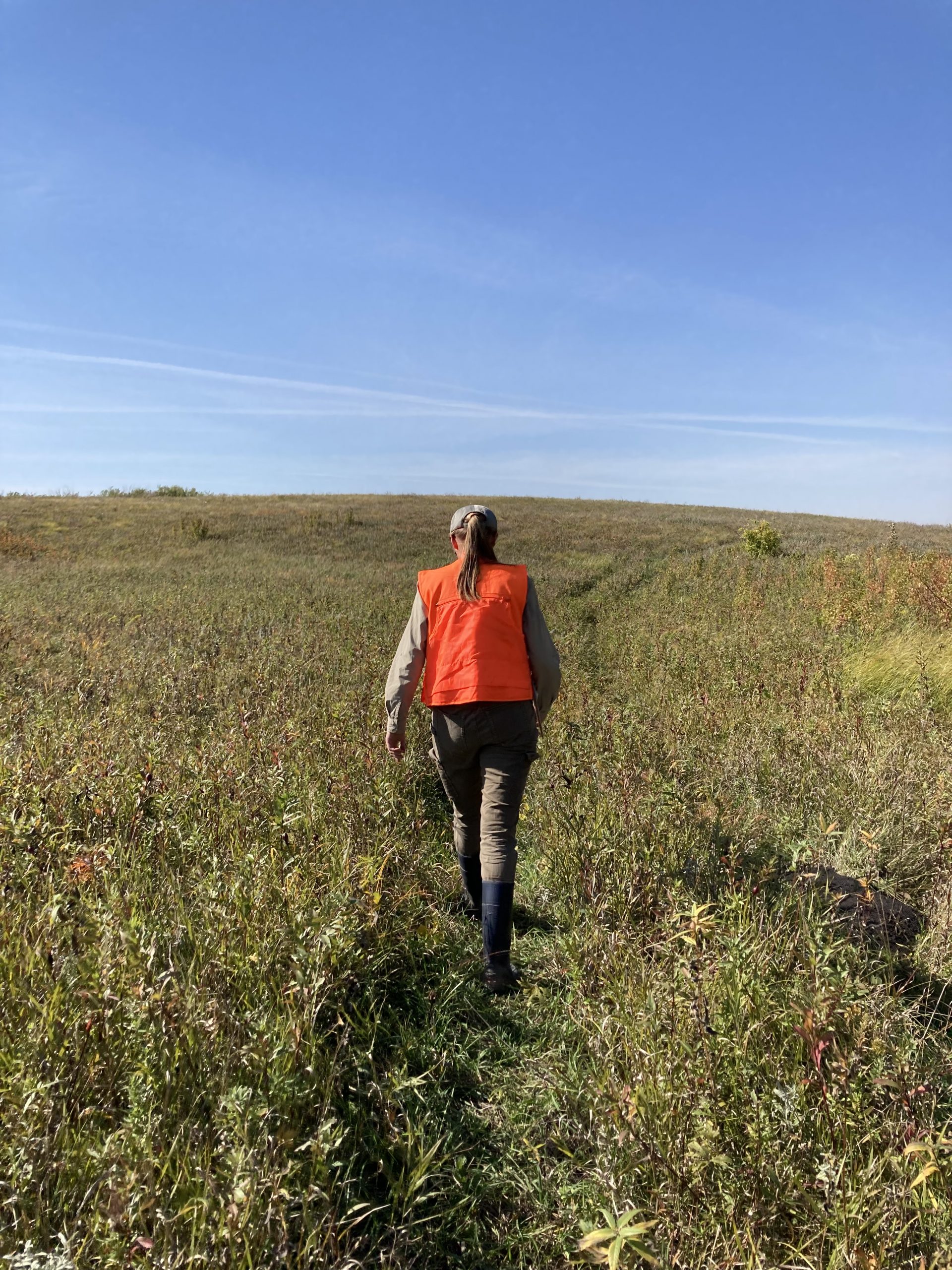
Mia hikes out to visit the slings at Staffanson Prairie West
Start year: 2007
Location: Remnants in Douglas County, MN
Sites with seedling searches: East Elk Lake Road, East Riley, East of Town Hall, KJ’s, Loeffler’s Corner, Landfill, Nessman, Northwest of Landfill, Riley, Steven’s Approach, South of Golf Course, Staffanson Prairie
The data were collected on a visor using the demo form. The team recorded plant status (can’t find, basal, dead this year’s leaves, dead last year’s leaves, flowering), number of rosettes, leaf count, nearest neighbors, and head count, if flowering.
The 2021 sling materials such as maps and scanned datasheets are here: “Dropbox\burnRem\remData\115_trackSeedlings\slingRefinds2021”
The 2021 data from the demo form are here: “Dropbox\burnRem\remData\115_trackSeedlings\slingRefinds2021\slingRefindsData2021.csv”
The 2021 stakefile can be found here: “Dropbox\geospatialDataBackup2021\stakeFiles2021\sling2021stakeV.01.csv”
Samples or specimens collected: One head from East Elk Lake Road was harvested and is currently housed with the rest of the 2021 remnant harvest at the Chicago Botanic Garden
Team members who searched for slings in 2021: Amy Waananen, Ruth Shaw, Mia Stevens, Stuart Wagenius, Jared Beck, Alex Carroll
Products:
Amy Dykstra used seedling survival data from 2010 and 2011 to model population growth rates as a part of her dissertation.
Lea Richardson and Amy Waananen are both working on papers related to the sling dataset. Stay tuned!
You can read more about the seedling establishment experiment, as well as links to prior flog entries about this experiment, on the background page for this experiment.