|
|
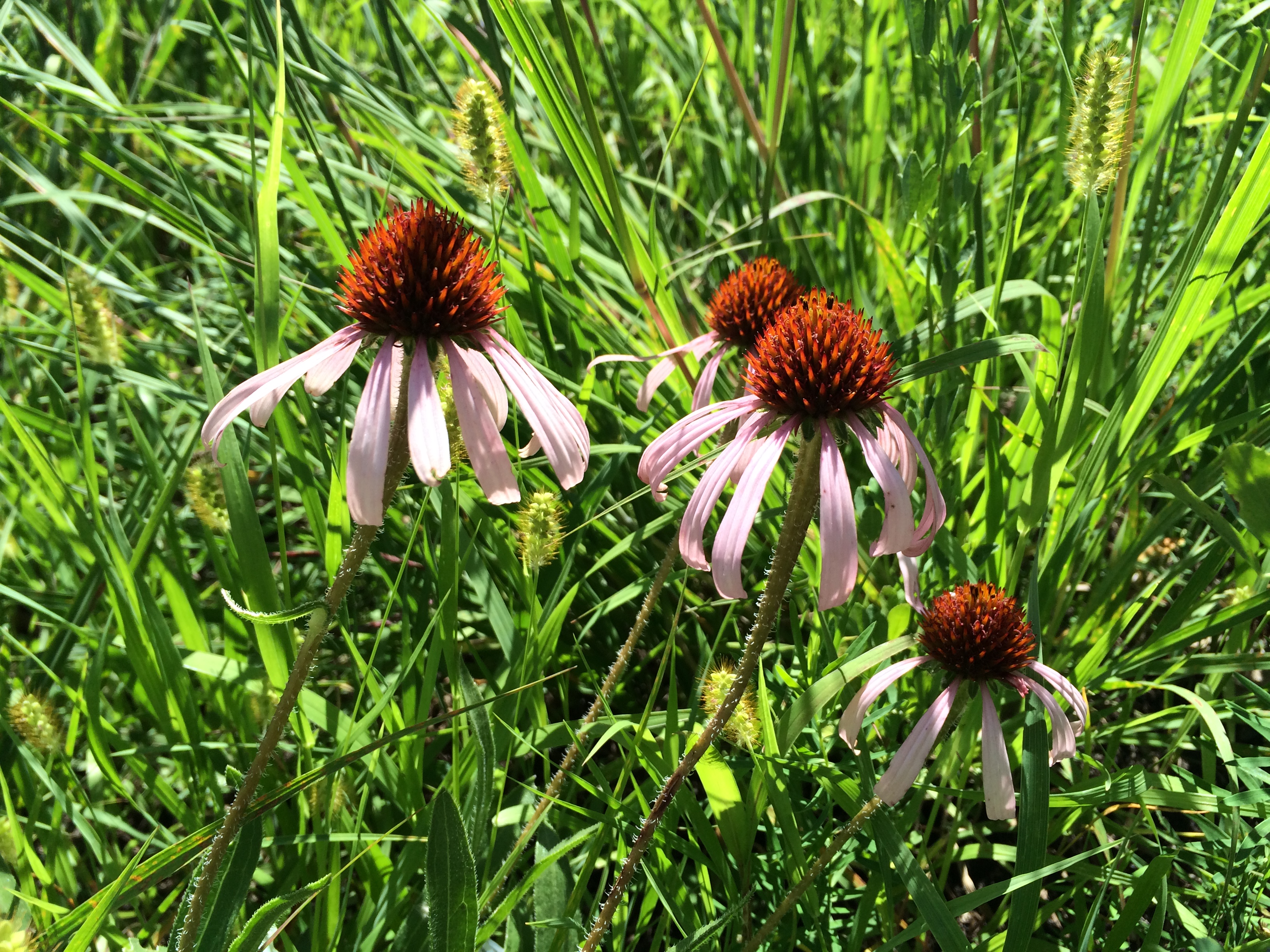
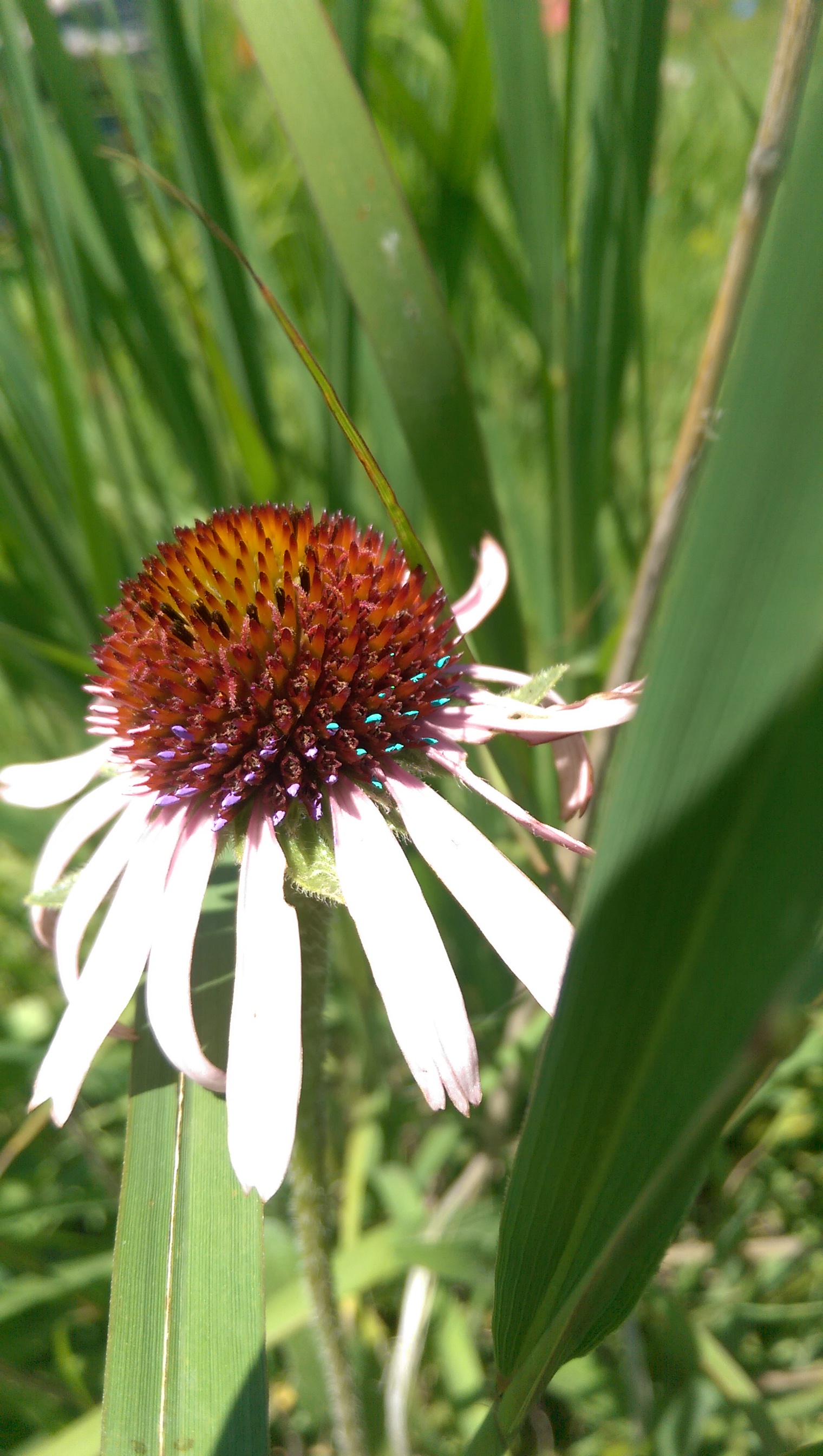
 Some heads in p1 that are just about done flowering. With so many of our remnant Echinacea done flowering (less than 300 down from the 2,000 we visited at peak!), this past Tuesday found the team with some extra time on their hands. Instead of starting out with phenology, we got a chance to make progress on our independent projects. Abby and I headed out to p1 to spend some time with the specialist aphid, Aphis echinaceae. For the past few weeks we’ve been applying addition and exclusion treatments to 100 study plants in the plot with the goal of understanding some of the effects of the aphid on its host plant–continuing a study that Katherine Muller began a few years back.
The wet and dewy Tuesday morning marked our seventh round of treatments. Since starting out we’ve learned a lot about handling (“herding”) our aphids–how best to coax them from their colonies, how to keep them happy during the move between leaves, how to get them settled on their new leaves. Aphid transferring is a delicate process that requires patience and a loving touch. Offering words of comfort and encouragement seems to help ease the transition for the aphids.
While we started out with a pretty scarce supply of aphids in the garden, only able to add a couple of aphids to each of our plants and struggling to get colonies to establish, we’ve noticed a recent spike in the population. After managing to apply about 10 aphids to each plant in one of our recent treatments, we finally had some successes. On Tuesday, we found about half of our additions plants with small colonies taking hold.
 This collection plant had some of the most aphids we’ve seen yet in one place! Some hypothesize that specialist aphids can have a more positive effect on their hosts as compared to generalist aphids. In just a week or two we’ll start assessing our study plants for fitness characteristics like basal leaf count and length of longest leaf, as well as for patterns in herbivory and senescence, to see if years of these addition and exclusion treatments have impacted the plants. I’m excited to move on to this phase of the research!
Today was one of the first days where the end of summer felt notably, and sadly very near. A big contributer to this feeling was that we finished doing phenology at all of the sites (p1 and p2 included!) before lunch. Several of the sites including East of Town Hall, KJs and North of Golf Course, are finished flowering all together! While Riley’s used to take many hours, it only took me and Will a few minutes to finish up phenology there this morning. At lunch Will taught us a puzzle/riddle which while difficult to explain in a flog post, elicited many laughs and caused hats to be thrown in frustration across the picnic table of the Hjelm house. After lunch, the most of crew went to p1 to continue working on crosses for the Q3 experiment. Many of those are done now too, and we have seen a lot of style shriveling hopefully indicating compatible pollen addition and a successful cross between flowers! Tonight we have a special guest appearance from Erica, Lea’s sister! While we’re all excited that she’s here, it’s bittersweet because it means that Lea is leaving tomorrow morning 🙁 We’re all feeling a little snuffly about Lea’s departure, but excited to stay in touch with all members of the 2015 Echinacea team.
Today started on the porch. We gathered at the table and talked about the tasks at hand. The first order of business involved organizing the mapped GPS data. Maps of all the remnants needed to be checked for missing GPS points and tag errors. Next up was an R Lesson. I loved learning the basics of loading/correcting data and executing a basic statistical test. After the morning lesson, we headed out to do a bit of GPS-ing and phenology at a few remnant sites, then gathered on the porch again for lunch.
After lunch, we started by pulling invasive thistles out of p1. After walking all the rows, we pulled 117 thistles in total! The two most impressive pulls were giant roadside plants seen below.
 Matt’s huge thistle!  Danny’s bouquet
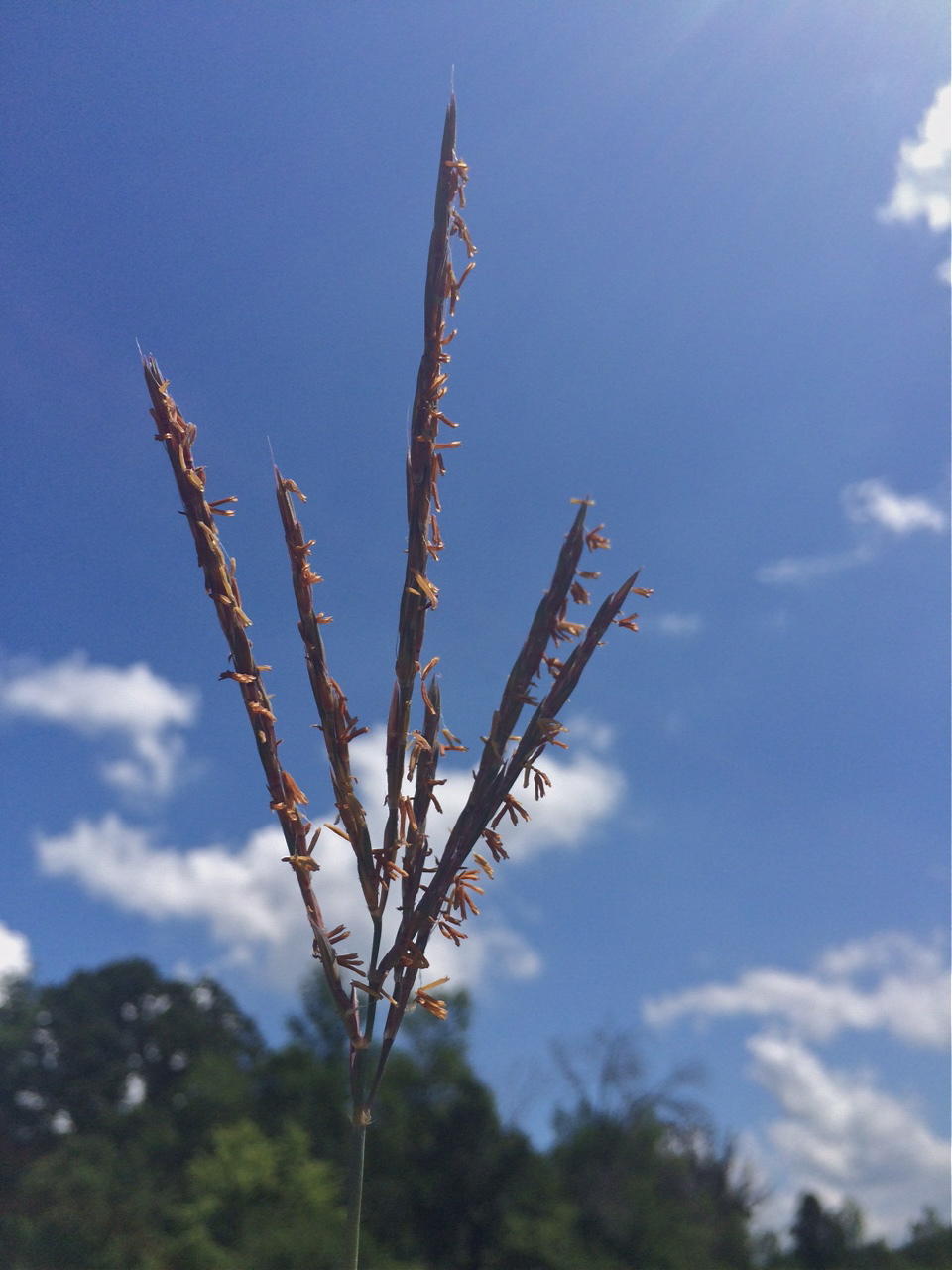
After the thistles were pulled, we moved on to hand crossing heads for Q3. On the way out to cross, I noticed some flowering grasses!
 
Staffanson pollen was organized and put into insulating styrofoam containers that correspond to each data sheet. We worked consistently until all 28 data sheets were complete, and all heads crossed.
 Crossing is almost done! Stuart passes out pollen.
On Friday, Gina and I didn’t have time to do our aphid treatments, so we decided to meet on Saturday morning. We collected aphids from around P1 and added 2-3 to each of our 50 addition plants. Then, we checked over all 50 of our exclusion plants to make sure those sneaky aphids weren’t trying to start a colony. So far, only 4 addition plants have started aphid colonies, but Gina and I learn more and more everyday about aphid tending. Sometimes we talk to them while moving them to their new plant homes. They seem to appreciate and enjoy this. The treatments went really quickly and we finished in about an hour.
The days and weeks are starting to fly by as we get into the busy part of the summer. Nearing the end of July, it seems like we’re hovering right around the peak of the flowering season for Echinacea angustifolia. In addition to keeping up with the phenology for our flowers (roughly a couple thousand across our remnants alone!), we’re also making timely progress on independent projects and getting important work done on the q3 experiment.
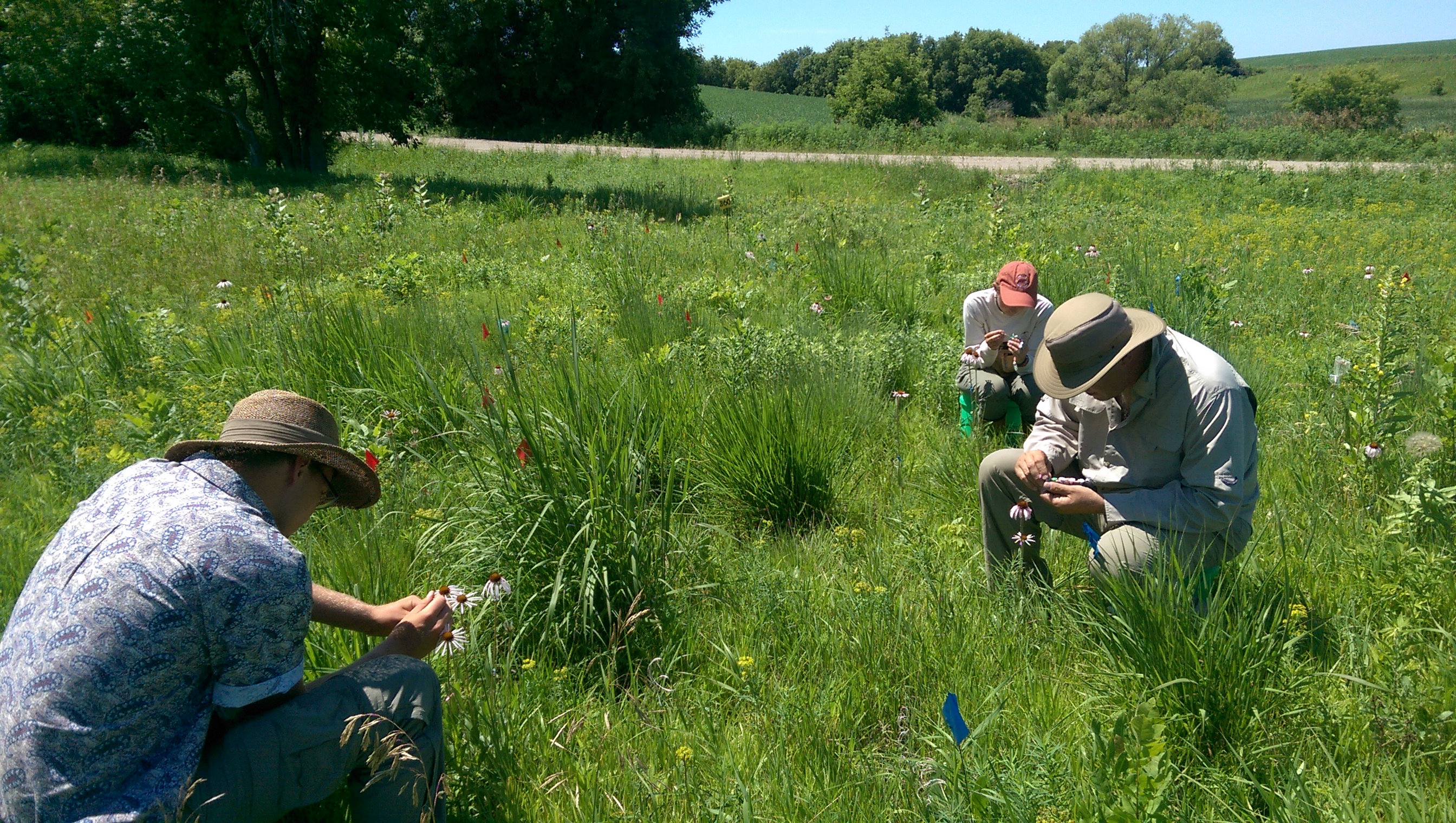
We got off to a quick start this morning sending half the crew out to do phenology at a handful of sites while Danny and Amy continued their work assessing compatibility across remnant flowers and still a few others collected pollen at Staffanson for q3. While phenology is proving to be quite the time commitment right now, we’re slowly (and satisfyingly) starting to be able to check the “Done flowering” box for more and more of our flowers. The flowering season is tapering off much faster than I had expected!
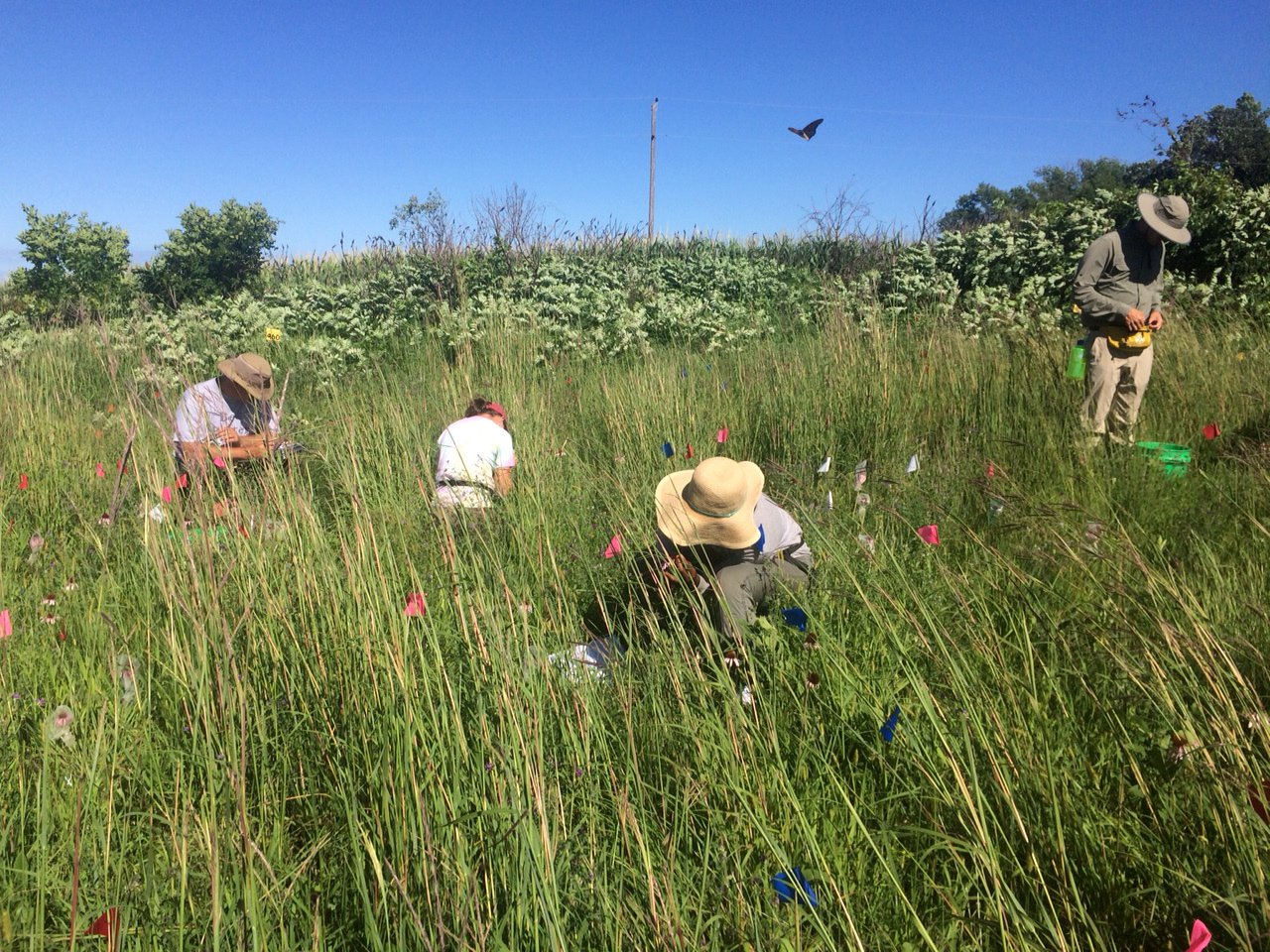
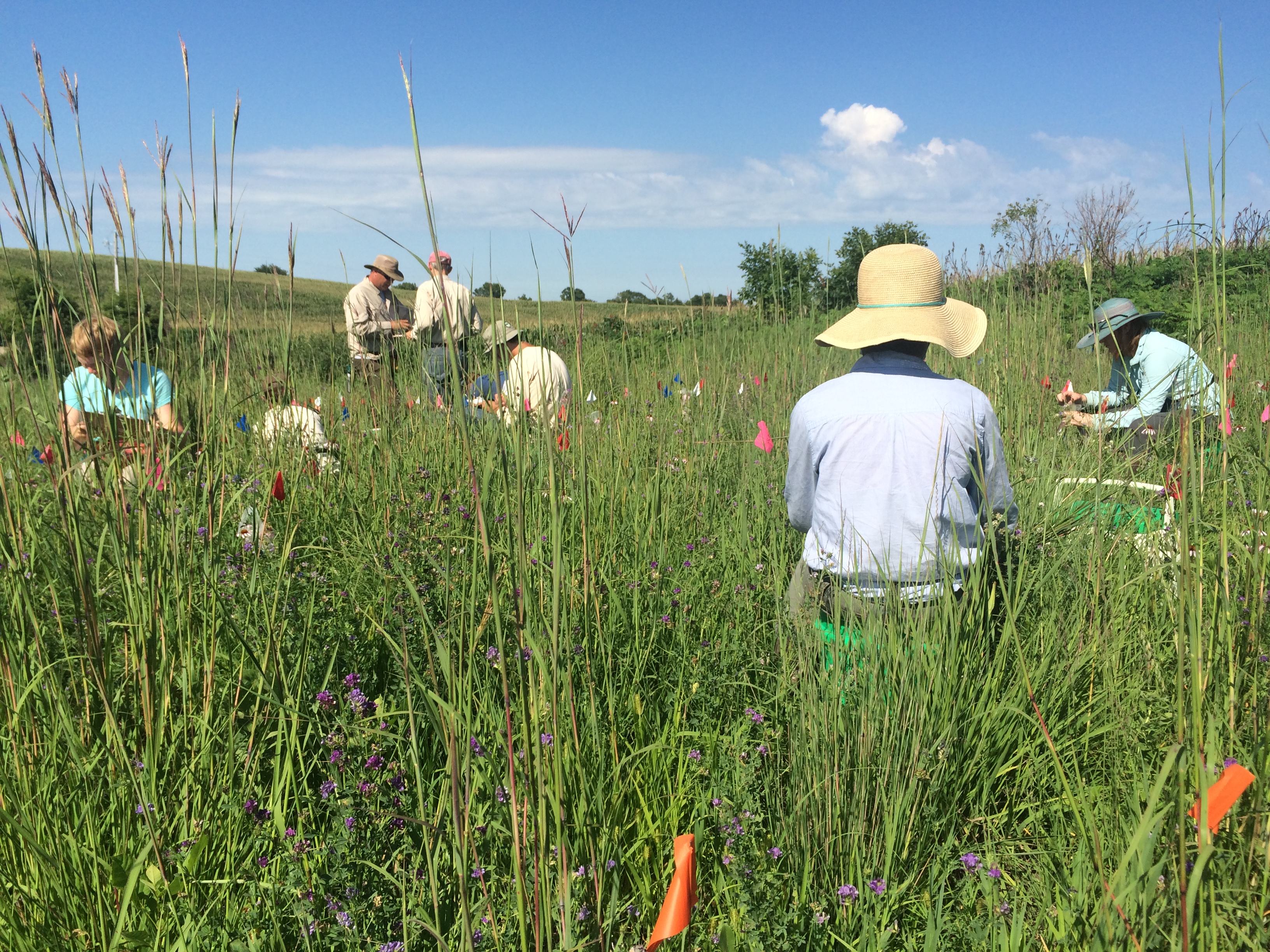
 A cross-pollinator’s eye view of a well-organized team carrying out crosses in p1. The bright and breezy afternoon had most of the team out in p1 doing pollen crosses for q3. Stuart debuted a new system for keeping us organized in the field as we share, swap, switch, and track down the right vials of sire pollen to be applied to the p1 dams. While the fits of wind that persisted for much of the afternoon were a nice way to cool down, it was not very much appreciated when the breeze swept away the valuable bits of pollen we were trying to apply to our flowers!
The day ended with a visit from some of the parents of the crew members and local science teachers (these two groups actually had quite a bit of overlap). These visits were timed excellently for our guests to appreciate the Echinacea in all their peak flowering glory.
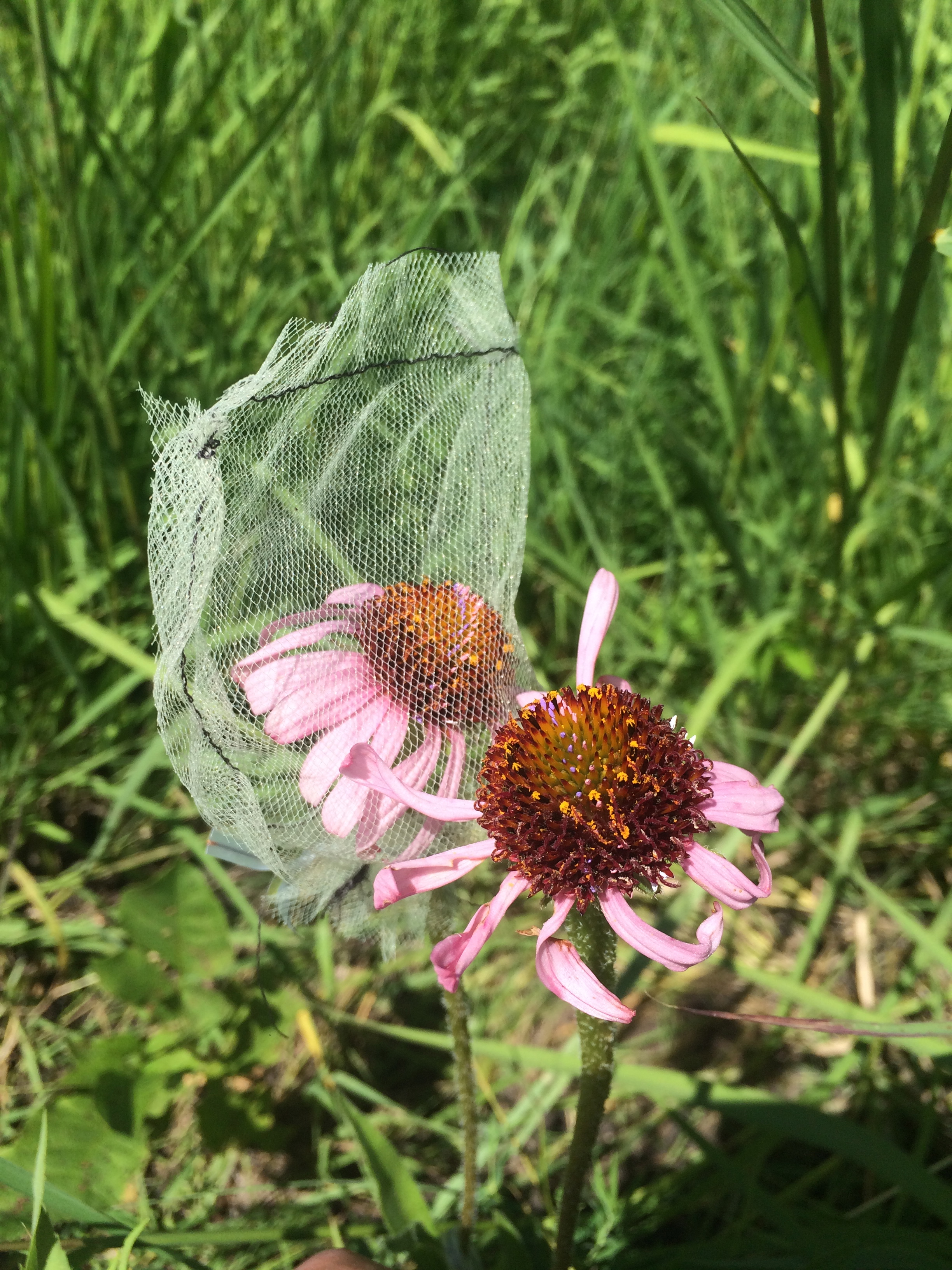
 Bagged and painted Echinacea ready to be cross-pollinated.
Today Brad and I finished the 2015 census on my crossing experiment plot.
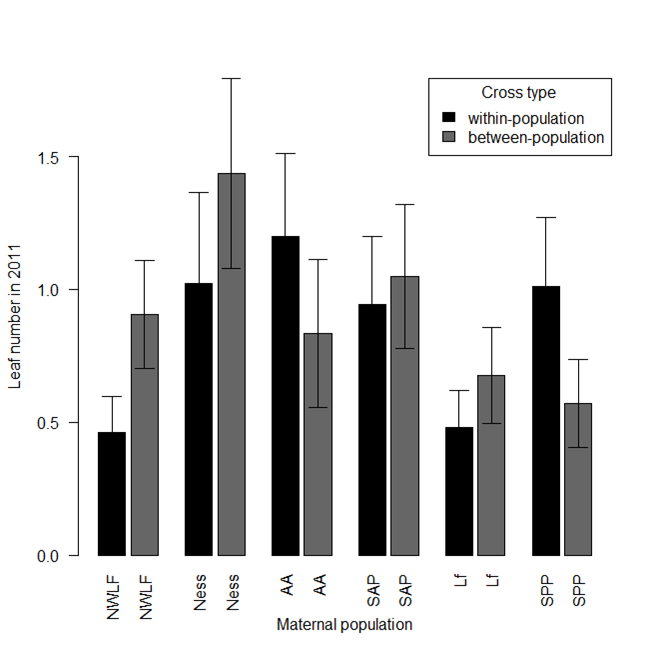
The plants in this plot are the offspring of within-population or between-population crosses of Echinacea plants from six nearby prairie remnants. In most cases, the pollen for between-population crosses was supplied by the largest prairie remnant in the experiment, identified as SPP in the figure below. Crosses were made in the summer of 2008 (thanks to LOTS of help from Team Echinacea). We sowed a total of 15,491 achenes into this plot in the fall of 2008. We estimated that about 40% of the achenes contained embryos, based on their weights.
In the spring of 2009, we found 396 seedlings. We found an additional 43 seedlings in late summer, 2009, and another 10 new seedlings in the summer of 2010. In 2011, we were only able to find 264 of these plants, and the numbers have continued to decline: we found 185 in 2012, 124 in 2013, 112 in 2014, and 89 this summer (2015). We have yet to observe any flowering!
 As you can see from the graph (based on results through 2011), results of within- and between-population crosses have been mixed. The columns in the graph represent estimated mean total leaf number for each cross, for a starting number of 25 achenes, based on an analysis of total fitness (using an aster model). The main effect of cross type was non-significant; however, there was a significant effect of maternal population, and a statistically significant interaction between maternal population and cross type. In other words, the success of the type of cross depended on the maternal plants that were crossed. For the smallest population (identified as NWLF), offspring of between-population crosses outperformed within-population crosses. For the largest population (SPP), the within-population crosses performed better than the between-population crosses. As you can see from the graph (based on results through 2011), results of within- and between-population crosses have been mixed. The columns in the graph represent estimated mean total leaf number for each cross, for a starting number of 25 achenes, based on an analysis of total fitness (using an aster model). The main effect of cross type was non-significant; however, there was a significant effect of maternal population, and a statistically significant interaction between maternal population and cross type. In other words, the success of the type of cross depended on the maternal plants that were crossed. For the smallest population (identified as NWLF), offspring of between-population crosses outperformed within-population crosses. For the largest population (SPP), the within-population crosses performed better than the between-population crosses.
What implications can we draw from these results? In some cases a small, inbred remnant population may be enhanced by cross-breeding with another local population (this is called “genetic rescue”). However, between-population crosses also run the risk of outbreeding depression, as we have observed for the SPP-Lf cross, compared to the SPP-SPP within-population cross.
We now have 4 more years of data, with quite a bit of mortality. It will be exciting to perform another analysis including more data!
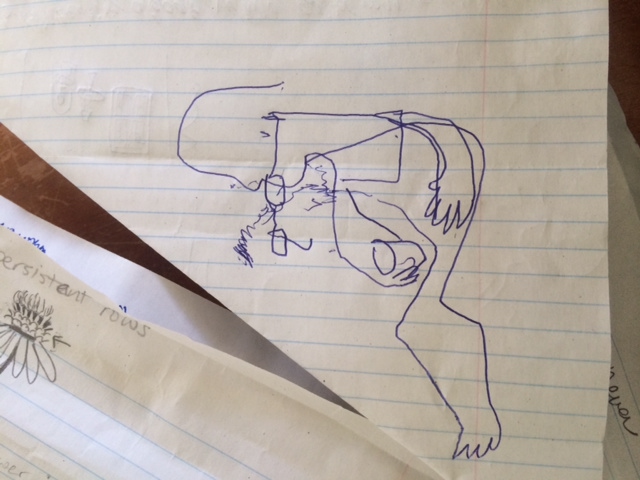
 Ben Lee (2015); ballpoint pen on notebook paper It was a good Saturday of phenology and fun for Team Echinacea! A group of us braved the morning fog and went out to our remnant sites to assess phenology. Lots of plants have reached or are nearing the end of their flowering time already. Later in the day we went swimming, played bananagrams, and drew blind contour drawings of each other.
This weekend, Danny and I have been working the ongoing project assessing compatibility between Echinacea individuals within remnants. On Friday, we went to Loeffler’s Corner and randomly selected 10 flowering plants; these are our focal plants. We do four crosses on each focal plant, with pollen from each of the crosses being placed on four or 5 bracts of the focal plants. We can tell if the cross is compatible by seeing if the styles shrivel after receiving pollen; if they do, they’re compatible, but if the styles persist, then the cross was between two plants that are not compatible.
For this study, we cross each focal plant with its nearest flowering neighbor, its furthest flowering neighbor, a plant that flowered early (i.e. one that is just ending flowering), and a plant that flowered late (i.e. one that just started flowering). To keep track of the crosses, we paint the bracts of the focal plant different colors which correspond to the cross that the style will receive: near, far, early, or late. We paint bracts corresponding to male florets; the next day, they will be styles, and we will be able to do the crosses. After we paint, we cover each focal flower with a pollinator exclusion bag so that we can be sure that no other pollen is introduced.
On the next day, Saturday, the styles of our focal plants emerged. We collected pollen from the various pollen donors and used a toothpick to perform the crosses, carefully placing pollen onto the styles identified by their painted bracts. We cover the focal flowers back up with the pollinator exclusion bags and wait one day to see if the styles shrivel.
This morning, Danny and I went back out to Loeffler’s to check on style shriveling. Here are the results!
| |
Compatible |
Incompatible |
Inconclusive |
| Nearest neighbor |
9 |
1 |
0 |
| Farthest neighbor |
7 |
2 |
1 |
| Early flowering |
7 |
1 |
2 |
| Late flowering |
9 |
1 |
0 |
Here I’m considering a cross compatible if 75% or more of the styles shriveled, incompatible if 25% or less shriveled, and inconclusive if it is anywhere in between. We’ll go back tomorrow to check on crosses that weren’t either 100% shriveled or not shriveled and see if any more styles have shriveled in that time.
Hopefully we’ll be able to repeat this process on several more remnant populations this coming week!
 My beautiful bracts!  Ben, Gina, & Matt practice precise painting Today was another successful day with the team! We had a morning filled with phenology at half of the sites and later everyone divided to get many things accomplished. After lunch, some of us practiced painting the bracts of Echinacea; this wasn’t too hard, it was actually very pleasant. Using toothpicks, we had to be sure to paint the tops of bracts as well as the bottom while making sure not to get paint on the florets or apply too much.
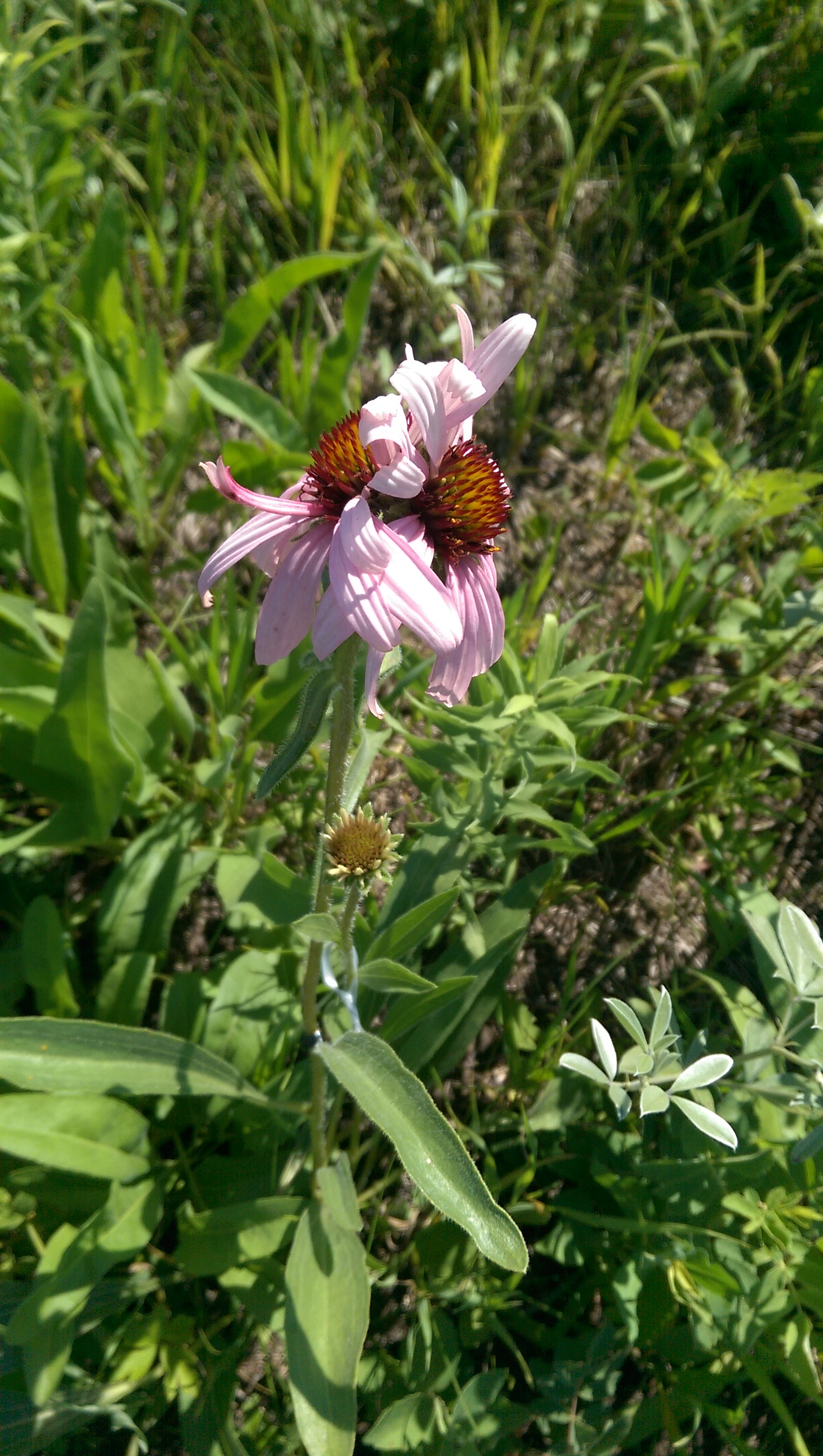
I see absolutely nothing wrong here. Here, Lea and I were at p2 collecting phenology data in the afternoon. There are 80 rows in this plot and it took us almost the whole day to get the job done! I’m from the south and it honestly takes a lot for me to confess that a place is hot, but the way the sun was blazing today, I wasn’t sure if I’d make it out of the prairie to deliver this flog post to you! It was so “warm” today I was seeing double headed Echinacea…….. sheesh.
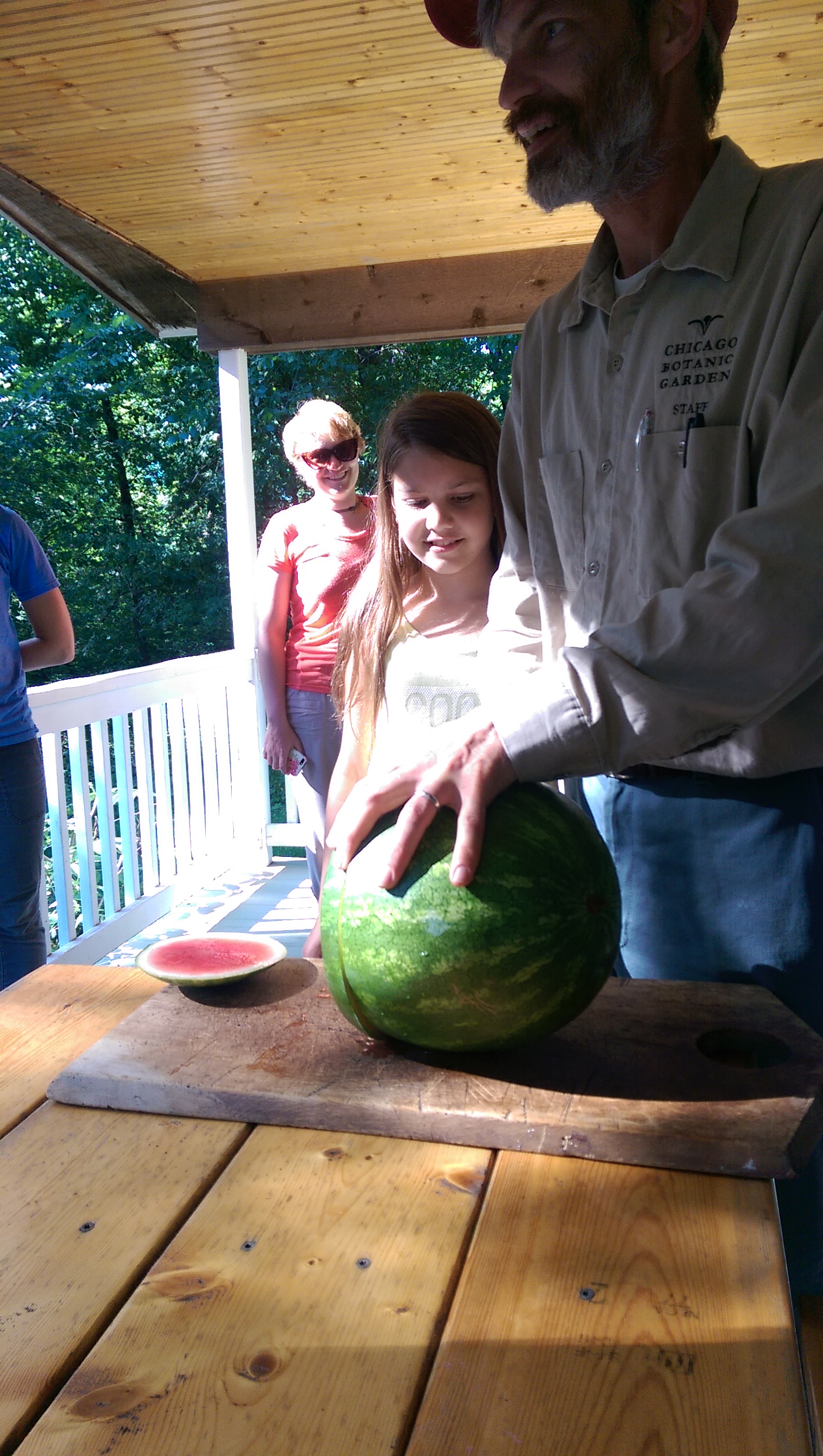
To conclude a week full of accomplishments, Stuart sliced up the best watermelon ever. One shouldn’t argue this watermelon’s caliber; I know this was the best watermelon ever because it replenished all the sense I lost in p2 today. I’d say that everyone else enjoyed this glorious melon as well! Today was a good Friday!
Watermelon after work!
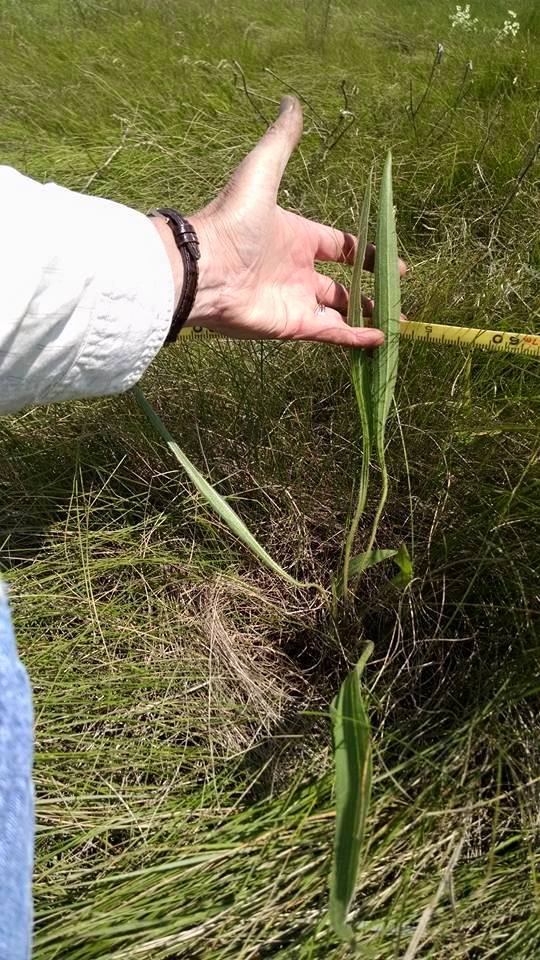
 Thanks to some critical help from Team Echinacea, we were able to complete the 2015 census on the local adaptation experiment this week. We found a total of 282 live Echinacea plants this summer (compared to 372 in 2014). 96 of the survivors live in the western South Dakota plot, and 186 in the Hegg Lake plot. None of the plants have yet flowered, though some of the western SoDak plants seem to be large enough (see photo). Maybe next year! Thanks to some critical help from Team Echinacea, we were able to complete the 2015 census on the local adaptation experiment this week. We found a total of 282 live Echinacea plants this summer (compared to 372 in 2014). 96 of the survivors live in the western South Dakota plot, and 186 in the Hegg Lake plot. None of the plants have yet flowered, though some of the western SoDak plants seem to be large enough (see photo). Maybe next year!
After our day was delayed by rain, we started off the morning with remnant phenology. Groups headed to the landfill site, Staffanson Prairie Preserve and other remnants. We shot several points at Landfill, East Elk Lake Road and Around Landfill. We got a lot done in the morning!
We had a late lunch and then headed back out into the field. Three of us went to Hegg Lake and put twist ties on flowering plants in Jennifer’s plot. there is a ton of flowers out there and we are almost a quarter of the way done! I will be doing a project involving the plants in Jennifer’s plot (p2) looking at the heritability of flowering phenology in Echinacea angustifolia. It is great to have a lot of flowers in p2!
Here is Ben after twist tying about 70 flowering Echinacea heads in p2, Thanks for the help Ben!
|
|