|
|
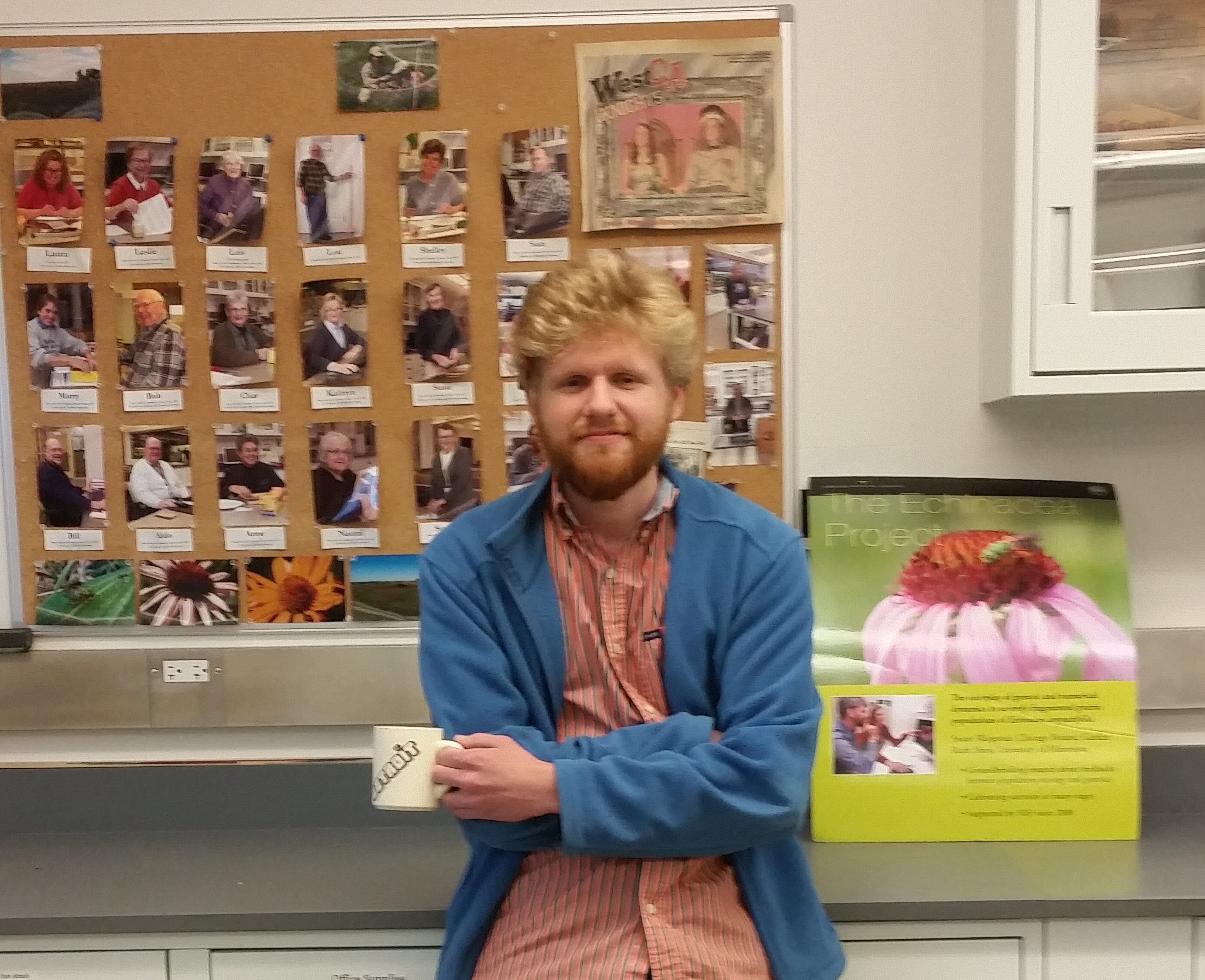
Today was Scott Nordstrom’s last day working at the Chicago Botanic Garden with the Echinacea Project. Scott completed a 13-month internship, during which he worked in the field in Minnesota, assessed lifetime fitness of Stipa plants in our common garden experiment, improved a workflow for taking x-ray images of Echinacea fruits, contributed to analysis and management of numerous long-term experiments, supervised citizen scientists in the lab, and made many other valuable contributions. It was great to have him on the team. This fall, Scott starts a PhD program at the University of Colorado in Boulder. Best wishes, Scott!

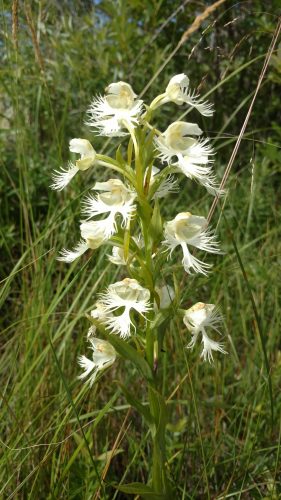
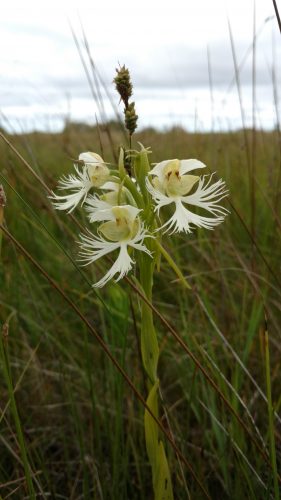
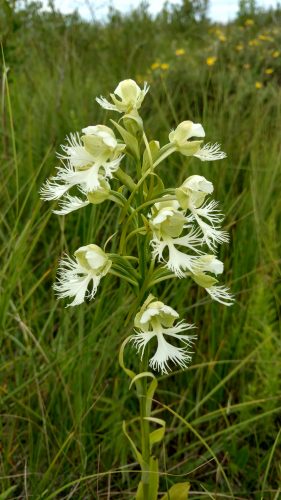
Gretel has a fantastic research project where she studies the resilience of Western Prairie Fringed Orchid, a federally endangered wet-prairie species.
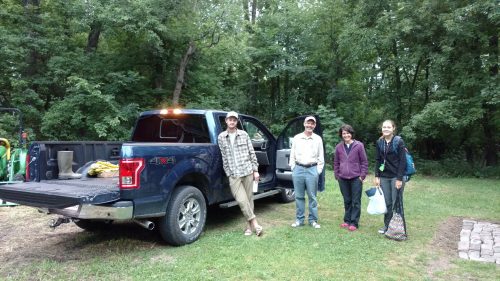
 Western Prairie Fringed Orchid We got up early in the morning to drive to the site and there were clearly different levels of excitement. The group in the truck had a normal attitude for 6 in the morning…
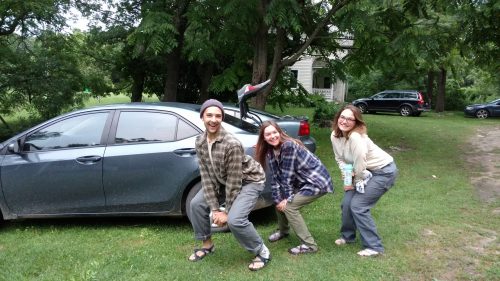
 The truck crew ready to leave. …but the crew from Andes was ready to partay!
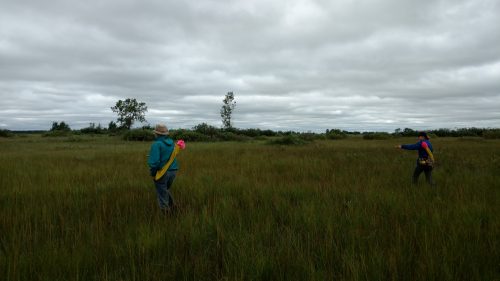
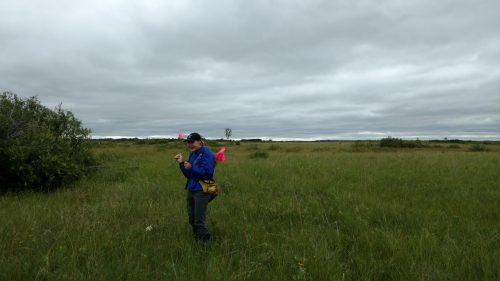
The Andes Crew is even more ready. When we got to the orchid site, the weather was cold and looked like rain might threaten our day. We went out to the first plots and learned how to identify orchids, count the flowers, and GPS-mark their location. Then we split up into two groups and systematically went through the orchid plots.
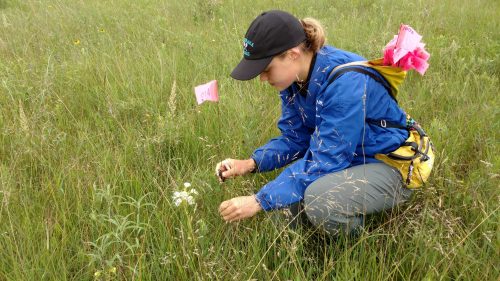
Stuart and Anna searching for orchids We came across a ton of orchids! Anna was enthusiastic in her finding.
Anna found an orchid! Then we marked each orchid with a flag so they can easily be found in the fall when fruit count surveys are done.
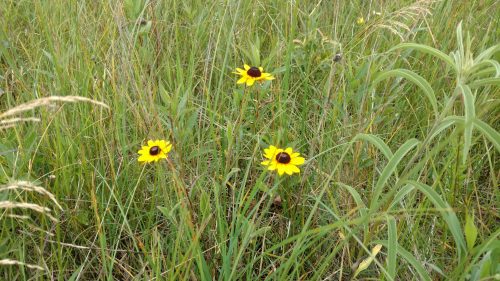
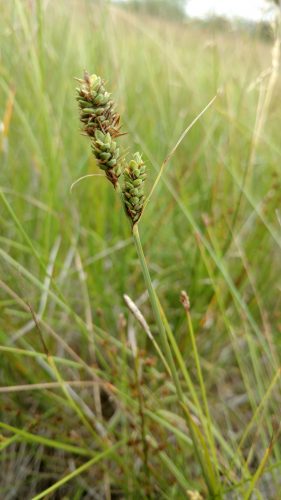
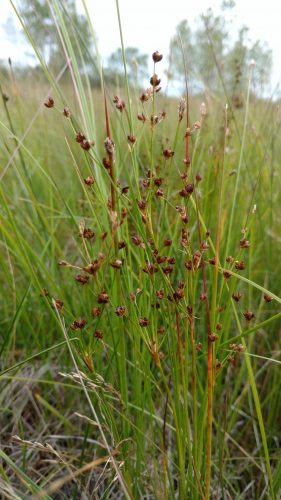
We marked each orchid with a flag with an identifying number. Besides seeing hundreds of orchids, we also saw many thousands of black-eyed susans (Rudbeckia hirta) and flowering sedges.
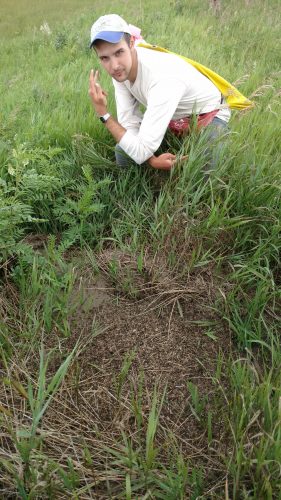
Rudbeckia hirta in full bloom. A flowering sedge. More flowering sedges! There was also a beautiful ant hill.
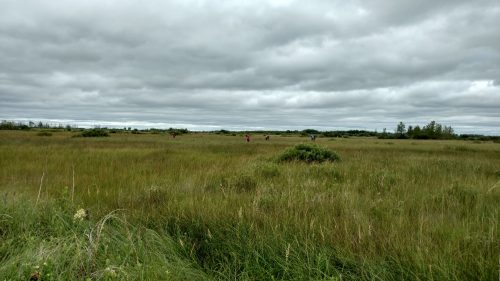
Alex and a massive ant hill. The wet prairie of Pembina. An orchid in it’s natural habitat. One of the biggest orchids we found. Until next time!
Wes
Today team echinacea enjoyed some weather on the other end of the spectrum from the high and humid 80s last week. With temps in the low 70s, clouds, and a breeze it was a convenient day for phenology and measuring.
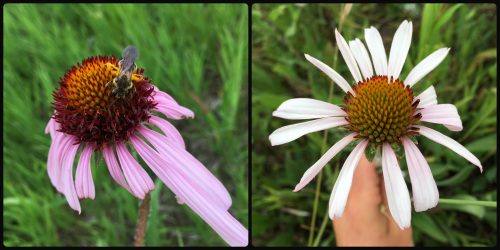
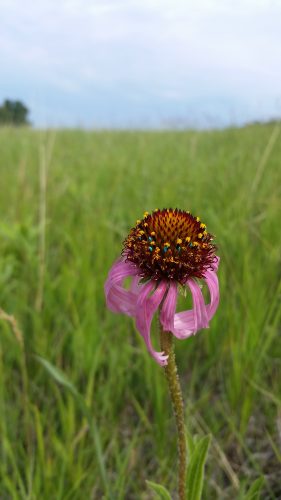
In the morning we broke off into teams to complete phenology at the remnants, Staffanson, and p2. Will, Tracie, and I went out to p2 and recorded the status of the many, many flowering plants. As we went along, Will and Tracie began rating some of the echinacea on a scale of 1-10. Ones with full heads and perfect florets received some high scores! We are also beginning to find plants that are already done flowering.
 Echinacea in P2
After everyone returned to the Hjelm house we had lunch and then headed right out to p1 to measure the plants part of the fitness experiment. When we had measured for exactly 100 minutes, everyone split up to work on their individual projects. I did some work on the computer looking at soil maps of Minnesota and some of the Echinacea plots on Google Earth. Ashley went out to Nice Island to do more pollination, Lea and Wes where out at Hegg Lake, and Alex checked on his yellow pan traps.
Tomorrow we are leaving bright and early to head up north for measuring orchids! Looking forward to an awesome and fun filled day!!
Happy Tuesday, Flog readers!
Team Echinacea took the morning to work on personal projects, so I hitched a ride to my experimental site, Nice Island. There, I collected pollen and made notes about what my plants were up to. Since I’m examining each row of Echinacea florets under different pollen treatments, I am generally quite careful to note strange things. Today, I noticed one of my plants had styles that were wilted and discolored, another had a severely tilted receptacle, and another was turning crispy–Yikes! I talked to Stuart, and I will remove those from my experiment later this week. Bummer. 🙁
One of my experimental plants after I painted R5! Fortunately, the ones that are becoming obviously unfit for my experiment are few and far between, and I’m finding more suitable candidates.
I spent most of my time this morning bagging capitula, pollinating styles, and painting bracts to denote rows. It’s a detailed-oriented task, no doubt, but it has required me to channel my inner artist to meticulously paint the small bracts. I really enjoy doing it too. I can put on some music, sing along, and paint at the tempo of the song. It’s great.
When I counted, pollinated, and painted all that I needed to for the day, I started back on my walk to the Hjelm House. To my surprise, Ruth met me at Nice Island, and I happily showed her what I was up to, and she asked some key questions about my project. She also showed me a magnifying visor I can wear while I do my crosses, and I think it will be very useful in the future, so I can be sure I am using enough pollen on each style.
 One of my experimental plants with a pollinator exclusion bag. When Ruth and I returned, I had about an hour before lunch to organize my data from the day. I’ve created a colorful spreadsheet to remind me of what color each row is painted and when each head needs to be pollinated. As I count shriveled styles in my steady pollination treatment and enter that data, my spreadsheet updates the percent of shriveled styles–a key metric for my experiment. I like how my experiment is shaping up!
When lunch came, I enjoyed my egg, hummus, and apple meal while the team talked about rating Echinacea and why Team Pallida isn’t quite the antihero to Team Angustifolia. Pleasant conversation, for sure. When lunch wrapped up, Ruth shared some tasty almond chocolate with all of us, and we marveled at the Romeo & Juliet excerpt on one chocolate’s wrapper and the Bubo bubo information on the other’s wrapper.
In our post-chocolate contentedness, Ruth talked to us about the Echinacea fitness experiment in p1, Gretel talked to us about the protocol for measuring that fitness. After our introduction to the experiment, we booted up (although some chose to tough it out in sandals), and headed out to p1. We measured for a couple hours, and by the time we wrapped up our field time for the day, we were nearly 2/3 done with that experiment’s measurement!
 The team after an afternoon of measuring in p1 When the Andes crew returned to our summer home, we removed our ticks and battled mosquitoes. For dinner, I made artichoke and spinach stuffed shells and a salad from the lettuce in our weekly CSA. Yum yum!
Now, I’m going to try to plan out a pollination schedule, so I can try to go on the orchid trip Thursday.
Until next time,
Ashley
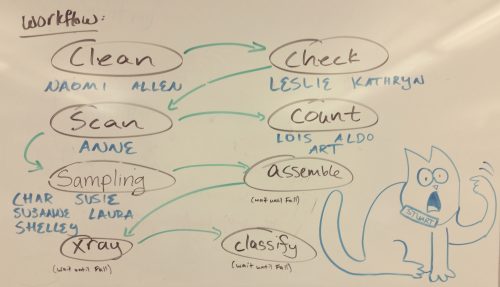
Welcome! This first post will introduce the Accurately Counting Everything (ACE) workflow. This is the standard protocol for the work done in the Echinacea lab at the Chicago Botanic Garden. While work is being conducted in the field here in the lab volunteers continue to progress through the flower heads collected the previous summer. You can explore the flog to get more acquainted with the details of the experiments and projects. The main goal in the lab is to process Echinacea angustifolia flower heads in order to quantify female fitness and seed set.
The main steps of the ACE workflow with the names of some of the volunteers that implement it are:
 Great illustration by Scott of ACE workflow
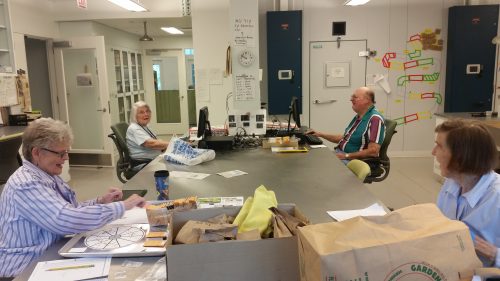
The tireless efforts of our amazing volunteers and lab members are key to the Echinacea Project!
Tuesday morning volunteer community implementing ACE workflow. From top left clockwise: Lois counting achenes from a scan; Aldo counting achenes from a scan; Susie cleaning heads; Char sampling achenes for x-raying.
Future flog posts will detail each step.
Check out the next post about how to clean flower heads to separate achenes (seeds) from the chaff like an ACE…
~Hilary
We started off today assessing phenology in all of the remnants, and both experimental plots. I went to p2 with Anna and Ashley where we saw all stages of flowering from bud to done! One of the Echinacea plants I visited in p2 was gone, pulled down into a gopher mound. But many more plants were flowering and pollinators were busy collecting pollen. We met back at the Hjelm house for lunch, and had a nice meal on the porch. Our lunchtime conversation turned to one where we discussed the importance of telling a good narrative in science. We learned all about the “ABT” structure which consists of connecting two known facts with “and”, revealing the gap in understanding with, “but”, and finishing off with a “therefore” statement which offers resolution. The “ABT” format is useful for clarifying and communicating ideas, but it isn’t easy to do well right away, so we practiced framing our research projects in the ABT format- a good exercise for everyone! Next up we split into teams, worked on projects, added aphids the aphid addition plants in p1, finished mapping the Echinacea pallida plants at Hegg Lake, and wrapped up the day.
 Pollinator hard at work in p2
The Andes crew spent another Sunday doing laundry, grocery shopping, and preparing for the week, so I’m going to take today’s flog to talk about the trip to Minneapolis that Ashley, Alex, and I took yesterday.
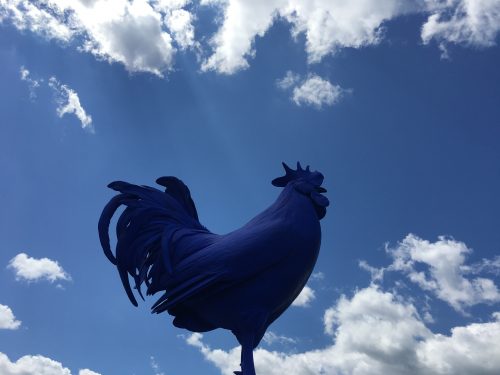
Besides eating delicious Vietnamese food for lunch and tacos for dinner, the highlight of the day was going to the Walker Art Center. We started out in the garden and saw the iconic Hahn/Cock by Katharina Fritsch, along with some other great sculptures by Jim Hodges and Theaster Gates.
 Hahn/Cock by Katharina Fritsch at the Walker Art Center Not forgetting our ecology side, we did notice some bird’s foot trefoil in the meadow restoration along the footpaths (though we resisted the urge to dig it out) and we couldn’t help but check how far along some of the flowering Echinacea varieties were as we walked from place to place.
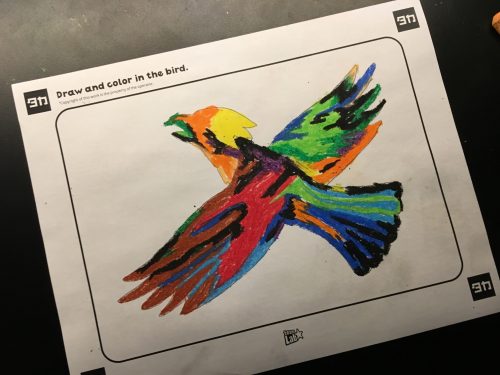
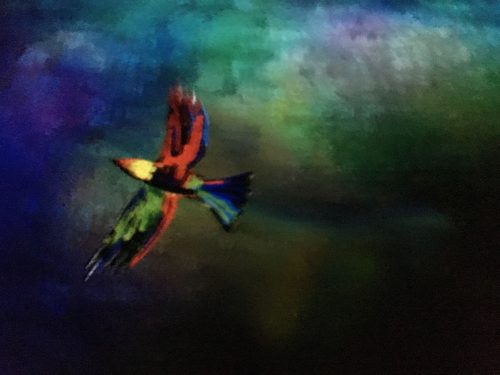
We spent a lot of time in the galleries, featuring Jimmie Durham, Katharina Fritsch, and videos of the Merce Cunningham Dance Company. One exhibit by teamLab involved building up an ecosystem by coloring in templates of different organisms. Then we scanned these drawings and they came to life as video projections moving about in a colorful space.
My colored-in bird for the teamLab interactive exhibit at the Walker Art Center The video projection bird flying free!
Team Echinacea did not meet today, so many of us used the day to work on projects or simply relax. I started my day by helping on my family’s dairy and after lunch enjoyed the rest of the day with some friends.
A couple members of the team used the day to get some work done on their projects. For example, Ashley spent some time crossing some of her experimental plants. Some of the team also took a little road trip to Minneapolis to visit the Walker Art Center and other things downtown.
Hopefully the weather will stay beautiful for the coming week!
Team Echinacea endured another warm day, but we got a good amount of work completed. In the morning, we worked on our individual projects. Wes took a trip out to Hegg Lake, I ran to Morris to pick up some soil testing equipment, Ashley chose the plants for her experiment, and Alex put out more yellow pan traps. Just to name a few of the things that went on.
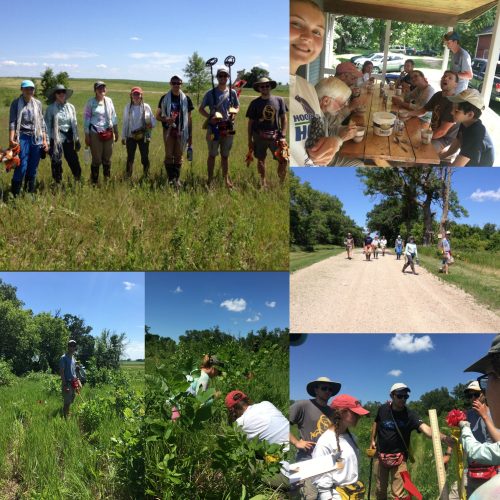
 (Top left clockwise) Team Echinacea after completing p8, rootbeer floats!, heading out to p8, measuring in p8. After lunch we headed back out to p8 to finish measuring the last 21 rows of the q2 and q3 experiment. To make the process go a little smoother in the east part of the garden, a few metal detectors were used to find the meter marking nails.
Working together and efficiently we were successfully able to finish measuring!! After all the tapes were pulled in, we headed back to the Hjelm house for root beer floats. They were super refreshing!
Tomorrow’s agenda includes more phenology and some work on the aphid experiment.
Today was undoubtedly the hottest work day this year (so far). It was the sort of heat that you can’t help but talk about, the kind that saps the energy out of you. We started out the morning phenology. Ashley, Gretel, and I went to p2. The heat seemed to have sped up the emergence of new male and female florets. It almost seemed like new rows of anthers and styles were emerging as we were observing them! There were bees and flies everywhere, on Echinacea heads, buzzing around our heads, and visiting other plants. Despite the heat, it was exciting to see so much activity.
Ruth visited us today to help us with phenology and measuring. It was nice to talk to her a little more at lunch and during measuring.
But while everyone else was starting measuring in p8 in the early afternoon, I split off and visited my yellow pan trap sites. I had placed 5 out at various points along the roadsides on Tuesday morning. Unfortunately, two of the pan traps tipped over during the night because of the intense rain we got in the early hours this morning. However, I was able to collect some insects from the remaining three. I can’t wait to put out the remaining traps later this week.
To end our day, Stuart and Gretel cut up some watermelon. It was an absolutely perfect end to a hot, hot day.
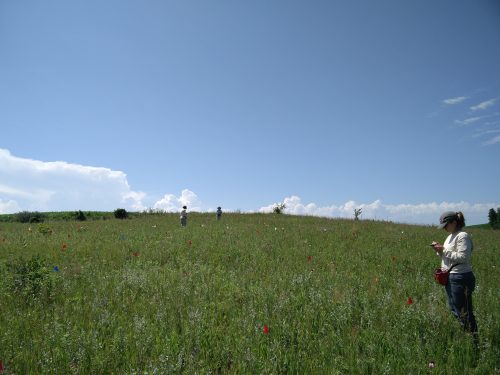
Phenology at p2 with Gretel, Ashley, and Lea; 05 July 2017.
|
|