|
|
It’s the start of a new week for Team Echinacea. This morning was jam packed with phenology and crossing. We’re past peak flowering at this point which is making phenology go quite a bit faster, however we’re definitely in the midst of peak crossing. Ilse and I printed off nearly 25 pages of crossing information, and together Team Echinacea probably visited three quarters of the plants in the crossing experiment today. Wowee!
The afternoon was spent (as many afternoons recently) crossing and measuring the common garden. After lunch we did spend an hour pulling thistle, which was surprisingly more enjoyable than it sounds (gloves helped). Kory got the record for largest thistle with this bad boy.

Marie made some delish baked mac n cheese with a side of broccoli puree for dinner and the mayor of Kensington stopped by to alert us of construction due next week. Not a bad Monday.
Today was about as exciting as one could expect an uneventful day to be. If the surface of a lake were as placid as the town hall was today, there wouldn’t be a single ripple of water.
However, that’s not to say that nothing happened. Dayvis bicycled out to Hegg Lake this morning to monitor phenology, and took the long way home (for a total round trip of about 6 miles). Sarah B.’s parents were visiting; the Bakers had lunch at the famous Mi Mexico in Alexandria, and then visited several prairie remnants to practice identifying wildflowers. Kory and Lydia went to Kensington for laundry and groceries. Lydia must have been hungry at the time, because she impulsively bought a large carton of doughnut holes. They probably won’t last long, since Sarah B. has been eyeing them ravenously.

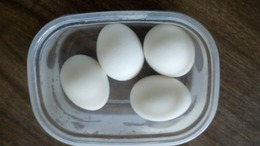
I had a few significant accomplishments of my own today. Shown above is a container of some eggs that I hard-boiled to perfection. The last batch that I made several weeks ago were rather inedible due to an under-cooked center. I have been reluctant to cook eggs ever since that debacle. Because my eggs had exceeded their expiration date, however, I decided to take the plunge and try again – and to what marvelous results! I also succeeded in debugging some R code that had me stumped all of yesterday.
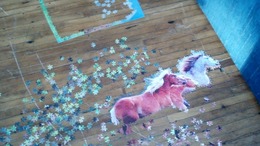
Since yesterday, there has also been significant progress on the puzzle. See if you can guess what it is now!
Well, this Saturday was so un-noteworthy that I forgot to flog it. Oops.
Some of us started Saturday morning with phenology in the common garden. Sarah B went out afterwards to do phenology at her sites. There are so few flowering now that she can visit all of her sites in one morning.
We all learned something new at the expense of Dayvis. Never take out the batteries in your Visor. You will lose all of your data. 🙁
The rest of the day was spent running errands in Alex, looking at data, and relaxing.
Reina, Mike, and Ilse are out this weekend so Town Hall feels very empty. We did, however, start a community puzzle. Can you guess what it will be?

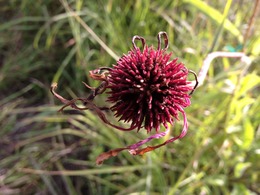
For many of our experiments we want to harvest Echinacea heads when they are as ripe as possible, but before any achenes have dropped.
The standard harvest indicators are as follows:
- Phyllaries (involucral bracts) are brown
- Bracts that subtend each disc floret are brown and sharp
- Flower stalk (peduncle) is brown (not purple)
- 1st (uppermost) cauline lf is brown (note: 1st lf may be close to hd!)
Once harvest indicators 1 – 4 are positive, or if a head has loose achenes or is in some way deformed and you think achenes may be lost before the next harvest, harvest the hd! Make sure to look for loose achenes at the top of every hd with brown bracts.
Harvest a head by cutting it off and placing it carefully into a labeled bag. When cutting the hd off, hold the head firmly in one hand and cut the peduncle with the pruners 3-5 cm under the hd. You don’t need to open the bag all the way and the hd doesn’t need to go all the way to the bottom of the bag.
That’s our standard harvest protocol! Everything’s flowering so late this year, we won’t be harvesting for a while, but I wanted to post this while I was thinking about it.
Hi flog readers,
I have finished collecting my final data for my independent project. Included in this post is the data sheet containing measurements on all one year-old plants in the Hegg plot and their parents.
-Marie
AllData.csv
(updated file)
Today, we pollinated flowers in the common garden during the entire morning. Afternoon we kept pollinating with simultaneous phenology in the same garden.
Also,
After almost an entire month of observation (start date: July 7th) and over 3700 minutes of pollination observation. Today was the last flowering day of the last head of the Echinacea pallida population I have been observing during this summer at the Hegg Lake Wildlife Management Area. it has been an amazing and unique experience to learn so much about these beautiful plants and their pollinators. I would like to make an especial mention to these wonderful insects called pollinators. Undoubtedly, they are the most interesting, beautiful, and beneficial creatures we have in these prairies. Although I will keep observing the flowering phenology of the remaining angustifolia that are close to finish flowering soon, today I finished my pollinator observation. Thanks to this project now I have a much better understanding and appreciation for this pollinator-plant relationship. How crucial this relationship is for them as well as for the total ecosystem in general. It has been a real good experience (I am missing it already).
Last flowering head of the Echinacea paliida polulation at Hegg Lake
Hello Everyone!
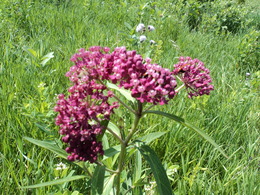
Today was a very nice day today. There were clear skies, it was sunny, there was just enough wind to keep the mosquitos at bay, but no pollinators. Up at Hegg Lake the wild Monarda have started blooming in force, along with the swamp milk weed (which is shown below).
In the morning Sara and Sarah went out to work on their individual projects, while Lydia, Marie, Gretel, Ilse, Per and Hattie worked on phenology.
In the afternoon Gretel, Lydia and Ilse worked on the QGen- which meant continuing the pollenating that has been going on since flowering began. Myself, Sarah, Sara, and Marie started and finished measuring the echinacea in the INB2 garden! Woot!
Another Wednesday dawned bright, but wet, for Team Echinacea. Mike and Reina left early this morning to go to St. Peter before eventually heading to ESA. Sarah visited several remnants to monitor phenology. Sara Z also worked on her independent project in the morning, identifying ants. Kory and Marie went to Hegg Lake: Marie to assess the phenology of Dayvis’s plants, and Kory to watch pollinators. Both Lydia and Ilse helped with the crossing experiment in the common garden.
After lunch, Nicholas and Marie measured the two-year old hybrids in Josh’s garden. All other team members continued to work on crossing.

Above: A thriving hybrid at Hegg Lake. I decided to check up on my plot while doing phenology for Dayvis.
There are a lot of left-overs from Pam’s party to supplement tonight’s dinner. Lydia is getting creative by mixing bratwurst into black bean soup (expertly pureed to perfection by her Cuisinart). Cheesy Bisquick biscuits will accompany the soup. Yum!
Today, we said hello once again to the muggy weather and clouds of mosquitoes. Phenology data was collected from the common garden in the morning. I collected my own flowering phenology data, too. Most of the plants in the remnants I’m using are finishing up flowering now!
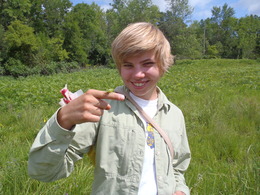
After lunch, Reina and Mike counted trichomes while the rest of us measured plants in the common garden. The mosquitoes were out in droves and it was difficult to keep up morale. Thankfully, Marie and I found a little friend. We fondly named him/her Herb.
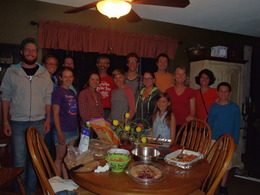
Later on in the evening, the whole team went to where Pam is staying with Susan to eat dinner and hang out. It was a lovely time with delicious food and wonderful company. I know I’m not the only one who ate too much!
Looking forward to a windier day tomorrow!
Sarah B
Another bustling day here in Douglas County. Gretel, Ilse, Ruth, and I continued working on the crossing experiment this morning while everyone else got busy with their independent projects. Mike and Reina were taking pictures of plants and counting trichomes while Marie and Kory were at Hegg Lake. Sarah B (you guessed it) continued her work on phenology while Sara Z collected some very mysterious ants that have been eating the head of one of the plants in the crossing experiments (uh oh).
After lunch the group started measuring plants in the common garden. While the weather forecast said only 10% chance of rain today, we got hit with some definite showers and were forced to abandon outdoor work for the rest of the day. Instead we had our second group tutorial in R where we learned some more basics like randomization and creating data frames.
|
|
-thumb-260x346-160469.jpg)