Categories

lists of random numbers for visors

Here’s a snippet of code I used to generate files to upload to visors.

makeRandFileForVisor <- function(size = 50, fname = "xyz"){
write.table(sample(1:size),
                 file = paste("E:\shared\rand",
                                    size, 
                                    fname,
                                    ".txt", 
                                    sep=""), 
                 quote= FALSE,
                 row.names= FALSE, 
                 col.names= paste("rand",size,fname, sep="")) }
visors <- c("ag","dr","kg","ad","cr","gk",
            "mmj","mj","ah","gd","sw","rs")
for (i in visors) {
makeRandFileForVisor(20,i)
makeRandFileForVisor(50,i)
makeRandFileForVisor(100,i)
makeRandFileForVisor(200,i)
}

Revised FNC protocol

Ech jenkins FNC protocol revised.doc
Ech Guide to Co-Fl Sp.xls

I have a photo guide but I can’t upload it b/c the file is too large.

If you plan on helping with FNC, please read the documents above. It’s important that everyone counts inflorescences the same way. Thanks!

Also, for tomorrow, there are a couple of notes I thought I’d add:
>Please make a note if you see ants on the head of the plant you are observing.
>Also make a note if it is mostly cloudy.
>Try to get to your site with about 10 min to spare so you can get your supplies ready and orient yourself with the placement of the flags to avoid time spent wandering in search of flags.
>Please try to start your observation as close to 8am as possible. End at 11am. Do not start an observation if you can’t finish by 11.
>Remember that you will only be collecting styles at the end of the observation pd from now on. Clean your tweezers with your shirt in between collections.

Team Echinacea

Photo from 2 July 2009, just after lunch break at the Hjelm house.

IMG_9559-2.JPG

Daniel, Gretel, Mimi, Greg
Amy, Jennifer, Per, Hattie, Diedre
Kate, Allegra, Caroline, Amanda, Stuart
not shown: Ruth, Megan & Andrea

Visitors to the Echinacea flog

The little map on the right shows the locations of recent visitors to the Echinacea flog (since 29 June 2009). I just noticed that Hong Kong caught up to Belize (2 visitors each). These countries are tied for third (behind USA and Australia). Which country is going to have the most visitors by the end of the summer?

Here are the standings today (12 July)…

United States	182
Australia (AU)	3
China (CN)	2
France (FR)	2
Hong Kong (HK)	2
Belize (BZ)	2
Canada (CA)	1
Romania (RO)	1
Norway (NO)	1
Austria (AT)	1
Israel (IL)	1
Ecuador (EC)	1
India (IN)	1
Afghanistan	1
Japan (JP)	1

You can view current tallies to see where you favorite country ranks. Note that Ecuador is in 4th place and Hungary isn’t yet on the list.

Are Echinacea siblings compatible?

I did some calculations of compatibility rates between pairs of half- and full-sibs while working on a revision of a paper about inbreeding depression in Echinacea. I started on the back on an envelope, but quickly moved to the flog because I did the calculations before, but lost the envelope. Here are the basic questions:

What proportion of matings between full-sib and half-sib Echinacea plants is compatible? Calculating a simple answer assuming no dominance in S-alleles is straightforward, but unrealistic. I think I started in the right direction toward a better answer. Comments appreciated.

Echinacea has a sporophytic self-incompatibility system. Plants don’t self because they have a self recognition mechanism that works like this: A plant produces pollen grains and stigmas that express products of two alleles at the S-locus. If either S-allele of a pollen grain is the same as either S-allele on the stigma, then the pollen grain won’t fertilize the ovule. To set seed an individual Echinacea plant needs pollen from another plant–and not just any plant.

If a pollen donor shares an S-allele with another plant, then its pollen grains won’t fertilize the ovules of the other plant. That pair is called “mating incompatible.” Mating incompatibility often occurs in pairs of related plants and sometimes between unrelated plants too. The extent of mating incompatibility among unrelated plants depends on how many total S-alleles are in a population.

So, here’s a basic question: What fraction of matings between full-sib Echinacea plants is compatible?

To answer it, designate each individual by its S-alleles: 12 is a plant with S-allele “1” and S-allele “2.”

The cross “12 x 12” represents selfing. It’s an incompatible cross.

The cross “12 x 34” represents mating between two plants that share no alleles. It’s a compatible cross.

The cross “12 x 13” represents mating between a pair that shares one allele. It’s an incompatible cross.

To designate some full-sibs, consider their parents first:
P: 12 X 34
There are four possible types of offspring resulting from this cross (F1s):
F1: 13, 14, 23, 24

Now, mate all possible combinations and note whether the cross is compatible. The below table summarizes the compatibility of all possible crosses. 13 x 13 in the upper left is mating incompatible. 13 X 24 is mating compatible.

F1 x F1
   13 14 23 24
13  N  N  N  Y
14  N  N  Y  N
23  N  Y  N  N
24  Y  N  N  N

4 of 16 mating combinations between pairs of full siblings are compatible, 25%.

The next basic question is What fraction of matings between half-sib Echinacea plants is compatible?

If the mom is S-genotype is 12 and the first dad (sire 1) is 34, then there are three types of pollen donors for the second dad (the dad of the other half sib): dads with the same S-alleles as the first dad (sire 2a = 34), dads sharing one S-allele with the first dad (sire 2b = 35), and dads sharing no alleles with the first dad (sire 2c = 56).

Represent the mating of mom and sire 1 and their progeny like this:
P: 12 X 34
F1.1: 13, 14, 23, 24

The mating of mom and sire 2a, yields the following progeny:
P: 12 X 34
F1.2a: 13, 14, 23, 24

The mating of mom and sire 2b, yields the following progeny:
P: 12 X 35
F1.2b: 13, 15, 23, 25

The mating of mom and sire 2c, yields the following progeny:
P: 12 X 56
F1.2c: 15, 16, 25, 26

The following tables represent all combinations of the three types of half-sib crosses possible:

F1.1 x F1.2a
   13 14 23 24
13  N  N  N  Y
14  N  N  Y  N
23  N  Y  N  N
24  Y  N  N  N

Just like full-sib crosses, 4 of 16 pairs are mating compatible, 25%.

F1.1 x F1.2b
   13 14 23 24
13  N  N  N  Y
15  N  N  Y  Y
23  N  Y  N  N
25  Y  Y  N  N

6 of 16 mating combinations between these pairs of half siblings are compatible, 37.5%.

F1.1 x F1.2c
   13 14 23 24
15  N  N  Y  Y
16  N  N  Y  Y
25  Y  Y  N  N
26  Y  Y  N  N

8 of 16 mating combinations between these pairs of half siblings are compatible, 50%.

So, 25 – 50% of pairs of half sib are mating compatible. As total S-allele diversity increases, half-sib compatibility would tend toward 50%.

These number don’t jibe with mate compatibility rates we’ve observed when crossing Echinacea siblings. In 1999 & 2000 we found that 68% of sib pairs (sibs from open pollinated materal plants) we attempted to cross were mating compatible, only 32% were incompatible.

The difference in theoretical and actual mating compatibility rates probably results from a bad assumption. The calculations above assume that there is no dominance among S-alleles. If one allele masks the expression of another, then it is much harder to answer the question. However, my first thought is that dominance will just increase the overall fraction of compatible mating pairs among siblings. It must be true for full siblings… I think.

Suppose that S-allele 1 is dominant to 3 (i.e. it masks the effect of allele 3), then for the original full sib scenario the 13 S-genotype behaves the same as a 11 S-genotype.

P: 12 X 34
F1: 13, 14, 23, 24

F1 x F1
   13 14 23 24
13  N  N  Y  Y
14  N  N  Y  N
23  Y  Y  N  N
24  Y  N  N  N

6 of 16 mating combinations between these pairs of full siblings are compatible, 37.5%. Ah hah–a greater fraction of compatible mate pairs with one dominant S-allele!

Wait, it’s not so clear-cut because with dominance there are other possible combinations of parental S-genotypes that can generate full-sib progeny: 13 X 34, 13 X 33, and 12 X 33. Notice that homozygous S-genotypes become possible with dominance.

P: 13 X 34
F1: 13, 14, 33, 34

F1 x F1
   13 14 33 34
13  N  N  Y  Y
14  N  N  Y  N
33  Y  Y  N  N
34  Y  N  N  N

6 of 16 mating combinations between these pairs of full siblings are compatible, 37.5%.

P: 13 X 33
F1: 13, 13, 33, 33

F1 x F1
   13 13 33 33
13  N  N  Y  Y
13  N  N  Y  Y
33  Y  Y  N  N
33  Y  Y  N  N

8 of 16 mating combinations between these pairs of full siblings are compatible, 50%.

P: 12 X 33
F1: 13, 13, 23, 23

F1 x F1
   13 13 23 23
13  N  N  Y  Y
13  N  N  Y  Y
23  Y  Y  N  N
23  Y  Y  N  N

8 of 16 mating combinations between these pairs of full siblings are compatible, 50%.

Ok, the introduction of one dominant allele does increase the overall fraction of compatible mating pairs among full siblings. I guess that adding more dominant S-alleles to a population would increase the proportion of full sib pairs that is compatible.

I’m guessing adding dominant S-alleles would increase the proportion of compatible matings between pairs of half-sibs too, but I am not sure. It’s too complicated for now.

One last thought, the dominance relationships among alleles may differ in pollen grains and stigmas. This probably occurs in Echinacea because we have observed the following non-reciprocal mating incompatibility: Pollen from plant A is mating compatible with plant B, but pollen from plant B is not mating compatible with plant A. Complicated, eh?

It was helpful for me to think through this. Please let me know if my reasoning is flawed. I’m sure folks have figured this out before. If you know who/where, please send me a reference!

Merci buckets yall

Thank you thank you thank you to everyone for helping this week. Just in terms of my project, we characterized floral neighborhoods for almost 70 plants in three days. In terms of pollinator observations, Tuesday’s escapades in the remnants were fruitful, but thursday’s weather would not hold out for us, so we had to postpone the second day of observations to next week, meaning we will have to randomly select a different set of 8 plants for all 10 remnants. I expect to see some more diversity in the neighborhoods next week because some species are just starting to flower like Coreopsis, Dalia, Apocynum, and Amorpha.
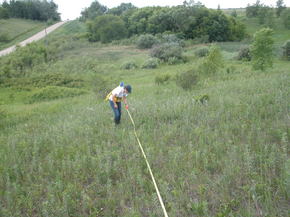
Here;s Amanda measuring to the nearest flowering Echinacea in Aanenson’s:
P7080213.JPG
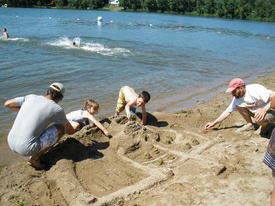
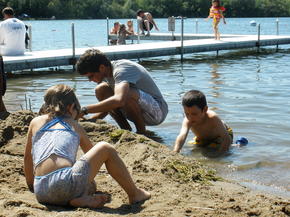
Here’s some pictures of our fun 4th of July and the amazing sustainable sandcastle.
P7040196.JPG
Waniel, Per, and Hattie
P7040194.JPG
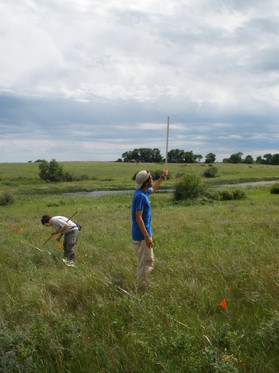
Yesterday Daniel told us we could have a romantic walk in Staffanson Prairie if we came with him, but instead he made kate and I search his and Amy’s transects. What a trickster. Here he is cursing the heavens.
P7100260.JPG
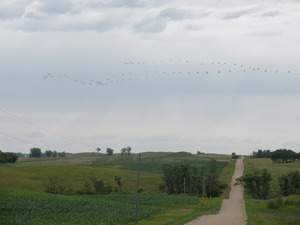
A flock of pelicans flew overhead at NWLF.

I have many more pictures http://picasaweb.google.com/mimijenkins/MinnesotaSummer09# in case you’re interested.

For next week

Hey everyone,

Thanks again for collecting helping with style collection, so far I’ve made four slides and the results are certainly interesting. There is certainly more pollen from 8am to 11am, but it’s going to be hard to tell what pollen is there. So far, I haven’t seen any thistle pollen, which is purplish, or any football shaped pollen, only a Echinacea and/or “-opsis” pollen (Heliopsis or Coriopsis). But then, my current sample size is tiny, so this may change. I have a lot more slides to produce, but so far so good!

FOR NEXT WEEK:

The protocol for style collection next week is a bit different, so please read this and take any notes that you feel are necessary, or ask me any questions you might have.

We will only be collecting styles at the end of the observation period. ONLY COLLECT STYLES ONCE!

Prior to taking the style off the plant, we will be recording style persistence data, to recap:
The form will have five new lines for you to fill out, fr1, fr2, mr1, mr2, and immatures.

Fr1 will be the lower row of unshriveled styles. Count a row if there are more that 3/4 of the styles left.

Fr2 will be the upper row (ie the most recent) row of unshriveled styles.

Mr1 will be the first row of male anthers

Mr2 will be the last row of male anthers (usually there will not be a mr2, so leave this blank)

Immatures is the number of rows or florets left (put an “r” or an “f” to indicate which). Only count florets if there are 11 or less. Only do this if head is at the end of flowering.

One last thing, if there is still a problem with recording the letter field, enter the tag number of the plant in that space and enter the flag letter in the notes (if there is no tag, put a zero). There shouldn’t be a problem, but if there is, just try to capture the information requested in the notes section.

Thanks again for your help and your patience!

-Kate Monster

New link for pollen pictures

This may (tentatively) be the official web presence of the pollen library – I am fairly comfortable using wikispaces and the students in my classes are as well. See if it works and provide any feedback you may have.

pollen.wikispaces.com

Enjoy the weekend.

Powerpoint of Pollen Slides

For those who may find it useful soon. The ppt file (which is large) contains the partial identification key for our usage.
If you look closely, the diameters of the main four (Amanda has found) at this time are marked.
More to come next week.Who’s who.ppt

where?

Where is our study area? We focus on >6400 ha (25 square miles) of land that used to be tallgrass prairie and is now mostly used for agriculture (especially corn & soybeans). There are lakes and sloughs too.

The study area comprises these 25 sections:

T128 N R40 W:
31, 32, 33, 34, 35
T127 N R40 W:
6, 5, 4, 3, 2,
7, 8, 9, 10, 11,
18, 17, 16, 15, 14,
19, 20, 21, 22, 23

Plus, the area extends into the surrounding sections:
T128 N R40 W: 30, 29, 28, 27, 26, 25, 36,
T127 N R40 W: 1, 12, 13, 24, 25, 26, 27, 28, 29, 30,
T127 N R41 W: 25, 24, 13, 12, 1,
T128 N R41 W: 36, 25