|
|
Hi everyone,
I presented a poster at MEEC 2013 (which Katherine wrote on in the previous entry) and just got back from another poster presentation at Chicago Area Undergraduate Research Symposium (CAURS) today!
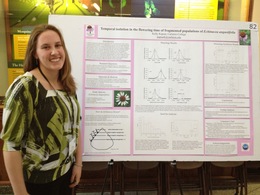
Here’s my poster – enjoy looking at it to see what I found out from my summer fieldwork!
Wang_MEEC2013-Poster36x44-pdf.pdf
Greg Diersen gave an oral presentation “Pollinator Collecting for the Lab and Classroom” at the Life Discovery – Doing Science Inaugural Education Conference on Mar 15-16 in St. Paul, Minnesota.
As a science teacher participant in the Echinacea project through the National Science Foundation RET program, Greg developed a lesson plan for experimentally pan-trapping pollinators to use in secondary and post-secondary biology classes. This experiment offers diverse opportunities for doing science, learning biological concepts, and understanding about our changing world.
Greg was a high-school science teacher for 16 years and is now a professor of biology at Martin Luther College in New Ulm, MN. diersegtATmlc-wels.edu
This past weekend, three students associated with the Echinacea Project presented their work at the Midwest Ecology and Evolution Conference at Notre Dame.
Kelly Kapsar (Carleton College, 2014) spent the winter analyzing her data on flowering phenology in prairie remants and presented her results in a poster.

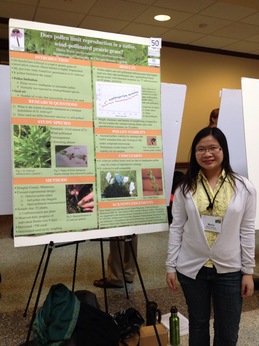
Maria Wang (Northwestern, 2013) presented the results of her undergraduate honors thesis on pollen limitation in the prairie grass Dicanthelium.

Master’s student Katherine Muller gave an oral presentation on her research on the relationship between Echinacea and its specialist aphid.
I should mention that Maria was recently accepted as a Master’s student in the Northwestern Program in Plant Biology and Conservation. She will graduate this summer and remain in Chicago another year to finish her M.S.. She will be working with Dr. Nyree Zerega investigating the genetic origins of tropical crops. Although we will miss her in the Echinacea Project, we wish her the best in her next endeavor.
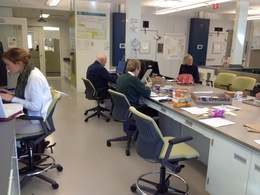
Our volunteers have been making progress in counting, randomizing, and weighing Echinacea achenes from 2011 and cleaning achenes from 2012. We are over half-way through randomizing and weighing achenes from the sizable 1999 experiment and have made progress counting achenes from the remaining 2011 harvest. And what better way to celebrate progress than with heart-shaped cookies, courtesy of Bob’s wife (Bob is on the left, counting achenes)?
In other news, intern Jill Pastick is making progress with her experiment comparing Echinacea germination on agar vs. blotter paper. Last week she transferred the newly-germinated sprouts from petri dishes to plug trays in order to monitor their growth. So far, it looks like the agar method worked well in promoting germination and minimizing mold. However, we will know more once Jill analyzes the data on germination rates and seedling growth. The results of this pilot study will help guide our methods in two upcoming germination experiments.
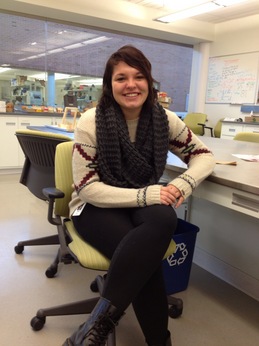
We have two interns pursuing independent projects in the lab. Jill Pastick, a junior at Lakeforest College, is testing out different methods of germinating Echinacea achenes and helping us prepare the germination phase of two ongoing experiments.
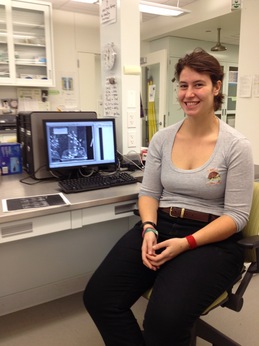
Gia Hallaman, a junior at Northwestern, is helping out with several projects, including counting achenes in x-ray images from Jill’s germination experiment (you can see them on the computer screen below). She is also learning how to identify ants to morphospecies. That means distinguishing different species based on morphology and making our best guess on which species they are. It takes time to develop an eye for the different traits that distinguish closely related species; often the most obvious traits, like color and size, are not informative for differentiating species. Jill is learning to use a combination of tools, including online dichotomous keys and photo databases (antweb.org), to identify ants to species or morphospecies. With her help, we should be able to make a dent in identifying the ants we collected from Minnesota prairie remnants in the summer of 2012.
This January Stuart and Gretel kindly hosted me in Chicago and gave me the opportunity to spend a few weeks working in the Echinacea Project lab continuing my research from the summer. Here is my final paper with some interesting results.
Sanford-Long_EchinaceaHybridization.doc
This week has involved a combination of new projects and ongoing endeavors.
First of all, I should mention that the Echinacea Project is hiring field interns for the summer of 2013. See https://echinaceaproject.org/opportunities/ for more information about job openings.
The volunteers have continued making progress in processing Echinacea heads harvested in 2011. We are nearly halfway through weighing achenes from an experiment planted in 1999 and have have obtained achene counts for 3 of the 9 experiments in the main experimental plot. The volunteers are working on counting achenes for the remaining experiments and on cleaning Echinacea heads harvested in 2012.
More projects has meant more people in the lab. On Thursday, we had a vibrant crowd of five volunteers and two student interns.
One of these interns (not shown in the picture) is Jill Pastick, a junior at Lakeforest college who will be working in the lab until May. Her project will involve germinating achenes from one or two ongoing experiments. One of these experiments is examining hybridization between two species of Echinacea: the native E. angustifolia (the one we work on) and the non-native E. pallida. This summer, Shona Sanford-Long (a junior at Middlebury College) performed experimental crosses of E. angustifolia and E. pallida growing in a Minnesota prairie restoration and is currently analyzing her results to assess the success of different parental combinations in producing fertile achenes. The other experiment examines the effects of burning on offspring fitness in E. angustifolia. Last summer, Kelly Kapsar (a junior at Carleton College) recorded the flowering phenology of Echinacea in burned and unburned units of a prairie preserve. Several interns have been involved in cleaning and weighing the achenes from those plants.The next step in both of these experiments will be to germinate the achenes in the lab and plant them in an experimental plot in Minnesota.
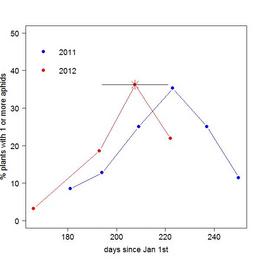
During the summers of 2011 and 2012, I conducted a survey of aphid infestation in a section of the main experimental plot to track, among other things, seasonal changes in the distribution and abundance of Aphis echinaceae on Echinacea. With help from members of team Echinacea, I conducted 6 bi-weekly surveys in 2011 and 3 monthly surveys in 2012. In both years there was a sharp rise and fall in the frequency of aphid infestation. The plot below shows the percentage of plants in the survey area observed to have 1 or more aphids on each dates. In 2011, the peak of aphid infestation (i.e. when the highest percentage of plants hosted aphids) was around August 12th. In 2012, the peak date of aphid infestation occurred some time between July 13th and August 9th. I was not able to observe the peak directly due to a sudden die-off of aphids before my third survey. I estimated the peak frequency of aphids as the percentage of plants with live or dead aphids on August 10th (indicated by the asterix and x-error bar).

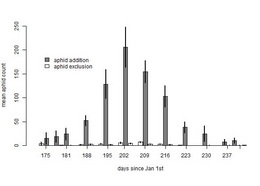
I was also able to get a sense of aphid phenology from my aphid addition/exclusion experiment. In 2011 and 2012, I added or excluded aphids from 100 plants that were not flowering in 2011. The graph below shows the mean abundance of aphids in each experimental group over the summer of 2012:

Based on this graph, I estimate that the peak of aphid infestation for 2012 occurred around July 22nd (202 days after January 1st), about two weeks before last year’s peak.
By Marie Schaedel
Most Echinacea heads have achenes with a clear weight gap between full and empty, which is useful for lab purposes. Sometimes, however, there is no clear difference in weight for full and empty achenes. This winter, I took a closer look at achenes from Echinacea heads that had a continuous pattern of variation in weight to see if there was another way to distinguish between full and empty achenes when the weight test failed. To do this, I reweighed achenes from 20 samples that lacked an obvious weight cutoff. After plotting the new weights in R, I gathered X-ray images of the achenes closest to my best-guess cutoff weight for each sample. I found that more than half of the samples I tested had an intermediate transition weight that divided the full from empty populations of achenes. For ambiguous cases in which there is no clear difference in weight between full and empty achenes, this transition weight can be used to predict the cutoff value.
Read more:What to do when the Weight Test Fails.pdfAppendix
Figures

Figure 1

Figure 2

Figure 3

Figure 4

Figure 5
X-Ray Images

12139.1_top_red

14011.1_bot_bac

14142.1_bot_wht

14142.1_top_wht

14142.2_bot_grn
14142.2_top_grn

14143.1_bot_grn
14143.1_top_grn
14143.2_bot_wht

14963.2_bot_bac

14963.2_top_bac

17019.1_bot_wht
17019.1_top_wht

17134.2_bot_wht
17134.2_top_wht

17172.1_bot_red
17172.1_top_red

17294.1_bot_clr

17294.1_top_clr

6417.1_top_blu
Photograph Images

12139.1_top_red: Close-up of two achenes with a transition weight

14142.1_top_wht: Close-up of two achenes with a transition weight


Mindy Runge & Ale Mendoza participated in a mini-internship in the Echinacea lab at the Chicago Botanic Garden this fall. They are in Lynn Westley’s Plant Biology class at Lake Forest College.
Mindy & Ale investigated seed set in Echinacea heads from a prairie remnant in western Minnesota. They compared seed set in tops and bottoms of heads (florets at the bottom of a head flower first). In the process of answering their question, they learned how to dissect achenes from Echinacea seed heads, how to operate our high-tech seed balance, and how to organize datasets.
Ale and Mindy dissecting seedheads
|
|